MBF / A1
Early maths
Counting and shape for the youngest pupils.
Open the syllabusBelfast · Maths for learners aged 6 to 67 · Live and online, small classes or one to one
OpenStreetMap gives the summit of Divis as 478 metres. Imagine the Earth as a perfectly smooth ball with no air to bend the light. How far away is the horizon from the top? One fact from GCSE geometry answers it: a tangent meets a radius at a right angle. Put Pythagoras on that right angle, with the Earth's radius of 6,371 kilometres on one side, and the horizon sits 78.0 kilometres away. Stand at sea level with your eyes 1.6 metres up and it shrinks to 4.5 kilometres. This page explains how we teach maths to Belfast learners, from P1 to A2 and adult study, and uses the Belfast Hills to show how much a single circle theorem can do.
Maths only on this page · Primary, secondary, sixth form and adults · Not linked with any Belfast school, college or university
In short
Belfast learners from 6 to 67 can study maths with us live online: primary maths from P1 to P7, Years 8 to 10, CCEA GCSE Mathematics at Foundation or Higher tier, CCEA GCSE Further Mathematics, CCEA AS and A2 Mathematics, and adult maths. Classes hold five to ten learners at the same level, or a learner can work one to one. Our Belfast example uses the hills: on a smooth Earth without refraction, the horizon from the 478 metre summit of Divis is 78.0 kilometres away, found with the circle theorem that a tangent is perpendicular to a radius and with Pythagoras. The first lesson is free. Afterwards, group places cost USD 100 a month and private lessons USD 150 a month.
Common starting points in Belfast
Pick by stage. The complete list, from first counting to degree-level maths, follows below.
BFS / 1
Number, fractions, measure and problem solving, with clear written working from the start.
Open the syllabus →
BFS / 2
Written for the English boards; for Belfast learners we teach to the CCEA specification and its unit structure.
Open the syllabus →
BFS / 3
Pure and applied mathematics, sequenced to follow the CCEA AS and A2 units.
Open the syllabus →Maths in Northern Ireland
Northern Ireland has its own curriculum and its own awarding body, CCEA. A Belfast pupil's path looks different from one in England, Scotland or Wales.
| Stage | Usual ages | Our concentration |
|---|---|---|
| P1 to P4 | 4 to 8 | Counting, place value, number facts, money and simple shape. |
| P5 to P7 | 8 to 11 | Times tables, fractions and decimals, measure, and multi-step problems. |
| Years 8 to 10 | 11 to 14 | Algebra, ratio, Pythagoras, angles and data handling. |
| CCEA GCSE | 14 to 16 | Mathematics at Foundation or Higher tier; Further Mathematics alongside for strong students. |
| CCEA AS and A2 | 16 to 18 | Pure and applied mathematics across four units. |
| Adults | 18 to 67 | Confidence with number, Functional Mathematics, or GCSE as an adult. |
CCEA's GCSE Mathematics specification says plainly: "This specification has two tiers: Foundation and Higher." It is built from units, including completion tests at each tier, and the specification adds that at Foundation Tier "students can achieve a Level 1 or Level 2 in Functional Mathematics as well as a grade in GCSE Mathematics".
Geometry runs right through it. The content asks students to "identify and apply circle definitions and properties, including tangent, arc, sector and segment", and the Higher Tier unit M4 asks them to "understand and use circle theorems". The horizon project below uses exactly those ideas.
Strong students can also take CCEA GCSE Further Mathematics, which has four units: Pure Mathematics, Mechanics, Statistics, and Discrete and Decision Mathematics. At sixth form, CCEA GCE Mathematics runs as Unit AS 1 Pure, Unit AS 2 Applied, Unit A2 1 Pure and Unit A2 2 Applied.
Our national pages go into detail: CCEA GCSE maths, A level maths and Further Maths. For P7 families, our transfer test maths page covers the maths side only.
Sources: CCEA specifications for GCSE Mathematics, GCSE Further Mathematics and GCE Mathematics, read on 1 October 2026. The ages in the table are typical, not fixed.
The Belfast project
A geometry question with real numbers: the heights of the Belfast Hills, the size of the Earth, and one right angle.
We took three summits from OpenStreetMap: Divis, tagged at 478 metres; Black Mountain, tagged at 389 metres; and McArt's Fort on Cave Hill, which has no height tag. To check the tags, we looked each point up in two public elevation models. EU-DEM, with a 25 metre grid, gives 468.8, 380.7 and 334.5 metres; SRTM, with a 30 metre grid, gives 474, 385 and 343 metres.
The models come in lower than the tags because each one averages the ground across a grid cell, and a summit is the highest point in its cell. That disagreement is worth a lesson on its own: which number would you use, and why?
Now the question. From a height h above a smooth sphere of radius R, the line of sight that just grazes the surface is a tangent. The radius to the point where it touches meets that tangent at a right angle. So the horizon distance d satisfies d² + R² = (R + h)².
With R = 6,371 kilometres and h = 478 metres, d comes to 78.0 kilometres. Using the EU-DEM height of 468.8 metres instead gives 77.3 kilometres. A 9 metre difference in height moves the horizon by about 750 metres, which shows how sensitive the answer is to the input.
| Viewpoint | Height used | Horizon distance |
|---|---|---|
| Divis, map tag | 478 m | 78.0 km |
| Divis, EU-DEM | 468.8 m | 77.3 km |
| Black Mountain, map tag | 389 m | 70.4 km |
| McArt's Fort, EU-DEM | 334.5 m | 65.3 km |
| Eye 1.6 m above City Hall ground | 13.8 m | 13.3 km |
| Eye 1.6 m above sea level | 1.6 m | 4.5 km |
Summits and City Hall: OpenStreetMap contributors, 1 October 2026. Heights: OpenTopoData eudem25m (EU-DEM v1.1, produced using Copernicus data) and srtm30m. Horizons are Modern Age Coders' calculations for an idealised smooth sphere; real views depend on the air, the weather and the land in between, and this page makes no claim about what can actually be seen from any hill.
From GCSE to A level
The same right-angled triangle carries a learner from Year 10 geometry to A level approximation, and it hides a lovely piece of algebra.
Expand (R + h)² − R² and you get 2Rh + h². Because h is tiny compared with R, the h² term hardly matters, so d ≈ √(2Rh). With R in metres, that becomes roughly 3,570 × √h metres. For Divis the shortcut gives 78,052 metres against the exact 78,044: an error of eight metres in seventy-eight kilometres.
Turning the formula round answers a different question. To see 100 kilometres across a smooth sphere you would need to stand about 785 metres up, h = d² ÷ 2R. No point in the Belfast Hills comes close.
Another way to see the curve: how far below a perfectly level line does the sphere drop after a distance x? Very nearly x² ÷ 2R. After 10 kilometres it is 7.85 metres; after 20 kilometres, 31.4 metres; after 50 kilometres, 196.2 metres.
Doubling the distance quadruples the drop, which is the square law in action. Students who see the table usually ask whether that is why ships seem to sink as they sail away, and that question leads naturally into A level modelling.
| Distance | Drop below the level line |
|---|---|
| 1 km | 0.08 m |
| 10 km | 7.85 m |
| 20 km | 31.4 m |
| 50 km | 196.2 m |
There is one more number worth showing. Seen from the centre of the Earth, the whole 78 kilometres from Divis to its horizon spans an angle of only 0.70°. Meanwhile, on the map, Divis is 5.96 kilometres in a straight line from Belfast City Hall and 6.05 kilometres from McArt's Fort. The local distances are tiny next to the horizon, and a learner who puts both on one sketch understands scale in a way no worksheet manages.
All values are our calculations from the inputs above. CCEA wording from the GCSE Mathematics specification.
Maths outside lessons
Families often ask what else is on. Here is what we could confirm on public pages; we organise none of it.
Its site gives the 2026 dates as 10 to 18 October and describes it as "an all-island initiative promoting positive attitudes towards maths and highlighting the importance of maths in our lives".
The same page says the week has been an annual festival since 2006, run as a partnership of many organisations. Schools register to take part.
Northern Ireland schools can enter the UK Mathematics Trust challenges at Junior, Intermediate and Senior level. Our competitions calendar lists the dates.
Universities in Belfast run their own events for schools, but their websites refused our automated requests, so we have not quoted them. A learner who is interested should ask a maths teacher, who will usually know what is coming up.
For a learner who enjoys puzzles, the horizon project is good preparation for challenge papers. It needs one key insight, the right angle, and then careful arithmetic, which is how many challenge problems work.
All our lessons are live online, so a learner in Ormeau, Malone or the Shankill joins from home. Classes are made up by level, so a Belfast learner might share a lesson with someone in Derry, Dublin or Glasgow.
For learners heading towards competition maths, our olympiad page explains how we prepare for the harder rounds.
Source: Maths Week Ireland 2026, read on 1 October 2026; UK Mathematics Trust. Modern Age Coders has no connection with Maths Week Ireland, the UKMT, CCEA or any Belfast school, college or university.
Adults welcome
Many of our learners are adults, and almost all of them are better at maths than they believe.
Fractions, percentages and simple algebra rebuilt slowly, with explanations instead of rules and no question too basic.
For a course, an apprenticeship or a job that asks for a maths qualification, at Foundation or Higher tier.
Budgets, rates, measurements and charts. Our adult maths page explains how adult groups run.
Adults enjoy the horizon project because it starts from something they have wondered about on a clear day. Ten minutes later they have used a circle theorem and Pythagoras, often for the first time since school, and found that both make perfect sense.
Building up
Each step relies on the previous one. A learner joins at whichever step fits, and the free lesson finds it.
| Usually | Step | Secure when the learner |
|---|---|---|
| P5 to P7 | 1. Measure and square numbers | Works with metres and kilometres and squares numbers accurately |
| Years 8 to 10 | 2. Pythagoras | Finds any side of a right-angled triangle and checks it is sensible |
| Years 11 and 12 | 3. Circle theorems | Uses the tangent and radius rule to set up a triangle |
| Years 13 and 14 | 4. Approximation | Explains which terms can be dropped and estimates the error |
It is still worth it. We make number and algebra secure first, because shaky foundations cost marks on every unit.
If there is more to do than time allows, we will say so honestly after the trial lesson.
Many carry on to AS and A2, some to statistics and probability, and some to maths through coding, where a short program draws the horizon for any height.
A few fall for problem solving and move on to competition maths.
Every course
Arranged by stage. Courses written for English exams are matched to the CCEA specification for Belfast learners.
MBF / A1
Counting and shape for the youngest pupils.
Open the syllabusMBF / A2
All primary topics, explained properly.
Open the syllabusMBF / A3
Calculation in the head, quickly and accurately.
Open the syllabusMBF / A4
Beads first, then a mental abacus.
Open the syllabusMBF / B1
Algebra, geometry and data before GCSE.
Open the syllabusMBF / B2
Firm algebra for the GCSE years.
Open the syllabusMBF / B3
Taught to CCEA units at either tier.
Open the syllabusMBF / B4
For international qualification entries.
Open the syllabusMBF / C1
Pure and applied units in CCEA order.
Open the syllabusMBF / C2
Probability and data at depth.
Open the syllabusMBF / C3
Calculus and linear algebra for degree study.
Open the syllabusMBF / C4
Challenge-style problems with no recipe.
Open the syllabusMBF / D1
Interest, loans and investment.
Open the syllabusMBF / D2
Numbers behind charts and reports.
Open the syllabusMBF / D3
Using Python to explore geometry.
Open the syllabusMBF / D4
Speed methods once basics are secure.
Open the syllabusLesson times
Teaching happens from India, where the clocks do not change. India is five and a half hours ahead of Belfast in winter and four and a half hours ahead in British Summer Time. Every time we agree is given in UK time.
Weekdays after school
Primary and post-primary pupils.
Weekday evenings
Years 13 and 14, and adults.
Saturday and Sunday mornings
For anyone who prefers weekends.
The same teacher each week, who learns each learner's habits.
A brief note after lessons on progress and next steps.
Five to ten learners at one level in each class.
Hill heights, maps and records next to exam questions.
One to one for a single topic or the last weeks before exams.
Methods are explained, then practised.
Student work
Learners who began with geometry and numbers created the four projects below. More are in the student labs.

AI and ML
An AI nutrition coach that reads what you eat and works you toward a target.
AI and ML
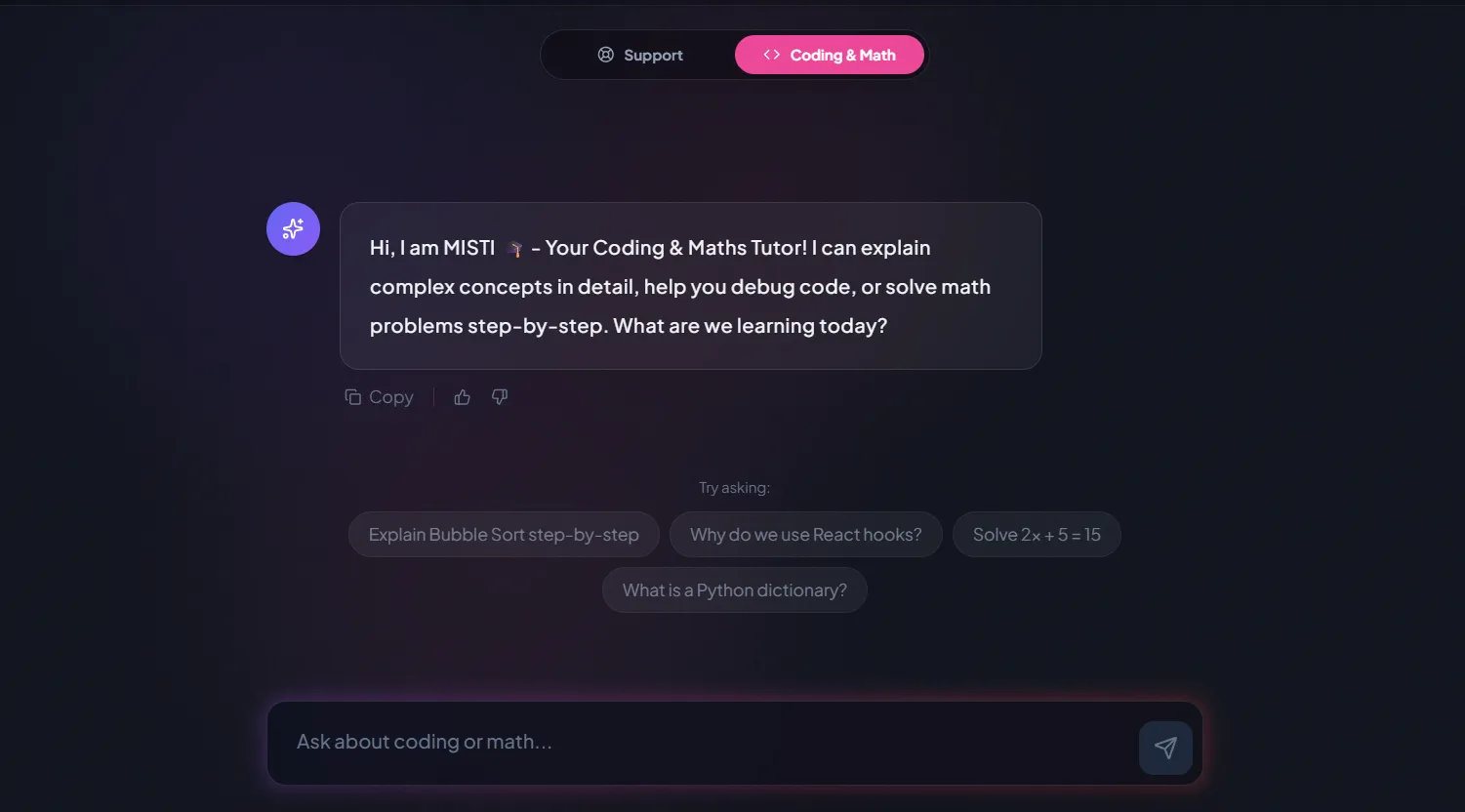
A chatbot that answers mathematics and programming questions, built and deployed by a student.

AI and ML
An assistant that helps a young person recognise unsafe situations online.
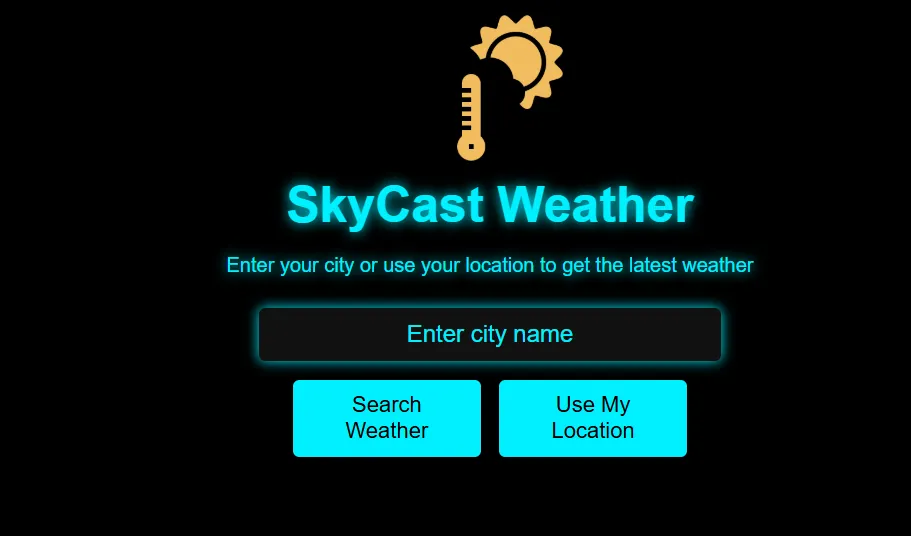
Web app
A weather forecasting site with live conditions for any location.
Fees
Paid monthly in US dollars, at the same rate for every country outside India, with no joining fee and no fixed term.
Free first class
USD 0
no card required
Group batch
USD 100
a month, billed in US dollars
One to one
USD 150
a month, billed in US dollars
What families say
Copied exactly from the Google reviews our families and learners wrote.
★★★★★
"The one step solution for my son. Modern Age Coders make learning coding so simple that kids love it. The teachers explain complex concepts clearly with practical exercises and interactive content."
Ria Mukherjee
Parent
★★★★★
"Modern Age Coders has been a game-changer for me. I struggled to grasp IT concepts and coding before joining, but their classes transformed everything. I can now confidently write complex programs with ease."
Samriddha Mondal
Student
★★★★★
"One of the most wonderful education centres out there. Education is not limited to school syllabus but focuses on skill development."
Vansh Agarwal
Student
★★★★★
"My child Dhairya is really enjoying the Modern Age Coders classes. This is his first online class and he eagerly looks forward to it. I can already see his improvement, and the teachers are very cooperative."
Sonam Oswal
Parent of Dhairya
★★★★★
"Modern Age Coders have wonderful teachers who teach in a clear, easy and practical way. The teacher boosts students' confidence and inspires them to learn without hesitation."
Sonu Goyal
Parent
★★★★★
"I highly recommend this computer coding class! The teachers are incredibly knowledgeable and passionate about coding."
Ritu Kedia
Parent
Belfast maths questions
A tangent to a circle meets the radius drawn to the point of contact at a right angle. That right angle lets you use Pythagoras, which is how the horizon distance from a hill can be calculated.
The first lesson is free. After that it is USD 100 a month for a place in a small class or USD 150 a month for one to one teaching, with no joining fee.
Yes. We teach CCEA GCSE Mathematics at Foundation or Higher tier, following its unit structure, and CCEA GCSE Further Mathematics for strong students.
Yes. We teach the pure and applied units of CCEA GCE Mathematics at AS and A2.
Whenever a learner first starts to feel unsure, before the gap grows. We teach children from 6 and adults up to 67.
For most learners it is. The teacher watches working appear on screen and responds immediately. Lessons are live, never pre-recorded, and each class keeps its teacher.
We help with the maths side only. Our transfer test maths page explains what we cover; we do not give advice on schools or admissions.
Yes, from first steps with number to Functional Mathematics and GCSE, in adult classes or one to one.
No. Nobody can honestly promise a grade. We teach thoroughly and tell you clearly how things are going.
No. We quote CCEA's published specifications so families know what is examined, but we have no link with CCEA, any university or any school.
Related
Northern Ireland maths pages, our Northern Ireland page and coding in Belfast.
The CCEA GCSE in detail.
The maths side of P7 preparation.
For learners who want more.
Our coding page for the city.
Our page for learners across Northern Ireland.
A census histogram project.
Start here
Tell us the learner's age or school year and the topic they find hardest. The trial is a proper lesson, and you get an honest picture of where things stand.
Want to look around first? Our courses and our page on how we teach are good places to start.
WhatsApp us · +91 91233 66161 · connect@modernagecoders.com
WhatsApp gets the fastest reply. Our number starts with India's code because the team works there; there is no Belfast office, and all teaching is online.
A priority demo is a full class of about 45 to 60 minutes. After the class the mentor sends a written skill report and a personal learning roadmap on WhatsApp. If you enrol, the demo fee is adjusted against your first month's fee. Share your demo Order ID with us on WhatsApp and we take it off.
Book a priority demo