Table of Contents
A student solves Bronze problems. Not all of them, but enough, and the ones they miss they can usually see afterwards. They get promoted, sit their first Silver contest, and come out of four hours with almost nothing. This happens so reliably that it is worth explaining properly, because the usual explanation, that Silver needs harder algorithms, is only half true and sends people to the wrong practice.
How a USACO contest works
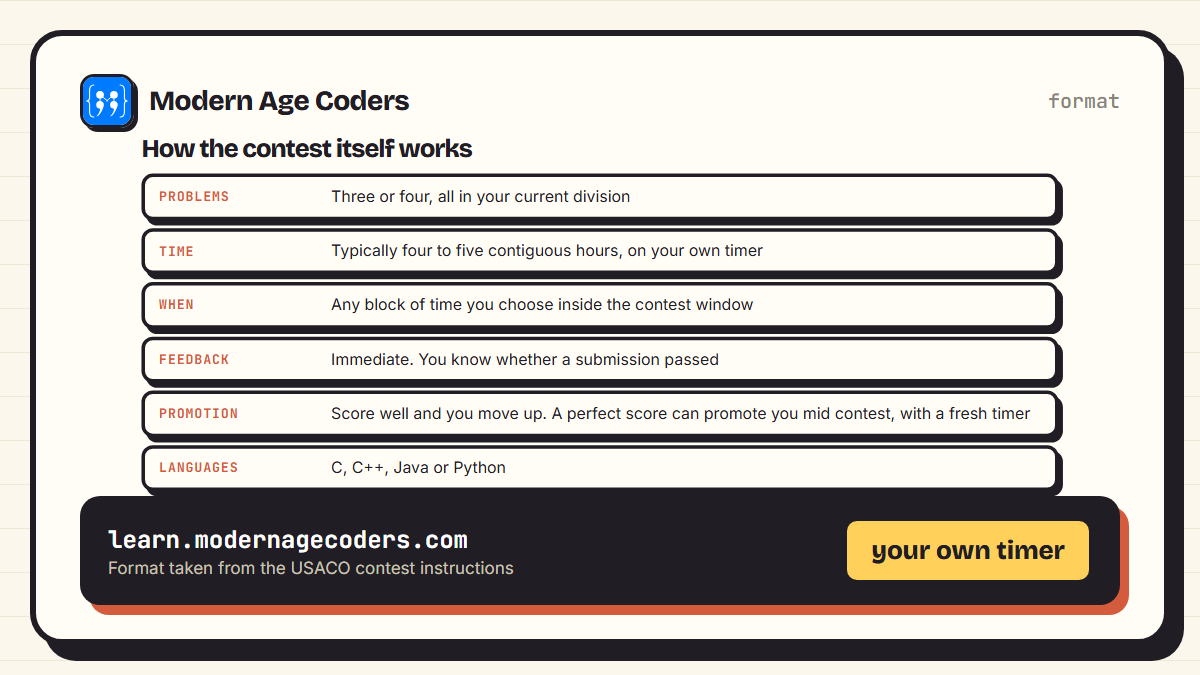
There are four divisions, Bronze, Silver, Gold and Platinum, and everybody starts in Bronze. A contest has three or four problems, all from your own division, and typically runs four to five contiguous hours on a timer that starts when you do, inside a window you choose your block from. Submissions come back with immediate feedback, so you know during the contest whether something passed.
Promotion happens by scoring well. A perfect score can promote you mid contest, at which point you get a fresh timer and the next division's problems in the same window. Promotions have traditionally been permanent, including across seasons, so moving up is a one way door and it is worth being ready for the room you are moving into.
What Bronze rewards, and what Silver stops rewarding
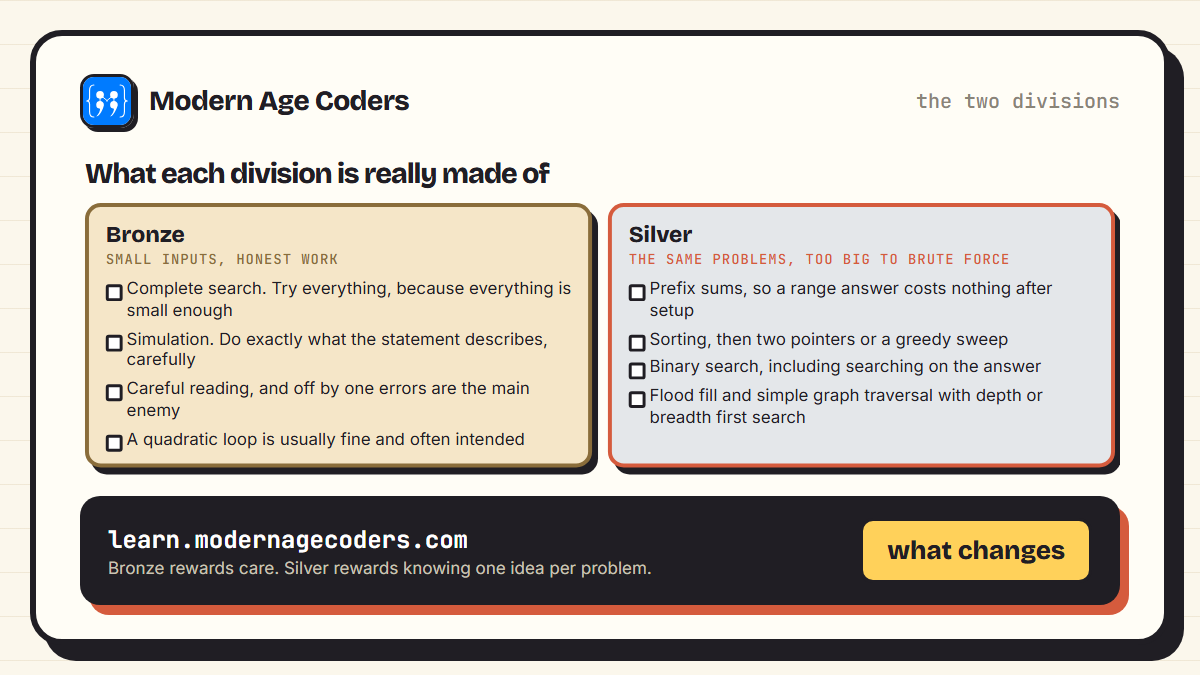
Bronze is a test of careful thinking with small inputs. Complete search, where you try every possibility because there are few enough possibilities to try. Simulation, where you do precisely what the statement describes and the difficulty is precision rather than insight. The commonest cause of a Bronze failure is misreading, or an off by one, not an inability to find an algorithm.
Silver keeps almost all of that and multiplies the input size. The same shape of problem, with n now large enough that the loop inside a loop which passed comfortably in Bronze runs past the time limit and scores zero. Nothing about the student's reasoning got worse. The constraint moved.
Why this feels so much worse than it is
A Silver failure gives no partial credit for having understood the problem. A student can read the statement correctly, design a correct solution, implement it without a single bug, and receive nothing, because correct and fast enough are two different requirements and Bronze only ever asked for the first.
The gap, measured
Here is the wall, in one program. The task is the plainest thing in competitive programming: answer a lot of questions of the form what is the sum of this range of the array. The Bronze habit is to add up the range each time it is asked. The Silver habit is to pay once, in advance, so each answer afterwards costs nothing.
import random
from time import perf_counter

random.seed(7)
N = 100_000
Q = 2_000
data = [random.randint(1, 1000) for _ in range(N)]
queries = [tuple(sorted((random.randrange(N), random.randrange(N)))) for _ in range(Q)]

# Bronze habit: add up the range every time. O(n) per query.
start = perf_counter()
slow = [sum(data[a:b + 1]) for a, b in queries]
slow_time = perf_counter() - start

# Silver habit: pay O(n) once, then answer each query in O(1).
start = perf_counter()
prefix = [0] * (N + 1)
for i, value in enumerate(data):
    prefix[i + 1] = prefix[i] + value
fast = [prefix[b + 1] - prefix[a] for a, b in queries]
fast_time = perf_counter() - start

assert slow == fast
print("array of %d, %d queries" % (N, Q))
print("brute force   %8.3f seconds" % slow_time)
print("prefix sums   %8.3f seconds" % fast_time)
print("speedup       %8.0f times" % (slow_time / fast_time))
Running it produces this, on the machine it was measured on.
array of 100000, 2000 queries
brute force      1.097 seconds
prefix sums      0.018 seconds
speedup             60 times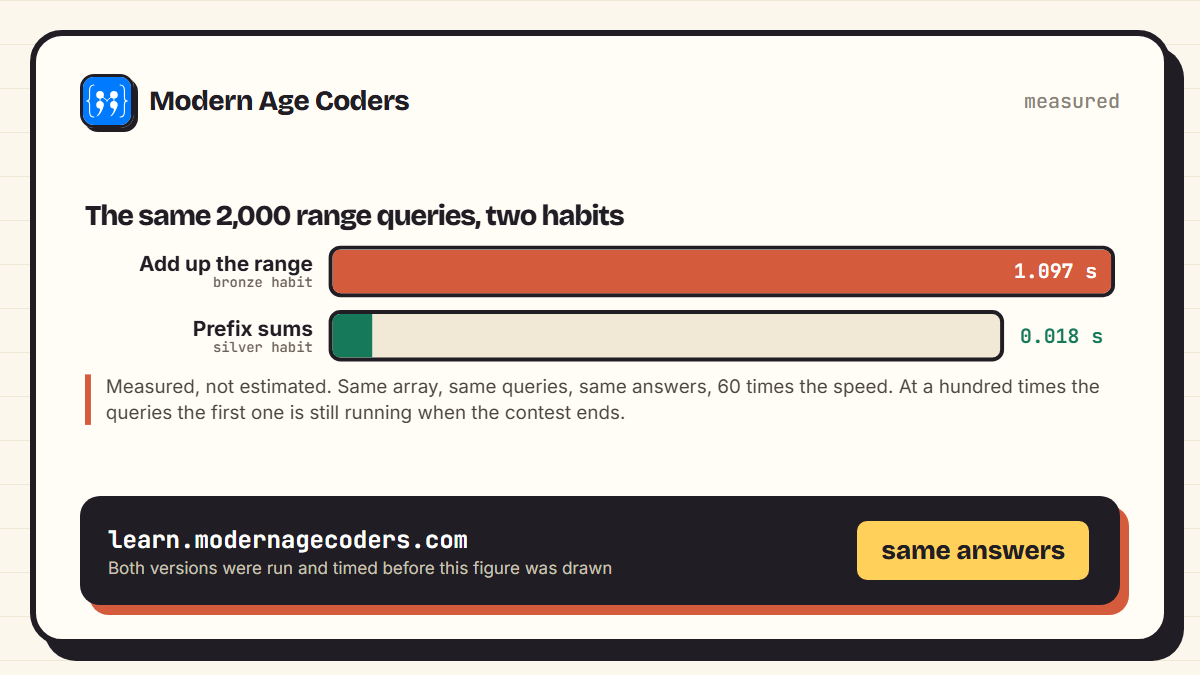
Identical answers, and the assertion in the program proves it. The difference is that one of them does the work once and the other does it every time it is asked. And note the scale of this test: only two thousand queries. A real Silver problem might ask a hundred times that, which would take the first version to somewhere around 110 seconds while the second stays under a second. There is no time limit anywhere that forgives that.
This is what the phrase know your complexity actually means in practice. Not being able to recite that this is O(n) per query and that is O(1). Being able to look at the constraint line in the statement, see n up to two hundred thousand, and know before writing anything that the obvious approach is dead.
If the notation itself is still hazy, Big O notation explained simply builds it up from step counts measured by running real searches, then shows how to read the complexity straight off a loop.
The four ideas that carry Silver
- Prefix sums. Precompute running totals so any range answer becomes one subtraction. The example above is the whole idea, and it generalises to two dimensions and to counting rather than summing.
- Sort, then sweep. An enormous number of Silver problems become easy once the data is in order. Two pointers moving through a sorted array replaces a nested loop, and a greedy choice that looks unjustifiable becomes obviously right once sorted.
- Binary search, including on the answer. Searching a sorted array is the easy half. The half that opens problems up is realising you can binary search the answer itself when you can cheaply test whether a candidate answer is good enough.
- Flood fill and basic graph traversal. Depth first or breadth first search over a grid or a graph, to find connected regions or shortest paths in unweighted graphs. Most Silver graph problems are one of these two with a story on top.
Breadth-first search finds the route with the fewest steps. When steps have different costs, you need Dijkstra's algorithm instead, and our guide to how maps find the fastest route shows on one small map how the two give different answers.
That is a short list, and it is short on purpose. Silver is not a wide syllabus. It is four or five ideas, each of which has to be recognised in an unfamiliar disguise under time pressure, which is a different skill from knowing them.
How to practise so that recognition actually develops
The mistake almost everyone makes is solving problems in a section labelled with the technique. Doing twenty problems from a page headed Prefix Sums teaches you prefix sums and teaches you nothing about recognising when you need them, because the page already told you.
- Read the constraints first, always. Before understanding the problem, look at how big n is. That single number rules out entire families of approach and it is the habit Bronze never forced you to build.
- Do old Silver problems mixed, unlabelled. Past USACO contests are freely available. Pick problems without looking at the editorial's tags, so that identifying the idea is part of the work.
- Give yourself the real four hours occasionally. Pacing is a separate skill. Three problems in four hours has a rhythm, and finding it during a real contest is expensive.
- When stuck for thirty minutes, read the solution properly, then close it and reimplement from nothing. Reading a solution and nodding is the most common way to feel productive without improving.
Does the language matter yet?
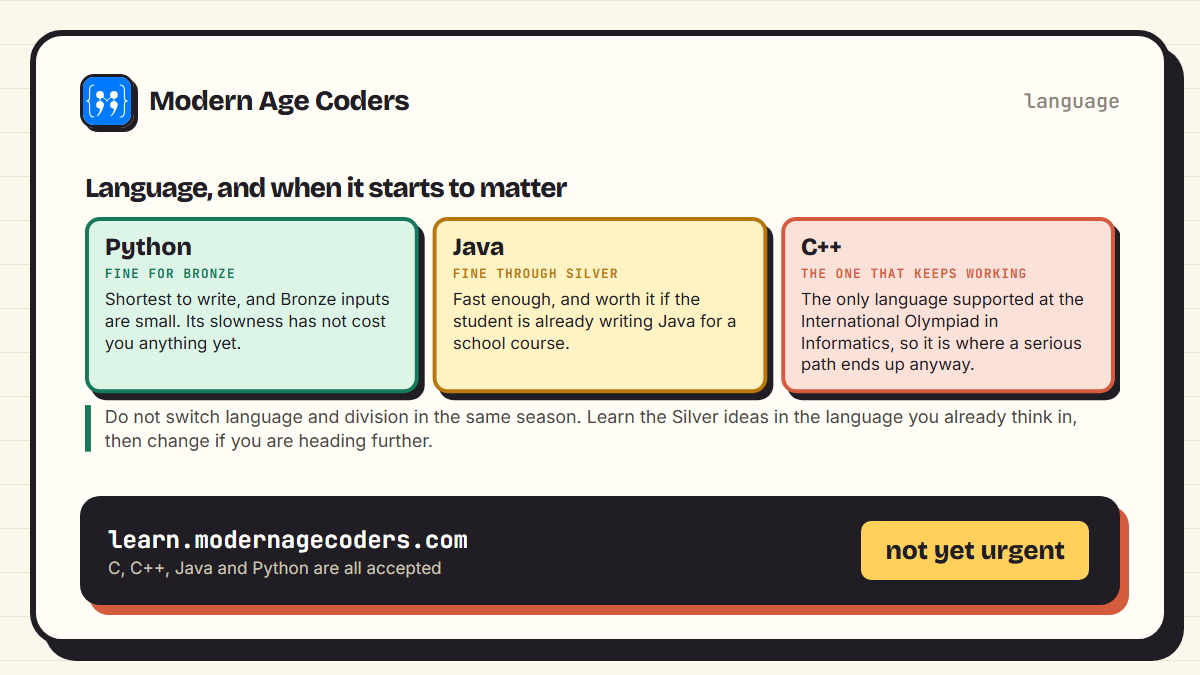
C, C++, Java and Python are all accepted. Python is perfectly fine for Bronze and gets uncomfortable somewhere in Silver, because a constant factor that was invisible when n was small becomes the difference between passing and timing out. Java sits between. C++ is where a serious competitive path ends up, partly for speed and partly because it is the only language supported at the International Olympiad in Informatics.
The advice we give is to not change language and division in the same season. Learn the Silver ideas in whatever language you already think in, get promoted, and then switch if you are continuing upward. Two new things at once means neither gets learned.
Bronze asks whether you can do the work. Silver asks whether you noticed you did not have to.
, The one sentence version, for students who want one
How we coach it
Competitive programming is one of the few things where a teacher's main value is not explanation. The ideas above are all explained well and free online. What is hard to get alone is somebody watching you attempt a problem and stopping you at the moment you commit to the approach that will time out, because that moment is where the learning is and it passes in about fifteen seconds.
Our USACO coaching is live, one to one or in a batch of five to eight students, taught from India to students worldwide. We work through unlabelled past problems with the constraint line read out loud first, every time, until doing that becomes automatic. The first class is free, and the most useful thing to bring is a problem you attempted and got wrong.
Frequently asked questions
For a student already comfortable programming, a few months of consistent practice, and the variable is not talent but whether they are practising recognition or practising technique. Students who do labelled problem sets can spend a year at Bronze without moving.
Yes. A perfect score in your division during a contest qualifies you for an in contest promotion, which gives you the next division's problems with a fresh timer inside the same window. It is worth knowing this can happen so that it is not a surprise on the day.
No. Silver is reachable in Python and comfortable in Java. C++ becomes genuinely useful at Gold and above, and is worth learning at some point if the goal is olympiad selection, because it is the only language supported at the International Olympiad in Informatics.
Yes, and most participants are not. It is one of the few activities that measures problem solving rather than syllabus coverage, and a Silver or Gold promotion is a concrete thing on an application that cannot be manufactured. It also makes ordinary programming courses feel easy afterwards.
Whenever they can write loops, arrays and functions confidently in some language. That is usually somewhere around thirteen to fifteen, though we have taught younger students who were ready and older ones who were not. Starting before the programming basics are fluent makes contests miserable rather than motivating.
Three to five, and the shape matters more than the total. Two long weekend sessions build the endurance that a four hour contest needs, and a shorter midweek session keeps recognition fresh. Cramming the week before a contest does very little here.
Past USACO contests are published and free, and they are the correct primary source because they are exactly the thing being prepared for. Use them unlabelled and untagged, and save the editorials for after a genuine attempt.