UK / YN1 / 01
First Python
The crossing from blocks to a keyboard, taken with no deadline attached.
Open the syllabusEngland · Year 9 options · Ages 13 to 14
Options evening feels like the moment of decision. The evidence suggests it is mostly the moment of recording one. Ofsted's research review on computing cites a Wellcome Trust finding that "by Year 9, there was a large gender divide in the subject, with less than half the number of girls finding the subject interesting compared with boys", and that "from Year 7 to Year 9, computing was the least enjoyed subject for girls". Whatever a family concludes in February of Year 9, two years of lessons have already shaped it. This page sets out what the research actually says, the second choice nobody mentions at options evening, and an honest account of who the subject suits and who it does not.
Live teaching since 2020 · 10,000+ students · Years 8 to 10 welcome
In short
Two things are worth knowing before an options form is signed. The first is that the research Ofsted reviews puts the decisive period earlier than the decision: a large divide in interest is already present by Year 9, and one cited report found computing was the least enjoyed subject for girls from Year 7 to Year 9. Examination data from 2021 put girls at 21 per cent of GCSE entries and 15 per cent at A level. The second is that choosing Computer Science also means choosing a board, and the three English boards differ more in this subject than in almost any other: one sits a practical paper on a computer, one prints its questions in its own pseudo-code, one publishes a list of what you need not learn. A family can ask which board, and should. We teach Years 8 to 10 to the point where the subject is a real option. The first lesson is free, then USD 100 a month in a group or USD 150 one to one.
Start here
The aim before options is fluency, because fluency is what makes the choice feel available. Cards open the full syllabus.
YN / 01
The move from blocks to typed code, which is the single biggest predictor of whether Year 10 feels manageable.
Open the syllabus →
YN / 02
Depth before the course starts, so that Year 10 is spent on problems rather than on syntax.
Open the syllabus →
YN / 03
The specification itself, for students who have chosen it and want to start ahead rather than behind.
Open the syllabus →When it is decided
From Ofsted's research review series on computing, published 16 May 2022 and applying to England. The figures and findings are the review's summaries of research it cites.
The finding that reframes options evening
The review reports that "The Wellcome Trust found that, by Year 9, there was a large gender divide in the subject, with less than half the number of girls finding the subject interesting compared with boys. The same report noted that, from Year 7 to Year 9, computing was the least enjoyed subject for girls."
| Finding | As the review states it |
|---|---|
| Girls at GCSE and A level | Examination data from 2021 shows girls "make up only 21% of entries at GCSE and only 15% of entries at A level" |
| Compared with the old subject | For ICT a decade earlier, girls were "around 35% of the cohort" at AS and A level; the imbalance "is significantly higher in the new subject of computing" |
| What girls said | In a snapshot survey of 350 girls aged 14 to 18, "over a quarter of respondents said that the subject is boring and nearly a fifth said that they lack interest" |
| And about confidence | Some respondents "inferred confidence in their ability as a reason for why they did not choose computing for further study", and other research indicates girls "tend to underestimate their performance in programming compared with boys" |
| Access to the subject | On 2018 data, "nearly 80% of Year 11 pupils" were in schools offering the GCSE, but "state schools with higher proportions of disadvantaged pupils were less likely to offer" it, and "7.6% of pupils were in a school that did not offer key stage 4 computing qualifications" |
Not that anyone learns differently. The review reports participation, interest and self-assessment, and none of those is a statement about capability. We are not going to extend it into one.
What it does say is that a February conversation is late. If a student finds the subject dull or believes they are bad at it, that belief formed in Years 7 to 9 and it is what the options form will encode.
Confidence in programming tracks fluency more than almost anything else, and fluency is straightforwardly teachable. A student who can write a working program unaided rarely describes themselves as bad at it.
That is a Year 8 and Year 9 job, not a Year 11 one, which is the practical reason this page exists rather than a page about revision.
One structural point for context. The review notes that despite more pupils taking computer science, "the total number studying computing qualifications at key stage 4 fell substantially", largely because ICT GCSE was withdrawn in 2019. So the modern subject replaced a broader one, and some students who would have taken the old qualification now take nothing at all.
Source, read 20 September 2026: Ofsted, Research review series: computing, published 16 May 2022, applies to England. It reviews research literature rather than setting policy, and the organisations named above are its citations.
You pick a board too
In most subjects the board matters little to a family. In this one it changes what two years look like, and the school has already chosen.
| Board | The distinctive thing | Read more |
|---|---|---|
| Pearson Edexcel 1CP2 | The practical paper is sat on a computer, in Python 3, in the candidate's own editor, with no internet | Edexcel 1CP2 |
| AQA 8525 | Questions print their algorithms in AQA pseudo-code, and each question names the form the answer must take | AQA 8525 |
| Cambridge OCR J277 | The specification carries a Not required column, and Section B lets candidates answer in their own language or the board's | OCR J277 |
Which board does the school use, and which programming language does it teach? Two sentences at an options evening, and the answer shapes two years.
In most GCSEs the boards test the same things in slightly different words. Here one board examines at a keyboard and another on paper, which is a different subject to practise for.
All three are good qualifications. The point is to know which one your child is taking, so that preparation matches it from the first term.
There is a prior question too, and in England it is not rhetorical. Most secondary schools are academies, and academies are not required to follow the national curriculum. The England page sets out what that means in practice, including that key stage 4 guarantees an opportunity to study the subject rather than a course everybody takes.
If a school offers no computing qualification at all, that is uncommon but not unheard of. The review cites 2018 data putting 7.6 per cent of pupils in schools with no key stage 4 computing qualification, and finding that schools with more disadvantaged pupils were less likely to offer the GCSE.
Who it suits
We teach this subject and we would still rather a student chose it for the right reason than chose it because a tutor was enthusiastic.
| This suggests it will go well | This suggests thinking harder |
|---|---|
| Enjoys the part where something does not work and has to be fixed | Enjoys using computers but has never wanted to make one do something |
| Can already write a short program without copying an example | Has done three years of blocks and never typed code |
| Is comfortable being wrong out loud and trying again | Finds visible failure genuinely distressing rather than annoying |
| Likes maths, or at least does not actively avoid it | Chose it because it sounds employable and for no other reason |
| Wants to build a thing they have already imagined | Is choosing it to avoid a subject they like less |
Computer Science is not maths, and a student does not need to be a top set mathematician. It does involve binary, logic and some arithmetic done by hand, and a student who avoids all number work will find parts of it uncomfortable.
That is a reason to know what is coming, not a reason to steer away. The uncomfortable parts are a minority of the content and they are learnable.
The single most useful thing a Year 9 can do before starting is write typed code. A student who arrives in Year 10 having only used blocks spends the first term fighting syntax while the content moves on without them.
A term of weekly lessons in Year 9 usually removes that problem entirely, which is a small intervention at exactly the right moment.
And one thing we will not say. Choosing this subject does not make a student better at other subjects. What the evidence supports about problem-solving and transfer is set out, with the claim refused, on the problem-solving page. Computer Science is worth taking because it is worth knowing, which is a good enough reason.
For a student who decides against it, nothing is closed off permanently. Plenty of people start programming at sixteen, at twenty-five and at sixty, and the adults page exists because that is ordinary rather than remarkable.
Progression
The useful work happens before the course starts, which is the opposite of how most families approach a GCSE.
| When | What helps most | Why then |
|---|---|---|
| Year 8 | Move from blocks to typed code, slowly | There is no time pressure, so the awkward stage happens without a deadline attached |
| Year 9, before options | Write small programs unaided, and finish some | Confidence follows fluency, and the options decision follows confidence |
| Year 9, after options | Ask which board and which language, then start on it | Two terms of a head start costs nothing and removes the Year 10 scramble |
| Year 10 | Keep programming weekly alongside the taught content | Every board rewards fluency; only one of them tests it at a keyboard |
Nothing is at stake, so a student can be bad at it for a month without consequence. That is exactly the condition under which people learn to program.
The full sequence of topics runs down the coding roadmap.
After options are chosen the pressure changes, and a student who is behind is now behind at something that counts.
A term of weekly lessons before Year 10 begins is the highest-value intervention we see.
The catalogue
Grouped by where a student is in Years 8 to 10. The free lesson settles the starting point.
UK / YN1 / 01
The crossing from blocks to a keyboard, taken with no deadline attached.
Open the syllabusUK / YN1 / 02
Decomposition and precise description, which is where students who find the wording hard get stuck.
Open the syllabusUK / YN1 / 03
Real programming inside a world a student already knows, which removes the hardest part of starting.
Open the syllabusUK / YN2 / 01
Depth before the course begins, so Year 10 is spent on problems rather than syntax.
Open the syllabusUK / YN2 / 02
The specification itself, taught to whichever board the school has chosen.
Open the syllabusUK / YN2 / 03
Searching, sorting and tracing, which every English board examines in some form.
Open the syllabusUK / YN3 / 01
Building something real, with no examination attached to it at all.
Open the syllabusUK / YN3 / 02
Training and breaking models, which interests plenty of students who did not pick the GCSE.
Open the syllabusUK / YN3 / 03
An app from sketch to something installable, for students who want to make rather than to be examined.
Open the syllabusHow lessons work
Teachers work from India on a clock that never shifts, so the UK is five and a half hours behind from October and four and a half from March. Slots are agreed in UK time.
After school
Where nearly every Year 8 and 9 student settles.
Early evening
For students with clubs, sport or a long journey.
Weekend morning
Calmer, and better for finishing something in one go.
Predictions out loud before anything runs, so that failure becomes information instead of embarrassment.
A student who has made nothing has not had a lesson. Finished things are what change how a student sees themselves.
Five to ten at the same stage, so nobody is the only beginner in a room of confident programmers.
Before options we teach the subject. Once a school has chosen, we teach to that specification.
The free lesson ends with a frank view, including saying when a student should wait a year.
Finished projects are saved where a family can open them, which is usually how a parent finds out it is going well.
Student work
Four projects from learners around Years 8 to 10. More sit in student labs.
AI and ML
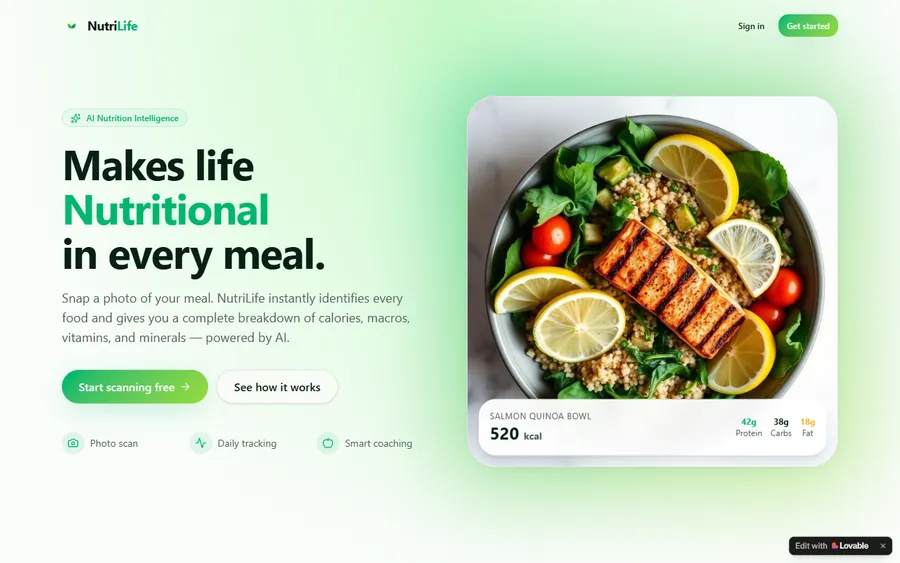
An AI nutrition coach that reads what you eat and works you toward a target.
AI and ML
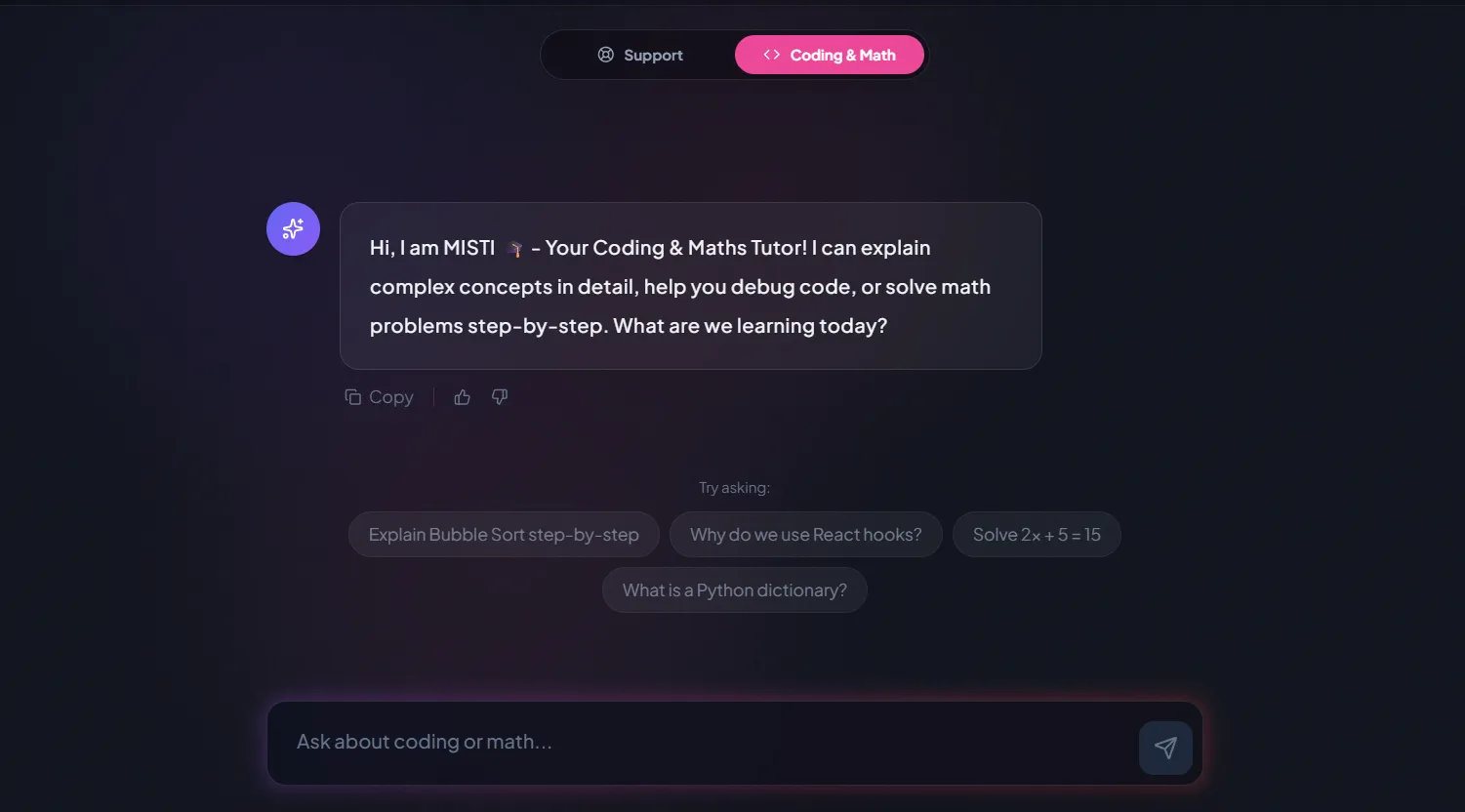
A chatbot that answers mathematics and programming questions, built and deployed by a student.
AI and ML
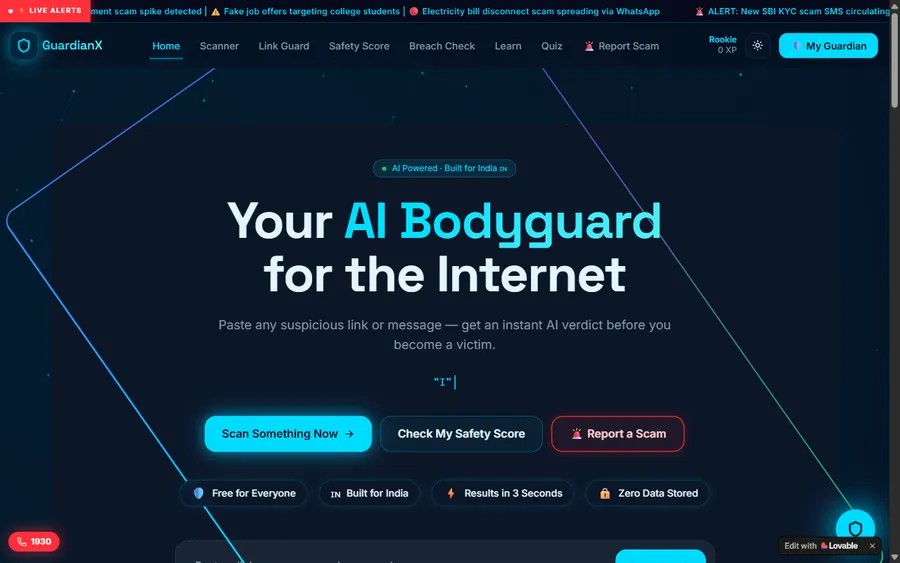
An assistant that helps a young person recognise unsafe situations online.
Web app
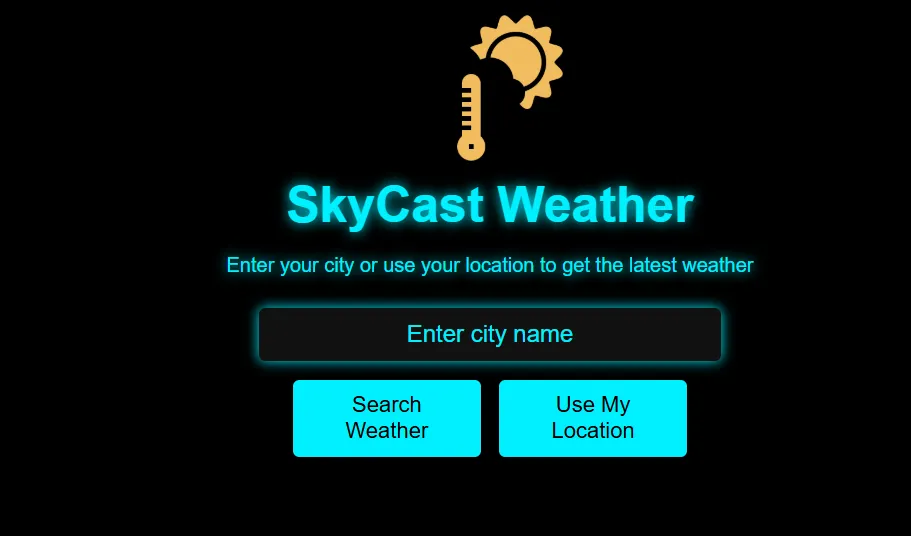
A weather forecasting site with live conditions for any location.
Fees
One charge a month in US dollars, the rate outside India. The free lesson comes first, and billing only starts once a course and a weekly time are agreed.
Free first class
USD 0
no card required
Group batch
USD 100
a month, billed in US dollars
One to one
USD 150
a month, billed in US dollars
What families say
From Google, unedited, by parents nobody asked.
★★★★★
"The one step solution for my son. Modern Age Coders make learning coding so simple that kids love it. The teachers explain complex concepts clearly with practical exercises and interactive content."
Ria Mukherjee
Parent
★★★★★
"Modern Age Coders has been a game-changer for me. I struggled to grasp IT concepts and coding before joining, but their classes transformed everything. I can now confidently write complex programs with ease."
Samriddha Mondal
Student
★★★★★
"One of the most wonderful education centres out there. Education is not limited to school syllabus but focuses on skill development."
Vansh Agarwal
Student
★★★★★
"My child Dhairya is really enjoying the Modern Age Coders classes. This is his first online class and he eagerly looks forward to it. I can already see his improvement, and the teachers are very cooperative."
Sonam Oswal
Parent of Dhairya
★★★★★
"Modern Age Coders have wonderful teachers who teach in a clear, easy and practical way. The teacher boosts students' confidence and inspires them to learn without hesitation."
Sonu Goyal
Parent
★★★★★
"I highly recommend this computer coding class! The teachers are incredibly knowledgeable and passionate about coding."
Ritu Kedia
Parent
Questions from families at options time
It is demanding in a specific way: it rewards fluency in programming and precise reasoning rather than memorisation. Students who can already write small programs generally find it manageable.
Not top set. There is binary, logic and arithmetic done by hand, so a student who avoids all number work will find parts of it uncomfortable, but it is a minority of the content.
Then typed code is the gap worth closing before Year 10. A term of weekly lessons in Year 9 usually removes the problem entirely.
Ofsted's review reports 2021 data putting girls at 21 per cent of GCSE entries and 15 per cent at A level, and cites research finding a large divide in interest already present by Year 9. It reports participation and interest, not capability, and neither do we.
More than in most subjects. One English board sits its practical paper on a computer, one prints questions in its own pseudo-code and one publishes what candidates need not learn. Ask which board and which language your school uses.
It happens. The review cites 2018 data putting 7.6 per cent of pupils in schools with no key stage 4 computing qualification. Learning outside school is then the only route, and it is a perfectly good one.
We do not claim so. The research Ofsted reviews advises caution about transfer claims, and we take that seriously enough to have written a whole page about refusing it.
No. People start programming at sixteen, at twenty-five and at sixty, and plenty of our students never took the GCSE.
Year 8 or Year 9 is the cheapest moment, because nothing is at stake and a student can be bad at it for a month without consequence.
The first lesson is free. After that a group place is USD 100 a month and one-to-one teaching USD 150, charged monthly with nothing in advance.
Elsewhere on this site
The three board pages go deep; the others cover the wider decision.
Three notations in one paper, and answering in the form the question asks.
The Not required column, and the notation choice in Section B.
One question per topic, and a paper sat at a keyboard.
Why most secondary schools are not required to teach computing at all.
The transfer claim the research does not support, refused in full.
What Ofcom found about British teenagers, AI and checking.
Start here
Send a number and we will reply at a British hour you choose. The lesson is real teaching, something gets built in it, and it ends with a straight view of readiness.
Prefer reading? Every course page lists its syllabus, how we teach covers the method and its limits, and the coding roadmap sets out the sequence.
WhatsApp us · +91 91233 66161 · contact@modernagecoders.com
WhatsApp is free from a British mobile and gets the quickest answer. The number is an Indian one, said here rather than noticed later.