FSU / FE / 01
HTML and CSS
Responsive websites from the first tag.
Open the syllabusUK · Teens and adults · Front end to database
Most full stack courses measure success by whether the app runs. The UK government publishes a stricter test for its own web services, and anyone can read it. Its Service Standard sets 14 points, among them "Make sure everyone can use the service" and "Make new source code open", and its guidance on accessibility is blunt about why the first matters: "At least 1 in 5 people in the UK have a long term illness, impairment or disability". For public sector websites, meeting the Web Content Accessibility Guidelines at level WCAG 2.2 AA, and publishing an accessibility statement, is how a site meets the legal requirement; the same guidance reports a study that found "4 in 10 local council homepages failed basic tests for accessibility". Our course trains UK teenagers and adults to build complete web applications, front end, back end and database, and treats that published standard as the quality bar: keyboard-navigable interfaces, readable contrast, real HTML forms, code kept in the open without its secrets.
Live teaching since 2020 · 10,000+ students · full stack, accessible by design
In short
The GOV.UK Service Standard, published by the government for teams building public services, has 14 points, including making sure everyone can use a service, creating a secure service that protects privacy, choosing the right tools and technology, and making new source code open. Accessibility regulations have applied to public sector websites since 23 September 2018, and a site meets the legal requirement by meeting WCAG 2.2 AA and publishing an accessibility statement; all UK service providers also have a duty to make reasonable adjustments under the Equality Act 2010, or the Disability Discrimination Act 1995 in Northern Ireland. Modern Age Coders teaches full stack development live and online to UK teenagers and adults, covering HTML, CSS, JavaScript and TypeScript, React, Node and Express, SQL and MongoDB, testing and deployment, with accessibility and open, secret-free repositories built into every project. We have no connection with GOV.UK or the Government Digital Service. The first class is free; afterwards a group place is USD 100 a month and one-to-one lessons USD 150 a month.
Start here
A full stack course for teenagers, one for adults, and the MERN stack. Each card opens the full syllabus.
FSU / 01
React and Node.js for ages 13 to 18, with keyboard use and accessibility part of every project.
Open the syllabus →
FSU / 02
React, Node.js and DevOps basics for university students, graduates and career switchers.
Open the syllabus →
FSU / 03
MongoDB, Express, React and Node, ending with an accessible web application.
Open the syllabus →A published standard
The GOV.UK Service Manual introduces it in one line: "The Service Standard helps teams to create and run great public services." Several of its 14 points are, in practice, a full stack developer's checklist.
| Point | Title | In a full stack project |
|---|---|---|
| 5 | Make sure everyone can use the service | Keyboard navigation, readable contrast, meaningful labels, screen reader testing |
| 9 | Create a secure service which protects users' privacy | Hashed passwords, validated input, least data collected, HTTPS throughout |
| 11 | Choose the right tools and technology | A stack chosen for the problem, not for fashion, and a reason written down |
| 12 | Make new source code open | A public repository from day one, with secrets kept out of it |
| 13 | Use and contribute to open standards, common components and patterns | Reusing well-tested components instead of rebuilding them |
| 14 | Operate a reliable service | Tests, error handling, logging and a deployment that can be repeated |
The Service Standard is written for government teams, and nobody outside government is bound by it. It is simply one of the clearest public descriptions of what good web software looks like, free to read and backed by years of use.
The other eight points cover understanding users, solving whole problems, joining up channels, simplicity, multidisciplinary teams, agile working, iterating, and publishing performance data.
The GOV.UK Design System invites teams to "Learn from the research and experience of other service teams and avoid repeating work that's already been done." Studying why its form patterns are built the way they are is a free lesson in accessible interface design.
We teach from the principles, not the branding: student projects use their own designs, never an imitation of GOV.UK.
Sources, read 21 September 2026: GOV.UK Service Manual, Service Standard; GOV.UK Design System. Modern Age Coders has no connection with GOV.UK or the Government Digital Service.
Accessibility
From gov.uk's guidance on accessibility requirements for public sector bodies, first published in 2018 and updated on 30 September 2024.
| Point | As published |
|---|---|
| Who it affects | "At least 1 in 5 people in the UK have a long term illness, impairment or disability" |
| In force | For public sector bodies from 23 September 2018 |
| The regulations | The Public Sector Bodies (Websites and Mobile Applications) (No. 2) Accessibility Regulations 2018 |
| Meeting the requirement | Meet WCAG 2.2 AA and publish an accessibility statement |
| The four principles | Perceivable, operable, understandable and robust |
| Everyone else | "All UK service providers have a legal obligation to make reasonable adjustments under the Equality Act 2010 or the Disability Discrimination Act 1995 (in Northern Ireland)." |
| Common problem | The fix, in code |
|---|---|
| Websites that are not easy to use on a mobile | Responsive layouts tested at phone width, not just shrunk |
| Websites that cannot be navigated using a keyboard | Real buttons and links, a visible focus state, a logical tab order |
| Inaccessible PDF forms that screen readers cannot read | HTML forms with labels, error messages tied to fields, and server-side validation |
| Poor colour contrast that makes text difficult to read | Contrast checked against WCAG thresholds as part of the build |
The guidance puts the scale of the problem plainly: "Most public sector websites and mobile apps do not currently meet accessibility requirements", citing the finding that "4 in 10 local council homepages failed basic tests for accessibility". A developer who can build accessible interfaces from the start is solving a problem that large organisations still have.
Source, read 21 September 2026: gov.uk, Understanding accessibility requirements for public sector bodies, updated 30 September 2024. This page is not legal advice; private organisations should take their own advice on the Equality Act.
The stack
Full stack means understanding how a click in a browser becomes a query in a database and comes back as a page, and being able to build every step.
| Layer | What you learn | Course |
|---|---|---|
| Structure and style | Semantic HTML, CSS layout, responsive design | HTML and CSS, Frontend for Teens |
| Behaviour | JavaScript, then TypeScript for larger codebases | JavaScript for Teens, TypeScript |
| Interface | React components, state, forms and routing | React, the full stack courses |
| Server | Node and Express, REST APIs, authentication | Backend for Teens, full stack courses |
| Data | Relational design with SQL; document stores with MongoDB | MySQL, MERN |
| Quality | Testing, accessibility checks, logging | Every course, every project |
| Delivery | Git, deployment and environment variables | Git and GitHub, full stack courses |
Slots, sign-ups and confirmations for a club or tutor, with accessible forms and a database behind them.
Posts, moderation and accounts, with passwords hashed and only necessary data stored.
Public data fetched through an API and presented with charts that also work as tables for screen readers.
Mobile apps usually talk to exactly this kind of back end; our app development course covers the phone side. Security on the server connects to the cyber security course for teens.
Working in the open
Service Standard point 12 asks teams to "write code in the open from the start, and publish it in an open repository - minus any sensitive information, like secret keys and credentials". It is a good habit for any learner.
A public repository with a readable history shows how you work, not just what you finished. It is also the easiest way for a teacher to read your code between lessons.
Every student keeps projects in their own GitHub account, so the work stays theirs.
The hard part of point 12 is the exception: keys, passwords and connection strings must never reach the repository. Students learn environment variables, ignore files and what to do if a secret leaks.
It is the kind of mistake that is cheap to learn in class and expensive to learn at work.
| You are | A sensible route |
|---|---|
| A teenager new to code | HTML, CSS and JavaScript, then Full Stack for Teens |
| A teenager who already codes | Frontend or Backend for Teens, then the full stack course |
| An adult career switcher | Full Stack for Adults, from HTML to deployment |
| A developer adding a skill | React, TypeScript or MERN on their own |
| A student aiming at a degree apprenticeship | Full stack plus Git, for the software engineering option |
Learners heading for a software degree apprenticeship can read how the route works on coding before a degree apprenticeship. We never work on coursework, NEA or assessed projects.
Stages
Where you start depends on what you can already build, not on age.
| Stage | What should be true |
|---|---|
| 1. Pages | You build accessible, responsive pages with semantic HTML and CSS |
| 2. Interfaces | You write JavaScript and React components with forms that work by keyboard |
| 3. Servers and data | You build an API with Node and Express and store data safely in a database |
| 4. Deployed and maintained | A tested application runs online from an open repository with its secrets kept out |
Most accessibility failures are interface failures, fixed in the component, not afterwards.
The wider sequence of subjects is on the coding roadmap.
Deployment, logging and fixing things after launch are part of the job.
A site that goes live is the point where real users start finding the bugs.
The catalogue
Front end, back end and the practice around them.
FSU / FE / 01
Responsive websites from the first tag.
Open the syllabusFSU / FE / 02
CSS craft to React, ending with accessibility.
Open the syllabusFSU / FE / 03
JavaScript to production React, for adults.
Open the syllabusFSU / BE / 01
Node, APIs and databases.
Open the syllabusFSU / BE / 02
Typed JavaScript, React and Node.
Open the syllabusFSU / BE / 03
Relational design and SQL.
Open the syllabusFSU / PR / 01
Open repositories, done properly.
Open the syllabusFSU / PR / 02
Branches, reviews and history.
Open the syllabusFSU / PR / 03
Why the server must be defended.
Open the syllabusHow lessons run
The team teaches from India, which has no daylight saving. That gap is four and a half hours while British Summer Time runs and five and a half in winter, which leaves UK afternoons, weeknights and weekends open for lessons.
Weekday late afternoon
Teen groups, once homework allows.
Weeknight
Adult learners fitting code around a job.
Saturday or Sunday
Two-hour blocks for wiring front end to back end.
We check your level and choose a route through the stack with you.
Five to ten learners of similar age and level.
For a career switch deadline or a faster pace.
Every project is tried with a keyboard and checked for contrast before it counts as done.
Projects live in your own GitHub account, with secrets kept out.
A teacher reads your front end and back end and explains what to change.
Student work
Four finished projects by our students. The rest, from every age group, are in student labs.
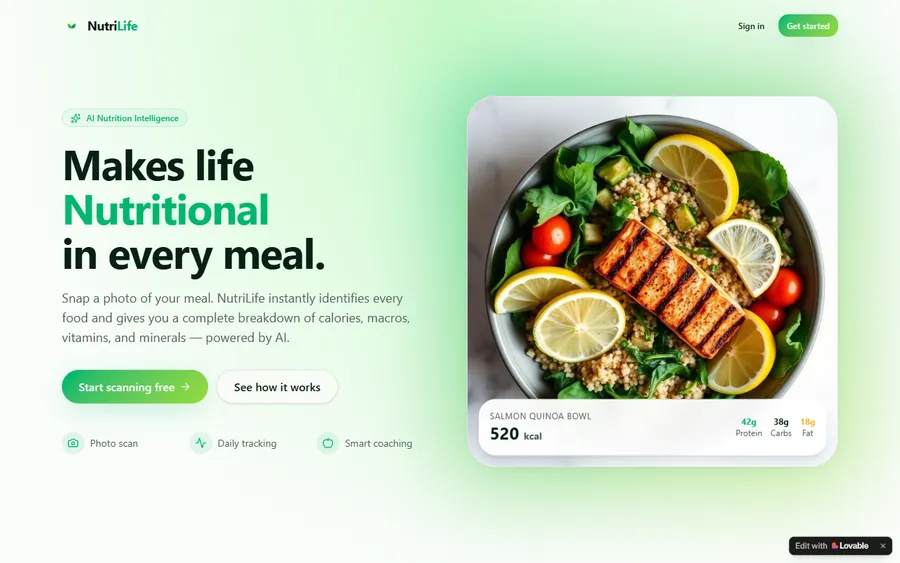
AI and ML
An AI nutrition coach that reads what you eat and works you toward a target.
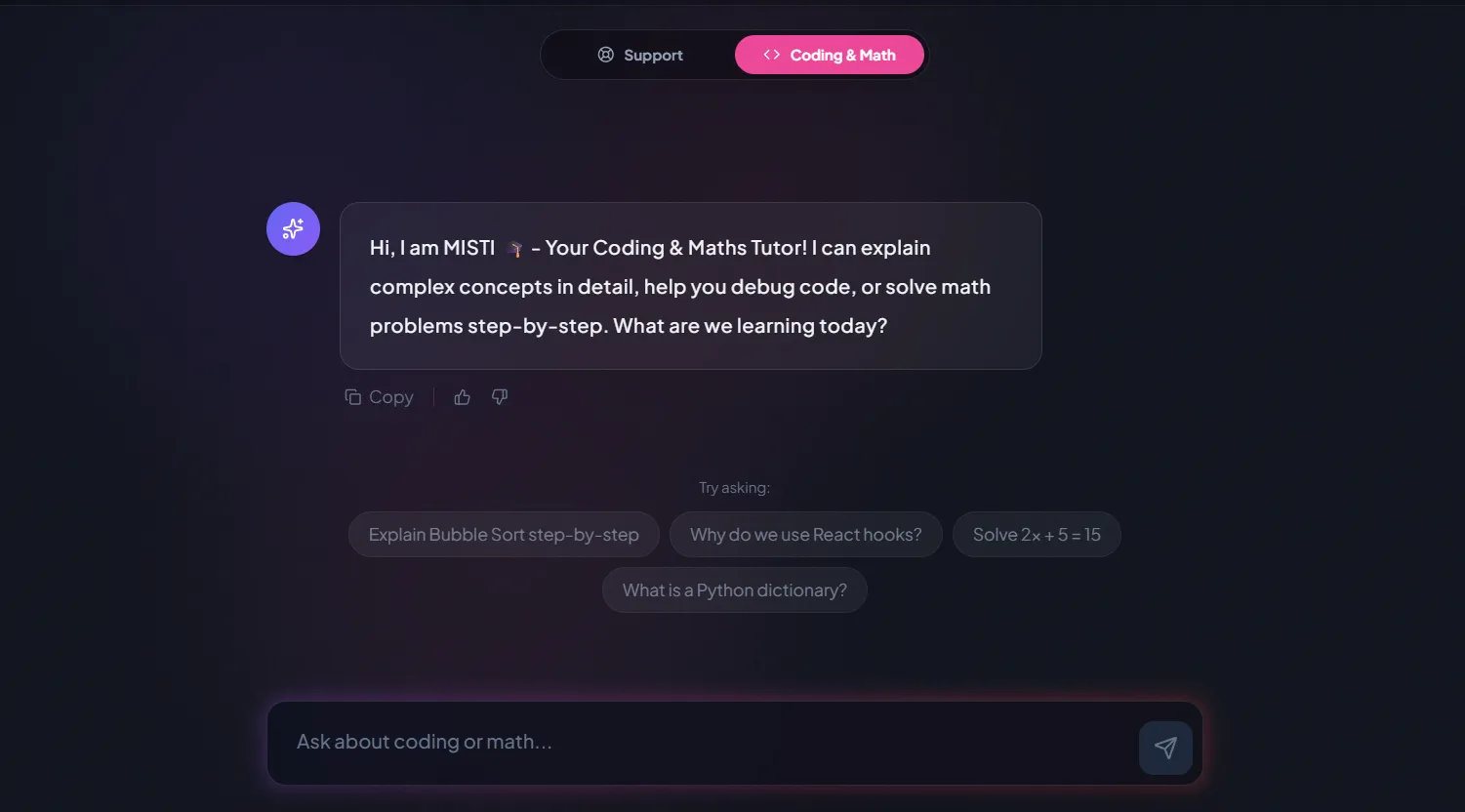
AI and ML
A chatbot that answers mathematics and programming questions, built and deployed by a student.
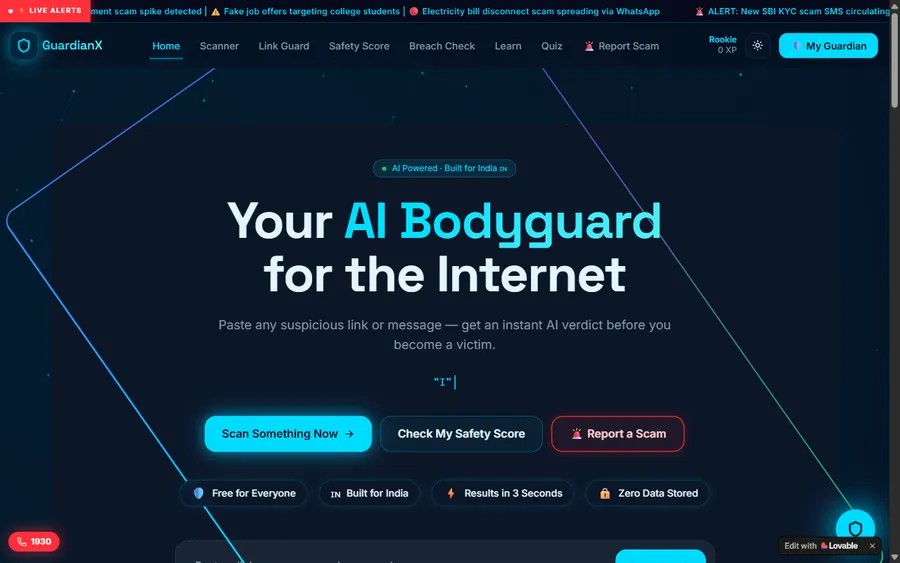
AI and ML
An assistant that helps a young person recognise unsafe situations online.
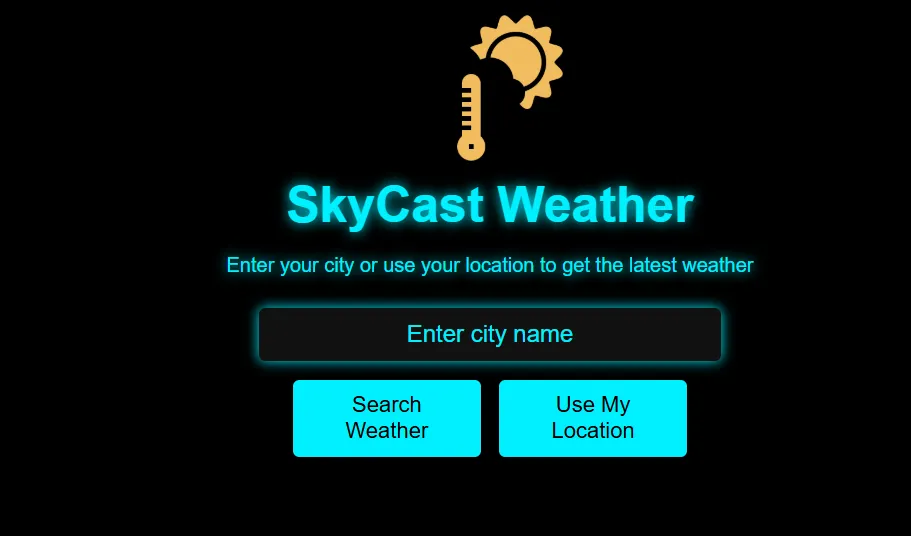
Web app
A weather forecasting site with live conditions for any location.
Fees
Priced per month in US dollars at a single rate for all learners outside India. Nothing is charged to join, and each month stands alone. Hosting for deployed projects can usually run on free tiers.
Free first class
USD 0
no card required
Group batch
USD 100
a month, billed in US dollars
One to one
USD 150
a month, billed in US dollars
What families say
Reviews our students and their families left on Google, word for word.
★★★★★
"The one step solution for my son. Modern Age Coders make learning coding so simple that kids love it. The teachers explain complex concepts clearly with practical exercises and interactive content."
Ria Mukherjee
Parent
★★★★★
"Modern Age Coders has been a game-changer for me. I struggled to grasp IT concepts and coding before joining, but their classes transformed everything. I can now confidently write complex programs with ease."
Samriddha Mondal
Student
★★★★★
"One of the most wonderful education centres out there. Education is not limited to school syllabus but focuses on skill development."
Vansh Agarwal
Student
★★★★★
"My child Dhairya is really enjoying the Modern Age Coders classes. This is his first online class and he eagerly looks forward to it. I can already see his improvement, and the teachers are very cooperative."
Sonam Oswal
Parent of Dhairya
★★★★★
"Modern Age Coders have wonderful teachers who teach in a clear, easy and practical way. The teacher boosts students' confidence and inspires them to learn without hesitation."
Sonu Goyal
Parent
★★★★★
"I highly recommend this computer coding class! The teachers are incredibly knowledgeable and passionate about coding."
Ritu Kedia
Parent
Questions about full stack development
Building every layer of a web application: the interface in the browser, the server and API behind it, and the database that stores its data.
A set of 14 points the government publishes for teams building public services, including making sure everyone can use a service and making new source code open. Private learners can read it freely.
For public sector websites, the accessibility regulations have applied since 23 September 2018, and meeting WCAG 2.2 AA with an accessibility statement meets the requirement. All UK service providers also have a reasonable adjustments duty under the Equality Act 2010, or the Disability Discrimination Act 1995 in Northern Ireland.
gov.uk's guidance says at least 1 in 5 people in the UK have a long term illness, impairment or disability, and many more have a temporary one.
HTML, CSS and JavaScript, then TypeScript for larger projects, with Node and Express on the server and SQL or MongoDB for data.
Yes. Our teen full stack course, with React and Node.js, starts from absolute beginner for ages 13 to 18.
No. We use the published Service Standard and accessibility guidance as a quality bar, and have no connection with GOV.UK or the Government Digital Service.
No. We never work on coursework, NEA or anything submitted for assessment.
The first class is free. After that it is USD 100 a month in a group or USD 150 a month one to one, with no enrolment fee.
Late weekday afternoons for teenagers, weeknights for adults, or a weekend block, set in UK time during the free class. India runs four and a half hours ahead of British Summer Time and five and a half ahead of winter time.
Elsewhere on this site
Apps, security, and the routes into software work.
The phone side of the same back end.
Defending what you build.
Another back-end language.
The software route into work.
Projects alongside a degree.
All our UK pages.
Start here
Leave a number and we will call at a UK time that suits you. Tell us what you want to build; the class checks your level and maps a route from front end to database.
Want to look first? The course pages hold each syllabus, how we teach explains the method, and student labs shows finished builds.
WhatsApp us · +91 91233 66161 · contact@modernagecoders.com
WhatsApp from a UK phone reaches us fastest. Our team works from India, so the number starts +91, and there is no UK office.