CYT / SEC / 01
Cybersecurity for Teens
Six months of defence, ending in capture-the-flag.
Open the syllabusUK · Ages 13 to 18 · Defensive security
Curiosity about how systems break is exactly what the cyber security industry wants. It is also where a lot of teenagers get into trouble without meaning to. The National Crime Agency reports that in a survey of children aged 10 to 16, 20% engaged in behaviours that violate the Computer Misuse Act, rising to 25% among those who game, and that many people involved in low-level cyber crime "are unaware that their actions are criminal". Logging into a friend's account with a password you watched them type, knocking a rival offline in a game with a booter tool, downloading software to get into someone else's laptop: the NCA uses all three as examples of offences. At the same time, the government's own research finds that nearly half of UK businesses have a basic cyber skills gap. This course sits between those two facts. It teaches UK teenagers how attacks work and how defence wins, and it keeps every exercise on the legal side of the line: their own devices and accounts, puzzles built by the instructor, and nothing touched without permission.
Live teaching since 2020 · 10,000+ students · defence first, and always legal
In short
The Computer Misuse Act 1990 makes it an offence to access computer material without permission, to impair a computer's operation, or to make or obtain tools for those purposes, and the National Crime Agency warns that teenagers often break it without realising: in an NCA survey of 10 to 16 year olds, 20% had engaged in behaviours that violate the Act. The NCA's Cyber Choices programme exists to steer that curiosity towards legal use. Employers need it: DSIT's 2025 research found 49% of UK businesses had a basic cyber security skills gap. Modern Age Coders teaches a defensive cyber security course for UK teenagers aged 13 to 18, live and online, covering how the internet works, passwords and hashing, phishing, malware concepts, encryption and web security, ending with instructor-built capture-the-flag puzzles. No coding is needed to start. Every exercise uses the student's own devices or puzzles built for the purpose. The first lesson is free, then USD 100 a month in a group or USD 150 one to one.
Start here
The defensive security course itself, the programming that deeper security work needs, and how the web works underneath. Each card opens the syllabus.
CYT / 01
Six months of defensive security, from how the internet works to a capture-the-flag capstone. No coding needed.
Open the syllabus →
CYT / 02
The language most security scripting and tooling is written in, learned properly.
Open the syllabus →
CYT / 03
Servers, APIs and databases, the places where web security is won or lost.
Open the syllabus →The law
The NCA's Cyber Choices programme "was created to help people make informed choices and to use their cyber skills in a legal way". Its page sets out the Act section by section, each with an example.
| Section | Offence | The NCA's example |
|---|---|---|
| 1 | Unauthorised access to computer material | Adam watches a friend type a password, then later logs in without permission and reads their messages |
| 2 | Unauthorised access with intent to commit or facilitate further offences | Raj uses a teacher's unattended tablet to buy things with the saved card |
| 3 | Unauthorised acts impairing, or reckless as to impairing, a computer's operation | Sarah uses a booter tool to knock a friend offline so she can win a game |
| 3ZA | Unauthorised acts causing, or creating risk of, serious damage | Kim hacks a phone company and stops some people from calling the police, recklessly rather than deliberately |
| 3A | Making, supplying or obtaining articles for use in offences under sections 1, 3 or 3ZA | Robin downloads software to break into a friend's laptop, even without having used it yet |
The NCA says "The average age of someone convicted for cyber crime offences is much younger than other crime types; offenders are often teenagers." In an earlier release, from January 2022, it reported referrals to its prevention team with "the median age at 15 and the youngest at nine".
Its survey of 10 to 16 year olds found 20% engaging in behaviours that violate the Act, and 25% of those who game. Buying in-game items on someone else's account without permission, or DDoS-ing, are both offences, "despite often doing so unwittingly".
Arrest and a possible criminal record, computers or phones taken away, risk of expulsion from school, and limits on internet use, careers and international travel. For the most serious offences, the Cyber Choices page states a maximum of "Up to life in prison for the most serious offences".
None of this is meant to frighten a curious teenager away from the subject. The NCA's own point is the opposite: the skills are valuable, and there are legal places to use them.
Sources, read 21 September 2026: National Crime Agency, Cyber Choices; NCA, One in five children found to engage in illegal activity online; NCA, Rise in school cyber crime attacks sparks NCA education drive, 17 January 2022. Section wording is as the NCA presents it; this page is not legal advice.
The skills gap
From the Department for Science, Innovation and Technology's Cyber security skills in the UK labour market 2025, first published on 19 September 2025.
| Finding | Published figure |
|---|---|
| Businesses with a basic cyber skills gap | 49% |
| Charities with a basic skills gap | 59% |
| Public sector organisations with a basic skills gap | 14% |
| Businesses with gaps in advanced skills | 30% |
| People in the UK cyber security workforce | About 143,000 |
| Annual workforce gap | 3,800 people |
| Cyber sector employers diversifying recruitment who hired through non-degree routes | 63% |
DSIT describes the basic gap as businesses "struggling with essential tasks including setting up firewalls, managing personal data securely and detecting malware". That is defensive work, and it is exactly where a beginner's course starts.
The advanced gaps it names are forensic analysis, interpreting malicious code and penetration testing, which come much later and always under authorisation.
Of cyber sector employers who took steps to diversify recruitment, 63% said they had hired through non-degree routes and 41% had run events in schools or colleges. DSIT's annual inflow estimate also includes about 600 new apprenticeship starts flowing into the cyber labour market.
For a teenager, that means a degree is one route among several; our page on degree apprenticeships includes the level 6 standard with a cyber security option.
Source, read 21 September 2026: DSIT, Cyber security skills in the UK labour market 2025. The workforce estimate covers the end of 2024.
Practising legally
The rule is simple enough to put on a sticky note: only your own devices and accounts, only systems built for practice, and never anything without clear permission.
| Legal practice | The offence it can turn into |
|---|---|
| Auditing your own accounts and passwords | Trying passwords on someone else's account |
| Hardening your own home network settings, with your household's agreement | Scanning or testing a network you do not own |
| Solving capture-the-flag puzzles built for the purpose | Attacking a real website to see if it works |
| Studying how booter and DDoS attacks work in principle | Using a booter to knock anyone offline |
| Reading about malware and how defences detect it | Downloading or sharing tools meant for attacking others |
Our course syllabus puts the principle in one line, repeated as a checkpoint: "knowledge of weaknesses creates responsibility, never permission". Knowing how something could be broken never makes it acceptable to try it on a system that is not yours. Professional penetration testers work under written authorisation from the system's owner, and students learn to think the same way from the first week.
The NCA's Cyber Choices site lists legal ways to develop skills and careers, from coding and web development to penetration testing, security operations and law enforcement.
For girls, the NCSC's CyberFirst Girls competition is covered on our CyberFirst Girls page. Code-breaking fans can look at the National Cipher Challenge.
The NCA encourages parents and teachers of 10 to 16 year olds to help them understand the severity of these offences and develop their skills in positive ways. A structured course is one way to do that.
If a teenager has already crossed a line, the Cyber Choices programme is delivered through Regional Organised Crime Units and local police cyber teams. We are a teaching organisation, not part of that programme.
The course
Cybersecurity for Teens runs for 24 weeks over six months, for ages 13 to 18, with no coding required to start.
| Month | Title | What it builds |
|---|---|---|
| 1 | How the Internet Actually Works | Networks, addresses and what really happens when you load a page |
| 2 | Passwords, Hashing, and Proving Who You Are | Why strong passwords work, how hashing protects them, and two-factor login |
| 3 | Phishing and Social Engineering | How people, not machines, are usually the way in, and how to spot it |
| 4 | Malware Concepts and Safe Habits | What malware does in principle and the habits that keep it out |
| 5 | Encryption and How the Web Stays Trustworthy | Encryption, the HTTPS padlock, and web security ideas such as cookies and sessions |
| 6 | The Capture-the-Flag Capstone | Instructor-built puzzles in cryptography, logic and file forensics, with written solutions |
Every attack is studied so that the defence makes sense. Students harden their own accounts and audit their own digital footprint along the way.
The capture-the-flag month uses puzzle competitions built by the instructor: legal, safe, and a real test of thinking.
Solutions are written out, because explaining how a puzzle was solved is part of the skill, and a habit professionals rely on.
Students who want to go further usually add programming next, since scripting underpins most technical security work. Python is the usual choice, then web development to understand the systems being defended. For school exams, security topics also appear in GCSE computer science, and our AQA GCSE computer science page covers that specification.
Stages
Placement depends on what a student already knows, not age.
| Stage | What should be true |
|---|---|
| 1. Safe and aware | Your own accounts are secured and you can spot a phishing attempt |
| 2. Understands the machinery | You can explain networks, hashing and encryption in your own words |
| 3. Solves puzzles | You work through capture-the-flag challenges and write up your solutions |
| 4. Builds and scripts | You write programs in Python and understand the web systems security protects |
Puzzles turn knowledge into skill, legally.
The wider sequence of subjects is on the coding roadmap.
Programming is what turns an interest in security into a technical career path.
It comes after the defensive foundations, not before.
The catalogue
Security first, then the programming and systems knowledge that deepen it.
CYT / SEC / 01
Six months of defence, ending in capture-the-flag.
Open the syllabusCYT / SEC / 02
Using AI assistants well, and checking what they produce.
Open the syllabusCYT / SEC / 03
The exam subject, including its networks and security topics.
Open the syllabusCYT / PRG / 01
The scripting language of security work.
Open the syllabusCYT / PRG / 02
The logical thinking puzzles depend on.
Open the syllabusCYT / PRG / 03
Keeping and sharing your own work properly.
Open the syllabusCYT / SYS / 01
Servers and APIs, from the defender's side.
Open the syllabusCYT / SYS / 02
Databases, and why input must be handled safely.
Open the syllabusCYT / SYS / 03
Building a web application end to end.
Open the syllabusHow lessons run
Teachers work from India, which keeps one clock all year; the UK is four and a half hours behind India in British Summer Time and five and a half behind in winter. After-school and weekend times in the UK are easy to arrange.
After school
An early-evening weekday slot in UK time.
Saturday
A longer session for puzzle work.
Sunday
For teenagers busy on Saturdays.
We find out what the student knows and what draws them to security.
Five to ten teenagers at the same level.
For a faster pace or a particular interest.
Every exercise uses the student's own devices or puzzles built for the purpose.
Students write up how and why, not only what worked.
Taught at a level that respects teenagers without assuming prior coding.
Student work
Four projects finished by our students. More, across all ages, are in student labs.

AI and ML
An AI nutrition coach that reads what you eat and works you toward a target.
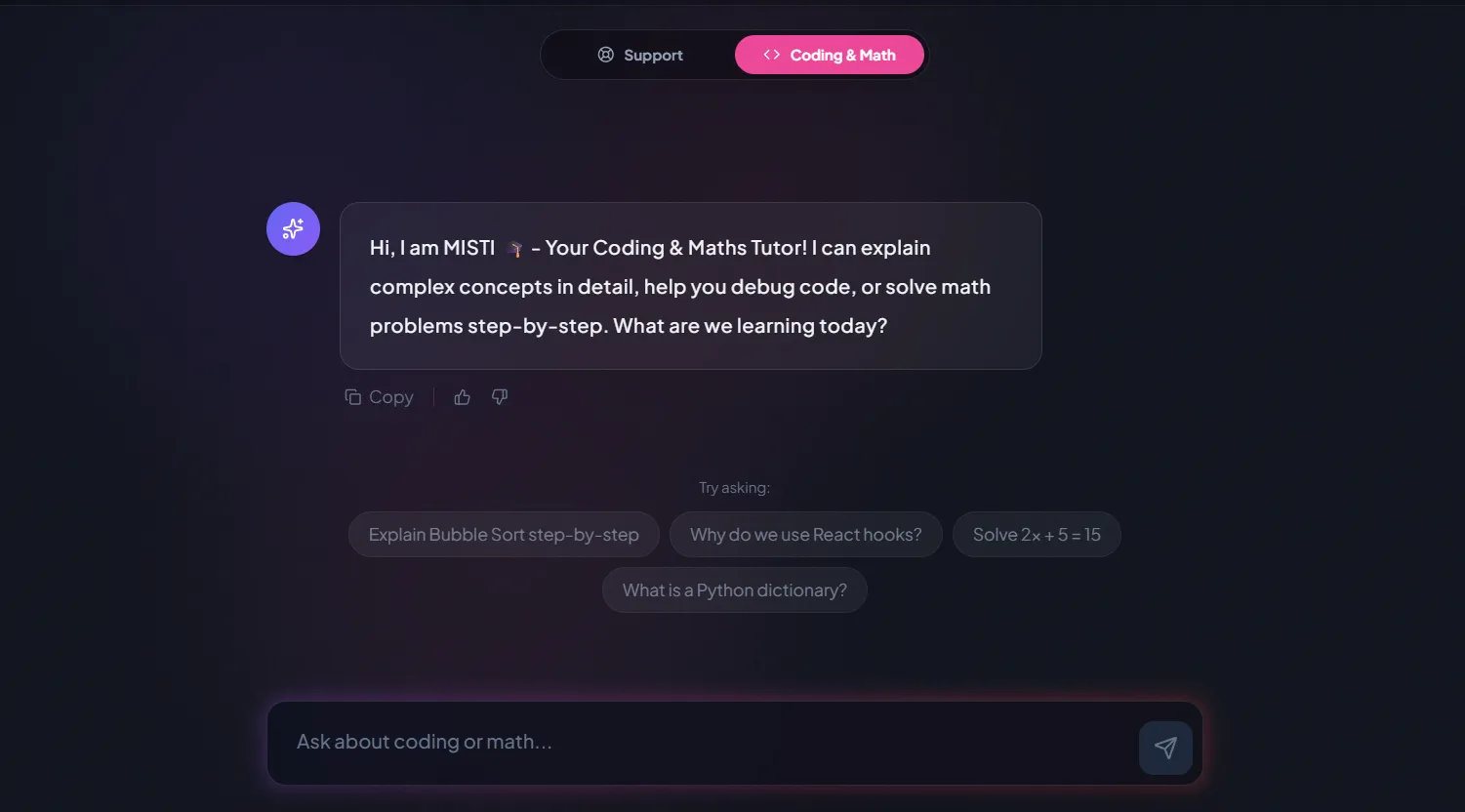
AI and ML
A chatbot that answers mathematics and programming questions, built and deployed by a student.
AI and ML
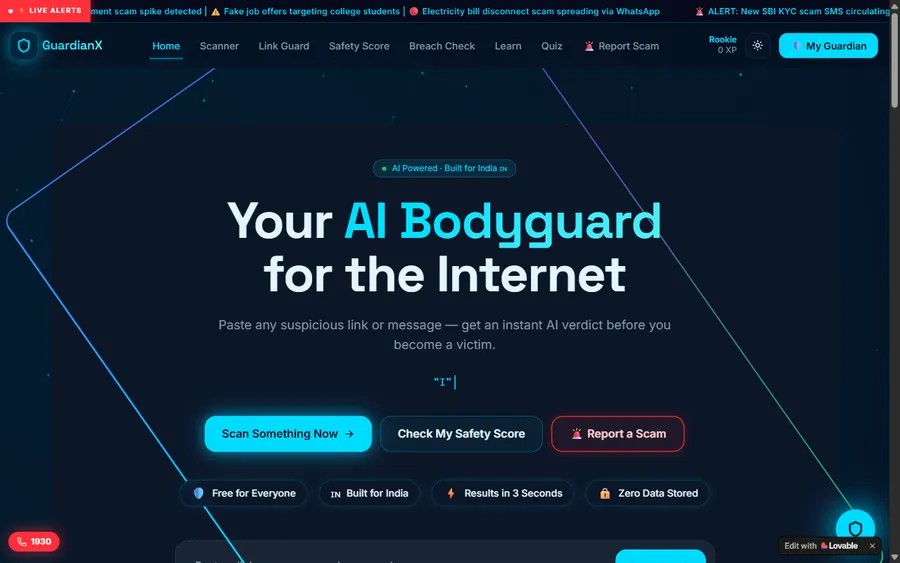
An assistant that helps a young person recognise unsafe situations online.
Web app
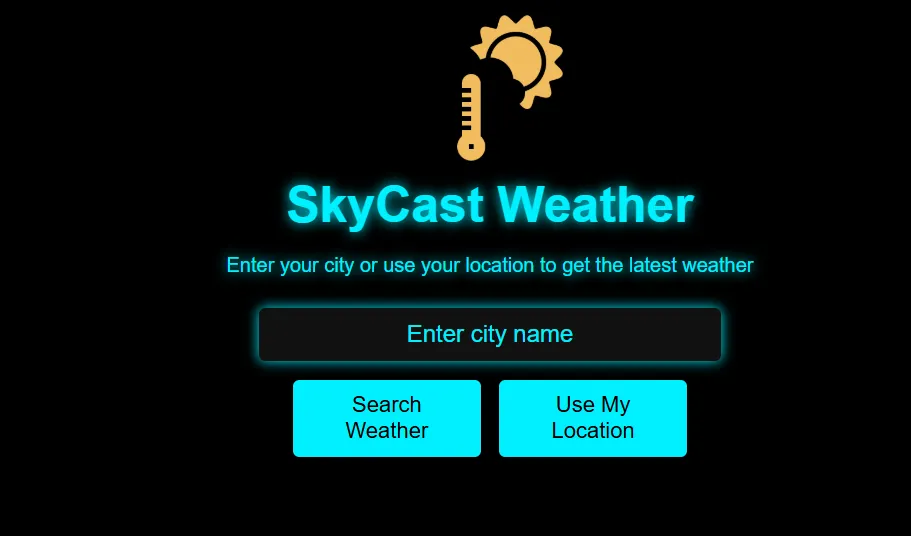
A weather forecasting site with live conditions for any location.
Fees
One monthly fee in US dollars, the same everywhere outside India, with no enrolment fee and no commitment beyond the month.
Free first class
USD 0
no card required
Group batch
USD 100
a month, billed in US dollars
One to one
USD 150
a month, billed in US dollars
What families say
Parents' and students' reviews from Google, exactly as posted.
★★★★★
"The one step solution for my son. Modern Age Coders make learning coding so simple that kids love it. The teachers explain complex concepts clearly with practical exercises and interactive content."
Ria Mukherjee
Parent
★★★★★
"Modern Age Coders has been a game-changer for me. I struggled to grasp IT concepts and coding before joining, but their classes transformed everything. I can now confidently write complex programs with ease."
Samriddha Mondal
Student
★★★★★
"One of the most wonderful education centres out there. Education is not limited to school syllabus but focuses on skill development."
Vansh Agarwal
Student
★★★★★
"My child Dhairya is really enjoying the Modern Age Coders classes. This is his first online class and he eagerly looks forward to it. I can already see his improvement, and the teachers are very cooperative."
Sonam Oswal
Parent of Dhairya
★★★★★
"Modern Age Coders have wonderful teachers who teach in a clear, easy and practical way. The teacher boosts students' confidence and inspires them to learn without hesitation."
Sonu Goyal
Parent
★★★★★
"I highly recommend this computer coding class! The teachers are incredibly knowledgeable and passionate about coding."
Ritu Kedia
Parent
Questions from parents and teenagers
Learning how attacks work is legal, and it is the basis of defence. Using that knowledge on devices, accounts or systems without permission is an offence under the Computer Misuse Act. Our course keeps every exercise on the student's own devices or puzzles built for practice.
In an NCA survey of children aged 10 to 16, 20% engaged in behaviours that violate the Computer Misuse Act, rising to 25% among those who game. The NCA says many do not realise it is a crime.
The NCA's examples include logging into someone else's account without permission, using a booter tool to knock someone offline, buying things with someone else's saved card, and downloading software to break into another person's device.
No. Cybersecurity for Teens needs no coding to start. Python is a natural next step afterwards for students who want technical depth.
DSIT's 2025 research found 49% of UK businesses had a basic cyber skills gap, and 63% of cyber sector employers diversifying recruitment had hired through non-degree routes. We teach skills; we do not promise jobs.
A puzzle competition in which students find hidden answers, or flags, by solving challenges in areas such as cryptography, logic and file forensics. In our course the puzzles are built by the instructor for practice.
A national programme co-ordinated by the National Crime Agency to help people use their cyber skills legally, delivered through regional and local police cyber teams. We are not part of it, but its website has useful resources.
Ages 13 to 18. Younger children interested in technology usually start with coding courses instead.
The first lesson is free. After that it is USD 100 a month in a group or USD 150 a month one to one, with no enrolment fee.
After school on weekdays or at weekends in UK time, agreed in the first lesson. Teachers are four and a half hours ahead of the UK in summer and five and a half in winter.
Elsewhere on this site
Competitions, routes into work, and programming for teens.
The NCSC competition for girls.
Code-breaking for school students.
Including the cyber security option.
How we teach teenagers.
The next step after security basics.
All our UK pages.
Start here
Leave a number and we will call at a UK time that suits you. Tell us what interests your teenager about security; the lesson starts there and ends with a route through the course.
Reading first? See the course list, our approach to teaching, and finished student work.
WhatsApp us · +91 91233 66161 · contact@modernagecoders.com
WhatsApp from a UK phone is the quickest way to reach us. We are based in India, so the number starts +91, and there is no UK office.