YTMP / B / 01
Algebra foundations
The by-hand algebra Examination 1 demands.
Open the syllabusAustralia · Year 10 · Getting ready for Methods
The jump from Year 10 maths to a calculus-based senior course is real, and most of it is not about calculus. Students stumble in Year 11 Methods because algebra is slow, function notation is unfamiliar and graphs feel like pictures rather than information. Year 10 is the year to fix those things calmly, before the senior course starts moving.
From VCAA and NESA documents · Algebra and functions first · Lessons after school in your state
In short
Mathematical Methods is the VCE calculus-based mathematics study, running from Units 1 and 2 in Year 11 to Units 3 and 4 in Year 12. VCAA lists no prerequisites, but says students starting Units 1 and 2 are assumed to have a sound background in number, algebra, function, geometry, probability and statistics. Year 10 is when that background is built. In NSW the same route runs through the Stage 5 Paths into Mathematics Advanced.
The right Year 10 courses
Algebra first, functions and graphs second, probability third.
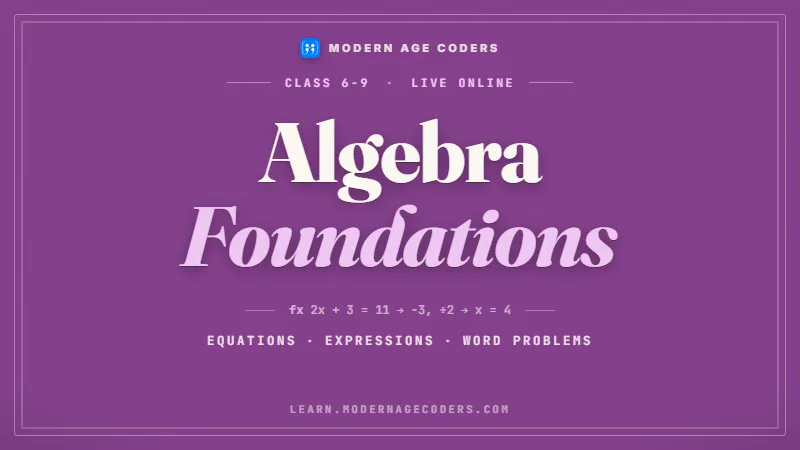
YTMP / 01
Expanding, factorising, solving and rearranging until they are fast and accurate, because Methods uses them on every page.
Open the syllabus →
YTMP / 02
Function notation, graph sketching and transformations, the language Units 1 and 2 of Methods are written in.
Open the syllabus →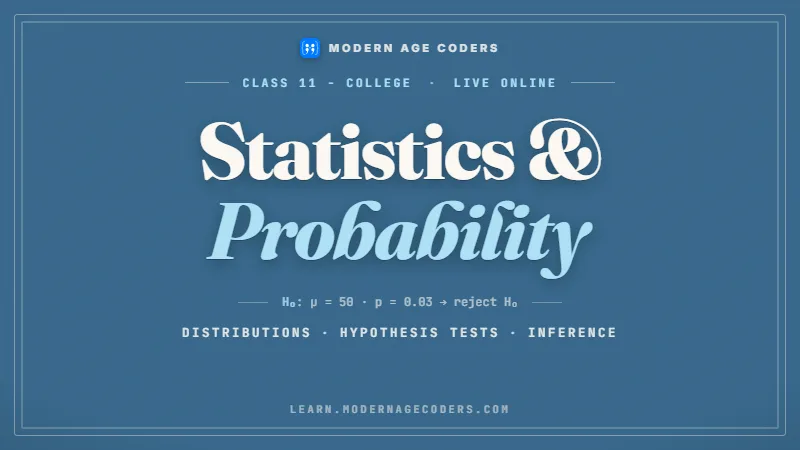
YTMP / 03
Probability rules and data handling, the strand Methods returns to in both Year 11 and Year 12.
Open the syllabus →What Methods assumes
These points are quoted from the VCE Mathematics Study Design, accredited from 2023, linked from VCAA's Mathematical Methods page and read on 7 October 2026.
| Topic | What the study design says |
|---|---|
| Entry | "There are no prerequisites for entry to Units 1, 2 and 3" |
| Assumed background | Students in Mathematical Methods Units 1 and 2 "are assumed to have a sound background in number, algebra, function, geometry, probability and statistics" |
| What the study covers | "simple elementary functions, transformations and combinations of these functions, algebra, calculus, probability and statistics, and their applications" |
| Sequence | Units 1 and 2 cover "assumed key knowledge and key skills as preparation for Units 3 and 4" |
| Time | Each unit involves at least 50 hours of scheduled classroom instruction |
| Specialist link | Specialist Mathematics Units 3 and 4 assume current enrolment in, or completion of, Mathematical Methods Units 3 and 4 |
Read the assumed background line carefully: number, algebra, function, geometry, probability and statistics. That is effectively a checklist for Year 10. A student who is shaky on any of the six will meet it again early in Units 1 and 2, usually at speed.
The phrase "combinations of these functions" in the study's description is worth noticing too. Combining functions, by adding them, multiplying them or feeding one into another, is a central idea in Methods, and it is the subject of the lesson further down this page.
VCAA designs Units 1 to 4 as a sequence. Units 1 and 2 are not a separate course students can skim through; they deliberately lay down what Units 3 and 4 rely on, and the final examinations can draw on it.
For students also considering Specialist Mathematics, the dependence runs one way: Specialist Units 3 and 4 assume Methods Units 3 and 4. Our guide to choosing computing subjects covers the computing side of senior choices.
Sources: VCAA, VCE Mathematical Methods and its linked 2023 Mathematics Study Design. Checked on 7 October 2026.
How VCE Methods is assessed
The weightings and exam rules below are from the VCE Mathematics Study Design and VCAA's 2026 examination timetable, checked on 7 October 2026.
| Component | Weighting | Notes |
|---|---|---|
| Unit 3 School-assessed Coursework | 20% | Set and marked by the school |
| Unit 4 School-assessed Coursework | 20% | Set and marked by the school |
| Units 3 and 4 Examination 1 | 20% | Technology-free; 2026 sitting Thursday 5 November, 9:00 to 10:15 am including reading |
| Units 3 and 4 Examination 2 | 40% | Assumes VCAA-approved technology; 2026 sitting Friday 6 November, 11:45 am to 2:00 pm including reading |
Examination 1 is technology-free, which is the single strongest argument for working on algebra in Year 10. Every manipulation in that paper is done by hand, under time pressure, and the marks go to students for whom expanding and factorising is automatic.
Examination 2 carries the largest single weighting at 40% and assumes access to approved technology. It rewards students who understand what their calculator output means and can interpret it in context, not just produce it.
Coursework in Units 3 and 4 adds another 40% between them. Schools design those tasks, and they are the student's own work. We teach mathematics with our own problems and never help with a task a school will mark.
At the end of Units 3 and 4, VCAA reports a study score on a scale of 0 to 50, measuring how a student performed relative to everyone else who took the study. Like any rank, it cannot honestly be promised by anyone.
Sources: VCAA 2023 Mathematics Study Design (assessment); VCAA 2026 VCE examination timetable. Checked on 7 October 2026.
The NSW route
NSW does not use the name Methods; its calculus-based course is Mathematics Advanced. The Year 7 to 10 structure that leads there is described in the Mathematics K-10 Syllabus (2022), read on 7 October 2026.
| Path outcome group | Why it matters for Advanced |
|---|---|
| Further algebra and equations | The algebra every Advanced topic relies on |
| Variation and rates of change | The idea underneath the derivative |
| Functions and graphs | The language of Year 11 Advanced |
| Further trigonometry | A head start on the trigonometric functions |
| Further probability | Groundwork for random variables in Year 12 |
The syllabus describes a Core that typically covers learning up to the middle of Stage 5, with Paths that teachers program "as appropriate to the needs of the students by the end of Stage 5". It also states that "The Core outcomes and content provide students with the foundation for Mathematics Standard 11-12."
The implication for a student aiming at Advanced is clear: the Paths content, especially further algebra, functions and graphs, is where the preparation happens. The right-hand column of the table above is our reading of how each group connects; the group names are NESA's.
The Paths also include further area and volume, geometrical figures and proof, introduction to networks and data analysis and statistical enquiry. They are all useful; the five in the table are the ones we prioritise for a student heading into Advanced.
NESA notes that the Core-Paths structure is not meant to lock students into a pathway at the end of Stage 4. A student who has missed some Paths content can catch up in Year 10, and that is often where our lessons begin. Our Year 11 mathematics page picks up from there.
Source: NSW Curriculum, Mathematics K-10 Syllabus (2022), course overview. Checked on 7 October 2026.
Combinations of functions
Feeding one function into another is a core Methods idea, and new students often assume the order does not matter. A small table settles it.
A worked lesson, written by us. Let f(x) = x + 3 and g(x) = x squared. The composite f(g(x)) means "square first, then add 3"; the composite g(f(x)) means "add 3 first, then square".
| x | f(g(x)) = x squared + 3 | g(f(x)) = (x + 3) squared | Equal? |
|---|---|---|---|
| -2 | 7 | 1 | No |
| -1 | 4 | 4 | Yes |
| 0 | 3 | 9 | No |
| 2 | 7 | 25 | No |
| 5 | 28 | 64 | No |
The two composites agree at exactly one value. Expanding gives f(g(x)) = x squared + 3 and g(f(x)) = x squared + 6x + 9. Setting them equal leaves 6x + 6 = 0, so x = -1, which matches the table. Everywhere else, the order changes the answer.
The lesson for Year 10 is the habit, not the result: read a composite from the inside out, work out which function acts first, and test a value or two before trusting any algebra. The same habit prevents errors with transformations of graphs later on.
Programmers meet the same idea constantly. Calling one function on the result of another is composition, and swapping the order of two steps in a data pipeline usually changes the output. Students who code can write f and g in Python and print both composites for a range of x in a few lines.
Function notation itself, f(x), is the other hurdle. Students who are comfortable reading f(2) as "the output when the input is 2" find Methods far less foreign. We spend real time on that reading skill in Year 10.
A Year 10 plan
Our teaching order for a student heading into Methods or Advanced. Schools teach in their own sequence; this sits alongside it.
| Step | Focus | The sign it is done |
|---|---|---|
| 1 | Algebra by hand | Factorises a quadratic in under a minute with no calculator |
| 2 | Function notation | Reads f(a + 1) correctly and evaluates it |
| 3 | Graphs as information | States intercepts and turning points from an equation |
| 4 | Probability | Uses tree diagrams and complements confidently |
That is normal and fixable. The usual cause is an algebra gap from Year 8 or 9, and closing it changes everything else.
A student finding Year 10 tough is not ruled out of Methods; they just need the base built before the senior course starts.
Students racing ahead can try competition problems; the competitions calendar lists maths contests by month.
Learning to code alongside maths is another stretch; our AI classes for teens pair well with senior mathematics.
The catalogue
Grouped by what they build. Each card opens a full syllabus.
YTMP / B / 01
The by-hand algebra Examination 1 demands.
Open the syllabusYTMP / B / 02
For rebuilding Year 8 and Year 9 gaps.
Open the syllabusYTMP / B / 03
Probability and data, part of the assumed background.
Open the syllabusYTMP / S / 01
Functions, graphs, trigonometry and a first derivative.
Open the syllabusYTMP / S / 02
Written for the US AP exam; useful for strong students curious about derivatives early.
Open the syllabusYTMP / S / 03
An international senior course with similar foundations.
Open the syllabusYTMP / E / 01
Harder problems for curious students.
Open the syllabusYTMP / E / 02
Functions and data explored in Python.
Open the syllabusYTMP / E / 03
Programming that pairs well with senior maths.
Open the syllabusPracticalities
Our tutors teach from India. Melbourne and Sydney are five and a half hours ahead of India time during daylight saving and four and a half hours ahead in winter; Brisbane stays four and a half hours ahead all year, and Perth two and a half. Australian after-school hours therefore fall comfortably in the Indian working day.
Weekday afternoons
One or two lessons a week through Year 10.
Weekend mornings
Longer sessions on algebra or functions.
Summer before Year 11
A focused bridge into the senior course.
Algebra is practised without a calculator, ready for a technology-free exam.
Function notation read aloud until it feels natural.
Every rule is tested on a number or two before it is trusted.
Five to ten Year 10 students at one level, each explaining aloud.
A private tutor for a specific gap.
We never promise a study score or a result.
Student work
Students' own projects, not school work. See more in the student labs.

AI and ML
An AI nutrition coach that reads what you eat and works you toward a target.

AI and ML
A chatbot that answers mathematics and programming questions, built and deployed by a student.

AI and ML
An assistant that helps a young person recognise unsafe situations online.

Web app
A weather forecasting site with live conditions for any location.
Fees
A monthly fee in US dollars, the same for all families outside India. Joining costs nothing, and only the current month is ever billed.
Free first class
USD 0
no card required
Group batch
USD 100
a month, billed in US dollars
One to one
USD 150
a month, billed in US dollars
What families say
Straight from Google, as students and parents wrote them.
★★★★★
"The one step solution for my son. Modern Age Coders make learning coding so simple that kids love it. The teachers explain complex concepts clearly with practical exercises and interactive content."
Ria Mukherjee
Parent
★★★★★
"Modern Age Coders has been a game-changer for me. I struggled to grasp IT concepts and coding before joining, but their classes transformed everything. I can now confidently write complex programs with ease."
Samriddha Mondal
Student
★★★★★
"One of the most wonderful education centres out there. Education is not limited to school syllabus but focuses on skill development."
Vansh Agarwal
Student
★★★★★
"My child Dhairya is really enjoying the Modern Age Coders classes. This is his first online class and he eagerly looks forward to it. I can already see his improvement, and the teachers are very cooperative."
Sonam Oswal
Parent of Dhairya
★★★★★
"Modern Age Coders have wonderful teachers who teach in a clear, easy and practical way. The teacher boosts students' confidence and inspires them to learn without hesitation."
Sonu Goyal
Parent
★★★★★
"I highly recommend this computer coding class! The teachers are incredibly knowledgeable and passionate about coding."
Ritu Kedia
Parent
Questions about Methods preparation
In Victoria, Mathematical Methods is the VCE calculus-based mathematics study, covering functions and their combinations, algebra, calculus, probability and statistics across Units 1 to 4.
VCAA says there are no prerequisites for entry to Units 1, 2 and 3, but students starting Methods Units 1 and 2 are assumed to have a sound background in number, algebra, function, geometry, probability and statistics.
For Units 3 and 4: school-assessed coursework worth 20% in each unit, Examination 1 worth 20% and Examination 2 worth 40%. Examination 1 is technology-free.
From the VCAA timetable: Examination 1 on Thursday 5 November 2026, 9:00 to 10:15 am, and Examination 2 on Friday 6 November 2026, 11:45 am to 2:00 pm, with reading time included.
NSW calls its calculus-based senior course Mathematics Advanced. In Years 9 and 10, the Stage 5 Paths of the Mathematics K-10 Syllabus (2022) build towards it.
A function made by feeding the output of one function into another, such as f(g(x)). The order matters: with f(x) = x + 3 and g(x) = x squared, f(g(2)) = 7 but g(f(2)) = 25.
Algebra by hand, function notation, reading graphs, and probability. Those match the background VCAA says Methods students are assumed to have.
VCAA states that enrolment in Specialist Mathematics Units 3 and 4 assumes current enrolment in, or completion of, Mathematical Methods Units 3 and 4.
No. A study score measures performance relative to everyone else that year, and nobody can honestly promise it.
We teach the shared mathematics any senior calculus course needs. For the details of a specific state's course, please check that state's curriculum authority.
Related pages
Senior mathematics in NSW, choosing subjects, and revision ahead.
The first year of senior maths in NSW.
The NSW calculus course, in full.
The computing side of senior choices.
Planning revision later on.
Help for any year and state.
Our method, plainly put.
Start here
Tell us the state, the senior course in mind and which topic feels shakiest. The free lesson works on it, usually starting with algebra.
Prefer to look first? Course outlines are on the course atlas, our method is on how we teach, and earlier numeracy is covered on our NAPLAN numeracy page.
WhatsApp us · +91 91233 66161 · connect@modernagecoders.com
For the quickest reply, use WhatsApp. The +91 number is Indian since we teach from India; there is no Australian office.
A priority demo is a full class of about 45 to 60 minutes. After the class the mentor sends a written skill report and a personal learning roadmap on WhatsApp. If you enrol, the demo fee is adjusted against your first month's fee. Share your demo Order ID with us on WhatsApp and we take it off.
Book a priority demo