Times tables that stay fluent, inside a proper maths course.
Times tables are not a separate subject. Our primary courses build them alongside place value, division and fractions, so recall is fast and the meaning behind it is secure.
 Start here
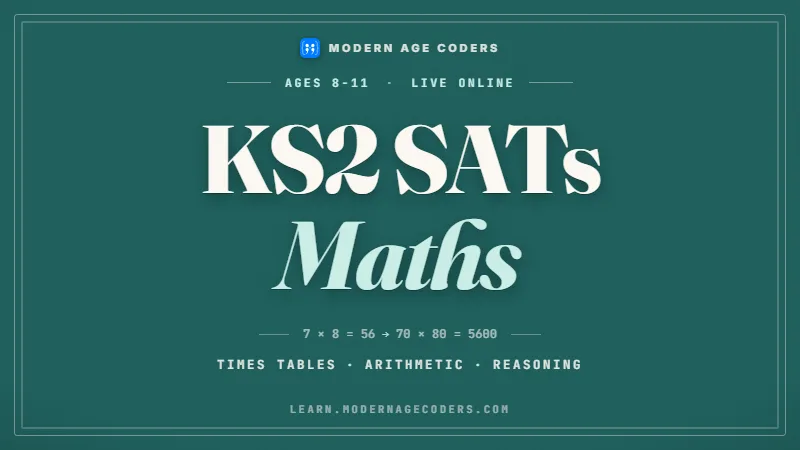
KS2 SATs Maths: Arithmetic, Reasoning and Times Tables
Year 6 SATs maths with times tables kept fluent: arithmetic, reasoning and the recall the check expects in Year 4.
$100/mo group · $150/mo one-to-one
View course and enrol
Elementary Maths, Years 1 to 6
Primary maths from Year 1 to Year 6: number, times tables, fractions and problem solving taught for understanding.
$100/mo group · $150/mo one-to-one
View course and enrol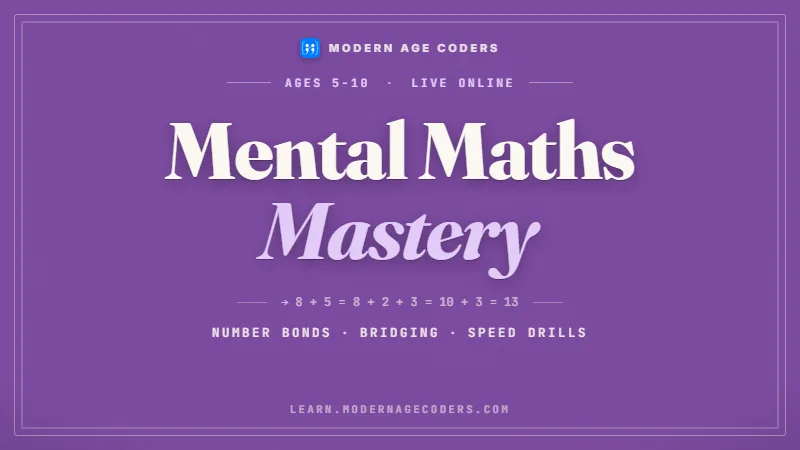
Mental Maths for Kids: Number Sense
Number sense and mental calculation for younger learners, the ground that quick times tables recall stands on.
$100/mo group · $150/mo one-to-one
View course and enrolFind your child, then follow the row.
| Your child now | What we would suggest | Start with |
|---|---|---|
| Year 3 or 4, slow on 6, 7, 8 and 9 times tables | Short daily recall practice plus the patterns that link the tables, so facts are remembered, not counted | KS2 SATs Maths, which practises in the check format in Year 4 |
| Knows the tables but freezes on a timer | Calm timed practice in small steps, building speed only after accuracy | Mental Maths for Kids |
| Year 5 or 6, tables fine, heading for SATs | Arithmetic and reasoning practice with times tables kept warm | KS2 SATs Maths |
| Younger child, ages 5 to 7 | Counting, number bonds and the 2, 5 and 10 times tables first | Mental Maths for Kids |
Five minutes on screen, one question at a time.
The check is taken on a computer or tablet at school. Each question looks the same, a multiplication such as 7 × 8 with a box for the answer, and the child types the number using the keyboard, a mouse with the on-screen number pad, or a touchscreen.
The 6 seconds start as soon as the question appears. Pressing enter moves on early; otherwise the answer on screen when time runs out is the one that counts. There is then a 3 second pause before the next question. Before the real check, children answer 3 practice questions.
The Standards and Testing Agency set the 6 second limit after trialling three limits with 1,124 pupils. Its aim is to allow time to recall an answer but not enough time to work it out.
The check at a glance
| Who takes it | Year 4 pupils in England |
|---|---|
| When | June; in 2027, a 2 week window from Monday 7 June |
| Questions | 25, worth one mark each |
| Time per question | 6 seconds |
| Practice questions | 3, before the check starts |
| Pass mark | None |
The check leans on the 6, 7, 8, 9 and 12 times tables.
Questions are drawn from the 121 facts that make up the 2 to 12 times tables. The 1 times table is left out of the real check. The assessment framework sets limits on how many questions each table can supply.
| Times table | Questions per check | Why |
|---|---|---|
| 6, 7, 8, 9, 12 | 2 to 4 each | Judged the most difficult tables, so they get the most weight |
| 3, 4, 5, 11 | 1 to 3 each | A steady share |
| 2 and 10 | 0 to 2 each | Key stage 1 tables, kept to a minimum |
The framework also keeps most of each check, 18 to 22 of the 25 questions, on tables taught in key stage 2, and a question and its reverse, such as 3 × 8 and 8 × 3, never appear in the same check. The table belongs to the first number: 4 × 12 counts as a 4 times table question.
A score out of 25, used to spot who needs help.
What the school gets
Every pupil's score out of 25 at the end of the window. The government says the purpose is to see whether a child can fluently recall the tables up to 12, and to help the school identify children who need extra support.
What parents get
Your child's teacher shares the score with you. There is no pass mark and no expected standard, so a score is information, not a verdict.
The national picture
In 2025 the national average score was 21.0, up from 20.6 in 2024, and 37% of eligible pupils scored full marks, the most common score. The share getting 25 has risen each year from 27% in 2022, when the check became statutory.
National figures from the Department for Education's "Multiplication tables check attainment" statistics for the 2024/25 academic year. Assessment arrangements are under review after the Curriculum and Assessment Review; the government says arrangements for 2026 to 2027 remain unchanged.
Recall beats counting, and recall is built in small daily doses.
Stuck on 7 × 8?
double it: 28 × 2 = 56
Knowing why 7 × 8 is 56 makes the fact stick. With practice the working fades and only the answer is left, which is what 6 seconds needs.
9 × 6 = ?
= 60 − 6 = 54
check: 5 + 4 = 9
For 9 × 2 up to 9 × 10, the digits of the answer add to 9. A child who sees the pattern stops fearing the nine times table.
12 × 7 = ?
2 × 7 = 14
70 + 14 = 84
Splitting 12 into 10 and 2 is the same idea as the written methods used later in key stage 2.
Little and often
Five to ten minutes a day does more than an hour at the weekend.
Accuracy first, then speed
Add a timer only once answers are reliably right without one.
Mix the order
The real check is not in table order, so practice should not be either.
Keep it calm
The government's own leaflet says parents do not need to do anything extra to prepare. Steady practice beats pressure.
Fluent recall, built on understanding, with a patient tutor.
In the first lesson the tutor asks a mix of times tables questions, watches which ones are recalled and which are counted out, and notes the tables that slow your child down. You see exactly which facts are secure.
Lessons then build the weak tables from facts your child already knows, with short timed rounds once accuracy is steady. Times tables sit inside a full primary maths course, so place value, division and fractions grow at the same time. Every lesson is live, after school or at weekends in UK time.
We never promise a grade or a score. Results depend on the starting point, the time available and the practice done between lessons, and we say so at the start.
"My son struggled with math for years. Integrating it into coding projects has transformed his understanding and confidence. Highly recommended!"
Shewta Singh, mother of Ishan · verified Google review
The multiplication tables check: what parents ask.
What is the Year 4 multiplication tables check?
An on-screen check taken by Year 4 pupils in England in June. It has 25 multiplication questions from the 2 to 12 times tables, with 6 seconds to answer each, and checks whether children can recall their times tables fluently.
When is the multiplication tables check in 2027?
Schools must give the check within the 2 week period from Monday 7 June 2027.
How long does the check take?
About 5 minutes on average, according to the Standards and Testing Agency.
Is there a pass mark for the multiplication tables check?
No. Schools receive a score out of 25 for each pupil, and there is no expected standard.
Which times tables are in the check?
The 2 to 12 times tables. The 6, 7, 8, 9 and 12 times tables get the most questions because they were judged the most difficult. The 1 times table is not in the real check.
Do I get my child's score?
Yes. Your child's teacher will share the score with you.
What happens if my child scores low?
The score helps the school spot children who need more support with times tables. There is no pass mark, so it is a starting point for help rather than a pass or fail.
Can my child practise the real check?
Schools have unlimited access to a "try it out" area from April so pupils can get used to the screen. At home, short daily practice of mixed questions helps most.
What was the average score in 2025?
The national average score was 21.0 out of 25, and 37% of eligible pupils scored full marks.
Can you help my child with times tables?
Yes. Book a Priority Demo: a full live class of about 45 to 60 minutes with a mentor reserved for your child. After the class the mentor sends a written skill report and a personal learning roadmap on WhatsApp.
Want to know which tables are secure?
In one live class a tutor checks recall across all the tables, shows you the ones that slow your child down and sets out a short daily plan. If you enrol, the demo fee is adjusted against your first month's fee.
Sources, read in October 2026.
- Standards and Testing Agency, Multiplication tables check: information for parents (September 2025).
- Standards and Testing Agency, Multiplication tables check assessment framework (updated 2022).
- Department for Education, Primary assessments: future dates (September 2026).
- Department for Education, Multiplication tables check attainment, academic year 2024/25 (Explore Education Statistics).