PMO / START / 01
Python and AI for Kids
For younger brothers and sisters, typed Python from 9.
Open the syllabusMönchengladbach · Python · Live online, in English
Online can mean a video you watch alone at midnight, or a person who watches you type and stops you when the loop goes wrong. Ours is the second kind. This page shows what one live Python lesson looks like from the inside, the four stages a learner in Mönchengladbach moves through, how that sits next to Informatik at NRW schools, and a real project on the city's own energy data in which two dates in the same row tell two quite different stories.
Live teaching since 2020 · 10,000+ students worldwide · a real mentor on the call, in English
The short answer
Modern Age Coders runs online Python classes for Mönchengladbach as live video lessons taught in English: a mentor shares a screen with the learner, watches the code being typed and corrects it on the spot. Teenagers from about 13 and adults start with typed Python, move to files and real data, then build their own projects, either in a group of 15 to 20 or alone with a mentor who matches your pace and accent.
Where Mönchengladbach learners start
One full course for school pupils, one for adults and university students, and one for teenagers who already know a little Python and want to work with data.

PMO / 01
From about 13. Variables, loops and functions first, then files, small games and data, at a pace the mentor sets with the group.
Open the syllabus →
PMO / 02
For adults, apprentices and students. From the first script to tested, organised code, with the kind of data files a job will hand you.
Open the syllabus →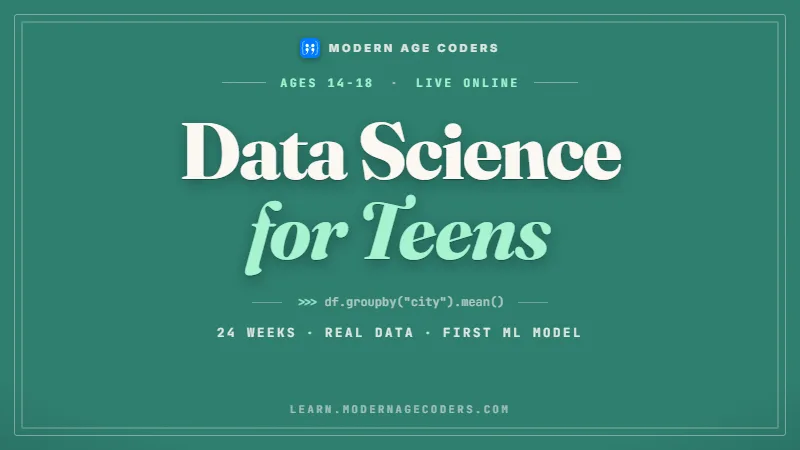
PMO / 03
For teenagers who can already write a loop. Real public data, careful counting, charts and a first look at models.
Open the syllabus →Live online, explained
Most people in Mönchengladbach who ask about online classes have tried a recorded course and stopped. The difference is a person who can see your screen.
The lesson opens on a video call. The mentor asks what happened with last week's exercise, and the learner shares their screen with the code still on it. If something did not run, that is where the lesson starts, because a mistake you made yourself teaches more than one in a slide.
Then the mentor sets the day's problem in plain English: one sentence, one goal, for example "count how many lines in this file mention solar".
The learner types; the mentor watches. When a learner writes a loop that never stops, the mentor does not fix it for them. They ask what the loop is waiting for. In a group, the mentor moves between learners and shares the most useful mistake with everyone.
The last minutes are for a small task to finish before next time, written down in the chat so nobody has to remember it.
| Question | Recorded video | Live group lesson | Live one to one |
|---|---|---|---|
| Who sees my code? | Nobody | The mentor, and the group when shared | The mentor, every line |
| When I am stuck | Pause and search | Ask straight away, or in the chat | Ask straight away |
| Who sets the pace? | The video | The mentor, for the group | You and the mentor |
| Who checks the homework? | Nobody | The mentor, next lesson | The mentor, next lesson |
| Language | Varies | English | English |
This comparison describes how Modern Age Coders teaches; it is our own summary, not a survey. Lessons are live online, given in English by India-based mentors, to groups of 15 to 20 or to one learner.
Because everything is on video, nothing about the lesson depends on where in Mönchengladbach you live, whether that is Rheydt, Wickrath or the Gladbach side of town, and nothing depends on a bus. What it does depend on is a laptop or desktop with a keyboard and a stable connection. A tablet will do for the first week, but typed Python is far easier with real keys.
Taught in English
English only, and we would rather you know that before the first class than after it.
Every lesson is taught in English by mentors based in India. We do not run German-language Python classes. If you need the teacher to explain in German, we are the wrong choice, and we say so.
Mentors slow down, rephrase and repeat, and they get used to the way you speak. A learner who answers in short sentences, or reaches for a German word, is understood and given the English one without fuss.
Keywords such as if, for, while, print and return are English words. Error messages are English too. Learning Python in English means the words on the screen and the words in the lesson are the same.
For pupils at a German school this has a second use: an hour of technical English each week, spoken rather than read. For adults in Mönchengladbach who work for international companies around Düsseldorf, English is often the language their code will be reviewed in anyway.
The Python path
Four stages, each one ending with something the learner has built and can explain. The times are typical, not promises; some move faster, some take longer, and both are fine.
| Stage | Typical length | Ends with |
|---|---|---|
| 1. Talking to the computer | About 4 to 6 weeks | A quiz program that keeps score |
| 2. Repeating and deciding | About 6 to 8 weeks | A game with functions and lists |
| 3. Files and real data | About 8 to 10 weeks | A counted answer from a public data file |
| 4. Your own project | Open ended | A program, a result and its limits, explained |
Stage lengths are our planning figures for two live lessons a week; they are not a guarantee. Learners who join with some Python start at the stage the mentor agrees with them in the first class.
School in NRW
NRW now teaches Informatik to every pupil early on, then lets it become optional. A private Python class works alongside that, never instead of it.
The Gesellschaft für Informatik records in its Informatik-Monitor 2026/27 that every general school type in Nordrhein-Westfalen teaches the compulsory subject Informatik in grades 5 and 6: "An allen allgemeinbildenden Schularten wird das Pflichtfach Informatik in den Jahrgangsstufen 5 und 6 unterrichtet."
After that, at a Gymnasium on the nine-year route, Informatik is one of the subjects pupils can choose in the Wahlpflicht area of grades 9 and 10.
In the Qualifikationsphase, NRW offers Informatik as a three-hour Grundkurs or a five-hour Leistungskurs, according to the same monitor. The written Abitur tasks are set centrally, and the monitor notes that no computer is used to answer them.
So a pupil can write excellent Python and still need to practise writing and tracing code on paper for the exam. We help with both, and the school course is the one that counts for the grade.
| What | When | Source |
|---|---|---|
| Christmas holidays | 23 December 2026 to 6 January 2027 | KMK Ferien 2026/2027 |
| Easter holidays | 22 March to 3 April 2027 | KMK Ferien 2026/2027 |
| Written Abitur, main dates | 13 April to 5 May 2027 | Schulministerium NRW |
| Abitur Mathematik | Wednesday 5 May 2027 | Schulministerium NRW, Anlage A |
| Summer holidays | 19 July to 31 August 2027 | KMK Ferien 2026/2027 |
Sources: Gesellschaft für Informatik, Informatik-Monitor 2026/27, Nordrhein-Westfalen page; Ministerium für Schule und Bildung NRW, Standardsicherung, Zentralabitur 2027 dates; Kultusministerkonferenz, Ferien 2026/2027 (Stand 09.10.2025). Read on 2 November 2026. We are not connected with the ministry, the KMK or any school.
Two contests run by Bundesweite Informatikwettbewerbe are open right now. Round 1 of the Bundeswettbewerb Informatik runs from 1 September to 23 November 2026, and the third round of the Jugendwettbewerb Informatik has its deadline on 23 November 2026. Both suit a pupil who has reached Stage 2 or 3. We teach with our own practice problems in the same spirit and never reproduce the organiser's tasks; the free archive is on the organiser's website.
A real Mönchengladbach project
Mönchengladbach's open data portal publishes the city's part of the Marktstammdatenregister, the national register of power and gas units, under a licence that allows reuse with attribution. Our Stage 3 learners use it to learn a habit that saves professionals from embarrassing charts.
The city's copy has 18,864 rows, every one in Mönchengladbach. In our count, 12,277 are solar units (energietrager "Solare Strahlungsenergie"), 6,413 are battery storage units and 14 are wind turbines. The register's own description calls it "das zentrale amtliche Register für Strom- und Gasanlagen in Deutschland" and says operators are legally obliged to register.
Each row has two dates that look alike: inbetriebnahmedatum, the day the unit was switched on, and registrierungsdatum, the day it was entered in the register.
How fast did solar grow in Mönchengladbach? A learner who picks the first date column they see might get one answer; a learner who picks the other gets a very different one.
The learner's file, mg_energy_units.csv, is the city's export as downloaded on 3 November 2026. The first program counts solar units per year by both dates side by side.
import csv

started, registered = {}, {}
with open("mg_energy_units.csv", encoding="utf-8-sig") as f:
    for row in csv.DictReader(f, delimiter=";"):
        if row["energietrager"] != "Solare Strahlungsenergie":
            continue
        start = row["inbetriebnahmedatum_der_einheit"][:4]
        signed_up = row["registrierungsdatum_der_einheit"][:4]
        started[start] = started.get(start, 0) + 1
        registered[signed_up] = registered.get(signed_up, 0) + 1

for year in ("2010", "2018", "2019", "2023", "2025"):
    print(year, " switched on:", started.get(year, 0), "  registered:", registered.get(year, 0))
It prints: 2010 switched on: 207 registered: 0, 2018 switched on: 87 registered: 0, 2019 switched on: 138 registered: 377, 2023 switched on: 2345 registered: 2237 and 2025 switched on: 2366 registered: 2402.
By registration date, Mönchengladbach had no solar at all in 2010 or 2018. That is obviously false: 207 units were switched on in 2010 alone. The register simply did not take entries before 2019, so every older unit was entered later, in a rush. In 2020, 302 solar units were switched on, but 1,506 were registered. A chart by registration date would show a spurious solar boom in 2020; a chart by switch-on date shows the real growth.
older = sum(n for year, n in started.items() if year != "" and year < "2019")
print("Solar units switched on before 2019:", older)
print("Units with no switch-on date yet:", started.get("", 0))
print("First registration year in the file:", min(registered))
running = 0
for year in sorted(y for y in started if y != ""):
    running += started[year]
    if year in ("2018", "2022", "2025"):
        print("Switched on by the end of", year, ":", running)
It prints: Solar units switched on before 2019: 1634, Units with no switch-on date yet: 156, First registration year in the file: 2019, Switched on by the end of 2018 : 1634, Switched on by the end of 2022 : 3242 and Switched on by the end of 2025 : 10420.
| Year | Switched on | Registered |
|---|---|---|
| 2010 | 207 | 0 |
| 2019 | 138 | 377 |
| 2020 | 302 | 1,506 |
| 2022 | 775 | 756 |
| 2023 | 2,345 | 2,237 |
| 2025 | 2,366 | 2,402 |
Data: Stadt Mönchengladbach open data portal, dataset Marktstammdatenregister (publisher Bundesnetzagentur, Marktstammdatenregister), licence Datenlizenz Deutschland Namensnennung 2.0, downloaded 3 November 2026. Counts are ours, solar units only, all operating states included. The 156 units with no switch-on date are listed as In Planung.
The answer the data supports is this: 1,634 solar units were running in Mönchengladbach by the end of 2018, 3,242 by the end of 2022 and 10,420 by the end of 2025, so more than two thirds of today's units were switched on in the last three full years. Since 2023 the two columns move together, because new units are registered when they are installed. The lesson is not about solar. It is that a column name is a promise you have to check: before you count, ask which event the date records.
Class times
The mentors teach from India, so a Mönchengladbach afternoon or evening lands in their evening. The rows below are examples to show the gap, not timetabled batches.
| Mönchengladbach time | India time, winter (until 28 March 2027) | India time, summer (from 28 March 2027) |
|---|---|---|
| 16:45 | 21:15 | 20:15 |
| 18:15 | 22:45 | 21:45 |
| Saturday 11:00 | 15:30 | 14:30 |
Clock rules: the Einheitenzeitgesetz fixes MEZ at UTC+1 in winter and MESZ at UTC+2 in summer. In 2026 the clocks went back on 25 October; in 2027 they go forward on 28 March. India stays on UTC+5:30 with no clock change, which puts it four and a half hours ahead of Mönchengladbach from late October to late March, and three and a half hours ahead the rest of the year.
You pick a slot in your own clock when you book, and the mentor sees it in theirs. Pupils often take the late afternoon after school; working adults tend to prefer a weekday evening or a Saturday morning. NRW school holidays do not stop the classes, though many learners pause for a family trip and pick up again afterwards.
Progress you can check
Our own checkpoints. The mentor uses them to place a new learner and to tell you honestly how things are going.
| Checkpoint | Typical point | The learner can |
|---|---|---|
| A. First program | Week 1 | Run a script, print text, store and change a variable |
| B. Decisions | Weeks 2 to 5 | Use if, elif and else to react to input |
| C. Loops and lists | Weeks 5 to 12 | Repeat work, keep a list and write a function |
| D. Files | Weeks 12 to 20 | Read a CSV file and count with a dictionary |
| E. Judgement | Weeks 20 onward | Say which column answers a question, and why |
Checkpoint E is the one the solar project trains. It is also the skill a teacher looks for when a pupil explains code on paper in an exam.
You will hear what was built and what was hard, not how many minutes were spent online.
Most adults reach checkpoint D in about four months of two lessons a week. That is the point where Python starts saving time at work.
If a week is lost to work or family, the mentor picks up where you are, not where the plan said you should be.
More Python and data
Each of these runs the same way as the three above: live, in English, and with a mentor you will get to know.
PMO / START / 01
For younger brothers and sisters, typed Python from 9.
Open the syllabusPMO / START / 02
Structured Python towards the Python Institute exams.
Open the syllabusPMO / START / 03
Support next to school Informatik, Klasse 5 to 10.
Open the syllabusPMO / DATA / 01
Spreadsheets, SQL and Python for real reports.
Open the syllabusPMO / DATA / 02
The maths behind every honest chart.
Open the syllabusPMO / DATA / 03
Analysis with familiar tools before any code.
Open the syllabusPMO / BUILD / 01
Django and Flask, from a form to a working site.
Open the syllabusPMO / BUILD / 02
Scripts that rename, fetch and tidy for you.
Open the syllabusPMO / BUILD / 03
For Oberstufe pupils, alongside the school course.
Open the syllabusThe weekly rhythm
Weekdays or weekends, flexible: choose your batch, or for a very personalised plan choose 1-on-1 at your convenience, weekend mornings or weekdays.
Late afternoon
After school in Mönchengladbach, for pupils.
Evening
After work, for adults on weekdays.
Saturday
A calm morning slot for either.
Each about an hour, with the same mentor.
The mentor sees every line you type.
One task, written in the chat.
Public data from your own city.
Rephrased until it is clear.
Fifteen to twenty, or just you.
Student work
Projects by our students elsewhere, shown as they made them. The student labs page collects more.

AI and ML
An AI nutrition coach that reads what you eat and works you toward a target.

AI and ML
A chatbot that answers mathematics and programming questions, built and deployed by a student.

AI and ML
An assistant that helps a young person recognise unsafe situations online.

Web app
A weather forecasting site with live conditions for any location.
Fees
You pay monthly for eight live lessons. We show the fee in euro, worked out at the European Central Bank reference rate, but the card payment itself is made in US dollars and your bank does the conversion, so your statement may show a slightly different euro amount.
Free first class
Free
no card required
Group batch
€90
a month, eight live classes, charged in US dollars
One to one
€134
a month, eight live classes, charged in US dollars
What families say
Google reviews from our students and parents, quoted word for word.
★★★★★
"The one step solution for my son. Modern Age Coders make learning coding so simple that kids love it. The teachers explain complex concepts clearly with practical exercises and interactive content."
Ria Mukherjee
Parent
★★★★★
"Modern Age Coders has been a game-changer for me. I struggled to grasp IT concepts and coding before joining, but their classes transformed everything. I can now confidently write complex programs with ease."
Samriddha Mondal
Student
★★★★★
"One of the most wonderful education centres out there. Education is not limited to school syllabus but focuses on skill development."
Vansh Agarwal
Student
★★★★★
"My child Dhairya is really enjoying the Modern Age Coders classes. This is his first online class and he eagerly looks forward to it. I can already see his improvement, and the teachers are very cooperative."
Sonam Oswal
Parent of Dhairya
★★★★★
"Modern Age Coders have wonderful teachers who teach in a clear, easy and practical way. The teacher boosts students' confidence and inspires them to learn without hesitation."
Sonu Goyal
Parent
★★★★★
"I highly recommend this computer coding class! The teachers are incredibly knowledgeable and passionate about coding."
Ritu Kedia
Parent
Mönchengladbach asks
No, never: our Python lessons are held live in English, and only in English, by mentors who work from India. They slow down, adjust to your accent and say things a second way when the first one did not land. Since Python keywords are English words, lesson and code share one language.
Not with us. Each lesson is a live video call with a mentor who sees your shared screen while you type, asks questions and corrects mistakes as they happen. Nothing is pre-recorded, and the homework is checked in the next lesson.
No. Stage 1 starts with print and variables. If you already know some Python, the free first class is used to find the right starting stage so you do not repeat what you know.
A laptop or desktop with a keyboard, a webcam or at least a microphone, and a stable internet connection. Python and the editor are free, and the mentor helps you install them in the first lesson.
Weekdays or weekends, flexible: choose your batch, or for a very personalised plan choose 1-on-1 at your convenience, weekend mornings or weekdays. Pupils often choose late afternoons, and adults often choose weekday evenings or Saturday mornings in Mönchengladbach time.
No. In NRW every pupil has Informatik in grades 5 and 6, and later it can be chosen as a Grundkurs or Leistungskurs. We teach alongside school; the school course is the one that counts for grades and the Abitur.
Adults are welcome. The Python Masterclass is built for adults, apprentices and university students, and one-to-one plans let you learn around shifts or family. Many adults learn Python to automate work with files and spreadsheets.
A group holds 15 to 20 learners who are at roughly the same stage. Anyone who prefers undivided attention can take the one-to-one plan instead: two private lessons each week, at slots agreed with the mentor.
In US dollars. The fees section displays each monthly plan in euro, converted with the ECB reference rate, so you can compare it easily; your card is then charged in dollars and your own bank turns that into euro, which can move the final figure by a little. Lesson one costs nothing.
An original project of ours on the Marktstammdatenregister data published by Stadt Mönchengladbach. Learners count 12,277 solar units by switch-on date and by registration date and find that registration only began in 2019, so the dates tell different stories.
Elsewhere on this site
More for Python learners in North Rhine-Westphalia.
Our page for the whole Land.
The Python path in more detail.
The NRW exam, explained.
Starting later, without fuss.
How we teach in the age of AI.
Our live lessons in detail.
Part of the guide: Coding classes in North Rhine-Westphalia
More guides: Coding classes in Lower Saxony · Coding classes in Land Bremen · Coding classes in Hesse · Coding classes in Bavaria · Coding classes in Saxony-Anhalt · Coding classes in Schleswig-Holstein · Coding classes in Baden-Württemberg · Coding classes in Saarland · Coding classes in Rhineland-Palatinate · Coding and maths in Berlin · Coding and maths in Hamburg · Coding classes in Saxony · Coding classes in Thuringia · Coding classes in Brandenburg · Coding classes in Mecklenburg-Vorpommern
Start here
During the free lesson you type and run a few lines of Python while the mentor watches the shared screen. Afterwards you get an honest view of where to begin and which of the courses above matches you.
Curious about the format first? How we teach walks through a lesson, and the course catalogue has each full syllabus.
WhatsApp us · +91 91233 66161 · connect@modernagecoders.com
All lessons are live on video, in English, with India-based mentors. A WhatsApp message gets the quickest reply.
A priority demo is a full class of about 45 to 60 minutes. After the class the mentor sends a written skill report and a personal learning roadmap on WhatsApp. If you enrol, the demo fee is adjusted against your first month's fee. Share your demo Order ID with us on WhatsApp and we take it off.
Book a priority demo