GLC / KIDS / 01
Scratch for kids
Complete beginners finish with their own games.
Open the syllabusBergisch Gladbach · Coding and AI · From 6 to adult
Most people who want to learn AI really want two things: to make a computer do useful work, and to understand the tools everyone now talks about. Both start in the same place, with writing small programs and checking what they do. This page is for learners of every age in Bergisch Gladbach: how to begin, a first data project on the town's own charging stations, what an NRW school already covers, and when live classes in English fit around school and work.
Live online since 2020 · 10,000+ students worldwide · code first, then AI you can check
In short
In Bergisch Gladbach, Modern Age Coders offers coding and AI lessons in English, taught live online for children from 6, teenagers and adults. Children build with Scratch and then Python; teenagers move to data and machine learning; adults learn Python, data handling and AI tools they can check. The same mentor, working from India, stays with each learner and follows their pace and accent, in a class of fifteen to twenty or one to one.
Good first courses
Chosen by age. Each one leads on to the AI courses once the coding basics are in place.

GLC / 01
Children of 9 to 12 write Python themselves, make games and pictures, and build tiny programs that learn from labelled examples.
Open the syllabus →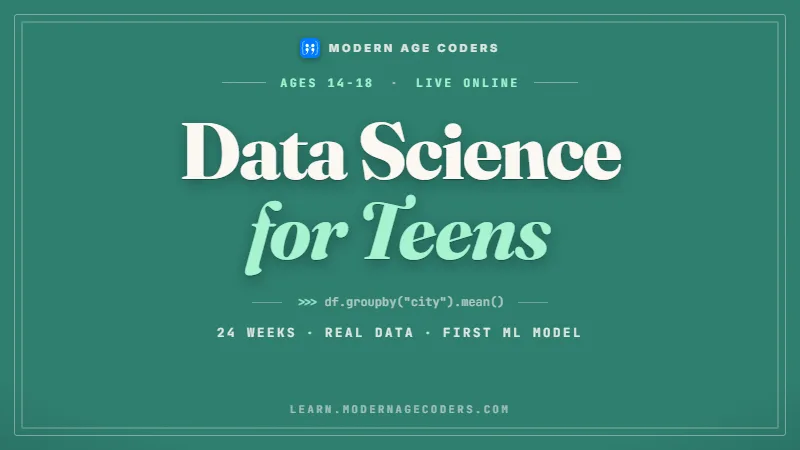
GLC / 02
Teenagers load real files, clean them, chart them and train a first model, which is where AI stops being magic.
Open the syllabus →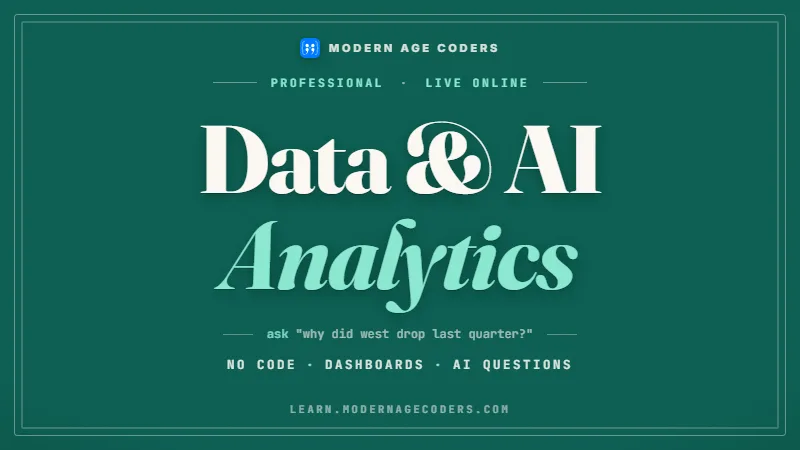
GLC / 03
Adults who work with spreadsheets learn to analyse data and use AI help safely, before deciding whether to go on to Python.
Open the syllabus →First steps
With a small program, not a chatbot. The four steps below are the same for a nine year old and a fifty year old; only the examples change.
Our own teaching order. Children spend months on steps 1 and 2; adults often reach step 3 within weeks. Step 4 is where AI becomes something the learner understands rather than something they only use.
AI tools are useful, and our adult courses use them. But a beginner who asks a chatbot for code cannot tell a correct answer from a confident wrong one. The habit we teach is to know what the answer should look like before asking anybody, human or machine.
There is also the law of the providers themselves: ChatGPT's terms set 13 as the minimum age, with a parent's permission until 18, and Claude's set 18. Our children's courses therefore need no AI account at all.
Classes are grouped by age and level: children with children, teenagers with teenagers, adults with adults. A family in Bergisch Gladbach can have three learners on three different courses, each with a mentor who knows them.
Everyone writes their own code in class. Watching someone else type is not learning to program, so the mentor's job is to ask the next question, not to do the typing.
Age limits as quoted from the providers' terms in our AI tools age guide, where each one is dated and linked.
A Bergisch Gladbach data project
The Bundesnetzagentur keeps a public register of charging stations for electric cars and lets anyone reuse it under CC BY 4.0. With the 140 stations listed for Bergisch Gladbach, learners discover that the average they reach for first describes no station that exists.
The register file is dated 1 September 2026; we downloaded it on 3 November 2026. It covers stations whose operators have finished the Bundesnetzagentur's reporting procedure, so the real number in town may be higher.
We kept the 140 rows whose place is Bergisch Gladbach, all in operation, with 267 charging points between them, and saved the useful columns as bergisch_gladbach_charging.csv. The column we study is the rated power of each station, in kilowatts.
If a friend asks what a typical charging station in Bergisch Gladbach looks like, what number should you give? Most people compute the mean. The program below does that, and then checks how many stations actually have that power.
The answer to the check is the lesson. A good summary should describe something real.
import csv

with open("bergisch_gladbach_charging.csv", encoding="utf-8") as f:
    sites = list(csv.DictReader(f))

power = [float(s["kw"]) for s in sites]
print("Stations:", len(power))
print("Mean power:", round(sum(power) / len(power), 1), "kW")

tally = {}
for kw in power:
    tally[kw] = tally.get(kw, 0) + 1
print("Stations at the mean power:", tally.get(round(sum(power) / len(power), 1), 0))

ranked = sorted(tally.items(), key=lambda pair: pair[1], reverse=True)
for kw, n in ranked[:4]:
    print(f"{kw:g} kW: {n} stations")
It prints Stations: 140, Mean power: 48.8 kW, Stations at the mean power: 0, then 44 kW: 55 stations, 22 kW: 49 stations, 11 kW: 14 stations and 150 kW: 6 stations.
Not a single station has 48.8 kilowatts. Charging hardware is sold in standard sizes, so the values bunch at a few numbers: 44 kilowatts is the most common rating, with 55 stations, closely followed by 22 kilowatts with 49. The mean is pulled upwards by a handful of fast chargers rated at 150 kilowatts or more, and lands in a gap where nothing is installed. For data like this, the most common value, called the mode, is the honest answer to "what is typical?". The median, the middle value of the sorted list, is also 44 kilowatts here.
by_year = {}
for s in sites:
    year = s["since"][-4:]
    by_year.setdefault(year, {})
    kw = float(s["kw"])
    by_year[year][kw] = by_year[year].get(kw, 0) + 1

for year in sorted(by_year):
    counts = by_year[year]
    top = max(counts.values())
    modes = sorted(kw for kw, n in counts.items() if n == top)
    print(year, sum(counts.values()), "stations, most common:", ", ".join(f"{m:g} kW" for m in modes), f"({top})")
It prints one line per year, for example 2022 21 stations, most common: 44 kW (10), 2020 2 stations, most common: 22 kW, 350 kW (1) and 2026 41 stations, most common: 22 kW (25).
| Year | Stations | Most common rating | Stations at that rating |
|---|---|---|---|
| 2021 | 13 | 22 kW | 6 |
| 2022 | 21 | 44 kW | 10 |
| 2023 | 14 | 44 kW | 6 |
| 2024 | 16 | 11 kW | 6 |
| 2025 | 26 | 44 kW | 15 |
| 2026, to 1 September | 41 | 22 kW | 25 |
Source of the rows: the Bundesnetzagentur charging register (Ladesäulenregister) as published for 1 September 2026, filtered by us to the place name Bergisch Gladbach and fetched on 3 November 2026; reused under CC BY 4.0, credit Bundesnetzagentur.de. Each year before 2021 has between one and three stations. Tallies by us.
Two details reward a careful reader. In 2020 two stations went into service, one at 22 and one at 350 kilowatts, so there are two modes and Version 2 prints both rather than pretending one wins. And 2026 is not over: the 41 stations counted for it stop at 1 September, already more than any earlier full year in the file.
Here is the link to AI. Imagine a model whose job is to predict the rating of the next station from its address. The laziest possible model ignores the address and always answers 44 kilowatts, the mode, and it would be right for 55 of 140 stations, about 39 percent of the time. Any real model has to beat that score before it has learned anything. Machine learners call this a baseline, and it is the first number our teenage and adult learners calculate in every project.
NRW schools
Two compulsory years early on, then whatever a pupil chooses. Bergisch Gladbach follows the North Rhine-Westphalia rules.
| Stage | Informatik | What we can add |
|---|---|---|
| Grundschule, grades 1 to 4 | No subject of its own | Scratch and logic puzzles from age 6 |
| Grades 5 and 6 | Compulsory at every general school | Typed Python alongside the school basics |
| Grades 9 and 10 at a G9 Gymnasium | A Wahlpflicht option | Data projects and contest practice |
| Qualifikationsphase | Optional, as a three-hour basic course or a five-hour advanced course | Abitur support in English, with paper tracing |
| Written Abitur | Set centrally, answered without a computer | Practice in reading and writing code by hand |
Source: Gesellschaft für Informatik, Informatik-Monitor 2026/27, North Rhine-Westphalia page, read on 2 November 2026. Written NRW Abitur exams in 2027 run from 13 April to 5 May and each starts at 9:00 (Ministerium für Schule und Bildung NRW). The right-hand column is ours.
Across all sixteen Länder, the monitor puts the share of Oberstufe pupils who keep Informatik into the Qualifikationsphase at roughly one in seven. We work alongside school, never replacing it, and marks and the Abitur are decided only by the school. Pupils who take the subject can follow it in English with our Informatik Abitur course in Java and Python.
For a project outside school, Jugend forscht accepts entries in mathematics and informatics from grade 4 up to age 21: pupils up to 14 enter Jugend forscht junior, those from 15 to 21 the main contest, and online registration for the coming round closes on 30 November. Our competitions calendar lists the others. We are not connected with any of them.
Class times
Pupils mostly come after school, adults after work, and both often at weekends. The mentor's clock in India runs several hours ahead.
| Bergisch Gladbach | In India this winter | In India from 28 March 2027 |
|---|---|---|
| 15:15 | 19:45 | 18:45 |
| 17:45 | 22:15 | 21:15 |
| Saturday 13:00 | 17:30 | 16:30 |
| Sunday 09:00 | 13:30 | 12:30 |
Germany switched back to Central European Time (UTC+1) on 25 October 2026 and moves to summer time (UTC+2) on 28 March 2027, as the Einheitenzeitgesetz provides; India keeps UTC+5:30 throughout. These four slots only illustrate the gap.
School breaks in NRW for 2026/27, per the Kultusministerkonferenz: two weeks in autumn ending on 31 October 2026, a Christmas break from 23 December 2026 that runs into 6 January 2027, Easter from 22 March 2027 up to 3 April, one free day on 18 May 2027, and six summer weeks from 19 July to 31 August 2027. Classes go on during the holidays for those who want them. Learners join from all parts of Bergisch Gladbach and from nearby Cologne, Leverkusen, Overath, Rösrath, Odenthal and Kürten.
Progress
Our own scale, the same for every age, so a learner always knows what the next step is.
| Stage | Often reached | Shown by |
|---|---|---|
| Follows exact steps | First weeks | Predicting what a short program will do |
| Repeats and decides | First months | A game or script with loops and conditions |
| Summarises data | Months 3 to 5 | Choosing mean, median or mode and saying why |
| Beats a baseline | Months 5 to 9 | A model that scores better than the lazy guess |
| Builds and explains | Later | A project someone else can run and question |
The third stage is the charging station project. A child who asks whether a typical value really exists will read school charts differently.
Reports describe what your child built and could explain.
Before you report an average, check whether anything in the data actually has that value.
When someone shows you an AI model's accuracy, ask what the lazy guess would score.
Next steps
Live, in English, with the same mentor throughout, as a class or as private lessons.
GLC / KIDS / 01
Complete beginners finish with their own games.
Open the syllabusGLC / KIDS / 02
A project built to a deadline, 8 to 12.
Open the syllabusGLC / KIDS / 03
Averages, patterns and puzzles in Python.
Open the syllabusGLC / TEEN / 01
Models that have to beat a baseline.
Open the syllabusGLC / TEEN / 02
Using AI well from 13, with checks.
Open the syllabusGLC / TEEN / 03
School Informatik in English, Klasse 5 to 10.
Open the syllabusGLC / ADULT / 01
Let scripts do the repetitive work.
Open the syllabusGLC / ADULT / 02
Mean, median, mode and much more.
Open the syllabusGLC / ADULT / 03
Language models, retrieval and agents.
Open the syllabusHow it runs
Weekdays or weekends, flexible: choose your batch, or for a very personalised plan choose 1-on-1 at your convenience, weekend mornings or weekdays.
School days
Afternoon classes for pupils.
Work days
Evening classes for adults.
Private plan
Your own slot, any day, agreed with the mentor.
No watching; the learner types.
Every model meets the lazy guess first.
Explained again, more simply, when needed.
The same person for the whole course.
Children, teens and adults learn separately.
A class of fifteen to twenty, or private.
Student work
Work by our students from many countries; the student labs page has the full collection.

AI and ML
An AI nutrition coach that reads what you eat and works you toward a target.

AI and ML
A chatbot that answers mathematics and programming questions, built and deployed by a student.

AI and ML
An assistant that helps a young person recognise unsafe situations online.

Web app
A weather forecasting site with live conditions for any location.
Fees
Each month's fee includes eight live classes. On this page it is shown in euro, worked out at the European Central Bank reference rate; the actual payment is made in US dollars and converted by your bank, so the euro amount it books may vary a little.
Free first class
Free
no card required
Group batch
€90
a month, eight live classes, charged in US dollars
One to one
€134
a month, eight live classes, charged in US dollars
What families say
Unedited Google reviews from our students and their families.
★★★★★
"The one step solution for my son. Modern Age Coders make learning coding so simple that kids love it. The teachers explain complex concepts clearly with practical exercises and interactive content."
Ria Mukherjee
Parent
★★★★★
"Modern Age Coders has been a game-changer for me. I struggled to grasp IT concepts and coding before joining, but their classes transformed everything. I can now confidently write complex programs with ease."
Samriddha Mondal
Student
★★★★★
"One of the most wonderful education centres out there. Education is not limited to school syllabus but focuses on skill development."
Vansh Agarwal
Student
★★★★★
"My child Dhairya is really enjoying the Modern Age Coders classes. This is his first online class and he eagerly looks forward to it. I can already see his improvement, and the teachers are very cooperative."
Sonam Oswal
Parent of Dhairya
★★★★★
"Modern Age Coders have wonderful teachers who teach in a clear, easy and practical way. The teacher boosts students' confidence and inspires them to learn without hesitation."
Sonu Goyal
Parent
★★★★★
"I highly recommend this computer coding class! The teachers are incredibly knowledgeable and passionate about coding."
Ritu Kedia
Parent
Bergisch Gladbach learners ask
No. All teaching is in English and live. Mentors follow the learner's pace and accent and explain again in simpler words when needed. The code itself is written in English keywords in any case.
Coding first, for a short while. A few weeks of small programs teach you to check what a computer gives back, which is exactly the skill you need to use AI tools well and to build models of your own.
From 6 with Scratch blocks. Most children move to typed Python at about 9 and to data projects such as the charging station exercise from about 10.
Informatik is compulsory in grades 5 and 6 at every general NRW school, according to the Gesellschaft für Informatik. From grade 7 the subject is a choice, and in the final two school years only around one pupil in seven in Germany still takes it.
OpenAI's terms allow ChatGPT from 13, with a parent's consent until 18, and we keep to that. Claude is for adults only under Anthropic's terms, so it appears only in adult courses.
Weekdays or weekends, flexible: choose your batch, or for a very personalised plan choose 1-on-1 at your convenience, weekend mornings or weekdays. Pupils usually come after school and adults in the early evening.
In India, teaching live online. A 16:00 class in Bergisch Gladbach is 20:30 for the mentor this winter; once German clocks go forward on 28 March 2027 the difference shrinks to three and a half hours.
Monthly, by card or bank. The page shows euro calculated from the European Central Bank reference rate, the payment itself is in US dollars, and your bank converts it, so the booked amount can differ a little.
The mode is the most common value. In the charging data it is 44 kilowatts, while the mean of 48.8 matches no station. A model that always predicts the mode is the simplest baseline, and every real model must beat it.
Yes, in separate classes by age, often with first classes booked on the same day.
Elsewhere on this site
Further reading for Bergisch Gladbach learners.
Our national overview and city list.
Informatik and holidays across the Land.
AI for pupils, explained for parents.
Which course fits which age.
Our page for the city next door.
Inside one of our live classes.
Part of the guide: Coding classes in North Rhine-Westphalia
More guides: Coding classes in Lower Saxony · Coding classes in Land Bremen · Coding classes in Hesse · Coding classes in Bavaria · Coding classes in Saxony-Anhalt · Coding classes in Schleswig-Holstein · Coding classes in Baden-Württemberg · Coding classes in Saarland · Coding classes in Rhineland-Palatinate · Coding and maths in Berlin · Coding and maths in Hamburg · Coding classes in Saxony · Coding classes in Thuringia · Coding classes in Brandenburg · Coding classes in Mecklenburg-Vorpommern
Start here
Let us know the learner's age and one thing they hope to build. In the free class the mentor sets a starter task at the right level, sees how the learner works and how easy English feels, and recommends a course.
More background: how we teach and all courses.
WhatsApp us · +91 91233 66161 · connect@modernagecoders.com
Lessons are live online, in English only, with mentors in India. You can reach us fastest on WhatsApp, in English.
A priority demo is a full class of about 45 to 60 minutes. After the class the mentor sends a written skill report and a personal learning roadmap on WhatsApp. If you enrol, the demo fee is adjusted against your first month's fee. Share your demo Order ID with us on WhatsApp and we take it off.
Book a priority demo