UK / MB1 / 01
Coding for kids
Blocks, MakeCode and a simulated micro:bit.
Open the syllabusUK · Ages 9 to 13 · Physical computing
If your child is in primary school in the UK, there is a good chance they have held a BBC micro:bit. In 2023 the BBC, the Micro:bit Educational Foundation and Nominet offered a free class set of 30 to every primary school, almost 700,000 devices, and nearly 20,000 schools signed up. Most children meet it through Microsoft MakeCode, whose colour-coded blocks, the Foundation notes, "are familiar to anyone who's previously used Scratch". What fewer families know is that the same little board also runs Python. The Foundation's own Python editor had over a million uses in its first year, and the Foundation calls Python "a great way to deepen your programming skills through text-based coding". So the step from blocks to real, typed code can start on a device your child already understands. This page explains that step, and the one after it.
Live teaching since 2020 · 10,000+ students · Built on the Micro:bit Educational Foundation's published material
In short
The BBC micro:bit is a pocket-sized programmable board from the Micro:bit Educational Foundation, a non-profit. In 2023 the BBC micro:bit the next gen campaign offered every UK primary school a free class set of 30, almost 700,000 devices funded by Nominet, and nearly 20,000 schools signed up. Children usually program it with Microsoft MakeCode blocks, which feel like Scratch and can switch to show JavaScript. The board also runs Python through the Foundation's own Python editor, which had over a million uses in its first year. That makes the micro:bit a gentle bridge from blocks to typed code: the same sensors, buttons and display, driven by text instead of blocks. After that, Python on a computer opens up bigger programs, data and games. Modern Age Coders teaches that next step in live Python lessons. We do not run a micro:bit course or sell boards. The first lesson is free, then USD 100 a month in a group or USD 150 one to one.
Start here
Python first, blocks for the younger, and data for the curious. Each card opens its syllabus.
MB / 01
Typed Python for ages 10 to 13, the language the micro:bit can already run.
Open the syllabus →
MB / 02
For younger children: Scratch, MakeCode arcade and inventions on a simulated micro:bit, before typing.
Open the syllabus →
MB / 03
For teenagers who enjoyed logging sensor data and want to analyse real datasets.
Open the syllabus →The board at school
From the Micro:bit Educational Foundation's announcements and its review of 2023.
| Fact | Detail |
|---|---|
| The campaign | BBC micro:bit the next gen, announced 15 May 2023 by BBC Education, the Foundation and Nominet |
| The offer | A free class set of 30 micro:bits and teaching resources for every UK primary school |
| Devices | Almost 700,000, funded by Nominet |
| Take-up | Nearly 20,000 UK primary schools signed up for kits |
| Delivery | Between September 2023 and March 2024 |
| Worldwide | 73.5 million children have learnt with micro:bit, in more than 85 countries |
The micro:bit has buttons, a small grid of lights, and sensors that detect movement, temperature, light and sound, plus a radio that lets boards talk to each other. That is why children love it: code does something visible and physical straight away. The Foundation reports that in the UK, "88% of students taught with micro:bit say computing and technology is more fun than other subjects", a survey finding worth reading as enthusiasm rather than proof of learning.
Microsoft MakeCode, with blocks that snap together much like Scratch. It is a very good start.
MakeCode can also switch to JavaScript to show the text behind the blocks, a first glimpse of typed code.
Run Python, written in the Foundation's own Python editor, using the same buttons, lights and sensors.
That means the move to typed code does not need new equipment, just a new way of instructing a familiar device.
Source: the Micro:bit Educational Foundation About page and Code page, its news post of 15 May 2023 announcing the campaign, and its review of 2023 published on 11 January 2024. We have no connection with the Foundation, the BBC or Nominet.
Blocks to Python
Why the micro:bit makes the jump to typed code smaller than it looks.
The Foundation describes Python as easy to start because of its "natural English-like structure", and says its Python editor "is designed to help teachers and learners get the most out of text-based programming on the micro:bit". The important thing for a child is continuity. A program that shows a heart when button A is pressed, or counts steps using the accelerometer, can be rebuilt in Python line by line. The idea is already understood; only the way of expressing it changes.
| Idea met in MakeCode | What changes in Python |
|---|---|
| On button A pressed | An if-statement checking the button, inside a loop that runs forever |
| Show icon, show number | Calling functions by name, with brackets and exact spelling |
| Variables for a score or count | Named variables, typed and updated in text |
| Forever loop | A while loop, with indentation that matters |
| Radio send and receive | Messages sent and read in code, as text or numbers |
Start by rewriting a project the child already made in blocks. Familiar behaviour makes the new syntax far less frightening.
Typed code produces error messages. Learning to read them calmly is the single biggest new skill, and the board gives quick feedback.
MakeCode's JavaScript view shows text behind blocks. Some children like seeing it before switching; it is not required for Python.
Beyond the board
The micro:bit is a bridge, not a destination. Bigger programs need a full computer.
| On the micro:bit | On a computer |
|---|---|
| Small programs that react to buttons and sensors | Programs that grow over weeks, split into functions and files |
| A five-by-five light display | Full screens: games, drawings and windows |
| Sensor readings logged on the board | Real datasets analysed and charted |
| Messages between boards by radio | Programs that talk to websites and files |
The Foundation notes that Python is "powerful enough to be used in areas like data science and machine learning", and that is exactly where Python on a computer leads. A child who logged temperature readings on a micro:bit is one step from analysing a real dataset; one who made a reaction game is one step from a full game with graphics. Our lessons take that step on the computer, where programs can grow.
Live Python lessons in small groups, starting from what children built on the micro:bit and moving to programs on the computer.
Projects the children choose, with a teacher who reads their code and suggests what to try next.
A micro:bit course. We do not teach MicroPython on the board as a course, and we do not sell or ship micro:bits.
Connected with the BBC, the Foundation or Nominet. We describe the micro:bit from their published material.
At home
Many families buy one after a child enjoys it at school. Here is how to use it well alongside lessons.
| Idea | Why it helps |
|---|---|
| Try each new Python idea on the board | A button or light reacting to the child's own code makes an abstract idea concrete |
| Use the official editors | The Foundation's MakeCode and Python editors are free and designed for learners |
| Build something for the house | A doorbell, a plant-watering reminder or a step counter gives a real reason to finish |
| Keep it playful | The board works well as a toy that teaches, not as homework |
None of this requires lessons. The Foundation's free resources are excellent for home use. Lessons help when a child wants to go further than the resources lead, gets stuck on their own idea, or is ready to move from the board to bigger programs on a computer.
For children who love community clubs, see the page on life after Code Club; for Raspberry Pi computers, Raspberry Pi coding projects; and for the curriculum, Key Stage 2 coding and Key Stage 3 computing.
Progression
Placement follows what a child can build, which a first lesson shows quickly.
| Rung | Usually | What should be true |
|---|---|---|
| 1. Confident in blocks | Ages 8 to 10 | MakeCode projects with buttons, sensors, variables and loops, designed by the child |
| 2. First Python | Ages 10 to 12 | Familiar projects rebuilt in typed Python, errors read and fixed |
| 3. Python on the computer | Ages 11 to 13 | Programs with functions, lists and files that grow over several weeks |
| 4. A real project | Ages 12 and up | A game, data project or tool planned and finished, reviewed by a teacher |
Rebuilding a known project in Python is the gentlest way across. It works on the board or on screen.
The wider sequence of topics is on the coding roadmap.
A child who plans and finishes their own project has become a maker, not a follower.
From there, GCSE computing and beyond are a natural path.
The catalogue
Grouped by stage. The free lesson places each child.
UK / MB1 / 01
Blocks, MakeCode and a simulated micro:bit.
Open the syllabusUK / MB1 / 02
The first typed language, step by step.
Open the syllabusUK / MB1 / 03
For younger makers still in blocks.
Open the syllabusUK / MB2 / 01
Reaction games grown into real ones.
Open the syllabusUK / MB2 / 02
Number patterns and measurement, explored in programs.
Open the syllabusUK / MB2 / 03
Inventing, building and presenting a project.
Open the syllabusUK / MB3 / 01
Programs, files and apps in Python.
Open the syllabusUK / MB3 / 02
Real data, analysed and charted.
Open the syllabusUK / MB3 / 03
Where Python meets machine learning.
Open the syllabusHow lessons work
Teaching happens from India, which does not change its clocks, leaving the UK four and a half hours behind in summer and five and a half in winter. Every lesson is booked in UK time.
After school
Short, practical sessions for this age.
Early evening
Time to try code on a home board afterwards.
Weekend
Longer project sessions for keen makers.
Lessons begin from what a child built on the micro:bit at school or home.
Familiar projects rewritten in Python, then pushed further.
Error messages read together until they stop being scary.
A teacher reads every child's program and gives specific next steps.
Children choose projects; the teacher picks the skills each one needs.
Five to ten children at one level.
Student work
Four projects from lessons, each made by the children. More in student labs.
AI and ML
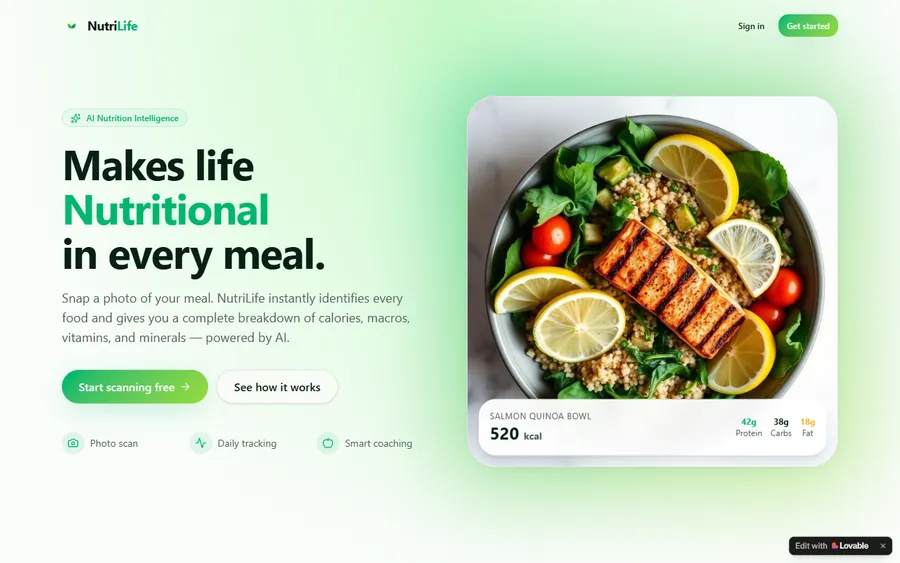
An AI nutrition coach that reads what you eat and works you toward a target.
AI and ML
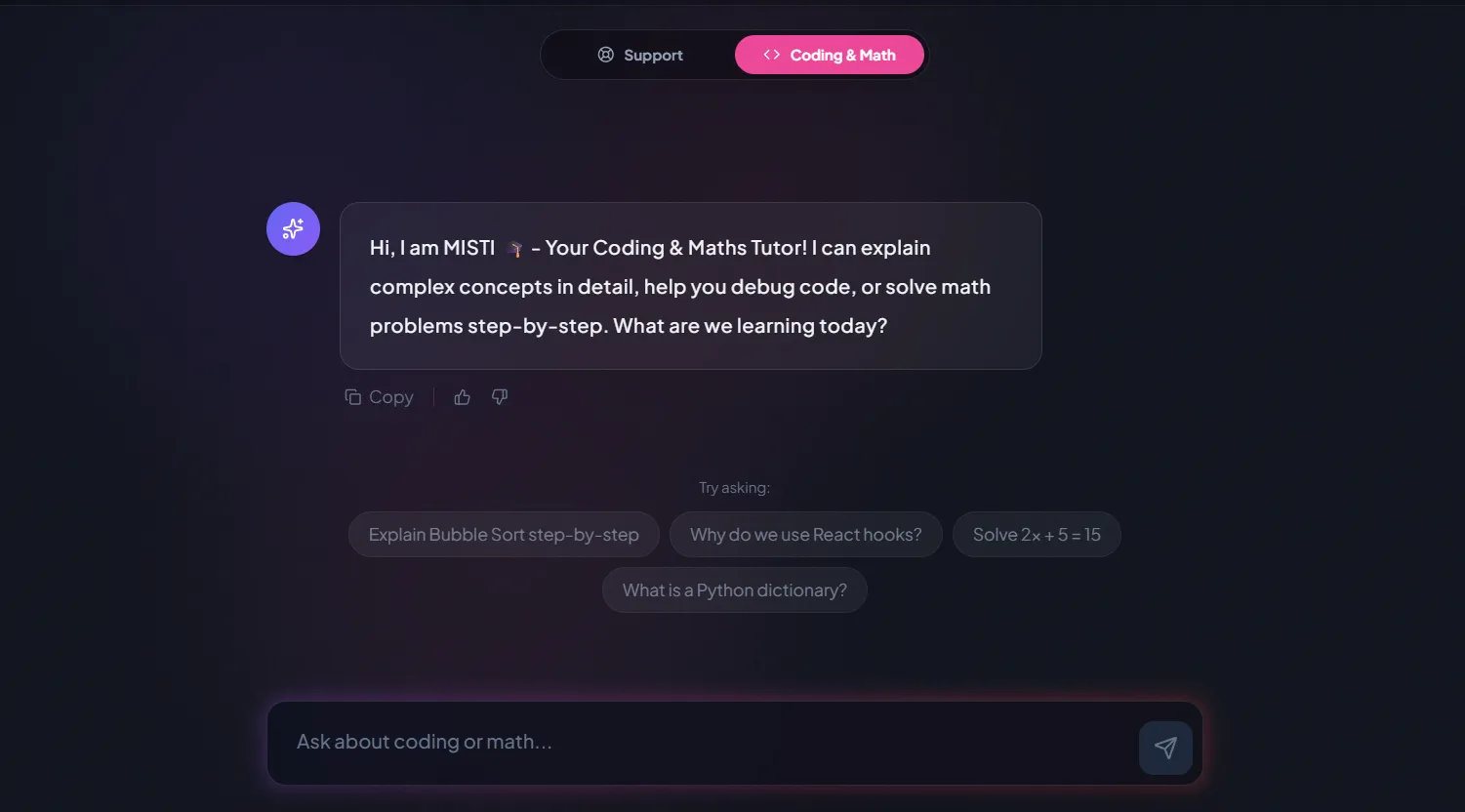
A chatbot that answers mathematics and programming questions, built and deployed by a student.
AI and ML
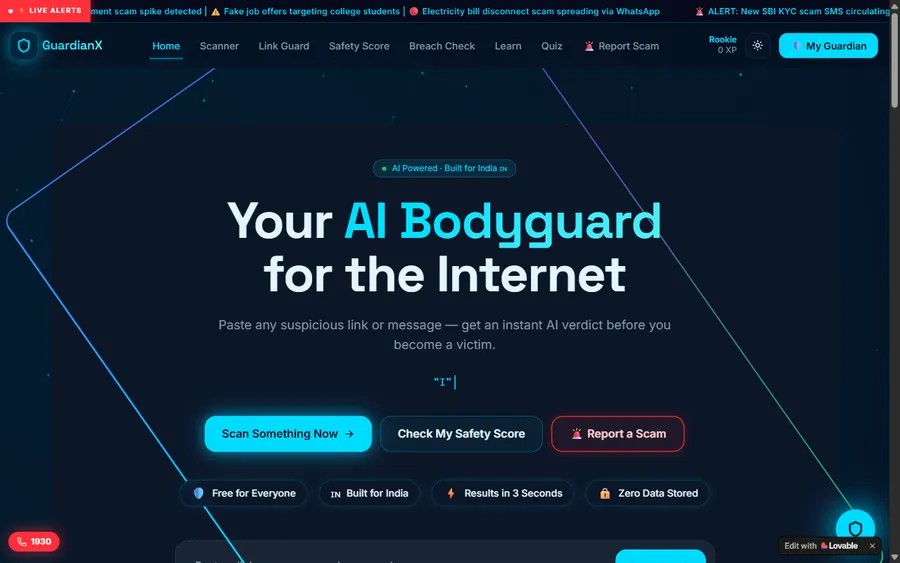
An assistant that helps a young person recognise unsafe situations online.
Web app
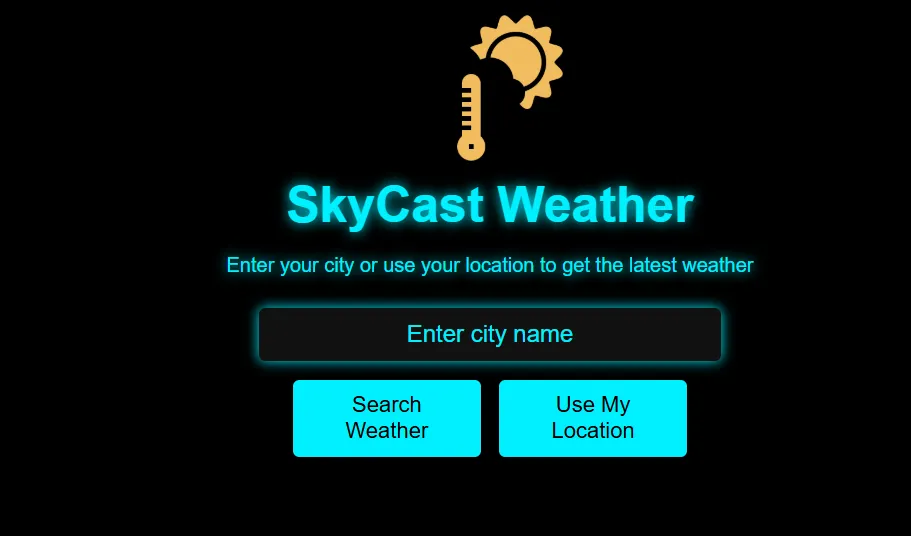
A weather forecasting site with live conditions for any location.
Fees
Lessons are paid monthly in US dollars, one rate wherever you live outside India. Nothing is due for the first lesson, and no invoice follows until you pick a course and a regular weekly time. Hardware is never part of the fee; we do not sell boards.
Free first class
USD 0
no card required
Group batch
USD 100
a month, billed in US dollars
One to one
USD 150
a month, billed in US dollars
What families say
Parents' reviews on Google, reproduced as written.
★★★★★
"The one step solution for my son. Modern Age Coders make learning coding so simple that kids love it. The teachers explain complex concepts clearly with practical exercises and interactive content."
Ria Mukherjee
Parent
★★★★★
"Modern Age Coders has been a game-changer for me. I struggled to grasp IT concepts and coding before joining, but their classes transformed everything. I can now confidently write complex programs with ease."
Samriddha Mondal
Student
★★★★★
"One of the most wonderful education centres out there. Education is not limited to school syllabus but focuses on skill development."
Vansh Agarwal
Student
★★★★★
"My child Dhairya is really enjoying the Modern Age Coders classes. This is his first online class and he eagerly looks forward to it. I can already see his improvement, and the teachers are very cooperative."
Sonam Oswal
Parent of Dhairya
★★★★★
"Modern Age Coders have wonderful teachers who teach in a clear, easy and practical way. The teacher boosts students' confidence and inspires them to learn without hesitation."
Sonu Goyal
Parent
★★★★★
"I highly recommend this computer coding class! The teachers are incredibly knowledgeable and passionate about coding."
Ritu Kedia
Parent
Questions about life after the micro:bit
A pocket-sized programmable board with buttons, lights, sensors and a radio, from the Micro:bit Educational Foundation, a non-profit. Children usually program it with MakeCode blocks.
Very likely. In 2023 every UK primary school was offered a free class set of 30 through BBC micro:bit the next gen, and nearly 20,000 schools signed up.
Yes. The Foundation has its own Python editor for the micro:bit, which had over a million uses in its first year.
Python is text-based and used far beyond school, in data science and machine learning. Moving to it lets children build bigger programs, and the micro:bit makes the first step gentle.
No. Our lessons use Python on the computer. A home micro:bit is a nice extra for trying ideas, but not required.
Not as a course. Our blocks course uses a simulated micro:bit, and our Python teaching happens on the computer. We do not sell or ship boards.
Often around 10 to 12, once a child is confident in blocks and can plan a project. Some benefit from more time in blocks first.
No. We are independent and describe the micro:bit from the Foundation's published material.
Yes, live and online, in small groups or one to one, at UK times.
A first lesson is free of charge. Continuing lessons are billed once a month in US dollars, cheaper in a group than one to one, as the fees section shows, and never paid ahead.
Elsewhere on this site
Clubs, computers and the curriculum.
The next step for children who outgrow the club guides.
What children can build with a Raspberry Pi computer.
The primary computing curriculum in England.
What secondary school computing asks next.
Where young makers build to a deadline.
All our UK pages in one place.
Start here
Leave a number and we will call at a UK time that suits. Tell us what your child made on the micro:bit; the lesson starts there and ends with a plan.
Want to look before you book? Browse the courses and their syllabuses, read about our method and who it suits, or see children's finished work in student labs.
WhatsApp us · +91 91233 66161 · contact@modernagecoders.com
For a fast answer, message us on WhatsApp, free from any UK phone. We are based in India, so our number has the +91 prefix.