CMH / MATHS / 01
Middle school maths
Pre-algebra and geometry, the ground under the MSA paper.
Open the syllabusHamburg · Coding and maths · Ages 10 to 19
Hamburg is a Land and a city at once, so one school authority sets the rules for every pupil from Blankenese to Bergedorf. Since 2025/26 those rules include four compulsory hours of Informatik, and the maths exams at the end of grade 10 and in the Abitur are written centrally on dates already fixed for 2027. This page covers both subjects, the holidays, and a project that asks a deceptively simple question: how many bridges does the register hold?
Teaching online since 2020 · 10,000+ students worldwide · coding and maths, in English
In short
Modern Age Coders runs coding and maths classes for Hamburg pupils of about 10 to 19, live online and in English; each learner keeps the same mentor, who sets the speed and gets used to the accent. Pupils join a class of 15 to 20 or learn one to one. Coding follows Hamburg's compulsory Informatik in grades 7 to 10; maths prepares for the central MSA and Abitur papers of 2027.
Where Hamburg pupils start
One for Informatik in the middle years, one for Abitur maths, and one for pupils who enjoy hard problems in either subject.
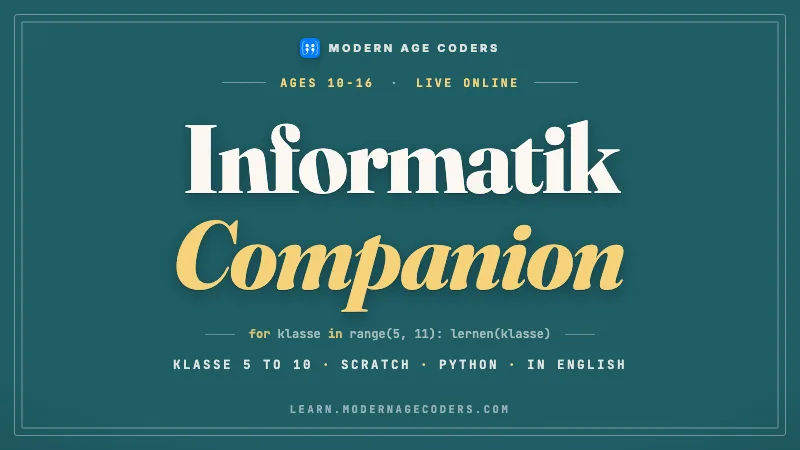
CMH / 01
For 10 to 16 year olds. Algorithms, Python, data and networks, so the four compulsory hours land on prepared ground.
Open the syllabus →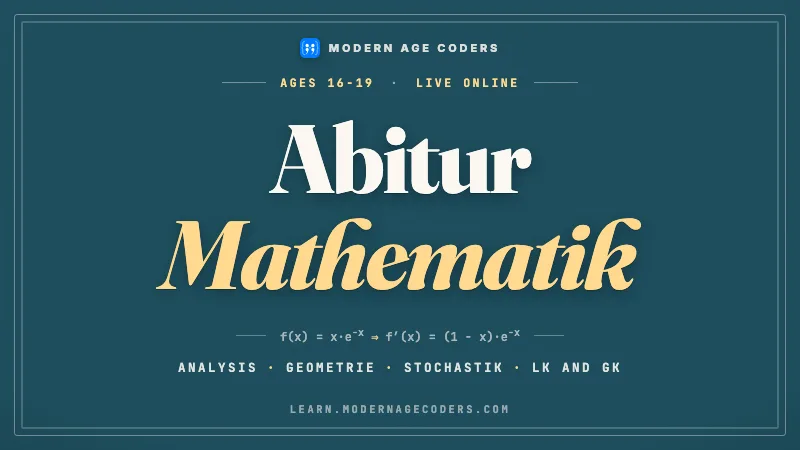
CMH / 02
For the Oberstufe. Analysis, geometry and stochastics in the two-part exam format, with our own practice papers.
Open the syllabus →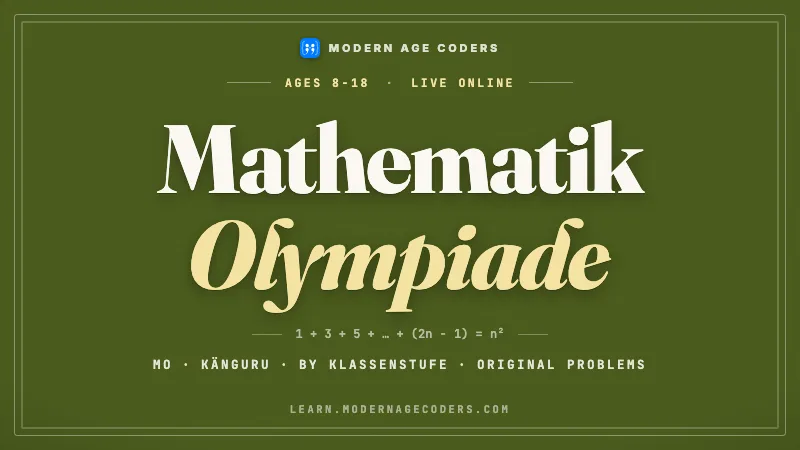
CMH / 03
From 8 to 18. Original problems by Klassenstufe for pupils who want maths beyond the syllabus.
Open the syllabus →Informatik in Hamburg
Yes, since the 2025/26 school year, at both school types of the Sekundarstufe I. The detail is drawn from the 2026/27 edition of the Informatik-Monitor, a survey of Land ordinances by the Gesellschaft für Informatik; Modern Age Coders is independent of it and of the school authority.
At Stadtteilschulen and Gymnasien, four weekly hours of Informatik have been compulsory since 2025/26. The schools decide how to place those four hours across grades 7 to 10, and they may add Informatik as a Wahlpflicht elective on top.
The monitor is careful about what it does not count: the subject Naturwissenschaften/Technik in grades 5 and 6 contains an Informatik strand, but too little of it to be treated as Informatik teaching.
After four years of Grundschule, Hamburg pupils go to a Stadtteilschule or a Gymnasium; the KMK names the Stadtteilschule as Hamburg's school offering all three tracks. At the Gymnasium the Abitur comes after grade 12, with grade 10 as the Einführungsphase. At a Stadtteilschule with an Oberstufe it comes after grade 13.
At the Stadtteilschule, Informatik can be an elective in grade 11 for two to four hours in total.
| Option | Level | Weekly hours | Exam |
|---|---|---|---|
| Wahlpflicht elective | Basic | Two | Not stated by the monitor |
| Profile-accompanying subject | Basic | Two | Written, oral or presentation exam; a besondere Lernleistung can replace it |
| Profile-giving subject | Raised | At least four | Written exam |
Source: Gesellschaft für Informatik, Informatik-Monitor 2026/27, Hamburg page, read 2 November 2026. The written Informatik Abitur at both levels is developed centrally and is the same across Hamburg; at present no practical computer work is allowed in it, and the permitted aids are a non-programmable, non-graphing calculator and a spelling dictionary.
That last rule matters for how a pupil prepares. A Hamburg Abitur candidate writes and reads programs on paper, without a compiler to point out the mistakes. We train exactly that: predicting what code does before running it, tracing variables by hand, and writing a class or an algorithm cleanly in one go.
The monitor's figures for Hamburg are higher than in most Länder: in 2024/25 about 22 percent of Sekundarstufe II pupils took Informatik and about 2 percent of Abitur candidates had it as an exam subject. In 2025/26 Hamburg had 610 qualified Informatik teachers, about 5 percent of all teachers.
Maths exams in 2027
Hamburg sets its written maths exams centrally at three points in a school career. The school authority has published the 2027 dates.
| Exam | German | Mathematics |
|---|---|---|
| Erster allgemeinbildender Schulabschluss (ESA) | 8 April 2027 | 12 April 2027 |
| Mittlerer Schulabschluss (MSA) | 9 April 2027 | 13 April 2027 |
| Abitur, regular dates | Within 13 April to 5 May 2027 | Within 13 April to 5 May 2027 |
| Abitur, resit dates | Within 25 to 31 May 2027 | Within 25 to 31 May 2027 |
Source: Behörde für Schule, Familie und Berufsbildung Hamburg, Termine für die Abschlussarbeiten 2027, as of 9 September 2026, read 3 November 2026. The document gives the Abitur as a window, not by subject. Resits for ESA and MSA are on 19 May 2027 (German) and 21 May 2027 (maths).
Hamburg's school authority states that the ESA and the MSA include a final exam in German and maths with centrally set tasks. For a grade 10 pupil in spring 2027, that means one maths paper on Tuesday 13 April, a month after Hamburg's spring break ends.
Central tasks reward steady skills: fractions and percentages, linear functions, equations, geometry with Pythagoras, and reading data from charts. Gaps from grade 7 show up here, which is why we start by testing the basics.
Across the Länder, the IQB's common pool describes a maths exam in two parts: Part A without any aids, Part B with them. At the raised level the paper lasts 300 minutes including choice time, at the basic level 255 minutes. Each Land's commission decides which pool tasks it uses and how many of its own it adds.
In our maths classes, Part A is the hard part to practise, because it needs fluent algebra and calculus with nothing but a pen.
Our lessons sit beside school, never in its place. Only Hamburg's exams and the school's marks count towards a certificate, which we neither give nor imitate, and our practice problems are written by us, never copied from published exam papers.
Taught in English
Yes, completely. Mentors teach live in English, and no lesson is given in German.
Many families come to Hamburg for the port, trade or media, and their children think in English. A lesson in English lets them learn hard ideas in the language they already reason in, while school runs in German or in an international programme.
A maths or coding lesson in English is a second subject practised for free. Mentors speak clearly, adjust speed and vocabulary, and know German school words such as Stadtteilschule, Profilfach or Ableitung when a pupil uses them.
A derivative, a for loop and a SQL query are written the same way in Hamburg, Chennai or Chicago. The notation on the screen does most of the work; the English around it is the easy part.
Our mentors are in India and teach the same way for every learner, wherever they are: a mentor who gets to know each pupil, the pupil doing the work on their own keyboard or paper, and every problem argued out before it is solved. We teach pupils to think, not to copy a worked answer or an AI tool's output.
A Hamburg project
Hamburg is proud of its bridges, and the city's Landesbetrieb Straßen, Brücken und Gewässer publishes its register of them, free to reuse. Counting them looks like a one-line program. It is a lesson in deciding what "one bridge" means.
The dataset is Brücken und sonstige Ingenieurbauwerke Hamburg, from the Transparenzportal under the Datenlizenz Deutschland Namensnennung 2.0. Its description says it lists the existing structures in the LSBG's area of responsibility: road bridges, foot bridges, tunnels, noise barriers, retaining walls and sign gantries. We downloaded the road and foot bridge files on 3 November 2026.
Each record has a name, an internal structure number, a sub-structure number, a construction type, a status and, for most, a year of construction.
How many road and foot bridges are in the register? A pupil counts the records and has an answer in a minute. Then a second pupil notices that the Traute-Lafrenz-Brücke appears three times: east footway, middle section, west footway.
Is that three bridges or one? The register answers it for us: all three records share one internal structure number and differ only in the sub-structure number.
import json

for name in ["strassenbruecken", "fussgaengerbruecken"]:
    with open(name + ".json", encoding="utf-8") as src:
        parts = json.load(src)["features"]
    print(name, "rows:", len(parts))
It prints: strassenbruecken rows: 881 and fussgaengerbruecken rows: 616.
Version 1 counts parts. A bridge with separate decks, ramps or footways has one record per part. Version 2 collects the internal structure numbers in a set, so each bridge is counted once however many parts it has.
import json

bridges = set()
for name in ["strassenbruecken", "fussgaengerbruecken"]:
    with open(name + ".json", encoding="utf-8") as src:
        parts = json.load(src)["features"]
    numbers = {p["properties"]["internebauwerksnummer"] for p in parts}
    print(name, "bridges:", len(numbers))
    bridges |= {(name, n) for n in numbers}

print("Bridges in both files:", len(bridges))
It prints: strassenbruecken bridges: 753, fussgaengerbruecken bridges: 591 and Bridges in both files: 1344.
So the two files hold 1,497 records but 1,344 bridges: 128 road-bridge records and 25 foot-bridge records are extra parts of a bridge already counted. Neither number is "wrong". They answer different questions, and a report that does not say which one it gives has not finished its job.
import json
from statistics import median

with open("strassenbruecken.json", encoding="utf-8") as src:
    parts = json.load(src)["features"]

first_year = {}
for p in parts:
    props = p["properties"]
    year = props.get("baujahr")
    if not year:
        continue
    key = props["internebauwerksnummer"]
    first_year[key] = min(int(year), first_year.get(key, 9999))

years = sorted(first_year.values())
print("Road bridges with a year:", len(years))
print("Oldest:", years[0], "Median:", median(years))
It prints: Road bridges with a year: 725 and Oldest: 1802 Median: 1976.
| File | Records | Distinct bridges |
|---|---|---|
| Road bridges (strassenbruecken) | 881 | 753 |
| Foot bridges (fussgaengerbruecken) | 616 | 591 |
Data: Landesbetrieb Straßen, Brücken und Gewässer, via Transparenzportal Hamburg, Brücken und sonstige Ingenieurbauwerke Hamburg, Datenlizenz Deutschland Namensnennung 2.0; we fetched both files on 3 November 2026 and every count in the table is ours. The register covers the LSBG's area of responsibility, so it is not a count of every bridge in the city. The 1802 record is named Franzosenbrücke.
Version 3 is where the maths joins in. For each bridge it keeps the earliest year among its parts, then takes the median. The median, 1976, is the year that splits the dated road bridges into two halves; the mean, 1969.5 in our own check, sits earlier because 29 of the dated road bridges were built before 1900 and drag it back. Ask a pupil to compute both and explain the gap, and you have a statistics lesson that no textbook had to invent.
School year 2026/27
Lessons continue through the holidays for those who want them. Families who travel simply pause and pick up where they left off.
| Holiday | Dates |
|---|---|
| Autumn | 19 to 30 October 2026 |
| Christmas | 21 December 2026 to 1 January 2027 |
| Single winter day | 29 January 2027 |
| Spring | 1 to 12 March 2027 |
| Ascension and Whitsun | 7 to 14 May 2027 |
| Summer | 1 July to 11 August 2027 |
Taken from the KMK holiday overview for 2026/27 (dated 9 October 2025) and, for summer 2027, from the KMK's long-term summer rules for 2025 to 2030. The KMK fixes the summer dates years ahead; the other holidays are set by Hamburg.
Destatis counts 1,862,565 people in Hamburg on 31 December 2024, the same figure for the city and the Land because they are one. Germany's second-largest city therefore has a single school authority and a single set of exam dates.
Online classes make the district irrelevant: a pupil in Harburg and a pupil in Wandsbek have the same mentors and the same lessons.
Hamburg's spring break, 1 to 12 March 2027, comes earlier than in most Länder, and the central exams start a month later.
For grade 10 and Oberstufe pupils, we use the spring break for a full practice paper under time, then spend the four weeks to mid April on whatever that paper exposed.
Class times
A Hamburg afternoon is an Indian evening, and a Sunday morning in Hamburg is early afternoon for the mentor. The rows below are examples of the offset, not fixed batches.
| Hamburg | India, winter (until 28 March 2027) | India, summer (from 28 March 2027) |
|---|---|---|
| 15:15 | 19:45 | 18:45 |
| 16:45 | 21:15 | 20:15 |
| Sunday 10:00 | 14:30 | 13:30 |
Germany keeps MEZ, UTC+1, in winter and MESZ, UTC+2, in summer, as the Einheitenzeitgesetz provides; this winter began on 25 October 2026 and summer time returns on 28 March 2027. India has no clock change and stays at UTC+5:30, four and a half hours ahead of Hamburg now and three and a half from late March.
Milestones
We wrote these five stages ourselves; they decide which class a new pupil joins and frame the reports parents receive.
| Stage | Typical grade | Coding | Maths |
|---|---|---|---|
| 1 | 5 to 6 | Write and debug step-by-step instructions | Fractions, negative numbers, area |
| 2 | 7 to 8 | Loops, decisions and lists in Python | Linear equations and functions |
| 3 | 9 to 10 | Read a data file and count it correctly | MSA topics: Pythagoras, quadratics, statistics |
| 4 | 11 | Classes and objects, traced on paper | Derivatives and the Einführungsphase basics |
| 5 | 12 to 13 | Data structures and automata | Abitur Part A without aids |
Stage 3 is the bridge project. Knowing whether you are counting parts or things is as much maths as coding.
Reports describe what your child can now do and what comes next, not how long they sat at a screen.
Before you count, write down what one thing is.
If a mean and a median disagree, the data is telling you something about its shape.
More courses
Each runs live, in English, in a class or privately, and a pupil keeps one mentor throughout.
CMH / MATHS / 01
Pre-algebra and geometry, the ground under the MSA paper.
Open the syllabusCMH / MATHS / 02
Functions, sequences and probability tried out in Python, for 10 to 15.
Open the syllabusCMH / MATHS / 03
From charts to hypothesis tests, with real data.
Open the syllabusCMH / CODE / 01
A first script in week one, files and objects by the end.
Open the syllabusCMH / CODE / 02
Tables, keys and queries, the counting skill behind the project.
Open the syllabusCMH / CODE / 03
Original puzzles for the Biber and the Bundeswettbewerb Informatik.
Open the syllabusCMH / UPPER / 01
Programming on paper for a central exam with no computer.
Open the syllabusCMH / UPPER / 02
For pupils in an IB programme instead of the Abitur.
Open the syllabusCMH / UPPER / 03
Trees, graphs and how to show a method is fast enough.
Open the syllabusHow classes run
Weekdays or weekends, flexible: choose your batch, or for a very personalised plan choose 1-on-1 at your convenience, weekend mornings or weekdays.
Afternoons
From mid afternoon, after the school day.
Sundays
Morning lessons, calm before the week starts.
1-on-1
Any time agreed with the mentor, shifted around exams.
The same mentor each week, for coding, maths or both.
Paced for the learner, with German school terms understood.
Code typed live, and maths worked on paper, as the exams demand.
Planned back from Hamburg's 2027 exam dates.
Parents hear what was learned and what is next.
A class of 15 to 20 at the same stage, or a mentor of your own.
Student work
A few student projects are below; the student labs page collects more.

AI and ML
An AI nutrition coach that reads what you eat and works you toward a target.

AI and ML
A chatbot that answers mathematics and programming questions, built and deployed by a student.

AI and ML
An assistant that helps a young person recognise unsafe situations online.

Web app
A weather forecasting site with live conditions for any location.
Fees
Fees are monthly, for eight live classes, with no long contract. You see them in euro, worked out from the European Central Bank's reference rate; the payment is made in US dollars and your bank converts it, so the statement can show a slightly different amount.
Free first class
Free
no card required
Group batch
€90
a month, eight live classes, charged in US dollars
One to one
€134
a month, eight live classes, charged in US dollars
What families say
Reviews from parents and students on Google, unedited.
★★★★★
"The one step solution for my son. Modern Age Coders make learning coding so simple that kids love it. The teachers explain complex concepts clearly with practical exercises and interactive content."
Ria Mukherjee
Parent
★★★★★
"Modern Age Coders has been a game-changer for me. I struggled to grasp IT concepts and coding before joining, but their classes transformed everything. I can now confidently write complex programs with ease."
Samriddha Mondal
Student
★★★★★
"One of the most wonderful education centres out there. Education is not limited to school syllabus but focuses on skill development."
Vansh Agarwal
Student
★★★★★
"My child Dhairya is really enjoying the Modern Age Coders classes. This is his first online class and he eagerly looks forward to it. I can already see his improvement, and the teachers are very cooperative."
Sonam Oswal
Parent of Dhairya
★★★★★
"Modern Age Coders have wonderful teachers who teach in a clear, easy and practical way. The teacher boosts students' confidence and inspires them to learn without hesitation."
Sonu Goyal
Parent
★★★★★
"I highly recommend this computer coding class! The teachers are incredibly knowledgeable and passionate about coding."
Ritu Kedia
Parent
Hamburg families ask
No. All classes are live and in English only. Mentors adjust their pace and get used to each pupil's accent, and they understand German school terms such as Stadtteilschule or Profilfach when a pupil uses them.
Yes. The Informatik-Monitor 2026/27 of the Gesellschaft für Informatik states that four weekly hours of Informatik have been compulsory at Stadtteilschulen and Gymnasien since 2025/26. Each school decides how to place them in grades 7 to 10.
No. According to the Informatik-Monitor, the written Informatik Abitur in Hamburg is set centrally at both levels and currently allows no practical computer work. The aids are a non-programmable, non-graphing calculator and a spelling dictionary.
Hamburg's school authority lists the central MSA maths exam on 13 April 2027 and the ESA maths exam on 12 April 2027, as of 9 September 2026. The German papers are on 9 and 8 April 2027.
The school authority gives the regular written Abitur dates as 13 April to 5 May 2027, with resits from 25 to 31 May 2027. It does not list dates by subject in that document, so the school's own plan gives the exact day.
Often, yes, and some families prefer it. In a one-to-one plan we can split the two weekly classes between maths and coding. In group classes each course has its own mentor.
Weekdays or weekends, flexible: choose your batch, or for a very personalised plan choose 1-on-1 at your convenience, weekend mornings or weekdays. India is 4 hours 30 minutes ahead of Hamburg in winter and 3 hours 30 minutes in summer.
No. We teach alongside school and do not award German grades or qualifications. Hamburg's central exams and the school's marks are the ones that count.
In India, teaching live over video. That is why Hamburg afternoons and Sunday mornings suit the timetable. Your child keeps the same mentor from week to week.
Monthly. Fees are shown in euro at the European Central Bank reference rate and charged in US dollars, so your bank converts the amount. The first class is free and needs no card.
Elsewhere on this site
More for Hamburg families.
All our pages for families across Germany.
The exam, the pool and how to prepare.
Oberstufe Informatik explained.
Hamburg next to the other fifteen.
IB, IGCSE and AP computing in Germany.
Our live lessons in detail.
More guides: Coding classes in North Rhine-Westphalia · Coding classes in Lower Saxony · Coding classes in Land Bremen · Coding classes in Hesse · Coding classes in Bavaria · Coding classes in Saxony-Anhalt · Coding classes in Schleswig-Holstein · Coding classes in Baden-Württemberg · Coding classes in Saarland · Coding classes in Rhineland-Palatinate · Coding and maths in Berlin · Coding classes in Saxony · Coding classes in Thuringia · Coding classes in Brandenburg · Coding classes in Mecklenburg-Vorpommern
Start here
The first class is a short coding or maths problem, chosen for your child's grade. The mentor listens to how your child reasons and how comfortable they are in English, then suggests a course and a class.
To read more first, see how we teach or browse all courses.
WhatsApp us · +91 91233 66161 · connect@modernagecoders.com
Live online with mentors in India, in English only. WhatsApp reaches us fastest, in English.
A priority demo is a full class of about 45 to 60 minutes. After the class the mentor sends a written skill report and a personal learning roadmap on WhatsApp. If you enrol, the demo fee is adjusted against your first month's fee. Share your demo Order ID with us on WhatsApp and we take it off.
Book a priority demo