CPF / KID / 01
AI literacy for kids
How machines learn, with games instead of accounts, 8 to 14.
Open the syllabusPforzheim · Coding and AI · Children to adults
Learning AI properly is less about chatbots and more about four plain steps: collect data, build a model, test it on something it has not seen, and find out where it breaks. This page walks through those steps with a real Pforzheim example, twenty-one seasons of audiences at Theater Pforzheim, where one perfectly reasonable model ends up forecasting fewer than zero visitors. It also covers what Baden-Württemberg schools now teach in Informatik, the national AI competition whose final is in Tübingen this month, and how our live English classes work from age 9 to adult.
Live classes since 2020 · 10,000+ students worldwide · AI taught as data, models and tests
In short
At Modern Age Coders, coding and AI classes in Pforzheim mean live video lessons in English for anyone from about 9 to adult. Everyone codes first, then works with real data and builds models they test honestly, finding where they fail. A regular mentor adapts to each learner's pace and accent, solo or with fifteen to twenty others, at Pforzheim afternoon, evening and weekend times.
Three ways in
A child, a teenager and an adult need different first steps into the same subject.

CPF / 01
For nine to twelve year olds: real Python, then small smart projects that sort, guess and learn from examples.
Open the syllabus →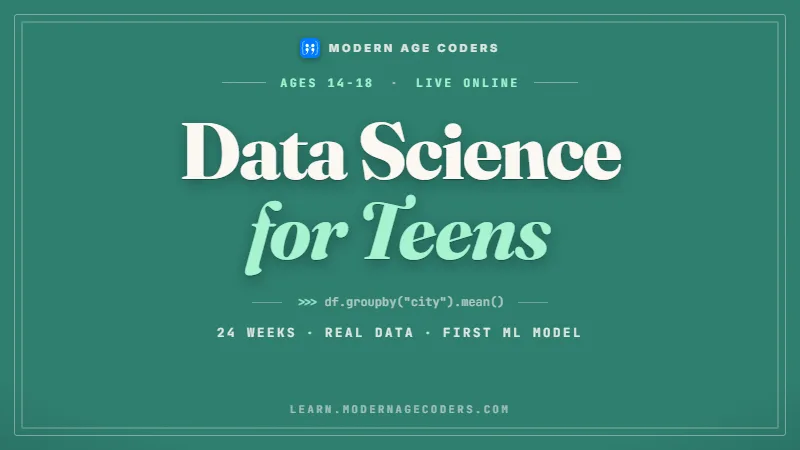
CPF / 02
For teenagers: Python, charts and first models on open data, tested properly, like the theatre forecast below.
Open the syllabus →
CPF / 03
For students and adults: search, logic, agents and machine learning, the ideas underneath today's AI tools.
Open the syllabus →AI, honestly
Every AI project we teach, from a child's first guessing game to an adult's forecast, follows the same four steps.
Nine to twelve year olds do the four steps with tiny datasets they can see whole: guessing a classmate's favourite fruit from three questions, then counting how often the guess was wrong.
Teenagers write the fitting formula themselves in Python, split data into training and test sets, and learn to distrust a result that looks too good.
Adults go further into machine learning and generative AI, but keep the same habit: every model is tested, and every limit is written down before anyone relies on it.
| Tool | Minimum age in its terms |
|---|---|
| ChatGPT | 13, with a parent or guardian's permission under 18 |
| Claude | 18 |
From the tools' terms of use as quoted in our AI tools age guide. We keep to those ages: no chatbot accounts for children, no 18+ tools for anyone under 18. Most of what younger learners do in our AI classes is code they write themselves.
A real Pforzheim project
The City of Pforzheim publishes yearly theatre figures, from Theater Pforzheim, as open data. Twenty-one seasons are enough to build two forecasting models, test both, and watch each fail in a different way.
The dataset Aufführungen und Besucher (Theater, Oper, Ballett) is published by the Stadt Pforzheim on GovData under the licence CC BY 4.0, with Theater Pforzheim named as the source. We downloaded it on 3 November 2026. It covers the seasons 2000/2001 to 2020/2021.
For each season we keep the total number of performances and the total number of visitors, in pforzheim_theatre.csv. A season label such as 2016/2017 becomes the number 2016, the year it started.
We train on the seasons that start from 2000 to 2016 and hide the last four, 2017 to 2020, for the test. Model 1 draws a straight line through visitors against the year. Model 2 draws a straight line through visitors against the number of performances.
Both use the same small fit function, the classic least-squares line, written out in full so nothing is hidden inside a library.
import csv

seasons = []
with open("pforzheim_theatre.csv", encoding="utf-8") as f:
    for row in csv.DictReader(f):
        start = int(row["season"][:4])
        seasons.append((start, int(row["performances"]), int(row["visitors"])))

train = [s for s in seasons if s[0] <= 2016]
test = [s for s in seasons if s[0] > 2016]

def fit(points):
    n = len(points)
    mx = sum(x for x, _ in points) / n
    my = sum(y for _, y in points) / n
    slope = sum((x - mx) * (y - my) for x, y in points) / sum((x - mx) ** 2 for x, _ in points)
    return slope, my - slope * mx

slope, base = fit([(year, v) for year, _, v in train])
print("Trend: visitors change by", round(slope), "a season")
for year, _, visitors in test:
    guess = slope * year + base
    print(year, "predicted", round(guess), "real", visitors)
It prints Trend: visitors change by -1376 a season, then 2017 predicted 96614 real 99241, 2018 predicted 95238 real 94144, 2019 predicted 93862 real 64831 and 2020 predicted 92486 real 1869.
The trend says audiences fell by about 1,376 a season, and for 2017 and 2018 it is within a few thousand. Then it misses badly: it expects 93,862 visitors for the 2019/2020 season and the real figure is 64,831, and for 2020/2021 it expects 92,486 against 1,869. Something changed that the calendar knows nothing about. The file shows what: the theatre gave 184 performances in 2019/2020 and only 16 in 2020/2021, against 245 or more in every training season. It does not say why, so neither do we.
So Model 2 uses the number of performances instead of the year. That is the more sensible input: fewer shows should mean fewer visitors. If the number of performances is known before the season, this model ought to cope better with the unusual years.
slope2, base2 = fit([(p, v) for _, p, v in train])
print("Each performance brings about", round(slope2), "visitors")
print("With no performances the line says:", round(base2))
for year, performances, visitors in test:
    guess = slope2 * performances + base2
    print(year, "predicted", round(guess), "real", visitors)
print("Fewest performances in training:", min(p for _, p, _ in train))
It prints Each performance brings about 540 visitors, With no performances the line says: -40396, then 2017 predicted 97310 real 99241, 2018 predicted 94069 real 94144, 2019 predicted 58968 real 64831, 2020 predicted -31756 real 1869 and Fewest performances in training: 245.
Model 2 is much better for 2019/2020, within about 6,000. And then it forecasts minus 31,756 visitors for 2020/2021, which is impossible. The reason is in the last line it prints: the model never saw a season with fewer than 245 performances, so between 245 and 300 a straight line fits well, but stretched down to 16 it runs through zero and keeps going. The line even claims that a season with no performances at all would have minus 40,396 visitors.
| Season | Performances | Real visitors | Model 1 (year) | Model 2 (performances) |
|---|---|---|---|---|
| 2017/2018 | 255 | 99,241 | 96,614 | 97,310 |
| 2018/2019 | 249 | 94,144 | 95,238 | 94,069 |
| 2019/2020 | 184 | 64,831 | 93,862 | 58,968 |
| 2020/2021 | 16 | 1,869 | 92,486 | -31,756 |
Data: Stadt Pforzheim, Aufführungen und Besucher (Theater, Oper, Ballett), source Theater Pforzheim, licence CC BY 4.0, downloaded 3 November 2026. Training on seasons starting 2000 to 2016; models, forecasts and the table are our own. For comparison, visitors per performance (also ours) were 421 in 2000/2001, 376 in 2016/2017, 352 in 2019/2020 and 117 in 2020/2021.
Neither model is "wrong" inside its comfort zone. Model 1 assumes the future is like the past; Model 2 assumes a season looks like the seasons it has seen. The lesson for anyone learning AI is the same at 12 and at 50: before trusting a prediction, check whether the question lies inside the range the model learned from, and say so next to the answer.
Baden-Württemberg
Baden-Württemberg has just made Informatik compulsory from grade 5, and the national AI competition holds its final in Tübingen, also in Baden-Württemberg, on 13 November 2026.
According to the Gesellschaft für Informatik, from 2025/26 Baden-Württemberg introduced a compulsory subject, Informatik und Medienbildung, across all secondary school types, beginning in grades 5 and 6 and extending upwards. Its 2026/27 monitor lists the Land among the four that now reach the recommended four compulsory hours.
The older profile subject IMP, combining Informatik, Mathematik and Physik, is being phased out; at Gemeinschaftsschulen it can still be offered in grades 8 to 10.
Behind the BWKI stands the Tübingen AI Center. Entrants come from Sekundarstufe I or II and work alone or as a team of at most four; every project has to apply machine learning, and the write-up may be German or English. This year's final takes place in Tübingen on Friday 13 November 2026.
We have no connection with the organisers. A Pforzheim teenager who enjoys the theatre project has the right instincts for an entry: real data, a fair test and an honest account of the limits.
| Stage | What the rules say |
|---|---|
| Grundschule, grades 1 to 4 | No Informatik subject |
| Grades 5 and 6 | Compulsory Informatik und Medienbildung, from 2025/26 |
| Later grades | The subject extends upwards year by year |
| Gymnasium Oberstufe | Mostly grade 10 Einführungsphase, grades 11 and 12 Qualifikationsphase |
Sources: Gesellschaft für Informatik, Informatik-Monitor 2026/27, national and Baden-Württemberg pages; Bundeswettbewerb Künstliche Intelligenz, rules and 2026 timeline; read on 2 November 2026. Population: Destatis, 31 December 2024: Pforzheim 134,912, Baden-Württemberg 11,245,898. Learners in Mühlacker, Bretten, Calw and Niefern-Öschelbronn share the same Land rules.
We teach alongside school. The school's Informatik teacher sets the marks; our part is the extra practice, the projects and a mentor who has time for every question. For adults in Pforzheim, school rules do not apply, and the course follows your own goals.
Class times
Pupils usually take a weekday afternoon or Saturday; adults often prefer an evening. A few examples, with the mentor's clock alongside.
| Pforzheim | India in the winter months | India from 28 March 2027 |
|---|---|---|
| Monday 14:15 | 18:45 | 17:45 |
| Thursday 17:45 | 22:15 | 21:15 |
| Saturday 12:15 | 16:45 | 15:45 |
Pforzheim follows German legal time under the Einheitenzeitgesetz: UTC+1 in winter, UTC+2 in summer. Clocks went back on 25 October 2026 and will go forward on 28 March 2027. India keeps UTC+5:30 all year, which puts it four and a half hours ahead in winter and three and a half in summer. Examples only; there are no fixed batch times.
| Ferien | Dates |
|---|---|
| Herbst | 26 to 31 October 2026 |
| Weihnachten | 23 December 2026 to 9 January 2027 |
| Ostern | 25 March, and 30 March to 3 April 2027 |
| Pfingsten | 18 to 29 May 2027 |
| Sommer | 29 July to 11 September 2027 |
Taken from the KMK overview of holidays for 2026/2027 (dated 9 October 2025), row Baden-Württemberg. Our classes continue through the holidays for anyone who wants them.
Milestones
Our five stages, used for every age, to choose a starting point and to report progress honestly.
| Stage | The learner can |
|---|---|
| 1. Code | Write and fix short programs with loops and conditions |
| 2. Data | Load a file, clean a label, count and plot |
| 3. Fit | Build a simple model, such as a straight line, from scratch |
| 4. Test | Hide data, predict it and measure the error |
| 5. Limits | Say where a model must not be used, and guard against it in code |
Stage 5 is the theatre project's last exercise: a program that refuses to answer when the question is outside what it knows.
Progress reports describe what was built and explained, never hours on a screen.
A good fit on old data is not a forecast. Test on data the model has not seen.
If a model predicts something impossible, it has left the range it learned from.
More coding and AI
Live, in English, with a regular mentor, one to one or in a batch.
CPF / KID / 01
How machines learn, with games instead of accounts, 8 to 14.
Open the syllabusCPF / KID / 02
Scratch to apps, grouped by age, 6 to 12.
Open the syllabusCPF / KID / 03
Logic and planning, the base of all coding.
Open the syllabusCPF / TEE / 01
Real models in Python, each one checked on unseen data.
Open the syllabusCPF / TEE / 02
Prompting and real projects within each tool's age terms, 13+.
Open the syllabusCPF / TEE / 03
Support for the new BW subject, in English.
Open the syllabusCPF / ADU / 01
A long adult course that ends with neural networks and language models.
Open the syllabusCPF / ADU / 02
The maths that tells you when to trust a model.
Open the syllabusCPF / ADU / 03
Scripts and applied AI for everyday work.
Open the syllabusHow classes run
Weekdays or weekends, flexible: choose your batch, or for a very personalised plan choose 1-on-1 at your convenience, weekend mornings or weekdays.
Afternoons
After school in Pforzheim, for pupils.
Evenings
For adults after work.
Private
A time fixed with your own mentor.
Data, model, test, limits, in every project.
Learners build models in their own code.
Tools used only within their age terms.
Steady pace, plain words, adapted to you.
The same person each week.
Fifteen to twenty learners, or one.
Student work
Work by some of our older students; the student labs page shows many more.

AI and ML
An AI nutrition coach that reads what you eat and works you toward a target.

AI and ML
A chatbot that answers mathematics and programming questions, built and deployed by a student.

AI and ML
An assistant that helps a young person recognise unsafe situations online.

Web app
A weather forecasting site with live conditions for any location.
Fees
The monthly fee covers eight live classes. You see it in euro, calculated with the European Central Bank reference rate; the money is collected in US dollars and your bank converts it, so the final figure on your statement may not match to the cent.
Free first class
Free
no card required
Group batch
€90
a month, eight live classes, charged in US dollars
One to one
€134
a month, eight live classes, charged in US dollars
What families say
Straight from our Google reviews, with nothing edited.
★★★★★
"The one step solution for my son. Modern Age Coders make learning coding so simple that kids love it. The teachers explain complex concepts clearly with practical exercises and interactive content."
Ria Mukherjee
Parent
★★★★★
"Modern Age Coders has been a game-changer for me. I struggled to grasp IT concepts and coding before joining, but their classes transformed everything. I can now confidently write complex programs with ease."
Samriddha Mondal
Student
★★★★★
"One of the most wonderful education centres out there. Education is not limited to school syllabus but focuses on skill development."
Vansh Agarwal
Student
★★★★★
"My child Dhairya is really enjoying the Modern Age Coders classes. This is his first online class and he eagerly looks forward to it. I can already see his improvement, and the teachers are very cooperative."
Sonam Oswal
Parent of Dhairya
★★★★★
"Modern Age Coders have wonderful teachers who teach in a clear, easy and practical way. The teacher boosts students' confidence and inspires them to learn without hesitation."
Sonu Goyal
Parent
★★★★★
"I highly recommend this computer coding class! The teachers are incredibly knowledgeable and passionate about coding."
Ritu Kedia
Parent
Pforzheim learners ask
No. Every class is live and taught only in English. Mentors adapt their speed and words to the learner, get used to each learner's accent, and explain again more simply when needed.
Code first. Then four steps on real data: read the data, build a simple model, test it on data it has not seen, and find its limits. The theatre forecast on this page is a typical project.
For the ideas, yes. Children of about 9 to 12 learn how machines learn from examples using small datasets and their own Python code. They do not use chatbot accounts, which have their own minimum ages.
Yes, from grade 5. Since 2025/26 Baden-Württemberg has a compulsory subject, Informatik und Medienbildung, starting in grades 5 and 6. We teach alongside school; the school sets the marks.
Weekdays or weekends, flexible: choose your batch, or for a very personalised plan choose 1-on-1 at your convenience, weekend mornings or weekdays. Pupils often take an afternoon, adults an evening.
They are in India and teach you on a live call. Pforzheim afternoons fall in the Indian evening: the gap is 4 h 30 in winter and 3 h 30 in summer.
Germany's national school AI contest, the Bundeswettbewerb Künstliche Intelligenz. Secondary pupils enter machine-learning projects, written up in German or English, and the 2026 final is held in Tübingen on 13 November.
A batch brings together fifteen to twenty learners of roughly equal level. You can also learn privately, two sessions a week with your own mentor, at times you set together.
By the month. The euro prices on this page use the reference rate of the European Central Bank; the actual charge is in US dollars and your bank does the exchange, so a slight difference can appear. There is no charge for the first class.
No. We teach learners to think through a problem and to check any answer, including an AI one. Adults learn to use AI tools well, which means testing what they produce.
Elsewhere on this site
Further reading for Pforzheim learners and families across the Land.
The Land's rules and dates.
All our AI courses for Germany.
AI ideas for younger learners.
Minimum ages for over a hundred tools.
Building with AI help, carefully.
What a live class is like.
Part of the guide: Coding classes in Baden-Württemberg
More guides: Coding classes in North Rhine-Westphalia · Coding classes in Lower Saxony · Coding classes in Land Bremen · Coding classes in Hesse · Coding classes in Bavaria · Coding classes in Saxony-Anhalt · Coding classes in Schleswig-Holstein · Coding classes in Saarland · Coding classes in Rhineland-Palatinate · Coding and maths in Berlin · Coding and maths in Hamburg · Coding classes in Saxony · Coding classes in Thuringia · Coding classes in Brandenburg · Coding classes in Mecklenburg-Vorpommern
Start here
We begin with a small task and a talk about what you hope to get out of AI, or what your child hopes to. From how the learner tackles the task, the mentor proposes where to start.
To read first, see how we teach or all courses.
WhatsApp us · +91 91233 66161 · connect@modernagecoders.com
Live classes with mentors in India, in English only. WhatsApp is the quickest way to reach us; please write in English.
A priority demo is a full class of about 45 to 60 minutes. After the class the mentor sends a written skill report and a personal learning roadmap on WhatsApp. If you enrol, the demo fee is adjusted against your first month's fee. Share your demo Order ID with us on WhatsApp and we take it off.
Book a priority demo