IMT / PRE / 01
Middle school maths
The MYP years made solid.
Open the syllabusGermany · IB Diploma Mathematics · Ages 15 to 19
An IB Diploma pupil in Germany sits the same IB maths papers as a pupil in Singapore or Toronto, but the choice of course carries a German consequence. The Kultusministerkonferenz has a written agreement on when an IB Diploma opens a German university, and maths is named in it, down to Standard and Higher Level. This page sets out what that agreement says, how it turns an IB total into a German grade, and how our mentors teach IB maths, live and in English.
Teaching live online since 2020 · 10,000+ students worldwide · AA and AI, SL and HL, one regular mentor
In short
Modern Age Coders is an IB maths tutor for Diploma pupils in Germany, teaching Mathematics: Analysis and Approaches and Mathematics: Applications and Interpretation at SL and HL, live online in English. Mentors match each pupil's pace and accent, cover exam papers and the internal assessment, and teach in a group of fifteen to twenty or one to one through our IB Maths AA and AI course.
Where to start
The IB course itself, a statistics course for pupils on the AI route or with a heavy statistics topic, and a bridge for MYP pupils before the Diploma starts.
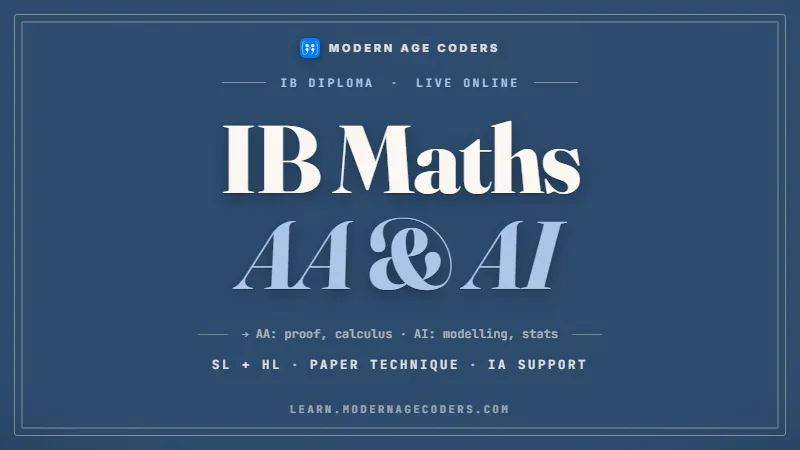
IMT / 01
Both IB maths courses at SL and HL: functions, calculus, statistics and probability, exam technique and the internal assessment.
Open the syllabus →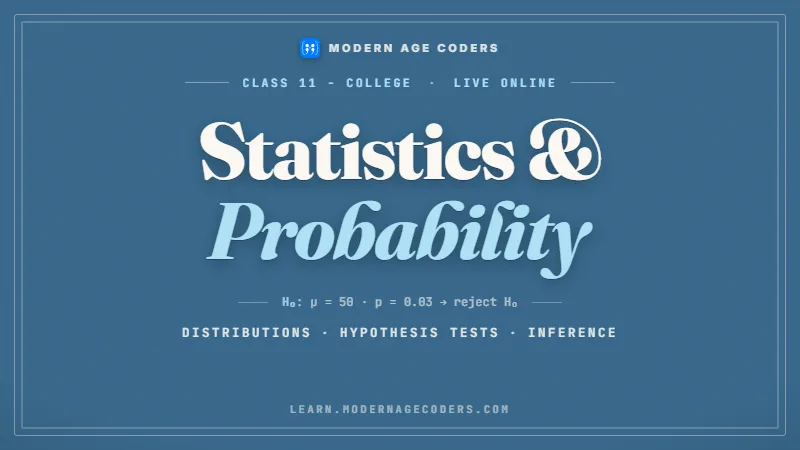
IMT / 02
Distributions, regression and hypothesis tests in depth, for AI pupils and for AA pupils who find the statistics topic hardest.
Open the syllabus →
IMT / 03
Algebra, functions and trigonometry secured in MYP 4 and 5, so the first Diploma year does not start with gaps.
Open the syllabus →KMK rules
The KMK, the standing conference of the Länder education ministers, first agreed in 1986 how an IB Diploma is recognised as a German university entrance qualification. The current version dates from 15 June 2023. These are its conditions, with the maths ones marked.
| Condition | What the agreement says | Maths? |
|---|---|---|
| Schooling | At least twelve years of full-time education in ascending year groups | |
| Six subjects | Two languages, one natural science, one social science, a sixth from a listed set, and maths | Yes |
| Which maths | Mathematics: Analysis and Approaches or Mathematics: Applications and Interpretation | Yes |
| Higher Level | At least one of the three HL subjects must be a language, Mathematics, or Biology, Chemistry or Physics (from exam year 2025) | Can be |
| Continuity | Every subject studied for the two years of the Diploma Programme | Yes |
| Grades | At least IB grade 4 in all six subjects; one grade 3 can be balanced by a 5 in a subject of at least the same level, with 24 points in total | Yes |
| Maths at SL | From the 2021 exams, AA SL or AI SL alone opens only a restricted entrance, outside maths, science and technology subjects, unless the school is listed in Annex 1 or 2 | Yes |
Source: KMK, Vereinbarung über die Anerkennung des "International Baccalaureate Diploma/Diplôme du Baccalauréat International", Beschluss vom 10.03.1986 i.d.F. vom 15.06.2023, current German text with Anlage 1 as at 26 March 2026 and Anlage 2 as at 22 May 2026, read alongside the KMK's unofficial English translation, downloaded from kmk.org on 3 November 2026. Up to and including exam year 2024, the version of 24 March 2022 applies. Up to 2020 the agreement named the older courses, Mathematics SL or HL.
Read the table from the bottom up and one thing is clear: in Germany, maths is not just one of six subjects. It is the only subject the agreement names twice, once as a required subject and again in a footnote on its level. A pupil who chooses Standard Level maths in the first Diploma year is making a decision that the KMK text treats as consequential for what she can study later.
This is not legal or admissions advice, and we give none. The agreement is applied by universities and the Länder, and its text names an advisory committee of the KMK's Central Office for Foreign Education (ZAB) to review whether the IB still meets the criteria. If a choice of course matters for a particular degree, ask the university, and the school's IB coordinator, before the subject choice is fixed.
SL or HL
The footnote is short and easy to miss. Here it is in plain English, then what it means for a pupil choosing courses.
In the German text, footnote 3 says that graduates who present Mathematics: Analysis and Approaches SL or Mathematics: Applications and Interpretation SL from the 2021 exam session onward can be granted only a subject-restricted entrance qualification (fachgebundener Hochschulzugang), for Fachhochschulen and universities and only for subjects outside the mathematical, scientific and technical field.
The exception is graduates of the schools listed in the agreement's two annexes: for them the maths requirement counts as met and the Diploma opens general university entrance.
Annex 1 lists international schools that have a separate agreement with the IBO; in the current German file it is dated 26 March 2026 and has a section for schools in Germany (Deutschland). Annex 2 lists schools abroad with the bilingual German IB.
Whether your school is on the list is a question for your school, which will know. We do not reproduce the list here, because it changes and only the KMK's current file is authoritative.
For a pupil the practical upshot is a three-way choice. AA HL keeps the most options open and is the hardest course. AI HL is also Higher Level and suits a pupil whose strength is modelling and statistics rather than proof. A Standard Level course is a sound choice for many pupils, especially at a listed school or with a clear plan outside the sciences, but it is a choice to make knowingly, not by default.
Algebra, proof and calculus in depth. The heaviest load and the widest set of doors.
Modelling, statistics and technology-led problem solving, still at Higher Level.
A lighter load. Check the footnote and your school's status before you settle on it.
German grade
German universities rank applicants by a single average grade, from 1.0 (the top) to 4.0. The KMK agreement gives a formula to turn an IB total into that grade.
The formula is N = 1 + 3 · (Pmax − P) / (Pmax − Pmin), where P is the IB total, Pmax = 42 and Pmin = 24. Bonus points are added into P, and a pupil with 42, 43, 44 or 45 points is given the top grade, 1.0. The agreement adds that the average is calculated in the country where the Diploma is issued. Put the numbers in and the formula simplifies to N = 1 + (42 − P) / 6: each extra IB point improves the German average by 1/6, about 0.17.
That is a straight line, and a straight line can be read in both directions. Most pupils ask "what grade do my points give?" An IB maths pupil can ask the more useful question, "how many points do I need for the grade I want?", by inverting the function: P = 42 − 6 · (N − 1).
import math

def grade(points):
    if points >= 42:
        return 1.0
    return 1 + 3 * (42 - points) / (42 - 24)

def points_needed(target):
    return math.ceil(42 - 6 * (target - 1))

for p in [24, 30, 35, 36, 39, 44]:
    print(p, "points ->", round(grade(p), 3))
for n in [3.0, 2.3, 1.5]:
    p = points_needed(n)
    print("for", n, "or better: at least", p, "points, giving", round(grade(p), 3))
It prints 24 points -> 4.0, 30 points -> 3.0, 35 points -> 2.167, 36 points -> 2.0, 39 points -> 1.5, 44 points -> 1.0, then for 3.0 or better: at least 30 points, giving 3.0, for 2.3 or better: at least 35 points, giving 2.167 and for 1.5 or better: at least 39 points, giving 1.5.
| IB total (with bonus) | Average grade N |
|---|---|
| 24 | 4.0 |
| 30 | 3.0 |
| 35 | 2.167 |
| 36 | 2.0 |
| 39 | 1.5 |
| 42 to 45 | 1.0 |
Formula and constants from the KMK IB agreement, as amended on 15 June 2023. The results are our own arithmetic. The agreement itself does not say how the result is rounded; the general KMK rules on overall grades for foreign qualifications apply, and we do not restate them here.
The inverted line has a trap, and it is the lesson. For a target of 2.3 the formula gives P = 42 − 6 · 1.3 = 34.2. IB totals are whole numbers, and a higher total gives a better (smaller) grade, so the pupil needs at least 35, not 34: 34 points give 2.333, just outside the target. Rounding the wrong way is the mistake; the check is to put the answer back into the original formula.
IB in Germany
We cannot give a national count: the IBO's school finder refused our request, so this page prints no total. What we can quote is AGIS (Arbeitsgemeinschaft der Internationalen Schulen in Deutschland) on its own members.
In AGIS's own words, every member is an IB school with IBO authorisation running one or more of the four IB programmes; it adds that English is the shared teaching language, and that the IB Diploma, with the prescribed subject combinations, is equivalent to the German Abitur. Its directory pages list the IB Diploma Programme, or the IB generally, for member schools in Berlin, Bonn, Dresden, Düsseldorf, Frankfurt, Hamburg, Hannover and Stuttgart, among other places. Some German Gymnasien also offer the IB Diploma alongside the Abitur, according to the same directory.
We mention these places only as context. We are not connected with AGIS, the IBO or any school, and no school sends pupils to us. A pupil at any IB school in Germany, or at a school abroad, learns the same course with us, because the IB syllabus is the same everywhere.
| In Germany | India, winter time in Germany | India, summer time in Germany |
|---|---|---|
| Weekday 14:15 | 18:45 | 17:45 |
| Weekday 15:45 | 20:15 | 19:15 |
| Saturday 12:15 | 16:45 | 15:45 |
Germany is on MEZ, UTC+1, from 25 October 2026 and on MESZ, UTC+2, from 28 March 2027, as the Einheitenzeitgesetz sets out; India keeps UTC+5:30 throughout. These rows illustrate the gap only; we do not publish fixed batch times.
Practice
Our own tasks in the style of IB papers, not taken from any IB exam. Each one starts from the target and works back to the input, then checks the answer in the original condition, as the grade example above did.
Task 1. f(x) = (3x − 1) / 2. Find f−1(x) and the value of x for which f(x) = 7. Working back: write y = (3x − 1) / 2, so 2y = 3x − 1 and x = (2y + 1) / 3. Hence f−1(x) = (2x + 1) / 3 and f−1(7) = 15 / 3 = 5. Check: f(5) = 14 / 2 = 7.
Task 2. Solve log2x + log2(x − 2) = 3. Working back: log2(x(x − 2)) = 3, so x(x − 2) = 8, x² − 2x − 8 = 0, (x − 4)(x + 2) = 0. Check: x = 4 gives log24 + log22 = 2 + 1 = 3. x = −2 is not in the domain, because log2(−2) is undefined. Only x = 4 survives.
Task 3. A phone battery at 18 % charges at a steady 2.5 percentage points per minute, so C(t) = 18 + 2.5t. When does it reach 80 %? Working back: 2.5t = 62, t = 24.8 minutes. Check: 18 + 2.5 · 24.8 = 80.
Then question the model. Real batteries slow down near full, so the straight line is honest only for part of the range. In an AI paper, saying where a model stops being reasonable earns marks of its own, and the internal assessment rewards it too.
Why "check" is a step. In task 2 the algebra produced two answers and only one was true. Working backwards finds candidates; the original condition decides.
Two Diploma years
Our own outline for a pupil starting the Diploma in Germany in August or September, adjusted by the mentor to AA or AI and to SL or HL.
| When | Focus | Alongside |
|---|---|---|
| Year 1, first term | Number, algebra and functions | Course choice reviewed against the KMK conditions |
| Year 1, second term | Calculus or statistics, by course | Internal assessment topic chosen |
| Year 1, summer | Geometry and trigonometry | Exploration draft written and checked |
| Year 2, autumn | Probability and the remaining topics | Internal assessment completed to the school deadline |
| Year 2, spring | Mixed past-paper style practice | Timed papers, calculator and non-calculator |
The most important maths decision in the Diploma is made at the very start: the course and the level. We look at the KMK conditions with your child before that decision is fixed, and point you to the school and the university for the final word.
After each mock or test, the mentor reports which topic lost the marks, in plain English.
In every rearranged equation, write the check line. It costs ten seconds and catches the answers that are not really answers.
Know your target total, then work out from the formula what it needs from maths.
More maths
Same format as the IB course: live, English only, one mentor who stays, group or individual.
IMT / PRE / 01
The MYP years made solid.
Open the syllabusIMT / PRE / 02
Rearranging with confidence, the skill this page relies on.
Open the syllabusIMT / PRE / 03
For schools that use IGCSE before the Diploma.
Open the syllabusIMT / DP / 01
The new guide, first assessed in 2027.
Open the syllabusIMT / DP / 02
Extra calculus depth for strong AA pupils.
Open the syllabusIMT / DP / 03
More statistics practice for AI pupils.
Open the syllabusIMT / PLUS / 01
Calculus and linear algebra for the first year at university.
Open the syllabusIMT / PLUS / 02
Pure and applied depth beyond the IB syllabus.
Open the syllabusIMT / PLUS / 03
Proof and problem solving for the keenest.
Open the syllabusHow classes run
Weekdays or weekends, flexible: choose your batch, or for a very personalised plan choose 1-on-1 at your convenience, weekend mornings or weekdays. Classes are live video sessions of about an hour, twice a week, with a shared whiteboard and the graphing calculator or software your school uses.
After school
German afternoons, when the mentor in India is in the evening.
Weekends
Longer sessions for timed papers and internal assessment drafts.
1-on-1
Extra sessions before school deadlines and mock exams.
Command terms, notation and mark-scheme habits, in English.
Taught to your course and level, not a mix of both.
Every rearrangement ends by substituting back.
Help choosing and structuring the exploration; the writing stays yours.
Topic by topic after each test or mock.
Fifteen to twenty pupils, or one to one.
Student work
Some of our older students build software alongside their maths. A selection is below; the student labs page has more.

AI and ML
An AI nutrition coach that reads what you eat and works you toward a target.

AI and ML
A chatbot that answers mathematics and programming questions, built and deployed by a student.

AI and ML
An assistant that helps a young person recognise unsafe situations online.

Web app
A weather forecasting site with live conditions for any location.
Fees
Tutoring is billed monthly, eight live classes at a time. On this page the fee appears in euro, taken from the European Central Bank reference rate, while the card payment itself is in US dollars, so the converted amount your bank books can be slightly different.
Free first class
Free
no card required
Group batch
€90
a month, eight live classes, charged in US dollars
One to one
€134
a month, eight live classes, charged in US dollars
What families say
Reviews left on Google by parents and students, copied as written.
★★★★★
"The one step solution for my son. Modern Age Coders make learning coding so simple that kids love it. The teachers explain complex concepts clearly with practical exercises and interactive content."
Ria Mukherjee
Parent
★★★★★
"Modern Age Coders has been a game-changer for me. I struggled to grasp IT concepts and coding before joining, but their classes transformed everything. I can now confidently write complex programs with ease."
Samriddha Mondal
Student
★★★★★
"One of the most wonderful education centres out there. Education is not limited to school syllabus but focuses on skill development."
Vansh Agarwal
Student
★★★★★
"My child Dhairya is really enjoying the Modern Age Coders classes. This is his first online class and he eagerly looks forward to it. I can already see his improvement, and the teachers are very cooperative."
Sonam Oswal
Parent of Dhairya
★★★★★
"Modern Age Coders have wonderful teachers who teach in a clear, easy and practical way. The teacher boosts students' confidence and inspires them to learn without hesitation."
Sonu Goyal
Parent
★★★★★
"I highly recommend this computer coding class! The teachers are incredibly knowledgeable and passionate about coding."
Ritu Kedia
Parent
Pupils and parents ask
Yes. Modern Age Coders teaches IB Mathematics: Analysis and Approaches and Applications and Interpretation, at SL and HL, live online in English to Diploma pupils in Germany, in a group or one to one.
No. Every class is live and taught in English only, which is also the language of the IB papers. Mentors adapt to each pupil's pace and accent.
The KMK agreement on recognising the IB Diploma, as amended on 15 June 2023, requires maths as Mathematics: Analysis and Approaches or Mathematics: Applications and Interpretation among the six subjects.
The KMK text says that from the 2021 exams, AA SL or AI SL alone gives only a subject-restricted entrance qualification, for subjects outside maths, science and technology, unless the school is listed in the agreement's annexes. Ask your school and the university about your own case; we do not give admissions advice.
The KMK formula is N = 1 + 3(42 - P) / (42 - 24), where P includes bonus points and totals of 42 or more give 1.0. By our arithmetic, 36 points give 2.0 and 30 points give 3.0.
The agreement asks for at least IB grade 4 in each of the six subjects. One grade 3 can be balanced by a grade 5 in another subject of at least the same level, with at least 24 points overall.
Yes, with choosing a topic, planning the maths and reviewing drafts against the criteria. The exploration must be the pupil's own work, and we teach it that way.
Weekdays or weekends, flexible: choose your batch, or for a very personalised plan choose 1-on-1 at your convenience, weekend mornings or weekdays. German afternoons fall in the Indian evening, by four and a half hours in winter and three and a half in summer.
Mentors based in India who teach IB maths live online in English. A pupil works with the same mentor throughout.
Monthly fees are shown in euro on this page using the European Central Bank reference rate; the payment runs in US dollars and your bank converts it. The first class costs nothing and needs no card.
Elsewhere on this site
More for international and English-speaking pupils in Germany.
Every Germany page we have published.
For pupils who sit the German Abitur instead.
The full syllabus, topic by topic.
The other IB subject we teach.
Inside a live class.
Everything we teach.
Start here
Tell us your course, AA or AI, and your level. In the first class the mentor works through a few short tasks with you, sees where your method slips, and suggests how many classes a week make sense before your next test.
Want the detail first? The IB Maths AA and AI syllabus lists every topic, and this page on our teaching shows a lesson.
WhatsApp us · +91 91233 66161 · connect@modernagecoders.com
Classes are live online, in English only, with mentors in India. A WhatsApp message gets the quickest reply.
A priority demo is a full class of about 45 to 60 minutes. After the class the mentor sends a written skill report and a personal learning roadmap on WhatsApp. If you enrol, the demo fee is adjusted against your first month's fee. Share your demo Order ID with us on WhatsApp and we take it off.
Book a priority demo