Table of Contents
- What official job projections show
- What developers say AI does for them
- What controlled studies show
- Which tasks change, and which stay with people
- A small example: the part AI cannot decide
- Skills that keep their value
- Will AI replace programmers in 10 years?
- Will AI replace programmers? What Reddit gets right and wrong
- What this means for you
- How we teach it
- Frequently asked questions
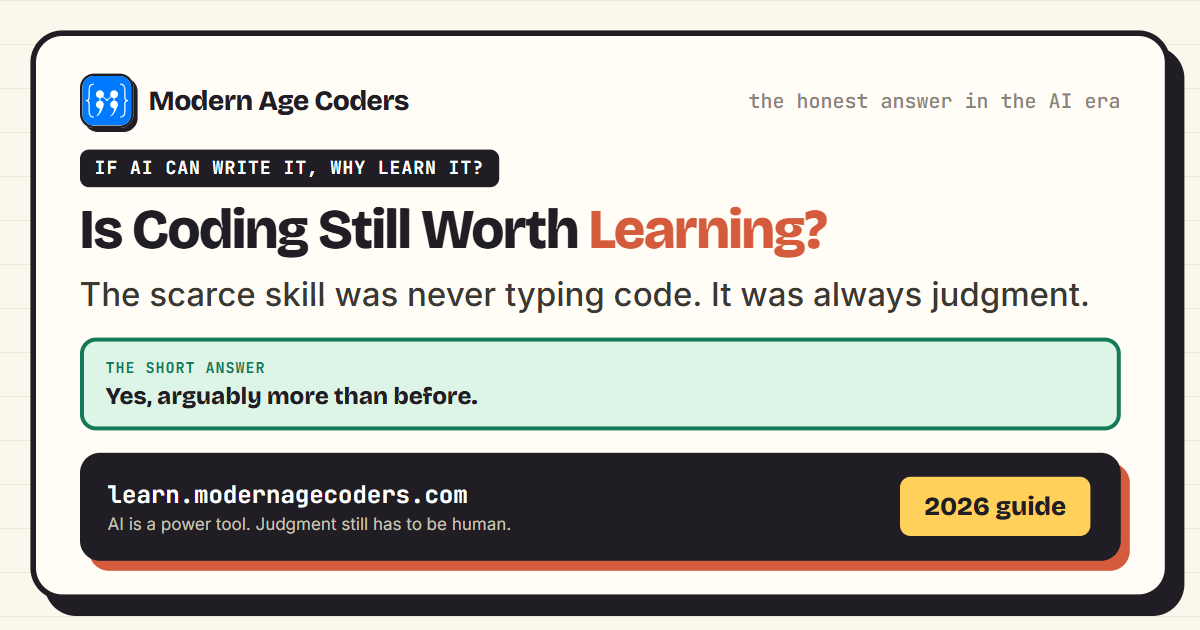
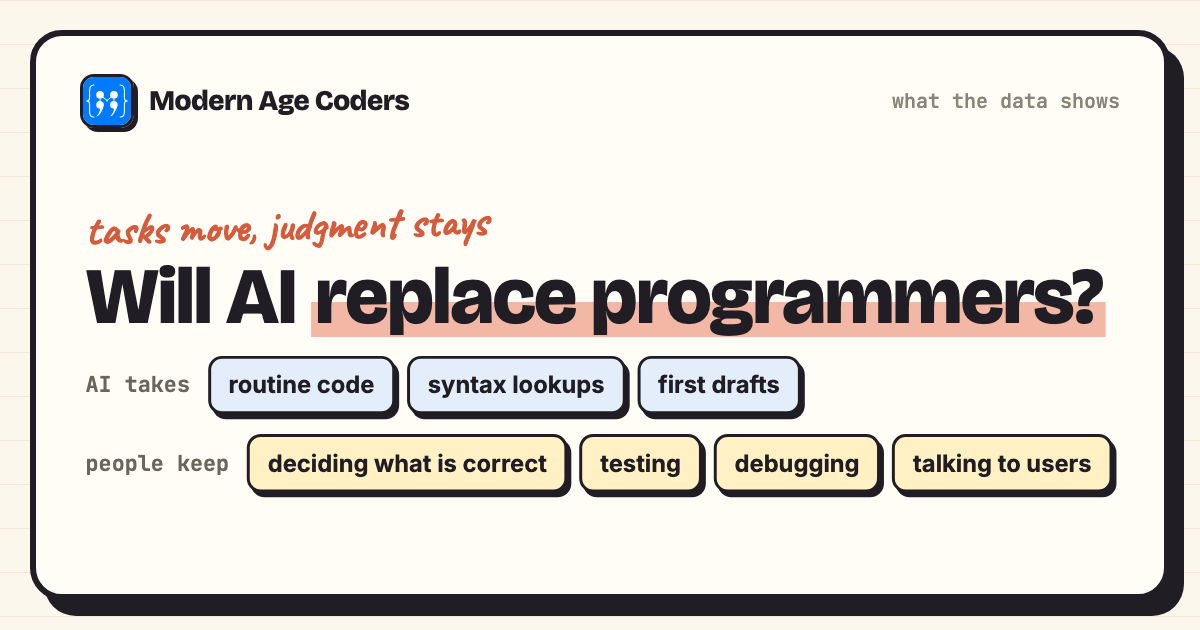
No, not on the evidence we have. AI is replacing tasks inside programming, mostly writing routine code from a clear description, rather than the whole job. Official US projections to 2035 still show software developer jobs growing much faster than average, while the narrower computer programmer role is projected to decline. In ten years the job will look different; whether there are fewer or more programmers is genuinely uncertain, and anyone who sounds sure is guessing.
Below is what the data actually says, from official labour statistics, the largest developer survey, two controlled studies and the vendors' own documentation, each quoted from the source. Then: which tasks are changing, which skills keep their value, and what that means if you are a student, a parent or a working developer.
What official job projections show
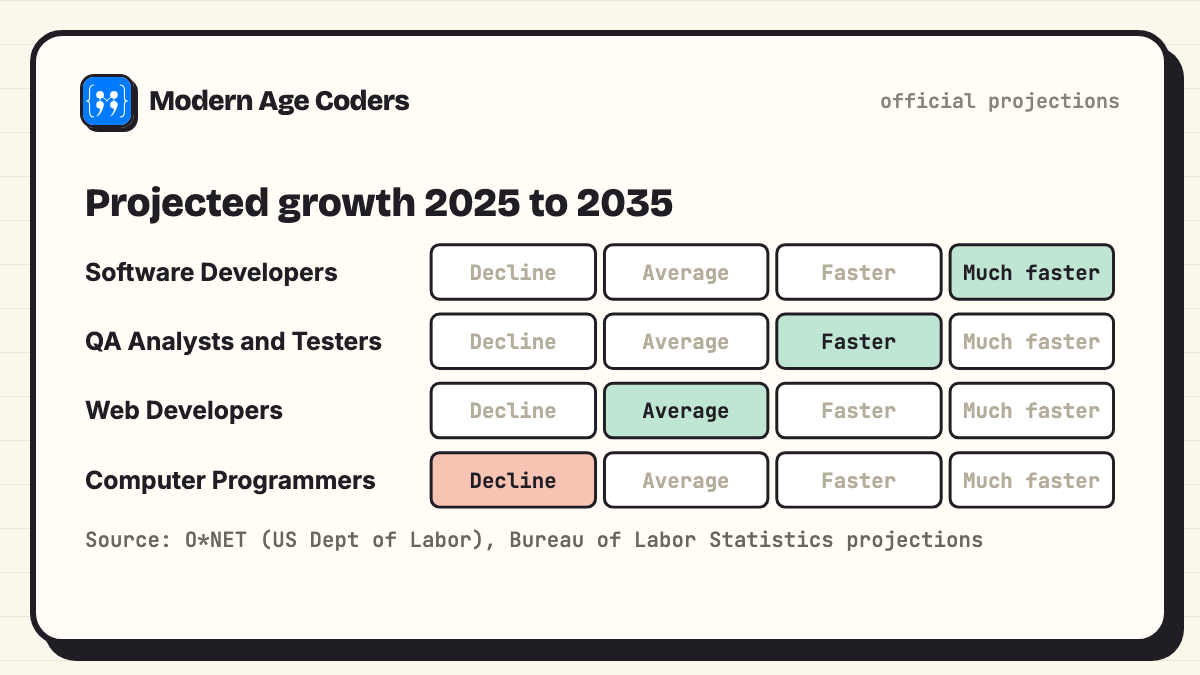
The most detailed public projections are American. O*NET, the US Department of Labor's occupation database, publishes Bureau of Labor Statistics projections for 2025 to 2035. Here are the four occupations closest to programming, in O*NET's own words:
| Occupation | Employment (2025) | Projected growth (2025-2035) |
|---|---|---|
| Software Developers | 1,717,800 | Much faster than average (7% or higher) |
| Software Quality Assurance Analysts and Testers | 187,600 | Faster than average (5% to 6%) |
| Web Developers | 87,400 | Average (3% to 4%) |
| Computer Programmers | 110,800 | Decline (-1% or lower) |
Fetched 15 November 2026; each page lists "Source: Bureau of Labor Statistics".
Read the rows together. The occupations that combine coding with deciding, designing and checking are projected to grow; the one most about turning someone else's design into code is projected to shrink. That is the pattern you would expect if AI takes over typing and leaves judgment.
Read projections with care
These are US numbers, built by economists from trends that began before the 2026 generation of coding agents. They can be wrong in either direction. Most countries we teach in, including India, publish no comparable occupation-level projection, so treat this as the best available signal, not as a verdict.
What developers say AI does for them
The Stack Overflow Developer Survey 2026 asked developers which parts of their work they now hand to AI. The top answers were "Generating code in a familiar area 69%, Debugging, troubleshooting, or refactoring code 64%, Answering straightforward technical questions 59%, Writing or improving tests 58%".
The survey team's summary is the most useful sentence in the report: "Basically, developers trust AI with machines but not with people." And: "technologists see AI as very good at technical problems with checkable answers, and considerably less good at solving the other everyday problems of work."
That gives a working rule for the next few years. Tasks with a checkable answer (does the code compile, does the test pass) move to AI fastest. Tasks that need someone to work out what people actually want stay with people longest.
What controlled studies show
Surveys record opinions. Two randomised studies measured what happens.
- Experienced developers, 2025. In a METR study published in July 2025, 16 experienced open-source developers worked on real issues with and without AI. Result: "when developers use AI tools, they take 19% longer than without". Even after that, "they still believed AI had sped them up by 20%."
- The same group, 2026. In a February 2026 update, METR wrote that "we believe it is likely that developers are more sped up from AI tools now", but warned their new data is "only very weak evidence for the size of this increase", partly because many developers refused to work without AI for the study.
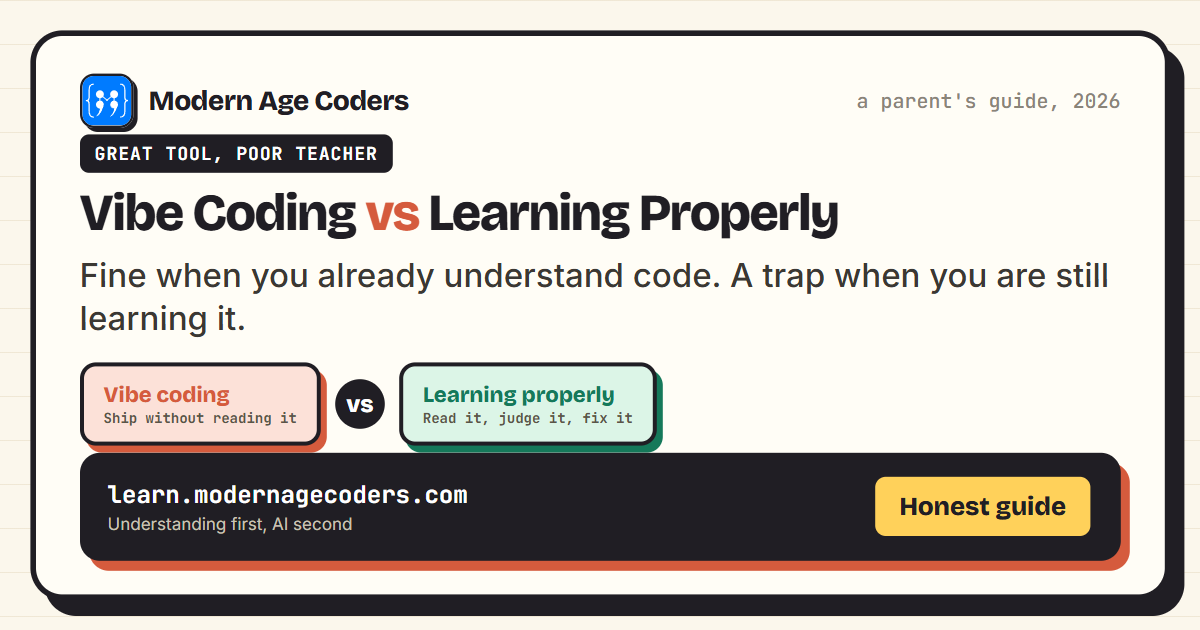
- Learning a new skill. In an Anthropic trial published in January 2026, developers learning a new library with AI help "scored 17% lower than those who coded by hand" on a quiz straight afterwards, with the biggest gap on debugging.
Honest summary: AI's effect on speed is real but hard to measure and changing fast, and leaning on it while learning has a measurable cost to skill. Neither study supports "programmers are about to disappear".
Which tasks change, and which stay with people
| Task | What is changing | Why a person still matters |
|---|---|---|
| Writing routine code from a clear description | Largely drafted by AI already | Someone has to write the clear description and check the draft |
| Looking up syntax and library functions | Mostly answered by AI | Knowing what to ask for, and spotting a function that does not exist |
| Writing tests | AI suggests many of them | GitHub's documentation says "Generated tests should still be reviewed, as they may not cover all scenarios." |
| Debugging | AI helps find likely causes | Deciding which explanation is true needs someone who understands the system |
| Turning vague requests into exact rules | Barely changed | AI does not know what your users or your business mean |
| Security and responsibility | AI can flag issues | GitHub: "always review and test the generated code thoroughly" |
The vendors are clear about where the responsibility sits. GitHub's own Copilot documentation says "Users are responsible for reviewing and validating suggestions before accepting them to ensure they are accurate and appropriate", and warns that "Copilot may generate code that appears to be valid but may not actually be semantically or syntactically correct or may not accurately reflect the intent of the developer."
A small example: the part AI cannot decide
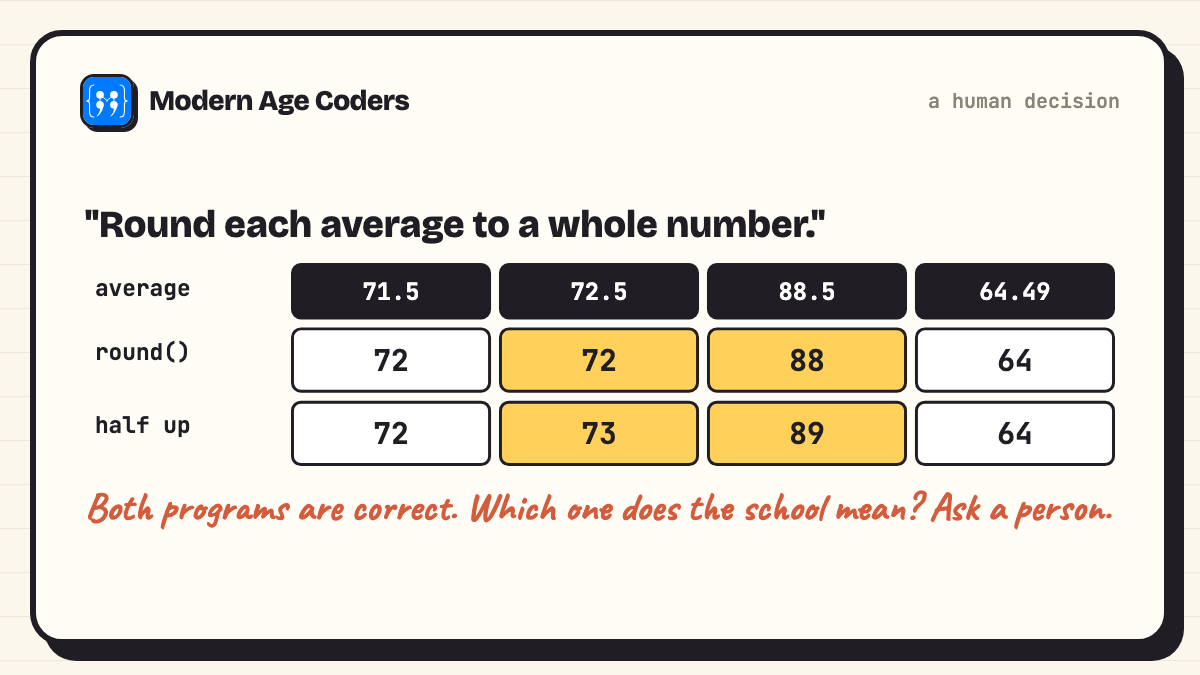
A school asks for a feature: "round each student's average to a whole number for the report card". The quick, plausible answer in Python uses the built-in round(). Here is what it actually does, next to what most schools mean:
# Request: "round each student's average to a whole number for the report card."
averages = [71.5, 72.5, 88.5, 64.49]

# A quick, plausible answer: Python's built-in round()
print("round():     ", [round(a) for a in averages])

# What most schools mean: halves always go up
from decimal import Decimal, ROUND_HALF_UP
half_up = [int(Decimal(str(a)).quantize(Decimal("1"), rounding=ROUND_HALF_UP)) for a in averages]
print("half up: ", half_up)round(): [72, 72, 88, 64]
half up: [72, 73, 89, 64]Python's round() sends exact halves to the nearest even number, so 72.5 becomes 72 and 88.5 becomes 88. That is a sensible rule for statistics and a surprising one for a report card. Neither answer is a bug in the code. The question is which rule the school wants, and that is a conversation with a person. This is the shape of most of the work AI does not replace: not typing, but noticing that a requirement has two readings and asking which one is meant.
Skills that keep their value
- Specifying. Turning "round the marks" into an exact rule with examples. This is what a good prompt is, too.
- Reading code. Most code you meet will be written by someone else or something else. Reading fast and accurately is the core skill.
- Testing. Choosing the awkward cases (zero, empty, ties, halves, century years) before trusting anything.
- Debugging. The skill with the biggest gap in the Anthropic study, and the one AI-only learners lose first.
- Fundamentals: data structures, algorithms, maths. They are how you judge whether a solution will still work at a thousand times the size.
- Talking to people. The survey's "trust AI with machines but not with people" is a career map.
Will AI replace programmers in 10 years?
Nobody can show you data for 2036, so be suspicious of anyone who does. What we can say:
- The official projection horizon runs to 2035 and still shows developer growth. Projections that far out are estimates, and they will be revised as the tools change.
- The trend in every source above is the same direction: more of the typing moves to AI, more of the human job becomes specifying, reviewing and owning the result. The Stack Overflow CEO put it as "every individual becomes almost a manager of agents".
- Whether that means fewer people or more depends on something no one has measured yet: whether cheaper software leads to much more software being built. History has examples both ways.
The safe bet for a learner is the one that works in either future: learn the skills that sit around the code, not just the code.
Will AI replace programmers? What Reddit gets right and wrong
Threads on this question tend to split into "it is over for juniors" and "AI is just autocomplete". The data supports a narrower claim than either. Routine entry-level tasks are the first to be automated, which is real pressure on beginners who can only type code. But the same data shows growing demand for people who design, test and own software, and controlled studies show AI is not a straightforward replacement even for experienced developers. The practical takeaway for a beginner is to start building judgment early, rather than to quit.
What this means for you
| You are | What to do now |
|---|---|
| A school student | Learn to code as problem solving. Write and trace by hand, and use AI as a tutor only where its terms allow your age. Our plan: how to learn programming in the age of AI. |
| A parent | Ask whether your child can explain their code, not just show that it runs. See coding vs AI: what should my child learn. |
| A college student | Add testing, debugging and data structures to every project. Use AI daily, and review every line it writes. |
| A working developer | Move towards requirements, review, architecture and domain knowledge. These are the parts of your job the survey says people still own. |
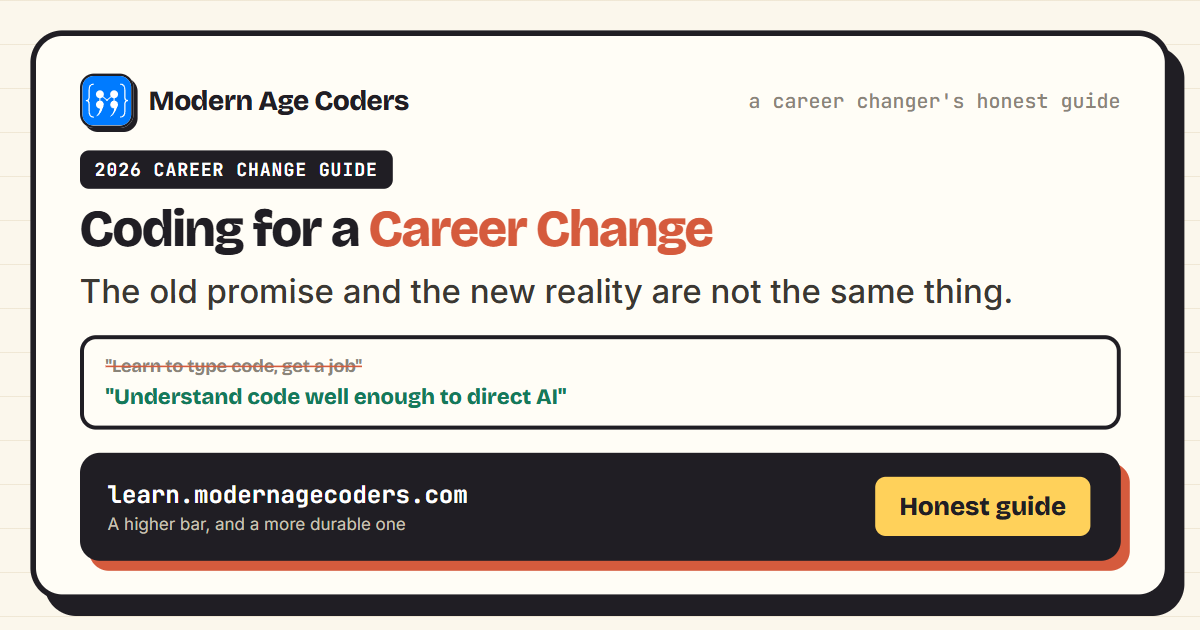
If you are still deciding whether to start, our evidence-led answer to is coding still worth learning covers who should learn and how.
How we teach it
The skills on this page are what our how we teach page describes: students explain their thinking in every lesson, we trace a loop line by line until the student can predict every step, learners derive a rule themselves before they see it written down, we show the same problem three ways, and mistakes are treated as data, not failures. They run through the problem solving and algorithms course for teens, the Python masterclass for college students and adults and the vibe coding course for teens, where students build with AI and review everything it writes. The first class is free.
Frequently asked questions
Not on current evidence. AI is taking over tasks such as writing routine code, while US projections to 2035 show software developer jobs growing much faster than average. The computer programmer role, which is closest to pure code writing, is projected to decline.
Nobody knows. Official projections only run to 2035, and they still show growth for developers. The clear trend is that the job shifts from typing code towards specifying, reviewing and testing it.
Software engineering includes understanding users, designing systems and taking responsibility for results. GitHub's own documentation says users are responsible for reviewing and validating AI suggestions, which is engineering work.
Roles that mostly turn a finished specification into routine code. In O*NET's projections, computer programmers are projected to decline while software developers grow.
It is changing what juniors do first. Routine tasks are being automated, so juniors who can test, debug and read code have an advantage over those who can only write simple code.
Yes, if you build the skills around the code: specifying, testing, debugging and working with people. Those are the skills developers say they still own.
Sometimes. A 2025 METR study found experienced developers took 19% longer with AI; its 2026 update said they are likely faster now but called its own data very weak evidence. The effect depends on the task and the person.
Requirements and specification, reading code, testing, debugging, data structures and algorithms, and the domain you work in. Use AI every day, and stay able to work without it.
Reddit is split between "it is over" and "nothing changed". The data supports neither extreme: tasks are moving to AI, and demand for people who can direct and check that work is still projected to grow.