Table of Contents
- Why AI makes critical thinking matter more
- The four habits of critical thinking with AI
- Real-life example 1: the airline chatbot
- Real-life example 2: a percentage that sounds right
- Real-life example 3: a source that may not exist
- Spotting a confident wrong answer
- Testing code an AI wrote
- Citing sources, including AI
- Exercises for the classroom or home
- How we teach it
- Frequently asked questions
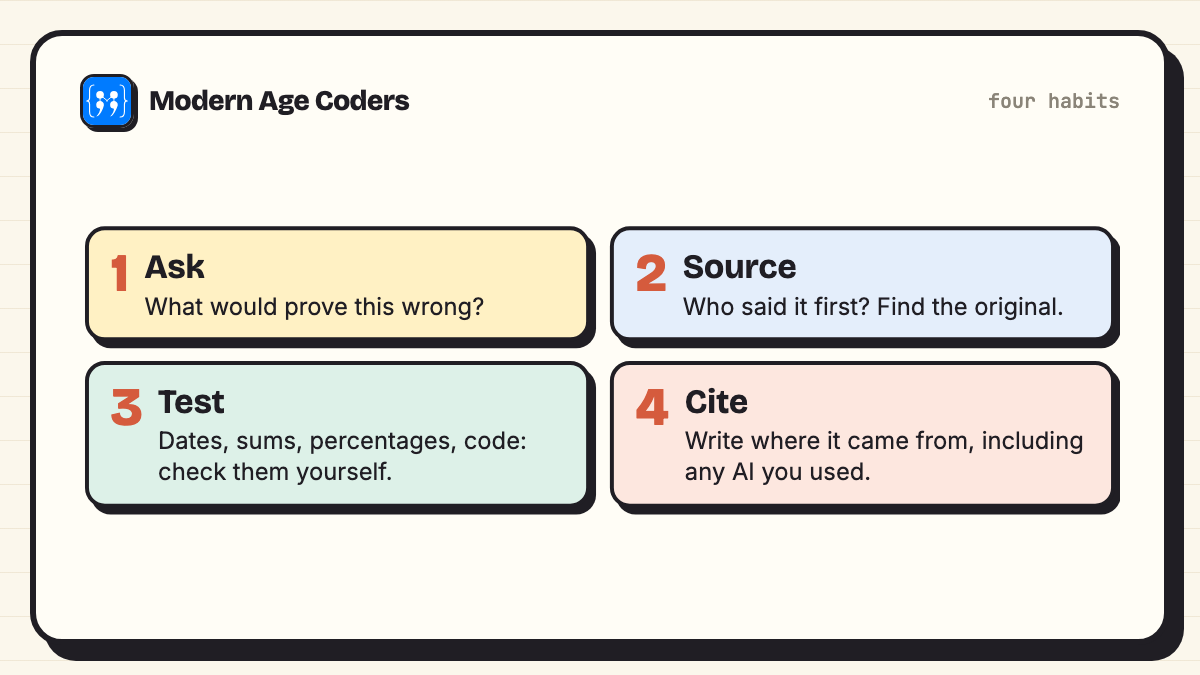
Critical thinking in the age of AI means treating every answer, whether it comes from a chatbot, a website or a friend, as a claim to check rather than a fact to copy. In practice that is four habits: ask what would prove the claim wrong, find the original source, test anything that can be tested (numbers, dates, code), and cite where your answer came from. AI makes these habits more important, not less, because it writes wrong answers in the same confident voice as right ones.
This guide is for students and the parents and teachers who work with them. It has the four habits with a real-life example of each, a coding example that shows how to test an answer, a section on spotting confident wrong answers, and a set of exercises you can use in a classroom or at home tonight.
Why AI makes critical thinking matter more
The companies that build AI tools say it plainly. Google's Gemini Apps privacy hub states: "LLM experiences (Gemini Apps included) can hallucinate and present inaccurate information as factual." GitHub's Copilot documentation defines hallucination as output "that sounds plausible but is factually incorrect, unsupported by the provided context, or entirely fabricated" and calls it "a key reason that human review of AI-generated output is important."
Professionals have drawn the same conclusion. Asked how they verify AI answers, respondents to the Stack Overflow Developer Survey 2026 pointed to sources: "93% of our respondents think that it all comes down to citing your sources."
There is also a quieter risk. When AI does the thinking, people can stop practising it. In a 2026 randomised trial by Anthropic, developers who leaned on AI to learn a new tool scored lower on a quiz afterwards than those who worked by hand, and the researchers describe the low scorers as showing "less independent thinking and more cognitive offloading." Critical thinking is a skill; like any skill, it fades if something else always does it for you.
The four habits of critical thinking with AI
- Ask: what would prove this wrong? Before you accept a claim, name one thing that would make it false. If nothing could, it is not a checkable claim.
- Source: who says so, originally? Find the first source, not a page that repeats it. An AI answer is never the original source.
- Test: can I check it myself? Dates, sums, percentages, unit conversions and code can all be tested in minutes.
- Cite: can someone else check my answer? Write down where each fact came from, including which AI tool you used and what you checked.
Real-life example 1: the airline chatbot
In 2022 a traveller used Air Canada's website chatbot to ask about bereavement fares after a death in the family. The tribunal decision, Moffatt v. Air Canada, 2024 BCCRT 149, records that "The chatbot suggested Mr. Moffatt could apply for bereavement fares retroactively. Mr. Moffatt later learned from Air Canada employees that Air Canada did not permit retroactive applications." The airline's own bereavement page said the opposite of its chatbot.
The tribunal ruled for the traveller and rejected the idea that the chatbot was separate from the airline: "It should be obvious to Air Canada that it is responsible for all the information on its website. It makes no difference whether the information comes from a static page or a chatbot."
The critical thinking lesson. The traveller did nothing foolish; the tribunal found relying on the chatbot was reasonable. But the habit that would have caught the problem early is source: when an answer affects money, health or a deadline, find the official policy page and read the rule there. And for anyone building an AI tool, the lesson is that you own what it says.
Real-life example 2: a percentage that sounds right
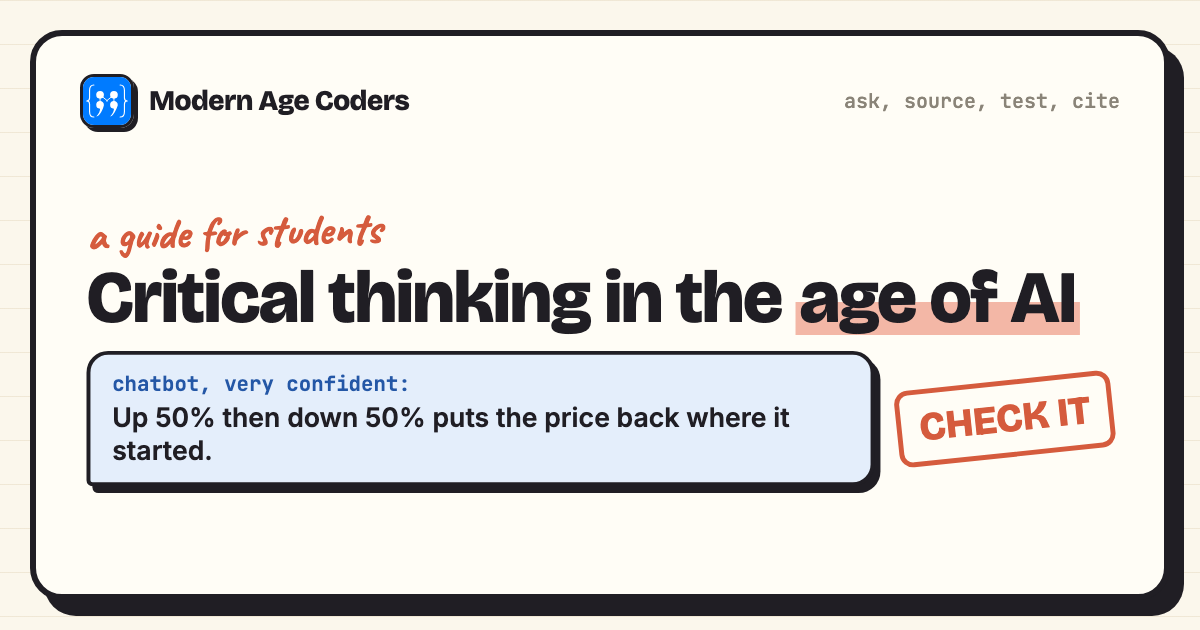
"The price went up 50% and then came down 50%, so it is back where it started." It sounds obvious and it is easy to nod along. It is wrong, and the test habit catches it in three lines of code, together with two other common claims:
# Three confident claims a chatbot or a friend might make. Check, do not trust.
from datetime import date

# Claim 1: "15 August 1947 was a Friday."
print("15 Aug 1947 was a", date(1947, 8, 15).strftime("%A"))

# Claim 2: "0.1 + 0.2 equals 0.3 in Python."
print("0.1 + 0.2 == 0.3 ->", 0.1 + 0.2 == 0.3, "| actual value:", 0.1 + 0.2)

# Claim 3: "A 50% rise followed by a 50% fall brings a price back to where it started."
price = 100
price = price * 1.5
price = price * 0.5
print("after +50% then -50%:", price)15 Aug 1947 was a Friday
0.1 + 0.2 == 0.3 -> False | actual value: 0.30000000000000004
after +50% then -50%: 75.0- Claim 1 is true. 15 August 1947 was a Friday. Checking is not about assuming everything is wrong; it is about knowing which things you have confirmed.
- Claim 2 is false, for an interesting reason. Computers store most decimals as binary fractions, so 0.1 + 0.2 comes out as 0.30000000000000004. Anyone writing money or marks code needs to know this.
- Claim 3 is false. 50% of the higher price is a bigger drop than 50% of the lower price was a rise. The price ends at 75, a quarter lower.
Real-life example 3: a source that may not exist
A common homework trap: you ask an AI for a fact and a reference, and it gives you both, neatly formatted. Before you use either, open the reference. Check three things: the source exists, it is the kind of source it claims to be (a government page, a published paper, a newspaper), and it actually contains the sentence you are about to repeat. GitHub's definition of hallucination includes output that is "entirely fabricated", and a reference is just more output.
We follow the same rule on this blog: every statistic is copied from the source page and searched for word for word before it goes in. That is why the quotes in our post on whether AI will replace programmers carry links you can check.
Spotting a confident wrong answer
AI tools do not sound unsure when they are wrong, so tone is no guide. These signals are more useful:
| Signal | What to do |
|---|---|
| A very precise number with no source attached | Ask where it comes from, then find that source yourself. |
| A reference you cannot open or find | Treat the claim as unsupported until you find a real source. |
| The answer changes when you ask again or rephrase | The tool is not sure. Go to a primary source. |
| It agrees with whatever you suggest | Ask the opposite question. If it agrees with that too, neither answer is evidence. |
| Fluent explanation, no steps you can follow | Ask for the working. A right answer can show its steps; check each one. |
| It is about something recent, local or personal | Check the date and the place. Rules, prices and policies change. |
Testing code an AI wrote
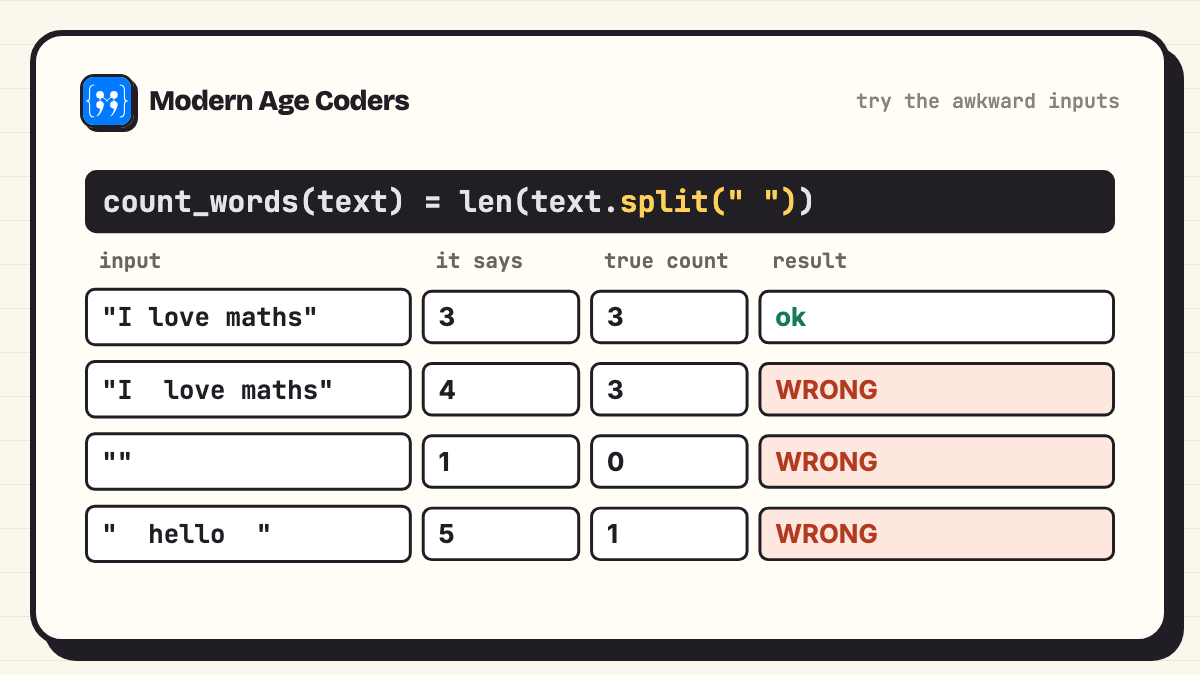
For code, critical thinking has a very concrete form: try the awkward inputs. Here is a word-counting function of the kind a chatbot might offer. It works on the first sentence anyone would try:
# An answer that looks right: "count the words in a sentence"
def count_words(text):
    return len(text.split(" "))

samples = ["I love maths", "I  love maths", "", "  hello  "]
for s in samples:
print(repr(s), "->", count_words(s), "| split() gives", len(s.split()))'I love maths' -> 3 | split() gives 3
'I love maths' -> 4 | split() gives 3
'' -> 1 | split() gives 0
' hello ' -> 5 | split() gives 1A double space, an empty string or spaces at the ends all give the wrong count, because split(" ") splits on every single space, while split() with no argument splits on runs of whitespace. The habit is to write the awkward cases before running anything: empty, one item, repeated items, extra spaces, very large. Our post on whether coding is still worth learning has a second example, a leap year function that fails on 1900.
Citing sources, including AI
Citing is what makes your thinking checkable by someone else. Follow your school's or exam board's rules on AI first; many require you to say when and how you used it. Where there is no rule, this simple line works:
A citation line for AI use
"I used [tool] to [explain / suggest / check] [what]. I checked [the claim] against [original source, with link or title] on [date]." If you did not check it, say so; that is honest and it tells your reader how far to trust it.
- Cite the original source for each fact, not the AI that told you about it.
- Keep the date. Web pages and policies change.
- Quote exactly when you quote, and copy numbers from the source, not from memory or from a summary.
Exercises for the classroom or home
Ten short activities, roughly from youngest to oldest. For children under 13 an adult should run the AI part, since most general chatbots set a minimum age of 13 in their terms; some, such as Claude, are for adults only. ChatGPT's terms require a parent's or guardian's permission for anyone under 18.
| # | Exercise | What it practises | Ages |
|---|---|---|---|
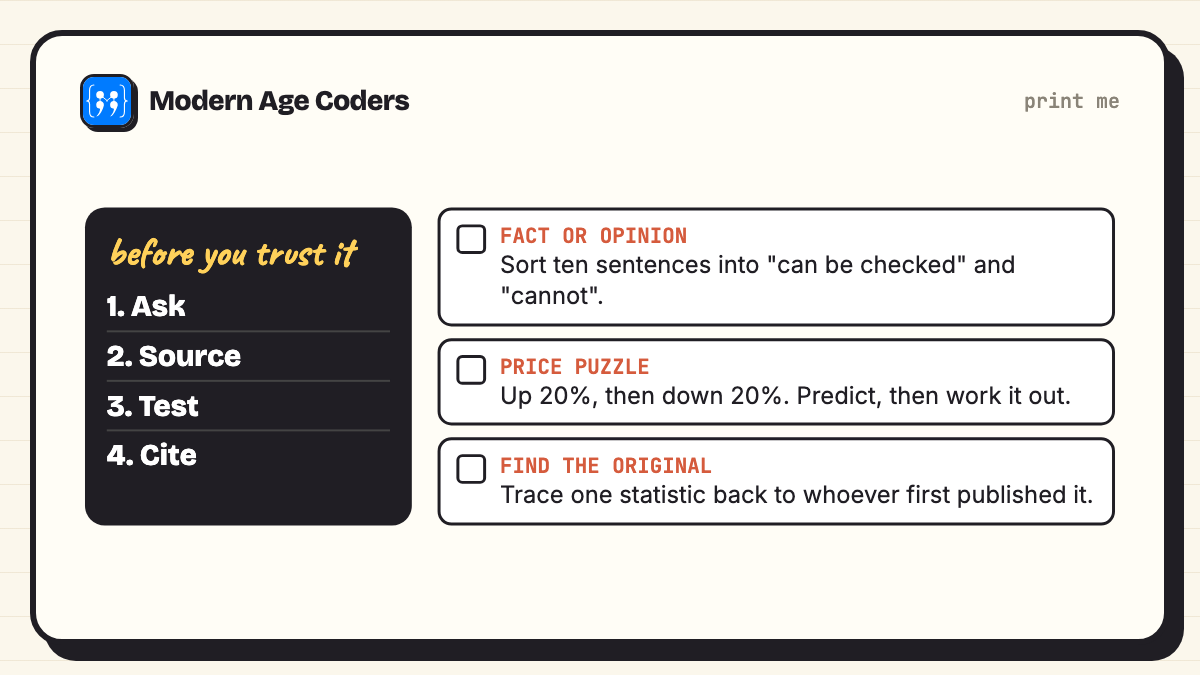
| 1 | Fact or opinion: sort ten sentences from a news story or a cereal box into "can be checked" and "cannot be checked". | Ask | 6+ |
| 2 | Birthday weekday: guess the day of the week you were born, then check on a calendar or with Python's datetime. | Test | 8+ |
| 3 | Price puzzle: a toy goes up 20% then down 20%. Predict, then work it out on paper. | Test | 10+ |
| 4 | Two answers: an adult asks a chatbot the same question twice in different words. Compare the answers and decide which to trust and why. | Ask, Source | 8+ with an adult |
| 5 | Find the original: take one statistic from an article and trace it back to the organisation that first published it. | Source | 12+ |
| 6 | Reference hunt: ask an AI for three sources on a topic, then open each one. Record which exist and which say what was claimed. | Source, Cite | 13+ where terms allow |
| 7 | Awkward inputs: write five test inputs for a function before seeing its code (word count, average, leap year). | Test | 11+ |
| 8 | Break the bot: find one maths or logic question where a chatbot's first answer is wrong, and explain the error. | Ask, Test | 13+ where terms allow |
| 9 | Citation line: rewrite a homework answer with a citation line for every fact, including any AI use. | Cite | 11+ |
| 10 | Policy check: pick a real rule (a school uniform policy, a bus timetable, a return policy). Ask what an AI says, then compare with the official page. | Source | 13+ where terms allow |
Answer notes: in exercise 3 the toy ends 4% cheaper than it started (1.2 times 0.8 is 0.96). In exercise 2, Python's date(year, month, day).strftime("%A") gives the weekday, the same method used in the code above.
How we teach it
These habits are what our how we teach page describes: students explain their thinking in every lesson, we trace a loop line by line until the student can predict every step, learners derive a rule themselves before they see it written down, we show the same problem three ways, and mistakes are treated as data, not failures. They are taught directly in the AI literacy course for kids, the problem solving and computational thinking course for kids and the problem solving course for teens; our AI literacy for students page explains the approach by age. The first class is free.
Frequently asked questions
It is the habit of treating every answer, from AI or anywhere else, as a claim to check. Ask what would prove it wrong, find the original source, test what can be tested, and cite where your answer came from.
AI tools can state wrong answers confidently. Google's own Gemini help pages say LLM experiences can hallucinate and present inaccurate information as factual, and GitHub says hallucinations are a key reason human review matters.
It can, if it does the thinking for you. In a 2026 Anthropic study, people who handed their work to AI learned less than those who worked by hand. Used to question and check your own work, it can do the opposite.
Give them AI answers to check rather than to copy: compare two answers, trace a statistic to its source, test a claim with a calculation or code, and add a citation line. The exercise set above works for ages 6 and up with an adult.
Look for precise numbers without sources, references you cannot open, answers that change when you ask again, and agreement with whatever you suggest. Then test or source the claim yourself.
Checking a chatbot's policy answer against the official page, as in the Air Canada tribunal case; testing a percentage claim with a calculation; and opening every reference an AI gives you before using it.
Follow your school's rules first. In general, cite the original source of each fact, and add a line saying which AI tool you used, for what, and what you checked.
The habits can start at 6 with fact-or-opinion and checking games, with an adult running any AI tool. Most general AI tools set a minimum age of 13 in their terms, and some are for adults only.
Yes. Testing code with awkward inputs, reading it line by line and asking what would make it fail are critical thinking applied to programs.