Table of Contents
Vibe coding is the buzzword of the moment, and it is easy for a parent to wonder whether their child should skip the hard work of learning to code and just describe apps to an AI instead. It is a fair question, and the honest answer matters, because getting it wrong wastes a child's time and leaves them dependent. Here is the difference, what happens when it breaks, and what it means for your child.
The short answer
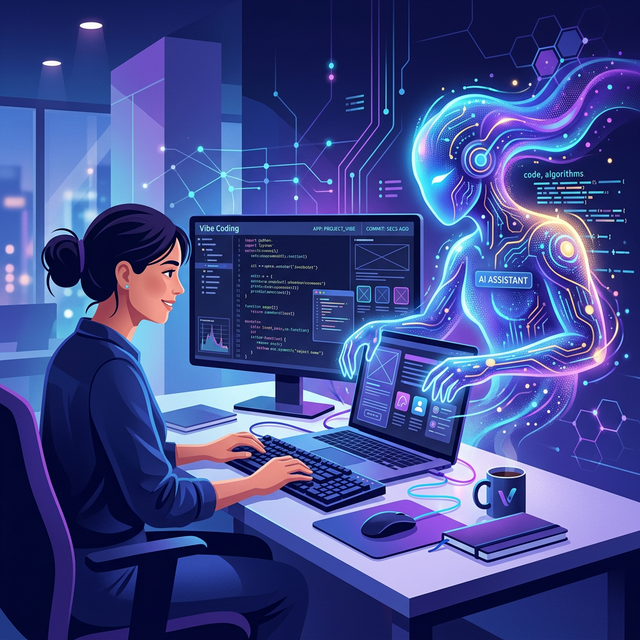
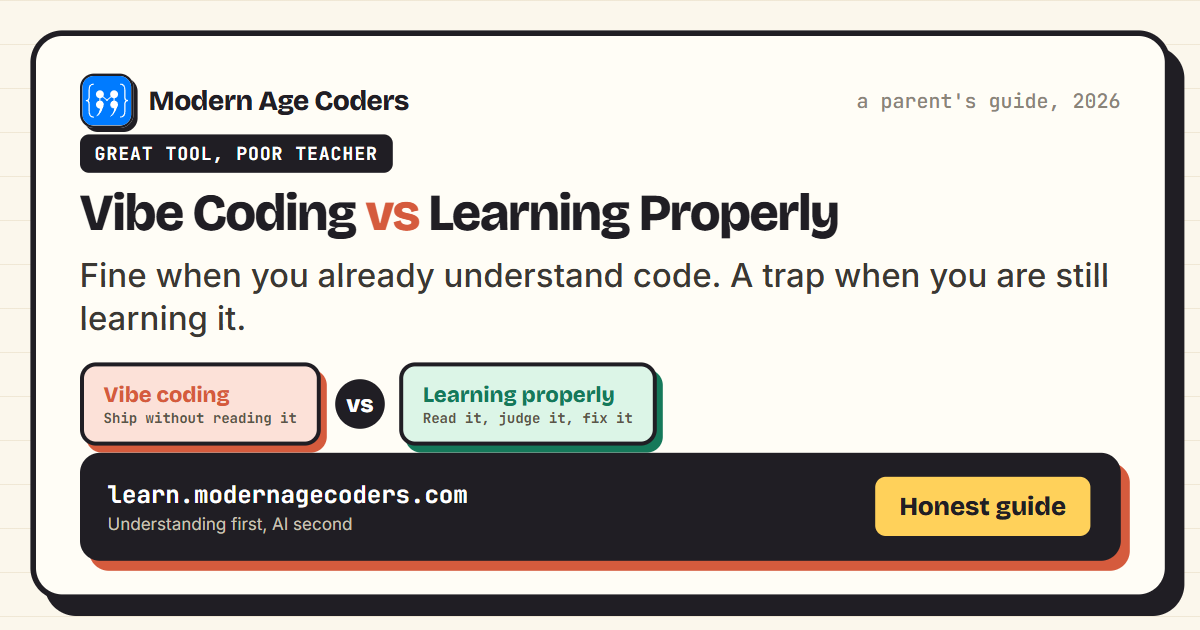
Vibe coding means building software by telling an AI what you want in plain language, without reading or understanding the code it writes. Learning to code properly means understanding that code well enough to check it, fix it and change it. Vibe coding is a genuinely useful tool for quick prototypes, but a poor way to learn. The goal is a child who understands code and uses AI to work faster, not a child who can only prompt a chatbot.
Vibe coding is a fantastic power tool and a terrible teacher. Give it to someone who understands code and they build faster. Give it to someone learning, as a substitute for thinking, and they build a pile of software they cannot read, fix or explain.
What each one actually is
- Vibe coding: you describe what you want, an AI writes the code, and you ship it without necessarily reading the code. Fast, impressive, and great for prototypes.
- Learning to code properly: you understand how programs are built, so you can read what the AI writes, judge whether it is correct, fix it when it breaks, and change it when you need to. Slower to start, but it lasts.
What happens when it breaks
The difference between vibe coding and understanding code is invisible right up until something goes wrong, and then it is the entire story.
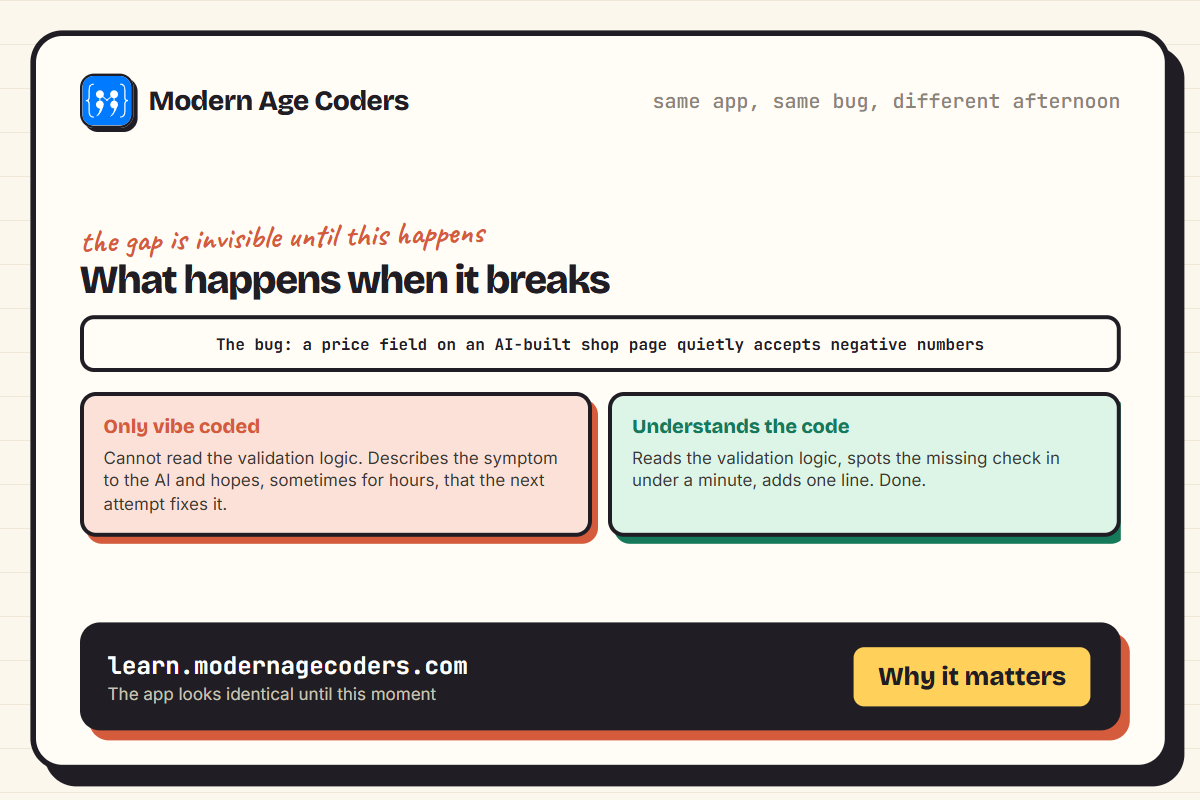
Picture an AI-built shop page where the price field quietly accepts a negative number. A child who only vibe coded has no way to notice, describe, or fix the problem, so they ask the AI to fix it and hope, sometimes for hours. A child who understands code reads the validation logic, spots the missing check in under a minute, and adds one line to stop it. Same starting app, same bug, completely different afternoon.
Why vibe coding is a poor way to learn
A child who only vibe codes builds a growing pile of software they cannot read, fix or extend. The moment the AI gets stuck, so do they, because they never built the understanding to take over. It feels productive and teaches almost nothing. Worse, it hides how little the child understands behind a working result, so the gap only shows up later, in an interview, an exam, or the first real problem the AI cannot solve on its own.
Why understanding still wins
The people who get the most out of vibe coding are, almost without exception, the ones who already know how to code. They can read every line the AI writes, spot when it is wrong, and fix it fast. Their understanding is what makes the tool powerful. Take that understanding away and the same tool becomes a trap. So the fundamentals, logic, structure and how to reason about code, matter more in the AI era, not less.
The right order to learn in
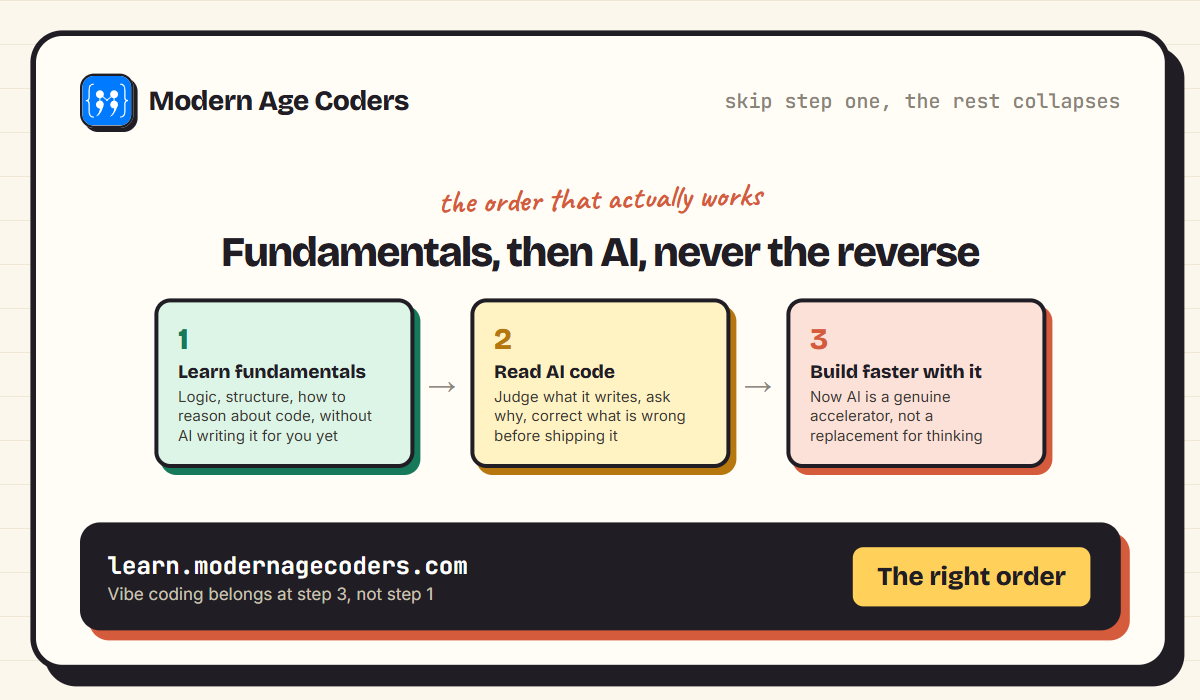
How your child should actually use AI
- Learn the fundamentals first, so they understand what code does.
- Use AI as a tutor and a tool: read what it writes, ask it why, and correct it.
- Build real projects and understand every part, using AI to go faster, not to skip thinking.
- Treat vibe coding as a way to prototype ideas quickly, then understand and improve what it produced.
- Never ship code they cannot read or explain.
Children do not need another app that teaches them to copy code. They need a mentor who teaches them to think.
, Shivam Khemka, Founder of Modern Age Coders
The bottom line
Vibe coding is a powerful tool and a poor teacher. Your child should learn to code properly first, then use AI, including vibe coding, to build faster while staying in control of the code. Modern Age Coders teaches exactly this: real fundamentals plus modern AI tools used the right way, live and in small batches for ages 6 to 67. We are rated 4.9 across 547 Google reviews, and there is a free demo class before you pay.
Frequently Asked Questions
No. Vibe coding means building software by describing it to an AI without necessarily reading the code, while learning to code properly means understanding that code well enough to check, fix and change it. Vibe coding is a useful tool for prototypes, but it does not teach the understanding that real coding requires.
No. A child who only vibe codes ends up with software they cannot read or fix, and gets stuck the moment the AI does. Learn the fundamentals first, then use AI, including vibe coding, to build faster while staying in control. Understanding first, tools second, is the order that lasts.
Yes, genuinely, for quick prototypes and for people who already understand code and can check what the AI writes. In skilled hands it speeds up building a lot. It is only a problem when used as a substitute for learning, because then the child never builds the understanding to take over when the AI gets stuck.
No, the opposite. When AI writes most of the code, the human's value is understanding it well enough to decide what to build and catch mistakes, which makes real coding skill more valuable, not less. The children who benefit most from vibe coding are the ones who learned to code properly first.
Learn the fundamentals first, then use AI as a tutor and a tool: read what it writes, ask why, and correct it. Build real projects and understand every part, using AI to go faster rather than to skip thinking, and never ship code they cannot read or explain. A mentor who reviews their work keeps this on track.
Whoever built it has to explain the bug to the AI well enough for it to find and fix it, which is much harder without understanding the code in the first place. Someone who reads and understands the code can usually spot the problem directly and fix it in minutes. The app looks identical until that moment; the difference in ability only shows up when something goes wrong.
It works about as well as it does for a child: fine for a quick, disposable prototype, but it does not build the understanding needed to maintain, debug or extend the result over time. Adults switching careers into tech usually still need to learn the fundamentals properly, then use vibe coding as an accelerator once they can judge what the AI produces.