Table of Contents
Ever asked Siri to set a reminder? Played a video game where enemies seemed to "think" on their own? Noticed how Netflix always knows what you want to watch next? Congratulations. You've interacted with AI agents!
But what exactly is an AI agent? And why does everyone in tech keep throwing around terms like "autonomous agents," "multi-agent systems," and "LLM agents"? If you're confused, you're not alone. The world of AI agents comes with its own vocabulary, and it can feel overwhelming.
Here's the good news: understanding AI agent terminology isn't as complicated as it sounds. Whether you're a student exploring tech careers, a professional looking to understand AI better, or just someone curious about how technology works, this guide breaks down everything you need to know. No jargon, no fluff, just clear explanations that actually make sense.
Let's dive in and decode the language of AI agents together!
What is an AI Agent?
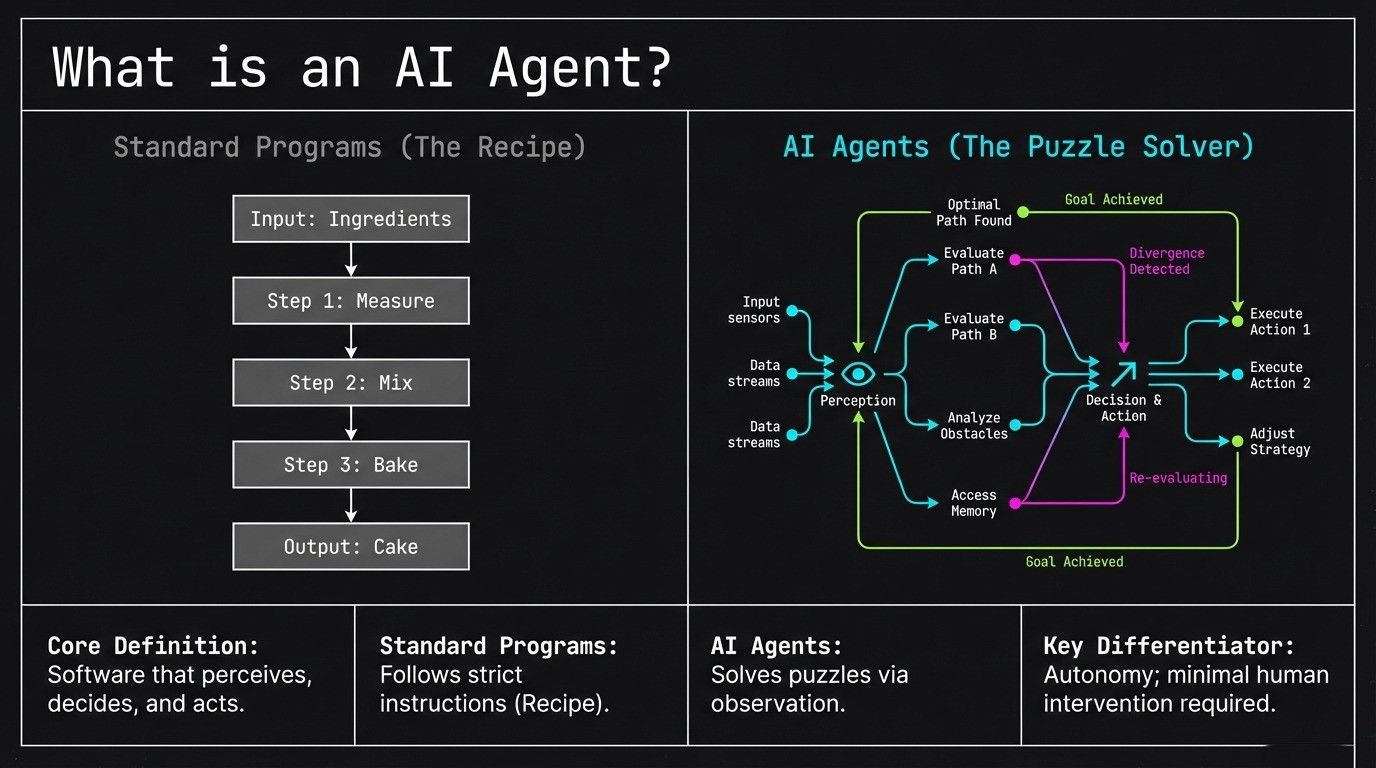
At its core, an AI agent is software that can perceive its environment, make decisions, and take actions to achieve specific goals, all with minimal human intervention.
Think of it this way: a regular computer program follows a strict set of instructions. If you tell it to add 2 + 2, it gives you 4. Simple. But an AI agent is different. It can observe what's happening around it, decide what to do based on that information, and then act accordingly. It's less like following a recipe and more like solving a puzzle.
Here are some AI agents you probably use every day:
Virtual assistants like Alexa or Google Assistant listen to your voice commands, understand what you want, and take action, whether that's playing music, setting timers, or answering questions.
Game characters (NPCs - non-player characters) in video games don't just stand around. They react to your moves, chase you when they're enemies, or help you when they're allies.
Recommendation systems on Netflix, YouTube, or Spotify observe what you watch or listen to, learn your preferences, and suggest content you might like.
The key difference between AI agents and regular programs? Autonomy. AI agents can make decisions on their own without you telling them exactly what to do in every situation. They perceive, think, and act, just like the word "agent" suggests, they act on your behalf.
For a deeper dive into how AI works, check out OpenAI's research on AI systems, which explores the fundamentals of intelligent agents.
Core AI Agent Terminology You Need to Know
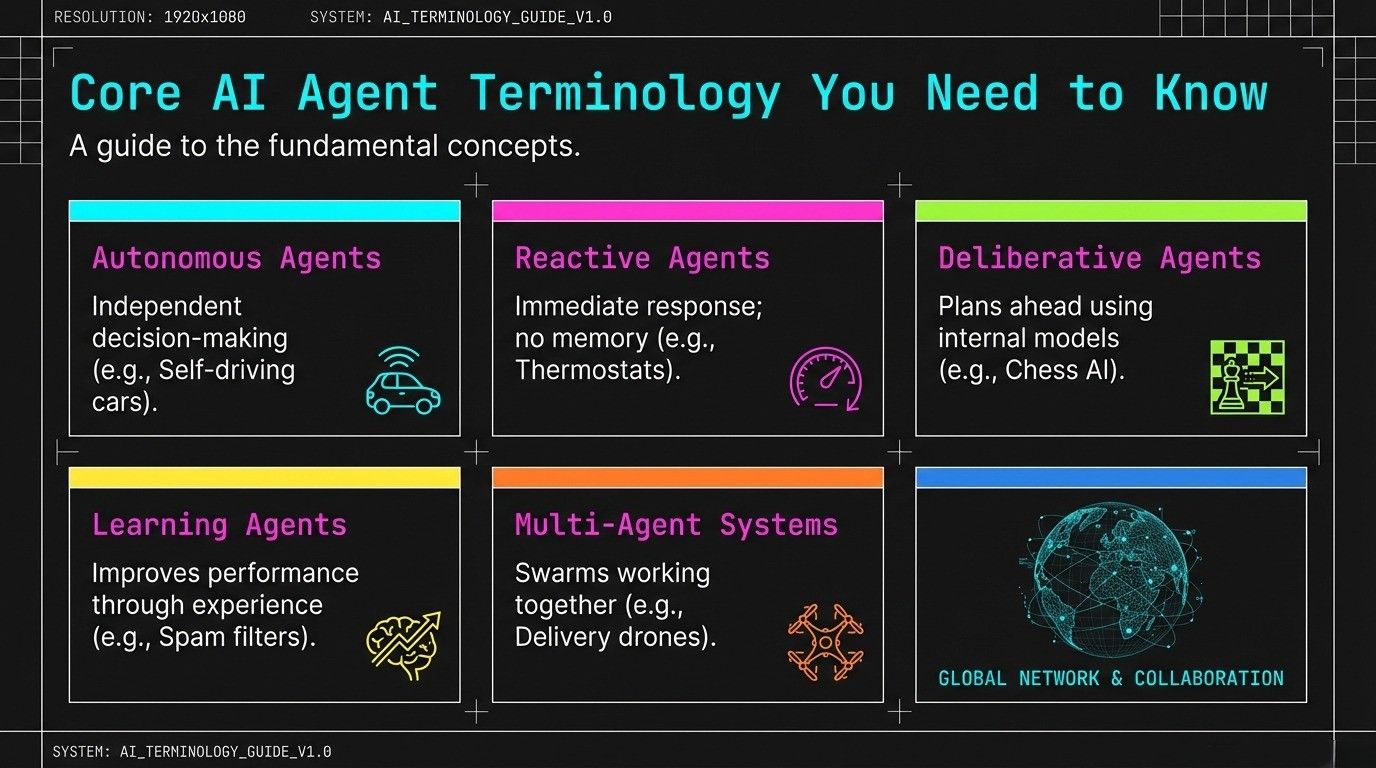
Now that you know what an AI agent is, let's break down the different types. Each type has its own strengths and use cases.
Autonomous Agents
Autonomous agents are the independent workers of the AI world. They operate without constant human control, making their own decisions based on their programming and what they observe.
Think of a self-driving car. Once you set the destination, it handles everything, reading traffic signals, avoiding obstacles, choosing routes, all without you touching the steering wheel. That's autonomy in action.
Other examples include automated trading bots that buy and sell stocks based on market conditions, or smart home systems that adjust temperature and lighting based on your habits.
Reactive Agents
Reactive agents are the simplest type. They respond immediately to what's happening right now, with no memory of the past and no planning for the future.
A thermostat is a perfect example. When the temperature drops below a certain point, it turns on the heat. When it gets too warm, it cools things down. It doesn't remember yesterday's temperature or plan for tomorrow. It just reacts to the current moment.
Reactive agents are fast and efficient for simple tasks, but they can't handle complex situations that require learning or planning.
Deliberative Agents
Unlike reactive agents, deliberative agents think before they act. They maintain an internal model of the world, consider different options, and plan their actions to achieve long-term goals.
Chess-playing AI is a great example. It doesn't just respond to your moves. It thinks several moves ahead, considering different strategies and their potential outcomes. This planning ability makes deliberative agents much more powerful for complex tasks.
Learning Agents
Learning agents are where things get really interesting. These agents improve over time by learning from experience. The more they work, the better they get.
Your email's spam filter is a learning agent. At first, it might let some spam through or accidentally mark legitimate emails as junk. But as you correct it by marking emails as "spam" or "not spam," it learns your preferences and gets more accurate.
You can see exactly how that learning works by building a small filter yourself. Our guide to how spam filters work trains one in about forty lines of Python and shows the mistake it makes on a perfectly normal message.
This ability to learn and adapt is what makes modern AI so powerful, especially when combined with machine learning techniques.
Multi-Agent Systems
Sometimes one agent isn't enough. Multi-agent systems involve multiple AI agents working together (or competing) to solve problems.
Imagine a swarm of delivery drones coordinating to deliver packages across a city. Each drone is its own agent, but they communicate with each other to avoid collisions, share information about traffic patterns, and optimize their routes collectively.
Traffic management systems, online multiplayer games, and even financial markets can be viewed as multi-agent systems where different agents interact to create complex behaviors.
Modern AI Agent Terms (LLMs and Beyond)
.jpg)
The AI landscape has exploded recently with new types of agents powered by advanced technology. If you've heard about ChatGPT or other AI chatbots, you're already familiar with some of these concepts. As AI continues to transform how we work and learn, understanding these modern agent types becomes increasingly important.
LLM Agents (Large Language Model Agents)
LLM agents are AI agents powered by large language models, massive neural networks trained on enormous amounts of text data. These agents can understand and generate human-like text, making them incredibly versatile.
ChatGPT, Claude, and Google's Gemini are all examples of LLM agents. They can write essays, answer questions, help with coding, translate languages, and even engage in creative storytelling. What makes them "agents" rather than just text generators is their ability to understand context, maintain conversations, and take actions based on your requests.
Prompt-Based Agents
Prompt-based agents are a subset of LLM agents that respond to text instructions (called prompts). The beauty of these agents is their flexibility. You can ask them to do almost anything just by changing how you phrase your request.
Want a formal business email? Ask for it. Need a casual explanation of quantum physics? Just say so. The same agent can handle countless different tasks without any additional training, all based on how you "prompt" it.
Tool-Using Agents
Here's where it gets even cooler. Tool-using agents can interact with external tools and services to extend their capabilities beyond just text generation.
These agents might use a web search to find current information, call a calculator API to solve complex math problems, or access a database to retrieve specific data. They're not limited to what they know from their training. They can actively seek out and use additional resources.
This is similar to how you might use Google to look something up or a calculator to check your math. Tool-using agents do the same thing, but automatically.
Agentic AI
Agentic AI is a newer term describing AI systems with greater autonomy and goal-oriented behavior. These systems can break down complex tasks into smaller steps, execute them in sequence, and adjust their approach based on results.
For example, instead of just answering "How do I plan a trip to Japan?", an agentic AI might search for flights, compare hotel prices, suggest itineraries, and even help you book reservations, all from a single request. It takes initiative and works toward the goal you set, rather than just providing information.
Research on agentic AI is rapidly evolving, with companies like Anthropic publishing safety research on how to build more capable and reliable autonomous systems.
Key Components of AI Agents
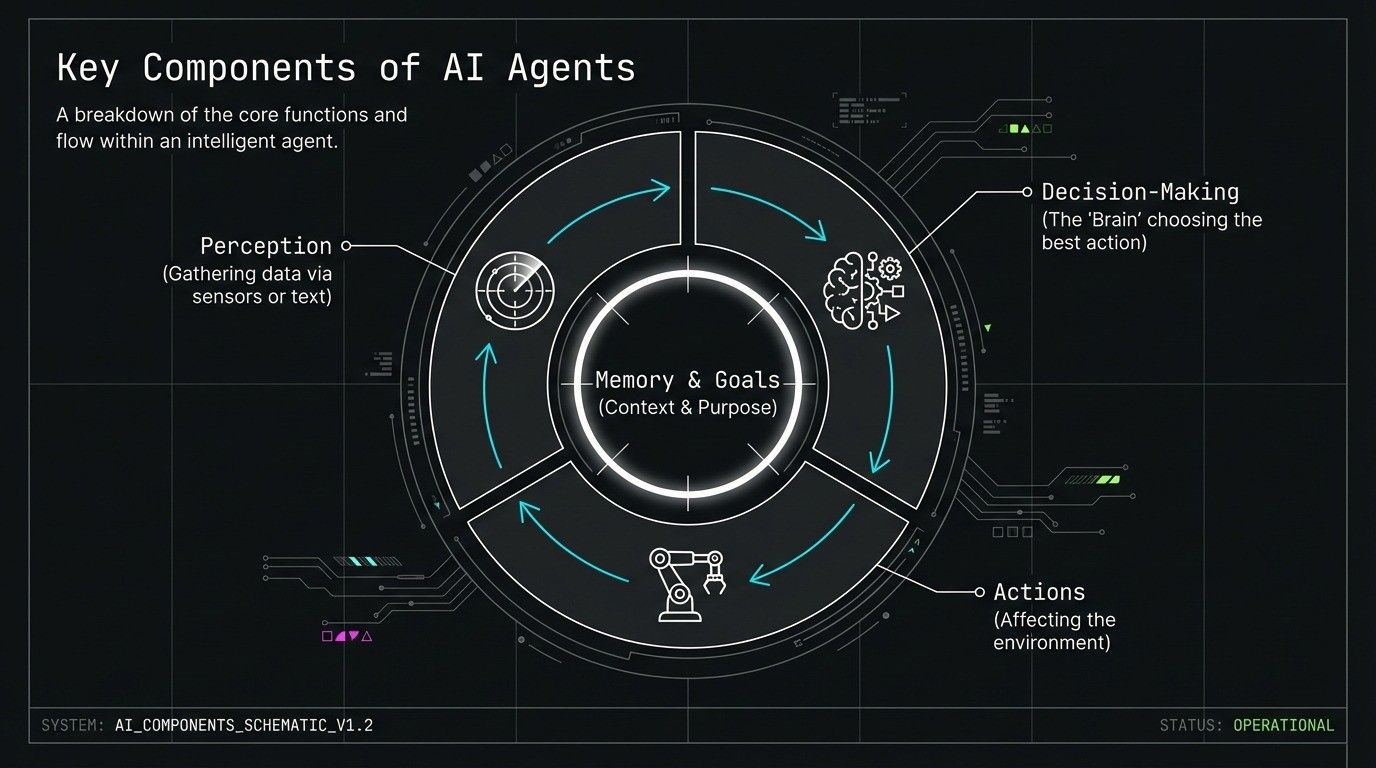
What makes an AI agent tick? Let's break down the essential parts that every AI agent needs.
Perception
Perception is how agents gather information about their environment. Just like you use your eyes and ears to understand what's happening around you, AI agents need ways to "sense" their world.
For a robot, perception might involve cameras for vision, microphones for sound, or sensors for touch. For a software agent like a chatbot, perception means reading text input from users or accessing data through APIs.
Without perception, an agent would be operating blind, unable to understand what's happening or what needs to be done.
Decision-Making (Reasoning)
Once an agent perceives its environment, it needs to decide what to do. Decision-making is the brain of the agent, the process of choosing the best action based on available information.
Some agents use simple rule-based logic: "If temperature is below 68°F, turn on heat." Others use sophisticated machine learning models that weigh multiple factors and predict outcomes.
The complexity of decision-making varies widely. A chess AI considers millions of possible moves and their consequences. A spam filter decides whether an email is legitimate or junk based on patterns it has learned.
Actions
Actions are how agents affect their environment. After perceiving and deciding, an agent needs to actually do something.
For a virtual assistant, actions might be playing music, setting reminders, or sending messages. For a self-driving car, actions include steering, accelerating, and braking. For a chatbot, the action is generating a text response.
Every action creates new observations, forming a feedback loop: perceive → decide → act → observe results → perceive again. This cycle continues as long as the agent is running.
Memory/State
Memory is what allows agents to be more than just reactive. It's the agent's ability to remember past interactions, learn from experience, and maintain context.
Imagine talking to a chatbot that forgot everything you said after each message. Frustrating, right? Good AI agents maintain conversation history (short-term memory) and sometimes even remember preferences across multiple sessions (long-term memory).
Memory is what transforms a simple reactive agent into something that can handle complex, multi-step tasks.
Goals/Objectives
Every agent needs a purpose, something it's trying to achieve. Goals guide an agent's decisions and actions.
For a game AI, the goal might be "defeat the player" or "protect the castle." For a recommendation system, it's "suggest content the user will enjoy." For a cleaning robot, it's "clean the entire floor without getting stuck."
In reinforcement learning (a type of machine learning), goals are formalized through reward functions, numerical scores that tell the agent whether its actions are bringing it closer to or further from its objective.
Types of AI Agents by Intelligence Level
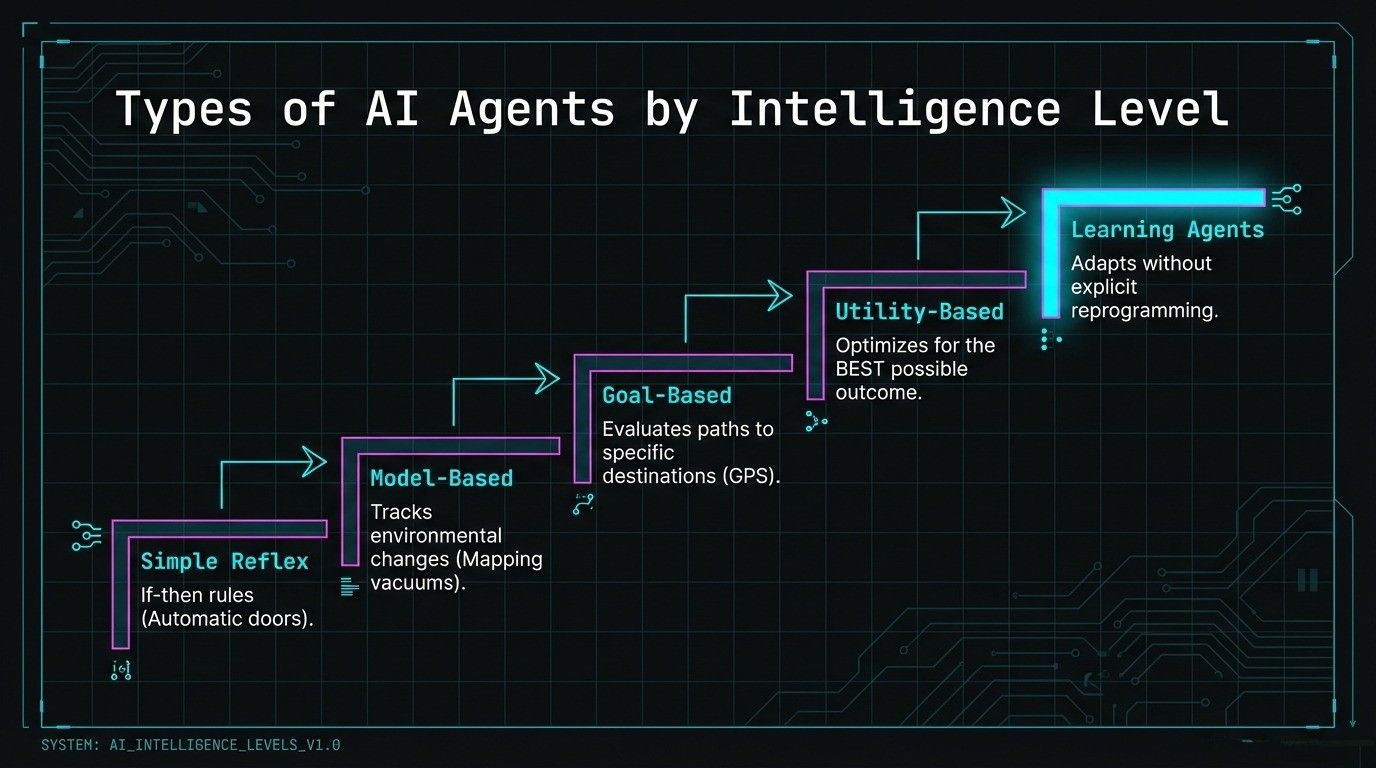
Not all AI agents are created equal. They exist on a spectrum from simple to sophisticated. Many students working on real-world programming projects start with simpler agents before building more complex systems.
Simple Reflex Agents
Simple reflex agents are the most basic. They follow "if-then" rules and have no memory or learning capability.
Example: An automatic door sensor. If motion is detected, open the door. If no motion for 5 seconds, close the door. That's it. No planning, no learning, just immediate reactions to specific conditions.
These agents are fast and reliable for straightforward tasks, but they can't adapt to new situations or handle complexity.
Model-Based Agents
Model-based agents maintain an internal representation of their world. They track how their environment changes over time and use this model to make better decisions.
A vacuum cleaning robot that maps your home is a model-based agent. It remembers which areas it has already cleaned and which still need attention, allowing it to work more efficiently than a simple reactive robot that just bumps around randomly.
Goal-Based Agents
Goal-based agents work toward specific objectives and can evaluate different paths to reach their goals.
Think of GPS navigation. You tell it your destination (the goal), and it calculates multiple possible routes, considering factors like distance, traffic, and toll roads. It then chooses the path that best achieves the goal based on your preferences.
Before any route can be planned, the phone has to know where it is, and that part is pure maths: timing signals from satellites and solving for the one point that fits. Our guide to how GPS works does the calculation in a few lines of Python.
This flexibility makes goal-based agents much more powerful than reflex agents, which can only respond to immediate conditions.
Utility-Based Agents
Utility-based agents take things a step further by optimizing for the best possible outcome, not just any path to the goal.
They assign values (utilities) to different outcomes and choose actions that maximize overall utility. This is useful when there are trade-offs to consider.
For example, a route-planning agent might weigh faster arrival time against lower fuel consumption and less traffic stress. It evaluates which combination provides the highest overall utility based on your priorities.
Learning Agents
Learning agents represent the highest level of sophistication. They improve their performance over time through experience, adapting to new situations without being explicitly reprogrammed.
Modern AI applications, from recommendation systems to language models, are primarily learning agents. They continuously get better at their tasks by analyzing patterns in data and adjusting their behavior accordingly.
This ability to learn is what makes AI so transformative. Instead of programming every possible scenario, we can create agents that figure things out on their own.
AI Agents in Different Fields
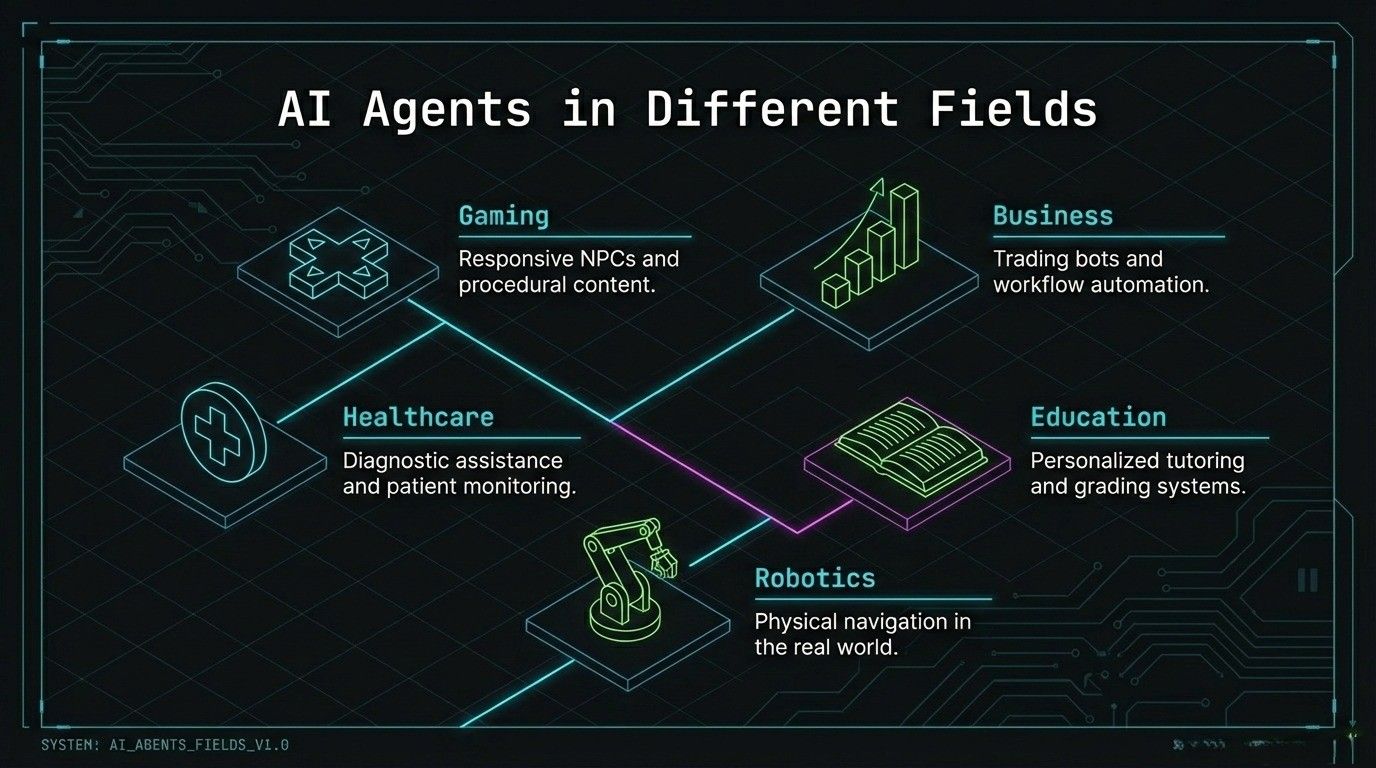
AI agents aren't just theoretical concepts. They're already working across countless industries. From entertainment to healthcare, AI and automation are transforming how businesses operate and deliver value.
Gaming
In video games, AI agents control non-player characters (NPCs), making them feel alive and responsive. Enemy soldiers coordinate attacks, teammates provide cover, and neutral characters react to your choices.
Modern games also use AI for procedural content generation, automatically creating levels, quests, and storylines. Some games even adjust difficulty dynamically based on your skill level, keeping the experience challenging but not frustrating.
Business and Finance
Financial trading bots are AI agents that analyze market data and execute trades automatically, often faster than any human could. Customer service chatbots handle routine inquiries, freeing human agents to tackle complex issues.
Workflow automation agents schedule meetings, route documents, send reminders, and manage data entry, boring tasks that AI can handle while humans focus on creative and strategic work.
Healthcare
Diagnostic assistance agents help doctors identify diseases by analyzing medical images, lab results, and patient histories. Treatment recommendation systems suggest personalized care plans based on the latest medical research.
Patient monitoring agents watch vital signs continuously, alerting healthcare providers to concerning changes before they become emergencies. These agents don't replace doctors. They augment human expertise with tireless attention to detail.
Education
Personalized tutoring systems act as AI teaching assistants, adapting lessons to each student's pace and learning style. They provide instant feedback, identify areas where students struggle, and adjust their approach accordingly.
Automated grading agents can assess essays, programming assignments, and problem sets, giving students faster feedback while reducing teachers' workload. Adaptive learning platforms continuously adjust content difficulty to keep students in their optimal learning zone.
Robotics
Physical robots are AI agents operating in the real world. They navigate warehouses, assist in surgery, explore dangerous environments, and even provide companionship.
These agents must handle the messy, unpredictable physical world, a much harder challenge than operating in digital environments. They integrate perception (sensors), decision-making (AI algorithms), and action (motors and manipulators) to accomplish tasks ranging from package delivery to disaster response.
Common Misconceptions About AI Agents
Let's clear up some confusion about what AI agents are, and aren't.
Misconception 1: AI agents are "intelligent" like humans. Not quite. Most AI agents are specialized for narrow tasks. A chess-playing AI can't drive a car. A language model can't navigate a physical space. They're incredibly good at specific jobs, but they lack general intelligence.
Misconception 2: Autonomy means consciousness. Just because an agent can make decisions doesn't mean it's aware or conscious. Today's AI agents follow patterns and rules. They don't have experiences or emotions, even if they sometimes seem to.
Misconception 3: All AI systems are agents. Not every AI system qualifies as an agent. Simple machine learning models that just classify images or predict numbers aren't agents. They don't perceive, decide, and act autonomously toward goals.
Misconception 4: Agents must be complex. Some of the most useful agents are quite simple. A thermostat is technically an agent, and it's just a basic sensor plus a switch. Complexity isn't required for something to be an agent.
Misconception 5: AI agents will soon match human intelligence. Current AI agents excel at narrow tasks but struggle with the flexibility and common sense that humans take for granted. We're still far from artificial general intelligence (AGI), agents that can handle any intellectual task a human can.
Understanding these limitations helps set realistic expectations about what AI agents can and can't do.
The Future of AI Agents
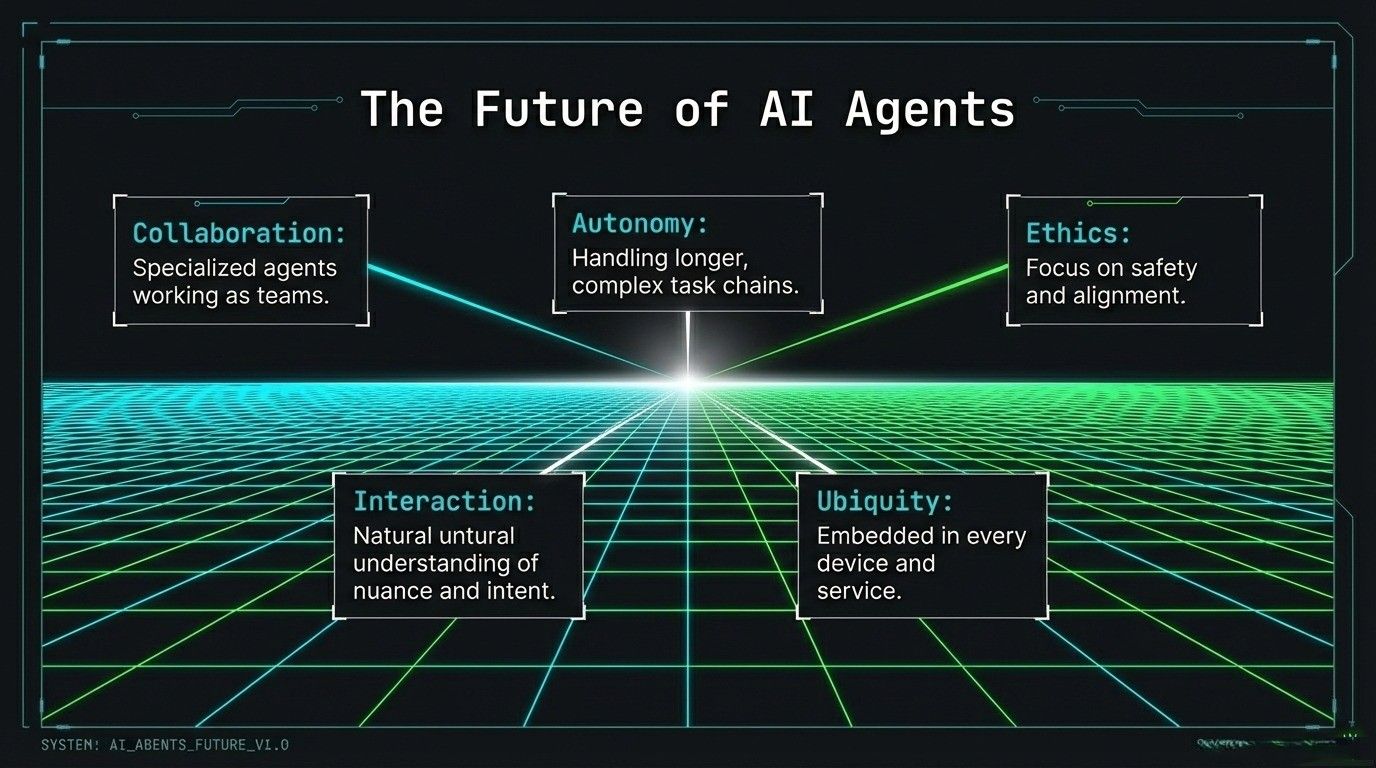
Where is AI agent technology heading? The trends are exciting.
More collaboration. Future multi-agent systems will coordinate more seamlessly, with specialized agents working together like members of a team. Imagine AI assistants for different tasks, scheduling, research, writing, coding, all collaborating to help you accomplish complex projects.
Better human interaction. As natural language processing improves, AI agents will understand context, nuance, and intent more accurately. Conversations will feel more natural, and agents will require less hand-holding to understand what you want.
Increased autonomy and reliability. Agents will handle longer task chains with less human supervision. Instead of giving step-by-step instructions, you'll describe desired outcomes, and agents will figure out how to achieve them.
Ethical safeguards. As agents become more capable, ensuring they behave safely and align with human values becomes critical. Expect more focus on AI safety, transparency, and accountability in agent design.
Ubiquitous integration. AI agents will be embedded in nearly every device and service, from smart homes to healthcare to education. The question won't be "Does this use AI?" but rather "How is AI helping here?"
Organizations like MIT Technology Review track these developments, offering insights into where AI agent technology is heading and how it will impact our lives.
Conclusion
Understanding AI agent terminology might have seemed daunting at first, but it's really not that complicated once you break it down. AI agents are simply software systems that perceive their environment, make decisions, and take actions to achieve goals, with varying levels of sophistication from simple thermostats to complex language models.
These concepts are becoming more relevant every day. AI agents are already integrated into apps you use, games you play, and services you rely on. As technology continues advancing, they'll become even more central to how we work, learn, and live.
Whether you're a student considering a career in tech, a professional looking to stay current, or someone curious about the AI revolution happening around us, understanding these terms gives you a foundation to make sense of what's really going on behind the scenes.
The best part? You don't need to be a computer scientist to understand or even work with AI agents. Many tools and platforms now make it easy for anyone to experiment with AI. The key is understanding the concepts, which you now do.
So take this knowledge and explore. Try out AI tools. Pay attention to how agents work in the apps you use. Maybe even start learning to code so you can build your own agents someday. The future of AI is being written right now, and understanding the language of AI agents is your first step toward being part of it.