SUK / SIX / 01
Scratch, start to finished game
Characters, sounds and a first full game.
Open the syllabusHong Kong · Summer holiday · Ages 6 to 12
For a primary-age child, a Hong Kong summer can drift: too hot for long outdoor afternoons, too long for screens without a plan. A coding course gives some of those hours a shape and something to show at the end. Ours is taught one to one, live and in English, from your home, starting the week the school holiday begins.
Teaching live since 2020 · 10,000+ students worldwide · in Hong Kong, one child and one mentor, online, in English
In brief
Modern Age Coders offers Hong Kong children of about 6 to 12 an online summer course in coding: live lessons, one to one, in English, with a mentor who teaches only your child. You pick the start week and agree a holiday pace with the mentor, including its fee, before the first holiday class; there is no camp timetable to fit. Six- to eight-year-olds build games with blocks, older children move to Minecraft code or Python, and every child finishes the summer with a project to show. The first class costs nothing.
Where most children begin
Three starting points, by age and confidence. A mentor confirms the choice in the free class, and can switch course if the first one turns out too easy or too hard.
SUK / 01
Drag-and-drop blocks, so reading and typing speed do not hold a young child back. Stories, then games with a score, then a simple app.
Open the syllabus →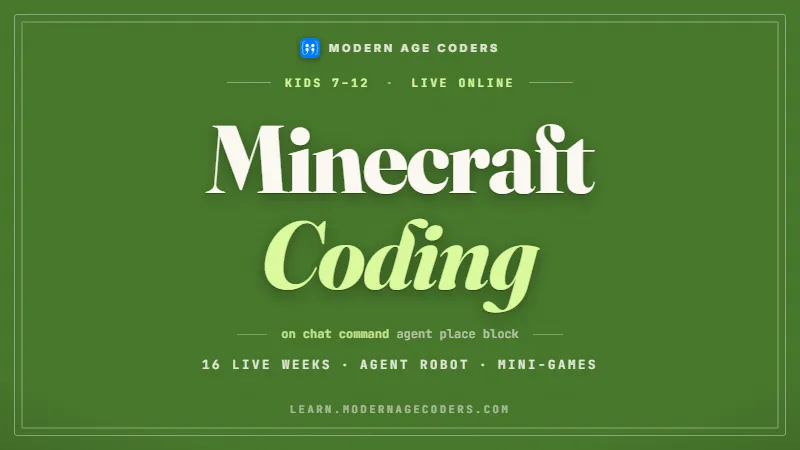
SUK / 02
For the child who already loves the game. Loops build walls, conditions open doors, and the summer ends with an automated build the child designed.
Open the syllabus →
SUK / 03
Real text code, from print to small games like the word game below, then a few AI projects built by hand. Best for confident readers.
Open the syllabus →Is it a good idea?
For many children, yes, if three things are true: lessons are short enough, a real person is on the other side, and the child makes something rather than watches something. Here is how we meet each.
Younger children tire after about half an hour of concentrated work. The mentor watches for it, mixes building with talking, and ends while your child still wants more.
The mentor sees your child's screen and face, asks questions and waits for answers. A recorded course cannot notice a child is lost; a mentor notices within a minute.
Your child's hands stay on the mouse and keyboard. The mentor explains and points, but the child places every block and types every line.
Hong Kong schools already give upper primary pupils some coding in term: the EDB's 2020 coding supplement suggests "one lesson (35/40 minutes per lesson) per week at each upper primary level", about 10 to 14 hours a year. A summer course is not a repeat of that. It gives a child who enjoyed it a chance to build something of their own, at their own speed, with nobody waiting for the rest of the class.
| Level | Pupils | Coding guidance in term |
|---|---|---|
| Primary 4 | 54,700 | About 10 to 14 hours a year |
| Primary 5 | 55,223 | About 10 to 14 hours a year |
| Primary 6 | 54,816 | About 10 to 14 hours a year |
Sources: EDB, Student Enrolment Statistics 2025/26, Table 3.1 (all primary schools, including international and private ones), printed level by level as published; EDB, Computational Thinking: Coding Education, Supplement to the Primary ICT Curriculum (2020). Read 23 November 2026. The coding guidance is addressed to publicly-funded schools; international schools set their own.
Holiday dates
Each school publishes its own calendar, so check yours. Two published calendars show the usual range for summer 2027.
| School type | Published date | What it means for a summer course |
|---|---|---|
| Local whole-day school, EDB example | "Summer Vacation (9/7-31/8) 54 days in total" | Lessons can start in the second week of July |
| ESF schools | "last day of school year on 25 June 2027" | Lessons can start in the last week of June |
| Any school | "Students do not need to attend school on Saturdays and Sundays." | Weekend lessons work in term too, if you continue |
Sources: EDB, An Example of a Whole-day School Calendar (2026/27 School Year), an illustration only, since each school sets its own holidays; ESF 2026/2027 School Calendar (final). Read 23 November 2026.
You can book the free first class in May or June, while school is still on, and agree a start date for the first week of the holiday. That way the mentor's time is reserved and your child knows what is coming.
If your family leaves Hong Kong for part of the summer, say so at the start. Lessons can follow you, or pause and pick up again on your return.
The EDB example calendar reminds schools to "make good use of the long holidays to assign appropriate self-learning tasks" while reducing homework, so children have space to rest.
We read that as a reason to keep summer coding light and chosen by the child: a project they want to finish, not more worksheets. Lessons can be fewer or more frequent, as the family prefers.
Setting up at home
Less than most parents fear. A computer with a keyboard, a camera and a microphone, a reliable connection, and a quiet corner away from siblings and the television.
Parents rightly worry about summer screen time. A coding lesson is a different kind of screen: the child is building, answering questions and explaining, not scrolling.
Many families set a simple rule: coding and reading count as "making time", games and videos as "watching time". Children usually accept it, especially when the coding is a game they designed.
Lessons run on a video link the mentor sends. Children do not need social media accounts or chatbot accounts for any of our primary courses.
We ask children not to share their full name, school or address in projects, and we never record a lesson without the parent's agreement.
For a longer read on choosing a first coding course for a primary child, see coding for primary students in Hong Kong. If your child is very young, coding for 6-year-olds in Hong Kong explains what works at that age.
A summer week
It depends on the pace you agree with the mentor. Here is one example of how a family might fit lessons around other holiday plans. It is an illustration, not a timetable.
| Day | Morning | Afternoon |
|---|---|---|
| Monday | Swimming | Coding lesson at 3 pm Hong Kong time |
| Tuesday | Library visit | Free play; the child adds a level to the game alone |
| Wednesday | Day camp | Rest |
| Thursday | Reading | Coding lesson at 3 pm Hong Kong time |
| Friday | Outing with family | Show grandparents the week's game |
| Weekend | Family time | No lessons, or a short one if the child asks |
An illustration only. Your child's lesson days and times are agreed with the mentor, and a faster or slower holiday pace is fine. A Hong Kong 3 pm lesson is 12:30 pm in India, where our mentors work.
Between lessons, most children carry on alone for twenty minutes here and there, especially once the project is theirs. That independent time is where much of the learning sets. Parents of children who also attend a holiday camp often book lessons on the camp-free days. For the hours that suit families most, live online classes in Hong Kong time sets out the clock.
A children's lesson
This one comes in the middle of the summer for children who have started Python. They build a word-guessing game, then discover a rule that seems unfair: guessing the same wrong letter three times costs three lives. The fix uses a set, Python's way of remembering things without repeats.
# Guess the word: a summer word game, played by a list of guesses instead of a keyboard.
# The word and the guesses are ours, chosen for this lesson.
def play(word, guesses, remember):
    lives, tried = 5, set()
    for g in guesses:
        if remember and g in tried:
            print("  ", g, "-> already tried, no life lost")
            continue
        tried.add(g)
        if g not in word:
            lives -= 1
        shown = "".join(c if c in tried else "_" for c in word)
        print("  ", g, "->", shown, " lives:", lives)
        if "_" not in shown:
            return "won with " + str(lives) + " lives left"
        if lives == 0:
            return "lost"
    return "out of guesses"

guesses = ["a", "e", "z", "z", "z", "n", "p", "d", "o"]
print("Version 1 (forgets what you tried):")
print("  result:", play("panda", guesses, remember=False))
print("Version 2 (remembers with a set):")
print("  result:", play("panda", guesses, remember=True))
The word and the list of guesses were chosen by us for the lesson. Run under Python 3, it prints the lines below exactly.
Version 1 (forgets what you tried):
   a -> _a__a  lives: 5
   e -> _a__a  lives: 4
   z -> _a__a  lives: 3
   z -> _a__a  lives: 2
   z -> _a__a  lives: 1
   n -> _an_a  lives: 1
   p -> pan_a  lives: 1
   d -> panda  lives: 1
  result: won with 1 lives left
Version 2 (remembers with a set):
   a -> _a__a  lives: 5
   e -> _a__a  lives: 4
   z -> _a__a  lives: 3
   z -> already tried, no life lost
   z -> already tried, no life lost
   n -> _an_a  lives: 3
   p -> pan_a  lives: 3
   d -> panda  lives: 3
  result: won with 3 lives left
Both versions win, but version 1 loses three lives to the same letter z, leaving one. Version 2 notices the repeats and ends with three lives. Look closely at the last line of version 1: "won with 1 lives left". That is a second bug, waiting for a child to fix.
Almost every child spots the unfairness before the code runs, because they have played the paper version. Turning "that is not fair" into a rule a computer can follow is the heart of programming.
Then someone reads "1 lives" aloud and laughs. The program is correct about the number and wrong about the English. Fixing it needs an if statement and a little grammar, and children enjoy both.
Ask your child why the second version keeps three lives. A child who can say "because it remembers what I already tried" has understood what a set is for.
Ask them to change the word to their own name. If the game still works, they have understood that the code does not care which word it guards.
By age
Children of the same age differ a lot, so read this as a starting point. The free first class settles where your child actually begins.
| Age | Usual school year | A realistic summer goal |
|---|---|---|
| 6 to 7 | P1 to P2, Year 2 to 3 | An animated story with sound, built from blocks |
| 7 to 8 | P2 to P3, Year 3 to 4 | A simple catch or maze game with a score |
| 8 to 10 | P3 to P5, Year 4 to 6 | A Minecraft build or a block game with levels |
| 9 to 12 | P4 to P6, Year 5 to 7 | A Python game such as the one above, with the child's own changes |
The school-year column is approximate. In Hong Kong, a child entering P1 in September 2027 must have reached 5 years 8 months (born on or before 31 December 2021), and "Parents are required by law to send their children aged six or above to school" (EDB Primary One Admission information). The goals are our own expectations, not a school standard.
At this age a summer course is about delight and precision: the joy of a character moving because you told it to, and the discovery that the computer does exactly what you said, not what you meant.
Lessons use few words and lots of pictures. Children who are still learning to read English can follow, because the mentor demonstrates every block. Scratch coding for kids in Hong Kong shows the block route in detail.
Children at the top of primary school can handle typed code, and many are ready for Python by the summer of P5. They also enjoy harder puzzles, such as making a game fair or finding a bug that only appears sometimes.
Children who love Minecraft often reach Python through it. Minecraft coding classes in Hong Kong describes that bridge.
Learning in English
Most do, quickly. English is a core subject in every Hong Kong primary school, and coding uses a small, repetitive set of English words.
Move, turn, repeat, if, else, print, score. Children meet the same handful of words every lesson, so within a fortnight they know them. The EDB lists English among the core subjects from "Primary 1- Secondary 6", so even young children arrive with a base to build on.
Mentors slow down, repeat, use the screen to show rather than tell, and type new words into the chat so a parent can see them later.
In a class of thirty, a quiet child can go a whole summer without speaking. With one mentor, your child explains their game every lesson, in short English sentences that grow longer as the weeks pass.
Lessons are always in English and never switch to Cantonese or Mandarin. Families tell us the English practice is a welcome side effect. Coding classes taught in English in Hong Kong says more about this.
Progress
Five stages we use with primary children. They describe what a child can do; they are our own, not an official level.
| Stage | Your child can | What you might see at home |
|---|---|---|
| 1. Comfortable | Join the lesson, share the screen, say hello in English | A child who logs in without fuss |
| 2. Directing | Give the computer exact steps in order | A character that moves where the child intended |
| 3. Repeating | Use a loop instead of copying the same step | Shorter programs that do more |
| 4. Deciding | Use if and else to make a game react | A game with a score, a win and a lose |
| 5. Showing | Explain their project and one bug they fixed | A proud demo before the new term |
If the game is unfair, you are allowed to change the rules. That is what programmers do.
Read your output out loud. Bugs are easier to hear than to see.
Praise the bug your child found, not only the finished game.
If your child carries on alone between lessons, the course is working.
More for children
Every one is live and in English; Hong Kong children always learn one to one.
SUK / SIX / 01
Characters, sounds and a first full game.
Open the syllabusSUK / SIX / 02
Sorting, patterns and puzzles for the youngest.
Open the syllabusSUK / SIX / 03
Ideas put into words, then checked block by block.
Open the syllabusSUK / EIGHT / 01
Typed scripts for games friends can play.
Open the syllabusSUK / EIGHT / 02
Plan, build and present one project.
Open the syllabusSUK / EIGHT / 03
Train small models and catch them out.
Open the syllabusSUK / TEN / 01
School maths turned into small programs.
Open the syllabusSUK / TEN / 02
Levels, enemies and scores, planned then built.
Open the syllabusSUK / TEN / 03
Pages a child designs and writes, then shares.
Open the syllabusHow lessons work
Any day, any time, flexible: one to one at the hour that suits your family, weekdays or weekends. In the holiday, many families choose late mornings or mid-afternoons, between outings and the heat of the day.
Late morning
11 am in Hong Kong; the mentor's 8:30 am.
Mid-afternoon
3 pm in Hong Kong; 12:30 pm in India.
Around camps
Lessons on the days your child is free.
Every block placed and line typed by your child.
Paced for young attention spans.
Holiday frequency and fee settled before the first holiday class.
Your child gets to know one friendly face.
A short note on what was built.
No social media or chatbot sign-ups for children.
Student work
Projects by learners in our longer courses. Student labs has plenty more.

AI and ML
An AI nutrition coach that reads what you eat and works you toward a target.

AI and ML
A chatbot that answers mathematics and programming questions, built and deployed by a student.

AI and ML
An assistant that helps a young person recognise unsafe situations online.

Web app
A weather forecasting site with live conditions for any location.
Fees
The fee card shows a monthly amount in Hong Kong dollars, and you pay for one month at a time with no advance payments and no holiday bundle. Extra lessons a week in the holiday are fine; you agree that pace and its fee with the mentor before the first holiday class. The gateway charge, if any, appears before you pay.
Free first class
Free
no card required
One to one
$1,200 HKD
a month, eight live classes
What families say
Reviews from parents and students on Google, shown as they wrote them.
★★★★★
"The one step solution for my son. Modern Age Coders make learning coding so simple that kids love it. The teachers explain complex concepts clearly with practical exercises and interactive content."
Ria Mukherjee
Parent
★★★★★
"Modern Age Coders has been a game-changer for me. I struggled to grasp IT concepts and coding before joining, but their classes transformed everything. I can now confidently write complex programs with ease."
Samriddha Mondal
Student
★★★★★
"One of the most wonderful education centres out there. Education is not limited to school syllabus but focuses on skill development."
Vansh Agarwal
Student
★★★★★
"My child Dhairya is really enjoying the Modern Age Coders classes. This is his first online class and he eagerly looks forward to it. I can already see his improvement, and the teachers are very cooperative."
Sonam Oswal
Parent of Dhairya
★★★★★
"Modern Age Coders have wonderful teachers who teach in a clear, easy and practical way. The teacher boosts students' confidence and inspires them to learn without hesitation."
Sonu Goyal
Parent
★★★★★
"I highly recommend this computer coding class! The teachers are incredibly knowledgeable and passionate about coding."
Ritu Kedia
Parent
Parents ask
From about 6 with block coding. Children of 9 or so who read comfortably can start typed Python. The free first class is where the mentor checks the right starting point.
No. It is our regular one-to-one course, started in the holiday. There are no fixed camp dates and no fixed number of weeks; you choose the start and agree a holiday pace with the mentor.
Yes, always, live on video with a mentor based in India. Mentors speak slowly and clearly for young children and never teach in Cantonese or Mandarin.
No. In Hong Kong every child learns one to one. Your child has the mentor's full attention and never has to wait for others.
Any day, any time, flexible: one to one at the hour that suits your family, weekdays or weekends. Hong Kong is 2 hours 30 minutes ahead of India, so an 11 am lesson is 8:30 am for the mentor.
Lengths suit the child. Younger children usually do best with shorter sessions; the mentor suggests a length in the free class and you can adjust it.
Yes. Agree the number of lessons and the fee that goes with it with the mentor before the first holiday class. Many families do more in July and August and fewer in term.
A laptop or desktop with a camera and microphone, a steady internet connection and a quiet place to sit. A headset helps in a busy home. No special software to buy.
No. Our primary courses need no chatbot or social media accounts. Children work in free tools and their own code.
Monthly, in Hong Kong dollars, with no lump sum and no prepayment. Any payment-gateway charge is shown before you confirm.
Related
Other pages parents read next.
All our courses for Hong Kong families.
Term-time coding for children in Hong Kong.
How we teach children in the summer anywhere.
What works at seven.
A longer look at starting ages.
A live lesson from start to finish.
Part of the guide: Every Hong Kong page
More guides: Coding and AI classes in Hong Kong · 中文:英文授課編程課程 · Start here: Online coding for kids · AI, vibe coding and AI agents: AI agents course · Coding subjects and courses: App development · By age and school level: Adults · HKDSE ICT and maths: DSE ICT elective guide · IB, IGCSE, A-level and SAT: A level Computer Science tutor · Olympiads and competitions: AMC 10 preparation · Guides for families: After-school coding · Districts and areas: Causeway Bay
Start here
In the free lesson your child builds something small with the mentor, perhaps a moving character or the first lines of a game. You see how your child responds and talk through summer dates and pace. No decision is needed on the day.
Curious first? See how we teach, or look through all our courses.
WhatsApp us · +91 91233 66161 · connect@modernagecoders.com
One child, one mentor, live online in English; mentors work from India. WhatsApp reaches us fastest.
A priority demo is a full class of about 45 to 60 minutes. After the class the mentor sends a written skill report and a personal learning roadmap on WhatsApp. If you enrol, the demo fee is adjusted against your first month's fee. Share your demo Order ID with us on WhatsApp and we take it off.
Book a priority demo