USC / CORE / 01
Python, beginner to advanced
The language most university courses start with.
Open the syllabusHong Kong · Secondary students · Summer 2027
Hong Kong universities run summer programmes that put secondary students on campus for a few days or a couple of weeks. An online class is a different thing: slower to show off, longer to last. This page sets the two side by side, using the universities' own descriptions, so you can decide which suits your teenager, or whether to do both. Our part is the second kind: one to one, live and in English.
Teaching live since 2020 · 10,000+ students worldwide · Hong Kong classes are one to one, online, in English
The short answer
A university summer camp in Hong Kong is a fixed stretch on campus, usually a few days to about two weeks, for senior secondary students, with lectures, workshops and student life. An online class with Modern Age Coders is live, one to one and in English, starts the week your teenager chooses at a holiday pace agreed with the mentor (its fee settled before the first holiday class), and can continue through the school year. The camp gives a taste of university; the class builds a skill week by week. Many students do both. The first class is free.
If you choose the online route
Three routes that go deeper than a camp week can. Each is taught one to one, so a strong student is never held back and a newer one is never rushed.
USC / 01
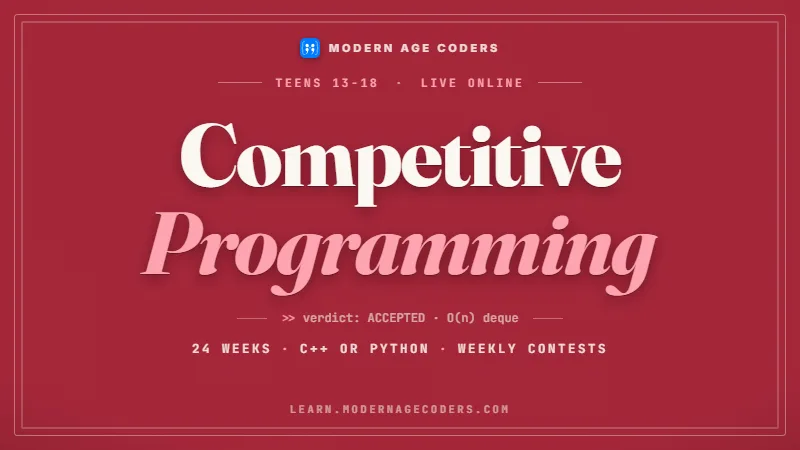
For students who like puzzles with right answers: data structures, algorithm design and timed problems. Good preparation for olympiad heats and university computing.
Open the syllabus →
USC / 02
The topic many university summer lectures introduce, taken all the way: data cleaning, models, evaluation and a project the student can explain.
Open the syllabus →
USC / 03
Real datasets, charts and questions. A strong summer choice for students heading towards economics, science or engineering.
Open the syllabus →What the universities offer
Several universities publish summer programmes for secondary students. Here are four, described only from each university's own page, all for summer 2026. Dates for 2027 had not been published on these pages when we read them.
| University and programme | Dates and length (2026) | Who it is for | What the page highlights |
|---|---|---|---|
| HKU Summer Institute | Summer programmes; a winter chapter is also listed for January 2027 | Secondary, undergraduate and postgraduate students "from around the globe" | A Technopreneurship programme "combining design thinking, business fundamentals, and AI tools" |
| PolyU Summer Institute 2026 | 27 July to 7 August 2026, with a residential camp of 5 days and 4 nights from 27 to 31 July | "senior secondary students" | Faculty attachments, signature lectures including AI fundamentals, then academic subjects |
| HSUHK Summer Academy 2026 | 29 to 30 July 2026 | "Secondary 4 to Secondary 6 students" | Simulated classes and workshops, including "Inside AI: A Hands-On Discovery Workshop" |
| HKUST Pre-University Program 2026 | A "nine-day program" | "Over 800 high-achieving secondary school students from 32 countries and regions" | Laboratories and lecture halls in life science, chemistry, engineering, business and more |
Sources: HKU Summer Institute home page; PolyU School of Design events page for PolyU Summer Institute 2026; HSUHK news release of 21 May 2026; HKUST article of 28 August 2026 on its inaugural Pre-U Program. All read on 23 November 2026. We print no fees and make no ranking; we have no link with any of these universities. Check each programme's own page for 2027 details and eligibility.
They are short and on campus. Of those that print their dates, PolyU's runs twelve days in all and HSUHK's two. They mix lectures, hands-on sessions and student life, and several lean towards senior secondary students thinking about university.
Places and selection vary. HSUHK, for example, said its 2026 academy took online registration "without school nomination", with a deadline of 29 May and priority for local Secondary 5 students. Rules like these change from year to year.
A campus programme lets a teenager walk into a university laboratory, hear a professor, live in a hall for a few nights and meet students from elsewhere. For a fifteen-year-old wondering what university is like, nothing online replaces that.
It can also help a student choose a subject. A day of engineering workshops is a cheap way, in time at least, to learn whether engineering excites you.
Format against format
They solve different problems. A camp is an experience; a class is practice. The table compares the formats, not the quality of any programme.
| Campus summer programme | Our one-to-one online class | |
|---|---|---|
| Length | Fixed: two to twelve days in the dated examples above | Open: starts in summer, continues as long as useful |
| Start date | Set by the university | Chosen by the student |
| Teaching | Lectures and workshops for a cohort | One mentor, one student |
| Depth on one skill | An introduction | Built week by week |
| Campus life and peers | Yes, the main attraction | No; the student works from home |
| After the summer | Ends with the programme | Can carry on through term |
| Language | Set by each programme | English, every lesson |
Our own comparison. Lengths for campus programmes come from the four 2026 pages above. A campus programme is not worse for being short; it is designed to be a taste.
Your teenager wants to see university life, meet other students and try several subjects quickly. They are in S4 or S5 and starting to think about where and what to study.
You are happy with a fixed week and the programme's own selection process, and your teenager is comfortable away from home for a few nights where a camp is residential.
Your teenager already knows they like computing and wants to get properly good at it: to write real programs, prepare for HKDSE ICT, IB Computer Science or an olympiad, or build a project worth showing.
You want something that starts on your own date, fits around travel, and keeps going after the summer. Coding for secondary students in Hong Kong explains those routes.
Doing both
Yes, and it often works best. The campus week raises a question; the class answers it properly.
This order suits a student who wants the social side of a campus programme and the depth of steady practice. It also avoids a common disappointment: a stimulating week that fades by October because nothing followed it. Students who hope their summer work will feed into school coursework later should read our HKDSE ICT SBA guidance, which sets out what help is and is not acceptable.
A word on applications. We make no promise that any summer activity, ours or a university's, improves admission chances. What we can say is that a project a student built and can explain in their own words is evidence of real learning, whatever it is used for.
A university-level lesson
Here is a lesson we use with strong S4 to S6 students: Huffman coding, a classic of first-year computer science. It answers a question students ask after any lecture on data: how do files get smaller without losing anything?
# Huffman codes: common letters get short codes, rare letters long ones.
# The message is ours, invented for this lesson.
import heapq
from collections import Counter

msg = "summer at the harbour"
counts = Counter(msg)
heap = [(n, i, ch) for i, (ch, n) in enumerate(sorted(counts.items()))]
heapq.heapify(heap)
tick = len(heap)
while len(heap) > 1:
    n1, _, a = heapq.heappop(heap)          # the two rarest groups
    n2, _, b = heapq.heappop(heap)
    heapq.heappush(heap, (n1 + n2, tick, (a, b)))
    tick += 1

codes = {}
def walk(node, path):
    if isinstance(node, str):
        codes[node] = path or "0"
    else:
        walk(node[0], path + "0")
        walk(node[1], path + "1")
walk(heap[0][2], "")

for ch in sorted(codes, key=lambda c: (len(codes[c]), c)):
    print(repr(ch), counts[ch], codes[ch])
bits = "".join(codes[c] for c in msg)
print("characters:", len(msg), " fixed 8-bit:", 8 * len(msg), " Huffman:", len(bits))
back = {v: k for k, v in codes.items()}
out, cur = "", ""
for b in bits:
    cur += b
    if cur in back:
        out, cur = out + back[cur], ""
print("decoded correctly:", out == msg)
We wrote the message for teaching. Run with Python 3, the program prints the lines below exactly.
' ' 3 100
'm' 2 000
'r' 3 101
't' 2 001
'u' 2 010
'a' 2 1101
'b' 1 0110
'e' 2 1110
'h' 2 1111
'o' 1 0111
's' 1 1100
characters: 21  fixed 8-bit: 168  Huffman: 72
decoded correctly: True
Twenty-one characters need 168 bits at a fixed 8 bits each, and 72 bits with these codes. No code is the start of another (a prefix code), which is why decoding never gets confused, and the round trip prints True.
The space and the r get three-bit codes, but so do m, t and u, which appear only twice, while a, e and h, also twice, get four bits. Ties are broken by the order items leave the heap. Students who spot this have understood that Huffman codes are optimal in total length, not unique.
The saving looks huge because 8 bits per character is generous for an 11-letter alphabet. A fair comparison would use 4 bits per character, 84 in all, and Huffman still wins with 72.
In a lecture, Huffman coding fits on two slides. Doing it oneself, a student meets heaps, trees, recursion and dictionaries in one sitting, and every one of them needs a question answered at the right moment.
It also connects to things the student uses daily: compressed files, images and the way text is stored. Competitive programming for teens in Hong Kong continues with algorithms of this kind.
Planning summer 2027
Earlier than feels necessary. University programmes in 2026 closed registration well before the summer, and online mentor time fills too.
| When | What to do | Published anchor |
|---|---|---|
| January to March 2027 | Watch university pages for 2027 announcements | In 2026, HSUHK announced its academy on 21 May with a 29 May deadline |
| April to May 2027 | Book a free first online class; choose a start week | None; our suggestion |
| Late June 2027 | ESF students can start online lessons | ESF: "last day of school year on 25 June 2027" |
| Around 9 July 2027 | Local school students can start | EDB example: "Summer Vacation (9/7-31/8) 54 days in total" |
| Late July 2027 | Typical campus programme weeks, judging by 2026 | PolyU 27 July to 7 August 2026; HSUHK 29 to 30 July 2026 |
| September 2027 | Decide whether to continue the class in term | None; our suggestion |
Sources: HSUHK news release of 21 May 2026; ESF 2026/2027 School Calendar (final); EDB example 2026/27 whole-day calendar (an example; each school sets its own); PolyU Summer Institute 2026 page. Read 23 November 2026. 2027 university dates were not yet published and are not guessed here.
Online lessons need no travel and no accommodation, so they can begin the day after school ends. Hong Kong keeps UTC+8 all year and India UTC+5:30, so the two-and-a-half-hour gap is the same in June as in August: a 4 pm lesson in Hong Kong is 1:30 pm for the mentor. Live online classes in Hong Kong time has more conversions.
English and one to one
Because university computing, wherever it is studied, runs on English vocabulary, and because one-to-one teaching lets a strong student go as far as they can.
Heap, prefix code, recursion, complexity: every textbook and documentation page uses these words in English. Students who explain their code aloud in English, week after week, are ready for lectures in it.
Every lesson is in English, never Cantonese or Mandarin, with a mentor based in India who adjusts pace and vocabulary to the student.
In Hong Kong we teach one to one only. A student who grasps heaps in ten minutes moves on; one who needs an hour gets an hour. Nobody waits and nobody is left behind.
Students preparing for HKDSE ICT or IB Computer Science can mix exam practice with projects. See IB Computer Science tutoring in Hong Kong or HKDSE ICT tutoring online.
Progress
Our own milestones for teenagers. They are not a school grade or a university credit.
| Milestone | The student can | Evidence |
|---|---|---|
| 1. Fluent | Write and debug short programs without help | Exercises solved alone |
| 2. Structured | Use dictionaries, heaps and recursion where they fit | Code like the Huffman lesson |
| 3. Measured | Compare two solutions by counting work or bits | A written comparison |
| 4. Built | Finish a project of their own choosing | A repository or demo |
| 5. Explained | Present the project in clear English | A short talk to family or mentor |
A lecture shows you the idea. Writing it yourself shows you whether you understood it.
Keep your summer code. It is the best record of what you learned.
Ask your teenager to explain one program in five minutes. If they can, the summer worked.
A campus week and a summer of practice are not rivals. Each makes the other more useful.
More for teenagers
All live and in English; in Hong Kong, always one student with one mentor.
USC / CORE / 01
The language most university courses start with.
Open the syllabusUSC / CORE / 02
Speed and structure for contest problems.
Open the syllabusUSC / CORE / 03
Make the browser respond to the user.
Open the syllabusUSC / BUILD / 01
Front end, back end and a deployed site.
Open the syllabusUSC / BUILD / 02
An app on a phone by the end.
Open the syllabusUSC / BUILD / 03
Physics, levels and polish.
Open the syllabusUSC / EXAM / 01
Theory, programming and internal assessment guidance.
Open the syllabusUSC / EXAM / 02
Pseudocode, theory and paper practice.
Open the syllabusUSC / EXAM / 03
Projects where every generated line is checked.
Open the syllabusHow lessons work
Any day, any time, flexible: one to one at the hour that suits your family, weekdays or weekends. Lessons pause for a campus week and resume the day after.
Before the camp
Start the week school ends.
Camp week
Pause, or one short evening check-in.
After the camp
Turn what was heard into code.
No cohort date to wait for.
Frequency and fee settled before the first holiday class.
The mentor questions; the student writes.
Code saved and explained, week by week.
The same person from summer into term.
Guidance on coursework, never doing it for the student.

AI and ML
An AI nutrition coach that reads what you eat and works you toward a target.

AI and ML
A chatbot that answers mathematics and programming questions, built and deployed by a student.

AI and ML
An assistant that helps a young person recognise unsafe situations online.

Web app
A weather forecasting site with live conditions for any location.
Fees
Monthly, shown on the card in Hong Kong dollars, paid one month at a time with no advance payment for later months and no summer bundle. If your teenager wants more lessons a week in the holiday, that pace and its fee are agreed with you before the first holiday class. Any gateway charge shows before you pay.
Free first class
Free
no card required
One to one
$1,200 HKD
a month, eight live classes
What families say
Google reviews from students and parents, as written.
★★★★★
"The one step solution for my son. Modern Age Coders make learning coding so simple that kids love it. The teachers explain complex concepts clearly with practical exercises and interactive content."
Ria Mukherjee
Parent
★★★★★
"Modern Age Coders has been a game-changer for me. I struggled to grasp IT concepts and coding before joining, but their classes transformed everything. I can now confidently write complex programs with ease."
Samriddha Mondal
Student
★★★★★
"One of the most wonderful education centres out there. Education is not limited to school syllabus but focuses on skill development."
Vansh Agarwal
Student
★★★★★
"My child Dhairya is really enjoying the Modern Age Coders classes. This is his first online class and he eagerly looks forward to it. I can already see his improvement, and the teachers are very cooperative."
Sonam Oswal
Parent of Dhairya
★★★★★
"Modern Age Coders have wonderful teachers who teach in a clear, easy and practical way. The teacher boosts students' confidence and inspires them to learn without hesitation."
Sonu Goyal
Parent
★★★★★
"I highly recommend this computer coding class! The teachers are incredibly knowledgeable and passionate about coding."
Ritu Kedia
Parent
Questions from families
Neither is better in general; they do different jobs. A campus programme gives a short taste of university life and subjects. An ongoing one-to-one class builds a skill over weeks and months. Many students benefit from both.
No. We teach live online classes, one to one, in English. We have no link with HKU, PolyU, HSUHK, HKUST or any other university, and we do not run campus programmes.
Yes. Start online lessons when school ends, pause them for the campus week, and pick up afterwards. The mentor can turn questions from the campus lectures into practical work.
There is no fixed length. Your teenager starts in the week you choose, agrees a holiday pace with the mentor (with its fee settled before the first holiday class) and decides in September whether to continue.
We make no admission promises for any activity. A project your teenager built and can explain in their own words shows real learning; how any university weighs it is for that university.
Yes, every class is live and in English, with a mentor based in India. Lessons never switch to Cantonese or Mandarin.
Always, in Hong Kong. One student, one mentor, no group sessions.
Any day, any time, flexible: one to one at the hour that suits your family, weekdays or weekends. Hong Kong is two and a half hours ahead of India year-round, so a 7 pm lesson in Hong Kong is 4:30 pm for the mentor.
We teach the skills and give guidance on coursework such as the ICT SBA or the IB internal assessment, but we never write any part of it for a student.
Month by month, in Hong Kong dollars, with no lump sum or prepayment. The payment-gateway charge, if any, is shown before you confirm.
Related
Pages that help with the next step.
All our courses for Hong Kong families.
Machine learning routes for teenagers.
Summer options for older students anywhere.
Project-based summers for strong students.
Practical trade-offs for Hong Kong families.
One live lesson, start to finish.
Part of the guide: Every Hong Kong page
More guides: Coding and AI classes in Hong Kong · 中文:英文授課編程課程 · Start here: Online coding for kids · AI, vibe coding and AI agents: AI agents course · Coding subjects and courses: App development · By age and school level: Adults · HKDSE ICT and maths: DSE ICT elective guide · IB, IGCSE, A-level and SAT: A level Computer Science tutor · Olympiads and competitions: AMC 10 preparation · Guides for families: After-school coding · Districts and areas: Causeway Bay
Start here
In the free class your teenager solves a short problem with the mentor, and you talk through summer dates, any campus programme already booked, and a holiday pace. You decide afterwards.
Reading first? See how we teach and the full course list.
WhatsApp us · +91 91233 66161 · connect@modernagecoders.com
Live online classes in English, one student at a time, with mentors in India. WhatsApp for a quick reply.
A priority demo is a full class of about 45 to 60 minutes. After the class the mentor sends a written skill report and a personal learning roadmap on WhatsApp. If you enrol, the demo fee is adjusted against your first month's fee. Share your demo Order ID with us on WhatsApp and we take it off.
Book a priority demo