Table of Contents
- A Quick Overview: Minecraft vs. Roblox
- How Minecraft Teaches Coding
- How Roblox Teaches Coding
- Head-to-Head Comparison
- Which Should Your Child Choose?
- The Honest Truth: Playing vs. Creating
- Safety Considerations
- Supplementing Game-Based Learning
- Roblox Studio vs Java: which language is it?
- Getting Started: Practical Next Steps
- For US families: the next step inside each game
- Frequently Asked Questions
- Conclusion
Minecraft vs Roblox for kids: for learning to code, Minecraft Education is the gentler start, from about age 7, because children program the game world with MakeCode blocks before moving on to Python. Roblox Studio goes further, with real typed code in a language called Luau, and suits children from about 10. Minecraft Education needs a licence through a school or a family offer; Roblox Studio is free but needs a Roblox account that a parent should set up.
Neither teaches coding if your child only plays. The learning happens in Minecraft's Code Builder or in Roblox Studio, when they start making things. Below: how each one teaches coding, a side-by-side table, which to choose by age, and the questions parents ask most.
| Minecraft Education | Roblox Studio | |
|---|---|---|
| Made by | Mojang / Microsoft | Roblox Corporation |
| Cost | Paid licence (school, or a family and homeschool offer) | Free |
| What your child writes | MakeCode blocks, then Python, in Code Builder | Luau, a typed language derived from Lua 5.1 |
| Runs on | Windows, Mac, ChromeOS, iPhone, iPad, Android | Windows and Mac |
| Our suggested age | About 7 and up | About 10 and up, with a parent managing the account |
| Best for | A gentle start inside a world they already love | Making real games and learning to type code |
A Quick Overview: Minecraft vs. Roblox
Before we dive into the coding stuff, let's quickly recap what each game actually is, because despite both being 'building games,' they're fundamentally different experiences.
Minecraft: The Digital Sandbox
Minecraft is essentially a giant digital LEGO set. Players explore blocky, procedurally-generated worlds where they can mine resources, build structures, survive against creatures, or simply create whatever their imagination dreams up.
The game comes in several editions: the standard Java and Bedrock versions, plus Minecraft Education Edition designed specifically for classroom use.
Roblox: The Game Platform
Roblox isn't really a single game. It's a platform hosting millions of games created by users. Kids can play everything from obstacle courses (obbies) to role-playing games to simulators. But here's the key difference: Roblox actively encourages users to create their own games using Roblox Studio, a free development tool.
Key Difference
Minecraft is primarily a game where coding is an optional add-on. Roblox is a platform where coding is central to creating content that others can play.
How Minecraft Teaches Coding
Let's be real: if your kid is just playing regular Minecraft, mining diamonds, building houses, fighting zombies, they're not learning to code. They're having fun (nothing wrong with that), but actual programming? Not so much.
However, Minecraft does offer several legitimate pathways into coding. Here's what they look like:
1. Redstone: The Gateway to Logic
Redstone is Minecraft's in-game equivalent of electrical wiring. Players use it to create circuits, automated doors, traps, and even functioning calculators. While it's not 'coding' in the traditional sense, Redstone teaches computational thinking, understanding inputs, outputs, logic gates, and cause-and-effect relationships.
Those Redstone circuits are built from the same logic gates as a real computer: AND, OR and NOT. Our guide to logic gates for beginners shows how a few of them combine into a circuit that adds binary numbers, the same idea behind Redstone calculators.
Kids who get deep into Redstone start thinking like engineers. They troubleshoot why their contraption isn't working, optimize their designs, and learn concepts like AND gates, OR gates, and signal delays. It's basically electronics without the soldering iron.
2. Command Blocks: Intro to Scripting
Command blocks take things a step further. These special blocks execute text commands that can teleport players, spawn creatures, change the weather, or modify game rules. The commands use a specific syntax, and kids need to type them correctly, introducing them to the precision required in real programming.
Commands like '/give @p diamond_sword 1' or '/tp @a ~ ~50 ~' require understanding parameters, targeting selectors, and coordinates. It's not Python, but it's a taste of what writing code feels like.
3. Minecraft Education Edition: Structured Learning
This is where Minecraft gets serious about coding. Minecraft Education is a separate edition made for schools, and its Code Builder lets children program the world, starting with MakeCode blocks (similar to Scratch) and then moving on to Python. It usually comes through a school licence; homeschools and families can buy it through a commercial offer, so check with your child's school first.
There are structured lessons and coding challenges, including an Hour of AI activity in which children solve puzzles with blocks or Python. It is genuinely effective for teaching programming in a setting children already love.
4. Modding: For Advanced Learners
Creating mods for Minecraft: Java Edition, the PC version, means real programming, usually in Java. This is advanced territory for teenagers who want to add new creatures, items or mechanics, and it is a genuine introduction to software development.
Bottom Line on Minecraft
Regular Minecraft gameplay doesn't teach coding. But with intentional use of Redstone, Command Blocks, or especially the Education Edition, it becomes a legitimate learning tool.
How Roblox Teaches Coding
Here's where things get interesting. Roblox has coding baked into its DNA in a way that Minecraft simply doesn't. The platform was literally built around the idea that players would create games for other players, and creating games means writing code.
Roblox Studio: A Real Game Engine
Roblox Studio is a free, downloadable tool that anyone can use to build Roblox games. It's a legitimate game development environment with 3D modeling, physics simulation, and, most importantly, scripting capabilities.
The scripting language is Luau, Roblox's own language, derived from Lua 5.1. Studio's script editor helps with autocompletion, syntax highlighting and error checking, and when children write scripts they are writing real code that controls how their game behaves.
What Kids Actually Learn
Creating games in Roblox Studio teaches:
- Variables: Storing and manipulating data like player scores, health, and currency.
- Functions: Writing reusable blocks of code that perform specific tasks.
- Events: Programming responses to player actions, when a button is clicked, when a player touches an object, etc.
- Conditionals: If-then-else logic that makes games respond dynamically.
- Loops: Repeating actions, like spawning enemies every few seconds.
- Object-Oriented Thinking: Understanding how game objects have properties and behaviors.
These aren't watered-down concepts. They're the exact same fundamentals you'd learn in any programming course. The difference is that kids are motivated because they're building games their friends can actually play.
The Motivation Factor
Roblox games can be published for friends to play, which is a powerful reason to keep improving them. Keep the focus on making something good rather than on popularity or money, and agree with your child what they will publish and share.
Head-to-Head Comparison
Let's break this down into categories that matter for parents trying to make a decision:
Coding Depth
Winner: Roblox. While Minecraft Education Edition offers solid coding instruction, Roblox Studio provides deeper, more extensive programming experience. Children writing Luau scripts are learning a real typed language, and the ideas carry over to any other.
Ease of Entry
Winner: Minecraft. Redstone and Command Blocks provide gentler introductions to logical thinking without the intimidation of a code editor. For younger kids or those anxious about 'real' coding, Minecraft is less daunting.
Age Appropriateness
Minecraft: Great for ages 6 and up. The Education Edition works well for elementary through middle school.
Roblox Studio: Better suited for ages 10 and up. Text-based coding requires reading proficiency and patience that younger kids might not have yet.
Structured Learning Resources
Winner: Tie, but different approaches. Minecraft Education Edition has curriculum designed by educators. Roblox has extensive documentation, tutorials, and a Creator Hub with learning pathways. Both offer quality resources.
Moving On to Other Languages
Winner: Roblox Studio, for moving on. Typing Luau builds the habits every later language needs: exact syntax, reading error messages and debugging. The next steps are usually Python, JavaScript or a larger game engine.
Cost
Roblox: Free to play and Roblox Studio is free to download.
Minecraft: the game itself is paid, and Minecraft Education needs its own licence, through a school or a family and homeschool offer.
Which Should Your Child Choose?
Honestly? It depends on your child's age, interests, and goals. Here's a quick guide:
Choose Minecraft If:
- Your child is under 10 and new to coding concepts.
- They're more interested in building and exploring than creating games for others.
- You want a gentler introduction to computational thinking before text-based coding.
- Their school uses Minecraft Education Edition (great to reinforce at home).
- They get frustrated easily and need quick wins to stay motivated.
Choose Roblox If:
- Your child is 10 or older and ready for text-based programming.
- They're excited about creating games that friends can play.
- They're motivated by the possibility of building something 'real.'
- They have the patience to work through tutorials and debug code.
- Long-term, they're interested in game development or programming careers.
Best of Both Worlds
There's no rule saying you have to pick just one. Many kids start with Minecraft for foundational thinking and transition to Roblox when they're ready for real coding. The skills complement each other.
The Honest Truth: Playing vs. Creating
Here's something we need to address directly: simply playing these games doesn't teach coding. And this is where parents often get frustrated.
Your kid might say they're 'learning to code' while playing Roblox, but if they're just jumping from game to game without ever opening Roblox Studio, they're not learning to code. They're playing video games. Same with Minecraft, unless they're actively working with Redstone, Command Blocks, or the Education Edition's coding features, they're just playing.
That's not necessarily bad (games are fun, kids deserve downtime), but let's call it what it is.
If you want actual coding education to happen, it needs to be intentional. Consider:
- Setting specific 'creation time' separate from 'play time.'
- Working through tutorials together or enrolling them in structured courses.
- Giving them project challenges: 'Can you build a game where players collect coins?'
- Celebrating their coding projects, not just their gameplay achievements.
Safety Considerations
Since we're talking about kids, we should mention safety, because both platforms have online elements.
Roblox Safety
Roblox is a platform full of games made by other users, with online chat, so set your child's account up with them and go through its parental controls and privacy settings together. For coding practice, Roblox Studio does not require publishing anything.
Minecraft Safety
Minecraft can be played offline in single-player mode, and Minecraft Education is played with classmates on school-managed devices rather than public servers. Public multiplayer servers vary widely, so agree with your child which ones they join.
For pure coding practice, both can be used offline: Minecraft in single-player, and Roblox Studio doesn't require publishing games to learn.
Supplementing Game-Based Learning
Here's a perspective you might not expect from an article comparing Minecraft and Roblox: neither is a complete coding education.
Both are fantastic tools for sparking interest and teaching foundational concepts. But kids who want to become proficient coders will eventually need to expand beyond these platforms. That might mean:
- Learning Python for broader programming applications.
- Exploring web development with HTML, CSS, and JavaScript.
- Trying other game engines like Unity or Godot.
- Taking structured courses that build systematic understanding.
Think of Minecraft and Roblox as entry points, not destinations. They get kids excited about coding, which is half the battle, but continued growth requires expanding horizons. Explore our Game Development courses to take their skills to the next level.
Roblox Studio vs Java: which language is it?
A common mix-up. Roblox Studio does not use Java: its language is Luau, derived from Lua. Java is the language behind Minecraft: Java Edition mods. So a child who wants to script Roblox games learns Luau, and a teenager who wants to mod Minecraft on PC learns Java. The core ideas, variables, loops, conditions, functions and events, are the same in both, so time spent on either carries over.
Getting Started: Practical Next Steps
Ready to help your child move from player to creator? Here's how to start with each platform:
Starting with Minecraft
- Begin with Redstone tutorials on YouTube. There are thousands of beginner-friendly videos.
- Challenge your child to build a working door, then a trap, then more complex machines.
- If possible, access Minecraft Education Edition through their school for structured coding lessons.
- For older kids interested in modding, look into courses that teach Java basics alongside Minecraft mod creation.
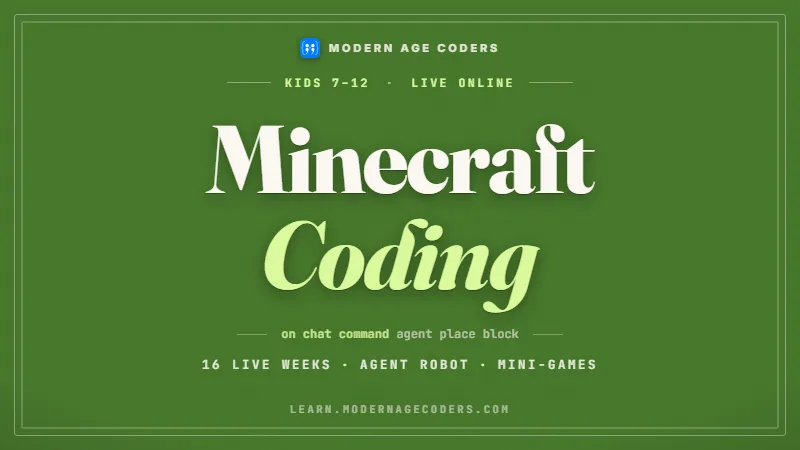
- For a teacher alongside, our Minecraft Coding for Kids course (ages 7 to 12) goes from blocks to real code.
Starting with Roblox
- Download Roblox Studio (free) and explore the built-in templates.
- Visit the Roblox Creator Hub for official tutorials and learning paths.
- Start with simple projects: a basic obby, a coin collection game, or a tycoon template modification.
- Join Roblox developer communities where kids can ask questions and share their work.
- Consider our Roblox Game Coding for Kids course (ages 8 to 14) for live, structured lessons in Luau.
For US families: the next step inside each game
Whichever game your child picked, there is a real coding path inside it, and it lines up with school grades better than with the game. Elementary students usually get the most from block coding and should play both games as games. A middle schooler who is comfortable typing is often ready for Roblox Studio and its Luau scripts. A high schooler with some Java, perhaps from a school computer science class, can start writing Minecraft mods.
- How to make a Roblox game: Studio, three working Luau scripts and how to publish safely.
- Lua for kids explains how Lua and Roblox Luau differ, with short programs to run in a browser.
- Roblox Studio errors fixed is the page to open when a script stops working.
- Learn to code Minecraft mods in Java compares Fabric and Forge and builds a first custom item.
- Video game coding classes for kids sets out which game tool suits each age.
If a live teacher would help, classes for US families run on a schedule you choose. Weekdays or weekends, flexible: choose your batch, or for a very personalised plan choose 1-on-1 at your convenience, weekend mornings or weekdays.
Frequently Asked Questions
For a first taste of coding, usually yes: Minecraft Education starts with blocks inside a world children know, from about 7. For real typed code and making whole games, Roblox Studio is better, from about 10. Many children do Minecraft first and move to Roblox Studio later.
No. Minecraft is one game, made by Mojang (part of Microsoft), with a separate Minecraft Education edition for schools. Roblox, from Roblox Corporation, is a platform of games made by its users, and Roblox Studio is its free tool for making them.
Minecraft, and ideally Minecraft Education if the school has it: blocks come before typing, and the building feels natural at 7. Roblox Studio needs typed code and a Roblox account, so it usually works better from about 10.
No. Roblox Studio uses Luau, a language derived from Lua 5.1. Java is used for mods in Minecraft: Java Edition.
Just playing? No. But actively creating with Redstone/Command Blocks in Minecraft or building games with scripts in Roblox Studio? Yes, those teach real coding concepts.
Most kids are ready around age 10-11, when they can read comfortably and have the patience for text-based coding. Some motivated 8-9 year olds can start with heavy parental guidance.
Luau itself is Roblox's own language, derived from Lua 5.1. What carries over is everything learned while using it: variables, loops, conditions, functions, events and debugging, which work the same way in Python, JavaScript or any other language.
If your child's school already has it, yes, use it. For home, Minecraft Education is sold to homeschools and families through a commercial offer, so compare that with a course before buying. Ordinary Minecraft with Redstone and command blocks still teaches logical thinking.
That's normal! Try introducing creation gradually, maybe modify an existing Roblox game together or follow a fun Redstone tutorial. Sometimes the spark just needs a little kindling.
Both appear in classes: Minecraft Education is built for schools, and Roblox Studio is common for game-making courses. Ours cover both, with Minecraft for ages 7 to 12 and Roblox in Luau for 8 to 14.
Conclusion
So, Minecraft vs. Roblox, which one actually teaches your child to code?
The honest answer: both can, but Roblox offers a more direct path to real programming. Roblox Studio teaches actual text-based coding with Lua, giving kids skills that translate directly to other programming languages and professional game development.
Minecraft, meanwhile, excels at teaching computational thinking through Redstone and offers genuine coding through its Education Edition. It's a gentler entry point that works especially well for younger children.
But here's what matters most: the magic happens when kids move from consuming to creating. Whether they're wiring up Redstone contraptions or scripting Roblox games, the real learning starts when they're actively building, problem-solving, and debugging.
Your job as a parent isn't to pick the 'perfect' platform. It's to encourage creation, celebrate their projects, and keep them curious. Do that, and you'll be surprised how far they can go.
The Best Platform Is...
The one your child is excited to create in. Passion beats perfection every time. Start with what gets them building, and growth will follow.
Learn it live, in the game your child loves
Minecraft fans, 7 to 12: Minecraft Coding for Kids. Roblox fans, 8 to 14: Roblox Game Coding for Kids. Both, and Scratch, 8 to 12: Game Development for Kids. The first class is a free demo, so you can see how it is taught before you decide.