CWB / P / 01
Scratch coding
The friendliest first language.
Open the syllabusHong Kong Island · Wan Chai District · Causeway Bay
Causeway Bay is where Hong Kong comes to shop, and the families who live there know what that means for a weekday afternoon. Our classes stay out of it. Every lesson is live and online, taught in English, one to one, with a mentor who works only with your child at home. This page sets out the neighbourhood in census figures, the schools on its streets and a first coding lesson built on the Central Library by Victoria Park.
Since 2020 · 10,000+ students worldwide · Hong Kong lessons are one to one, live and in English
The short answer
Modern Age Coders offers live online coding, AI and maths classes for families in Causeway Bay, Hong Kong, and nearby Tai Hang and Tin Hau. Every class is one to one and taught in English by a mentor based in India. Children start with Scratch or Python, older children add AI, and teenagers can work on DSE ICT, IGCSE or IB computer science and maths. You choose the hour on Hong Kong time, and your child learns at home instead of crossing Causeway Bay's busy streets.
Start with a course
Three starting points for the families who write to us from this corner of the island: AI understanding for primary children, Python for teenagers, and competitive programming for the strongest coders.
CWB / 01
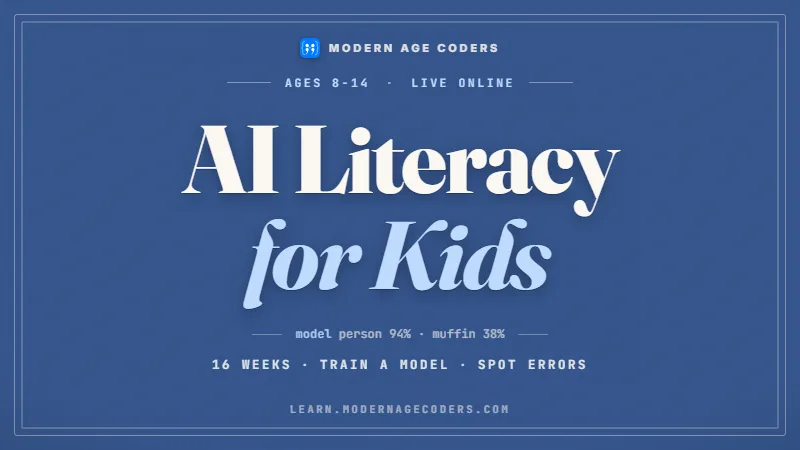
For 8 to 14. What AI is, how it makes guesses and how to test its answers, taught before a child is asked to rely on any AI tool.
Open the syllabus →
CWB / 02
For about 12 and up. Variables to files and data, with projects that line up with DSE ICT, IGCSE and IB programming.
Open the syllabus →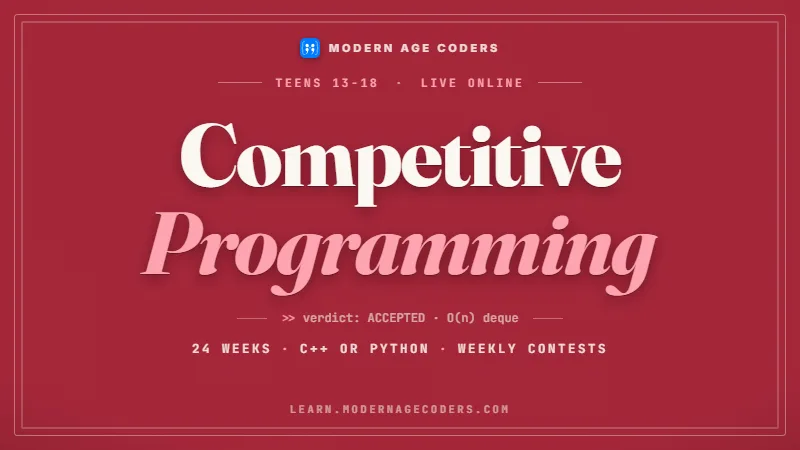
CWB / 03
For confident teenage coders. Algorithms, timed problems and C++, with practice sets we write ourselves.
Open the syllabus →The neighbourhood
Causeway Bay has no official boundary, but the 2021 Population Census published several small areas around it inside Wan Chai District. Four of them cover the streets most people mean, and they are listed here separately, exactly as published.
| Census area | Residents | Under 15 | Usually speak English (aged 5+) | Able to read English (aged 5+) |
|---|---|---|---|---|
| Causeway Bay (銅鑼灣) | 13,050 | 1,282 | 2,332 | 80% |
| Victoria Park (維園) | 13,521 | 1,307 | 1,290 | 84.3% |
| Tin Hau (天后) | 14,527 | 1,371 | 1,430 | 75.8% |
| Tai Hang (大坑) | 11,425 | 1,216 | 1,905 | 86.9% |
Source: C&SD, 2021 Population Census, DCCA_21C, results by 2019 District Council Constituency Area, as at 30 June 2021. Which areas count as Causeway Bay is our reading, since the name has no official edge; constituencies were redrawn in 2023. The four rows are not added, because no published figure covers them together.
Each area is small, between about 11,000 and 15,000 residents, and each has well over a thousand children under 15. That puts Causeway Bay families in the same position as many on the island: plenty of neighbours, not many of them children of the same age with the same interests.
English is familiar. In Tai Hang, 86.9% of residents aged five or above could read English in 2021, and in the Causeway Bay area itself 80%. Across Wan Chai District the figure was 84.1%, the highest of Hong Kong's 18 districts.
Causeway Bay sits inside Wan Chai District, which the 2021 census counted at 166,695 residents. A separate C&SD series based on the 2025 General Household Survey gives 160,600 for the district's land-based non-institutional population; it measures a narrower group, so the two are not a before and after.
Tin Hau straddles the boundary with Eastern District in everyday speech, although its census area is counted in Wan Chai. We teach families on both sides of that line exactly the same way.
Around Causeway Bay lie Wan Chai and Admiralty to the west, Happy Valley and Jardine's Lookout to the south, Tai Hang up the hill to the south-east, and Tin Hau, Fortress Hill and North Point along the shore to the east. Kowloon lies across the harbour. For the wider district see our Hong Kong overview, and for a hillside neighbourhood further west, Mid-Levels.
Schools on these streets
More than visitors might expect. In the Education Bureau's open school file, a dozen primary and secondary entries give an address in Causeway Bay, many of them on the slopes above the shops.
| EDB category | Schools |
|---|---|
| Aided Primary Schools | 2 |
| Aided Secondary Schools | 1 |
| Direct Subsidy Scheme Secondary Schools | 3 |
| Government Primary Schools | 1 |
| Government Secondary Schools | 2 |
| Private Primary Schools | 2 |
| Private Secondary Schools (Day/Evening) | 1 |
Source: Education Bureau, School Location and Information, from DATA.GOV.HK, saved 23 November 2026. We searched the English address field for "Causeway Bay" and counted distinct names, so a school whose address omits the name is missed. Schools are shown only to describe the neighbourhood; none is a partner of ours or a source of our students.
Most of these are local schools, aided, government or Direct Subsidy Scheme, teaching the Hong Kong curriculum. For them EDB circular 109/2023 sets the coding expectation: 10 to 14 hours of enriched coding each year at P4, P5 and P6, and 10 to 14 hours of AI learning advised across junior secondary.
Secondary students who take ICT for the HKDSE learn to program and complete a school-based assessment. Our DSE ICT Python help page explains how a mentor supports that, and our refusal to write any part of an SBA.
None of the dozen schools in our search is listed as international or ESF, but Wan Chai District as a whole has an ESF primary school and the French International School in the same file, and Eastern District next door has several international schools.
Families on those programmes can read our page for international school students, which explains how lessons follow IGCSE, IB and other curricula.
For teenagers who enjoy contests, the Hong Kong Olympiad in Informatics admits students through registered day secondary schools and asks for C++ (C++20). We prepare students with original problems and promise no outcome; the HKOI heat event explained describes what the first round looks like.
Learning at home
Because the shopping streets are at their fullest just as children finish school, and a coding lesson works best at a quiet desk with a keyboard, not after a walk through a crowd.
Centres in commercial buildings often mean lifts, queues and a parent waiting outside. We will not invent a journey time from your building to any of them; you know the crossings and the crowds better than we do.
A lesson at home skips every part of it. Your child closes a school bag, opens a laptop and starts, and the evening stays free.
In a one-to-one lesson the mentor sees each line as your child types it. Questions are answered at once, confusion is spotted early, and the pace is set by one learner, not a room.
Hong Kong homes are ready for it: C&SD reported that 96.9% of households had internet access at home in 2025. A computer with a keyboard and a headset are the only equipment.
| Hong Kong | India | Commonly picked by |
|---|---|---|
| 4:15 pm, weekday | 1:45 pm | Younger children after school |
| 6:15 pm, weekday | 3:45 pm | Older children after activities |
| 8:15 pm, weekday | 5:45 pm | Teenagers and adults |
| 11:30 am, Saturday | 9:00 am | Families keeping weekdays clear |
Our conversions. Hong Kong time is UTC+8 throughout the year; the Hong Kong Observatory's record shows no summer time after 1979. India is UTC+5:30. The difference stays at 2 hours 30 minutes, and the right-hand column reflects requests we often receive, not reserved slots.
A real lesson
Hong Kong Central Library stands at 66 Causeway Road, facing Victoria Park, and the Leisure and Cultural Services Department publishes how many items every public library lends each year. Asking how the Central Library compares with the island's other libraries teaches a teenager to tell "biggest" from "fastest to recover".
The dataset is Usage of Hong Kong Public Libraries (materials borrowed) by Library, published by LCSD on DATA.GOV.HK with a data specification that decodes each library code. Our saved copy covers 2018 to 2024. The Central Library's address comes from the Digital Policy Office's Wi-Fi.HK location list on the same portal. Both may be reused free of charge for any purpose under the DATA.GOV.HK terms, provided the source is named and the ownership of the Government and LCSD is acknowledged. We downloaded the files on 23 November 2026.
(2024, "HKCL"), and filters to the rows marked HK for Hong Kong Island.import csv
# Saved from DATA.GOV.HK: LCSD "Usage of Hong Kong Public Libraries (materials borrowed) by Library".
# The file is UTF-16 text; the District column is HK, KLN, NT, or blank for mobile libraries.
with open("lcsd_lib_stats.csv", encoding="utf-16", newline="") as f:
rows = [r for r in csv.DictReader(f) if r["District"] == "HK"]
loans = {} # (year, code) -> items borrowed
for r in rows:
loans[(int(r["Year"]), r["Code"])] = int(r["Materials_borrowed"])
years = sorted({y for y, c in loans})
print("1. Hong Kong Central Library: items borrowed, and change on the year before")
previous = None
for y in years:
now = loans[(y, "HKCL")]
change = "" if previous is None else f"{(now - previous) / previous:+.0%}"
print(f" {y} {now:>9,} {change}")
previous = now
print("2. Island libraries ranked by 2024 loans as a share of 2019")
codes = sorted({c for y, c in loans if (2019, c) in loans and (2024, c) in loans})
share = {c: loans[(2024, c)] / loans[(2019, c)] for c in codes}
ranked = sorted(codes, key=share.get, reverse=True)
for c in ranked[:3] + ["..."] + ranked[-3:]:
print(" ..." if c == "..." else f" {c:<6}{share[c]:.0%}")
print(f" HKCL is #{ranked.index('HKCL') + 1} of {len(ranked)} on this measure")
print("3. HKCL compared with the runner-up, 2024")
top, second = sorted((loans[(2024, c)] for yy, c in loans if yy == 2024), reverse=True)[:2]
print(f" {top:,} vs {second:,}: {top / second:.2f} times as many")Our program for this page. Download the LCSD CSV from DATA.GOV.HK, keep the file name, put it next to the script and run Python 3. Only the standard library is used.
1. Hong Kong Central Library: items borrowed, and change on the year before
   2018  1,441,725
   2019  1,258,886  -13%
   2020    590,172  -53%
   2021    833,984  +41%
   2022    684,507  -18%
   2023    900,032  +31%
   2024    888,049  -1%
2. Island libraries ranked by 2024 loans as a share of 2019
   YTPL  90%
   CHPL  75%
   SPL   74%
   ...
   SSWPL 50%
   SFPL  50%
   ALCPL 49%
   HKCL is #5 of 17 on this measure
3. HKCL compared with the runner-up, 2024
   888,049 vs 516,052: 1.72 times as many
Exact output from our copy. Codes come from LCSD's data specification: HKCL Hong Kong Central Library, CHPL City Hall, YTPL Yiu Tung, SPL Stanley, SSWPL Siu Sai Wan, SFPL Smithfield, ALCPL Ap Lei Chau.
The Central Library lent 1,441,725 items in 2018 and 888,049 in 2024. It is still by far the busiest library on the island: in 2024 it lent 1.72 times as many items as City Hall Public Library, the next busiest.
Yet by the recovery measure it is only fifth of 17. Yiu Tung Public Library in Eastern District reached 90% of its 2019 loans in 2024, while the Central Library reached about 71% (888,049 against 1,258,886). Several branches stood at about half their 2019 level. The data does not say why; e-books, opening hours and habits are all possible, and none is in the file.
A tuple key is a quiet but powerful idea: one dictionary holds every library for every year, and any figure is one lookup away. The signed percentage format +.0% saves a dozen lines of string fiddling.
The deeper lesson is about questions. "Which is largest?" and "which recovered most?" give different winners from the same file, and both are true. Students who can say which question they answered, and why it matters, are thinking like analysts; our thinking before AI page explains why we teach that before any AI shortcut.
By age
Children from six, teenagers working towards exams and adults building skills for work all learn the same way: one to one, live, online and in English.
| Age | Where most begin | Where it goes |
|---|---|---|
| 6 to 8 | Scratch: movement, sound, loops | Their own games, then Python |
| 8 to 11 | Python for kids, AI literacy | Small AI projects, maths through coding |
| 11 to 14 | Python for teens | AI and machine learning, contest maths |
| 14 to 16 | IGCSE or DSE ICT foundations | C++ and competitive programming |
| 16 to 18 | DSE ICT, IB or IGCSE computing and maths | A project portfolio for university |
| Adults | Python and automation | Web apps, data and AI agents |
Our placement guide only; mentors adjust it for every learner. AI tools are used only within their providers' age terms and only where offered in Hong Kong or supplied by a school or employer, as our AI tools age guide explains.
Young children learn best by making something that moves and responds, then explaining it. Our coding for 7-year-olds page describes a typical first term.
Primary pupils who are curious about AI can start with what it is and how it errs, before any tool is used. The AI course for kids page covers that.
Teenagers often bring a deadline: an exam, a contest or an application. We teach and coach towards it; assessed work stays the student's own.
Adults working nearby can book lessons for themselves in the evening, separately from any child's course.
In English
Usually, yes, and many families choose us partly for the English. Mentors based in India teach every lesson in clear English, at a pace set by the child.
Mentors use short sentences, type every new word into the chat and ask the child to repeat ideas in their own words. Code itself is in English, so the vocabulary is learned in context.
Children at English-medium schools find the terms match their schoolwork exactly.
There is no Cantonese or Putonghua teaching in our lessons. We prefer to say so plainly than to promise something we do not offer.
If you are unsure, the free first class answers the question quickly and costs nothing.
For more on the format, see one-on-one coding tutoring in Hong Kong, and for monthly fees, how our Hong Kong fees work.
Progress
With six stages of our own, used in every course. They describe skill, not a grade, and no school or exam board endorses them.
| Stage | The learner can | Shown by |
|---|---|---|
| 1. Read | Describe what short code will do | Accurate predictions |
| 2. Edit | Change working code to a new purpose | An altered game or tool |
| 3. Make | Write a small program from nothing | A unit project |
| 4. Analyse | Pull a finding out of a real file | A lesson like the library one |
| 5. Question | Say what the data cannot show | A written caveat in plain English |
| 6. Teach | Explain the work to someone new | A short demonstration |
Biggest and fastest are different questions.
Check the encoding before you blame the data.
Ask which question your child's program answers.
Keep each unit project; together they tell the year's story.
More courses
Nine more, grouped by stage, all taught to Hong Kong families live, one to one and in English.
CWB / P / 01
The friendliest first language.
Open the syllabusCWB / P / 02
Typing real code, then smart projects.
Open the syllabusCWB / P / 03
Scripts for games they design.
Open the syllabusCWB / S / 01
Cambridge 0478 in full.
Open the syllabusCWB / S / 02
Build a model, then test its limits.
Open the syllabusCWB / S / 03
For the 2027 first assessment.
Open the syllabusCWB / B / 01
Maths ideas explored in Python.
Open the syllabusCWB / B / 02
Core, Extended and Additional.
Open the syllabusCWB / B / 03
Full-stack apps with AI help, 18+.
Open the syllabusHow classes run
Any day, any time, flexible: one to one at the hour that suits your family, weekdays or weekends.
After school
Early afternoon for mentors in India.
Saturday late morning
A relaxed slot before weekend plans.
Evening
For teenagers and working adults.
Continuity from the first unit on.
Code written where the mentor can see.
Clear, steady, with words typed out.
A finished piece at each unit end.
Brief updates for parents.
Keyboard computer, headset, good internet.
Student work
Projects by students in longer courses worldwide; more in our student labs.

AI and ML
An AI nutrition coach that reads what you eat and works you toward a target.

AI and ML
A chatbot that answers mathematics and programming questions, built and deployed by a student.

AI and ML
An assistant that helps a young person recognise unsafe situations online.

Web app
A weather forecasting site with live conditions for any location.
Fees
The fee is set per month and displayed in Hong Kong dollars. You pay each month as it starts, never a bundle of months in advance. If your card or wallet carries a gateway charge, checkout shows it to you first.
Free first class
Free
no card required
One to one
$1,200 HKD
a month, eight live classes
What families say
Reviews on Google from parents and learners, unchanged.
★★★★★
"The one step solution for my son. Modern Age Coders make learning coding so simple that kids love it. The teachers explain complex concepts clearly with practical exercises and interactive content."
Ria Mukherjee
Parent
★★★★★
"Modern Age Coders has been a game-changer for me. I struggled to grasp IT concepts and coding before joining, but their classes transformed everything. I can now confidently write complex programs with ease."
Samriddha Mondal
Student
★★★★★
"One of the most wonderful education centres out there. Education is not limited to school syllabus but focuses on skill development."
Vansh Agarwal
Student
★★★★★
"My child Dhairya is really enjoying the Modern Age Coders classes. This is his first online class and he eagerly looks forward to it. I can already see his improvement, and the teachers are very cooperative."
Sonam Oswal
Parent of Dhairya
★★★★★
"Modern Age Coders have wonderful teachers who teach in a clear, easy and practical way. The teacher boosts students' confidence and inspires them to learn without hesitation."
Sonu Goyal
Parent
★★★★★
"I highly recommend this computer coding class! The teachers are incredibly knowledgeable and passionate about coding."
Ritu Kedia
Parent
Questions from Causeway Bay
No. We have no premises anywhere in Hong Kong. Lessons are online, so a child in Causeway Bay, Tai Hang or Tin Hau learns at home.
English, always. Mentors based in India teach live, speaking clearly and typing key words. Lessons are not offered in Cantonese or Putonghua.
Yes. In Hong Kong every lesson has one learner and one mentor, and that is the only format we offer here.
About six for Scratch. Many children move to Python between eight and eleven, and teenagers can work towards DSE ICT, IGCSE or IB computing.
Any day, any time, flexible: one to one at the hour that suits your family, weekdays or weekends. India is two and a half hours behind Hong Kong all year, so a 6:15 pm lesson in Causeway Bay starts at 3:45 pm for the mentor.
Yes, with teaching, Python practice and exam preparation. The SBA is the student's own work, and we never write any of it.
Monthly, at the Hong Kong dollar amount on this page. Each month stands alone, nothing is prepaid, and a gateway charge, if any, appears at checkout before payment.
No. OpenAI and Anthropic do not name Hong Kong among the places they offer ChatGPT and Claude. We use tools that are offered in Hong Kong or provided by your child's school, keep to their age terms, and teach children to check any AI output, which carries over to every tool.
Secondary students can practise HKOI-style problems in C++ with tasks we write. Entry is through their school, and we never promise a result.
A computer with a keyboard, a headset with a microphone and a stable connection. A quiet room matters more than a fast machine.
Related
Pages that usually answer the next question.
All 18 districts on one page.
Another island neighbourhood.
Support beside school, never the SBA.
AI understanding for younger learners.
What the first round asks.
Inside a live lesson.
Part of the guide: Every Hong Kong page
More guides: Coding and AI classes in Hong Kong · 中文:英文授課編程課程 · Start here: Online coding for kids · AI, vibe coding and AI agents: AI agents course · Coding subjects and courses: App development · By age and school level: Adults · HKDSE ICT and maths: DSE ICT elective guide · IB, IGCSE, A-level and SAT: A level Computer Science tutor · Olympiads and competitions: AMC 10 preparation · Guides for families: After-school coding · School holidays: AI summer course
Start here
Tell us your child's age and school, and anything they have built before. The free lesson is live and one to one: the mentor sets a short task, hears how your child tackles it and proposes a course.
If you would like to read more first, how we teach describes a lesson, and our courses page lists every syllabus.
WhatsApp us · +91 91233 66161 · connect@modernagecoders.com
Taught live, online and in English by mentors based in India. WhatsApp in English brings the fastest reply.
A priority demo is a full class of about 45 to 60 minutes. After the class the mentor sends a written skill report and a personal learning roadmap on WhatsApp. If you enrol, the demo fee is adjusted against your first month's fee. Share your demo Order ID with us on WhatsApp and we take it off.
Book a priority demo