Table of Contents
- What are problem solving skills for kids?
- 6 problem solving strategies for kids
- Problem solving activities for kids by age
- Real-life problem solving examples for kids
- How to teach problem solving to kids: what to say
- Problem solving worksheet for kids
- Problem solving skills through coding
- How we teach it
- Frequently asked questions
Problem solving skills for kids are the habits of saying what the problem is, thinking of more than one idea, trying one, checking whether it worked, and trying again without giving up. Children build them best through short, everyday activities with a parent asking questions rather than giving answers: sharing things fairly, packing a bag, building challenges, puzzles and simple coding.
This guide gives you the six strategies children can learn, activities sorted by age from 6 to 14, real-life examples you can use tonight, the questions to ask instead of the answers to give, and a ten-question worksheet with an answer key. Every puzzle on this page was written by us.
What are problem solving skills for kids?
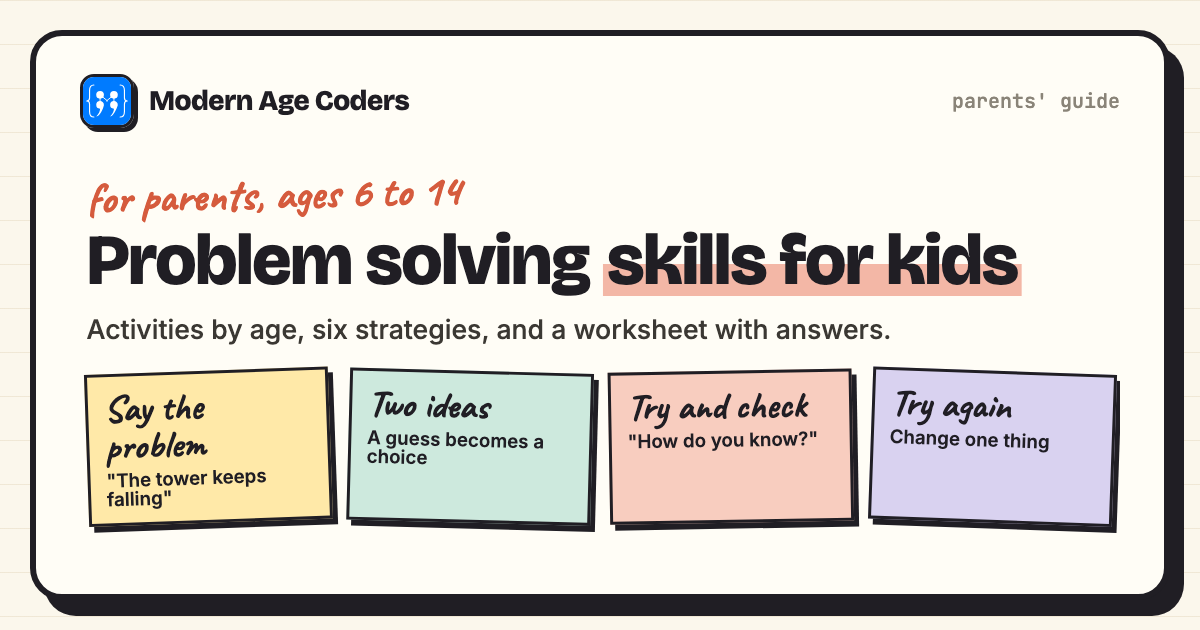
For a child, problem solving is five small habits. You can say them in these words:
- Say the problem. "The tower keeps falling over", not "it's not working".
- Think of two ideas. One idea is a guess. Two ideas is a choice.
- Try one. Small and quick, so it is cheap to be wrong.
- Check. Did it work? How do you know?
- Try again. Change one thing and go again.
Adults use the same loop, with longer words. Our guide to improving problem solving skills sets out the adult version. For children the most important habit is the last one: treating a wrong try as information rather than as failure.
6 problem solving strategies for kids
These are the strategies children use most in maths, puzzles and coding. Teach them one at a time, by name, so a child can say "I'll try working backwards" when stuck.
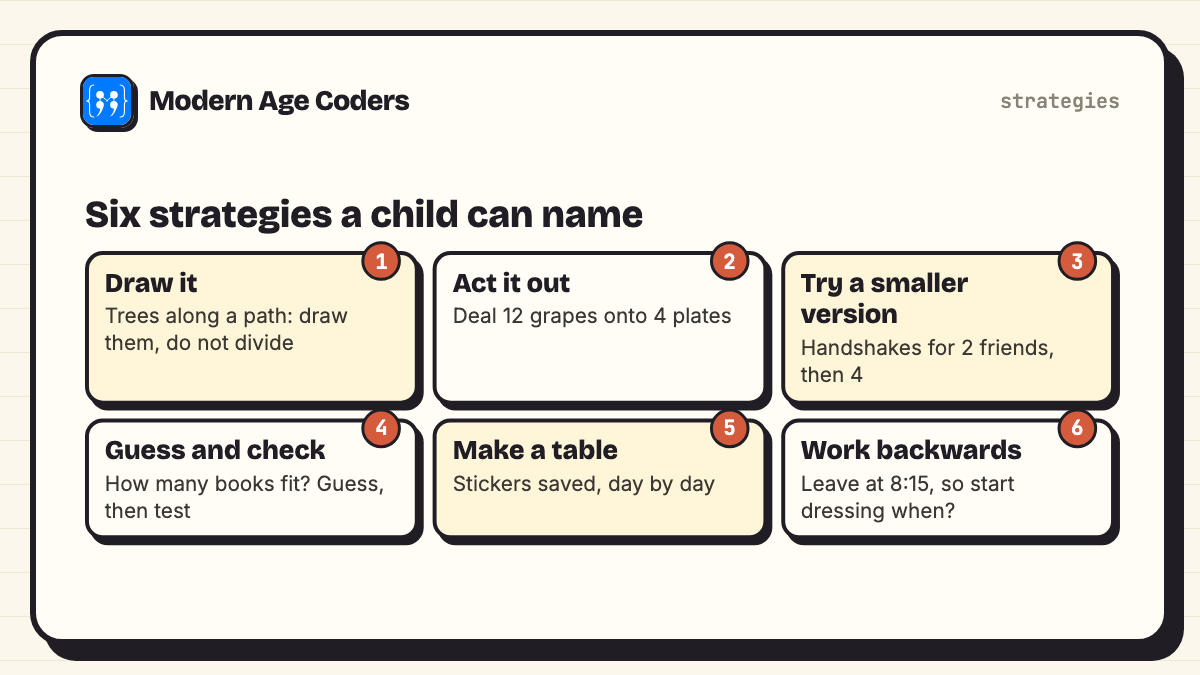
| Strategy | What it means | Real-life example |
|---|---|---|
| Draw it | Make a picture of the problem | Drawing the trees along a path to count them, instead of dividing |
| Act it out | Use objects or your body | Sharing 12 grapes between 4 plates, one at a time |
| Try a smaller version | Solve an easier case first | Working out 2 friends' handshakes before 4 friends' |
| Guess and check | Make a sensible guess, test it, adjust | Guessing how many books fit on a shelf, then testing |
| Make a table | Write the steps in rows | Tracking pocket-money stickers saved day by day |
| Work backwards | Start from the end | "We must leave at 8:15. What time must we start getting dressed?" |
Problem solving activities for kids by age
Ages 6 to 7
- Fair shares: give a pile of 12 crackers and 3 plates. Ask how to make it fair. Then try 13 crackers and talk about the one left over.
- Tallest tower: 20 paper cups or blocks, and the challenge to build the tallest tower that stands for ten seconds. Ask what they will change after it falls.
- Morning order: five picture cards (wake up, wash, dress, breakfast, shoes) to put in order. Then ask what happens if shoes come before socks.
- Odd one out at the table: spoon, fork, knife, cup. Which is different, and why? There can be more than one good answer.
Ages 8 to 9
- Packing challenge: fit everything for a day trip into one small bag. They must decide what to leave out and say why.
- Treasure hunt with clues: they write three clues for you to follow, which teaches them to give exact instructions.
- Recipe maths: a recipe for 4 people, made for 6. What changes and what does not?
- Scratch or unplugged coding: guide a toy across the floor with written instructions only (forward 2, turn right). Fixing the instructions is debugging.
Ages 10 to 12
- Plan a family outing: a fixed time window, travel time and two places to visit. They produce a timetable and check it works.
- Logic puzzles: deduction grids and sequences. Our logical reasoning puzzles for kids have answers and age labels.
- Fix it: a broken toy, a stuck zip, a game that keeps crashing. Ask them to describe what happens, guess a cause, and test one thing at a time.
- First programs: a guessing game in Scratch or Python. A program that does not work yet is the best problem solving lesson there is.
Ages 13 to 14
- Own a real problem: the family's weekly meal plan, or a revision timetable for exams. They define what "done" means and check it at the end of the week.
- Break a big task down: a school project split into small tasks with times. Our guide to breaking down a problem shows how.
- Coding challenges: short problems with tests, solved first by hand. See how to solve coding problems.
Real-life problem solving examples for kids
The best problems are the ones already in your house. Here are four, with the strategy and the question that turns them into a lesson.
| Problem | Strategy | Question to ask |
|---|---|---|
| Late for school every morning | Make a table of each step and its time | "Which step takes longer than we think?" |
| Two siblings want the same toy | Think of two ideas, then choose | "What are two ways to be fair? Which one would you both accept?" |
| A lost library book | Work backwards | "Where was the last place you are sure you had it?" |
| A Lego model falls apart | Try a smaller version | "Can you build just the bottom part so it stays strong?" |
For older children, our post on problem solving examples in real life has twelve fully worked examples.
How to teach problem solving to kids: what to say
The single biggest change a parent can make is to answer a question with a question. When you give the answer, the child learns that problems are solved by asking an adult.
| Instead of saying | Try asking |
|---|---|
| "Just do it like this." | "What have you tried so far?" |
| "That's wrong." | "How could you check that?" |
| "Let me do it." | "What is one small thing you could try next?" |
| "It's easy." | "What part is tricky?" |
| "Good job." | "How did you work that out?" |
Let them be stuck for a minute
Wait a full minute before you help. It feels long. Most children start a new idea in that minute, and that is the moment the skill is built.
Problem solving worksheet for kids
Ten questions, written by us, roughly in order of difficulty. Print or copy them out, and let your child pick a strategy for each one. Answers are below, so cover them first.
| # | Question | Age | Strategy hint |
|---|---|---|---|
| 1 | A spider has 8 legs. How many legs do 3 spiders have? | 6+ | Draw it |
| 2 | Share 12 grapes equally between 4 friends. How many does each friend get? | 6+ | Act it out |
| 3 | What comes next? circle, square, circle, square, circle, ... | 6+ | Look for the pattern |
| 4 | Tom is older than Ana. Ana is older than Ben. Who is the youngest? | 7+ | Draw a line, oldest to youngest |
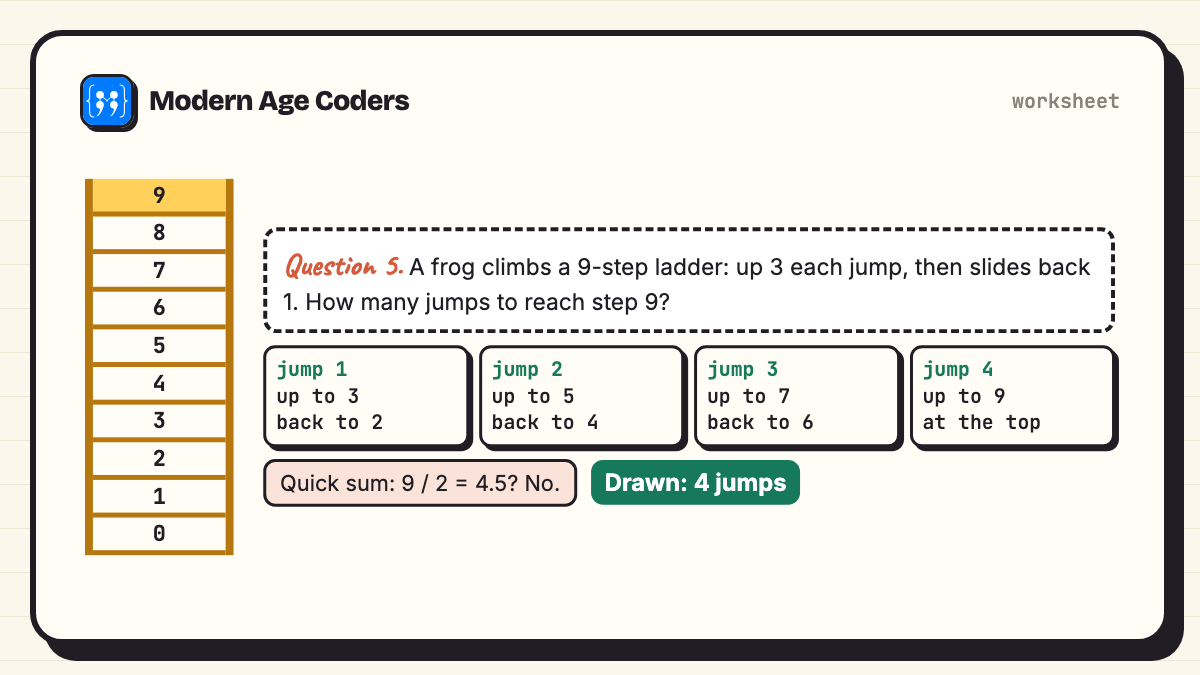
| 5 | A frog is at the bottom of a ladder with 9 steps. Each jump takes it up 3 steps, then it slides back 1. How many jumps to reach step 9? | 8+ | Draw it, step by step |
| 6 | A path is 20 metres long. A tree is planted every 5 metres, at both ends too. How many trees? | 8+ | Draw it |
| 7 | Stickers come in packs of 3 and packs of 5. How many different ways can you get exactly 30 stickers? | 9+ | Make a table |
| 8 | I think of a number, add 4, then double it. I get 18. What was my number? | 9+ | Work backwards |
| 9 | Sara saves 2 stickers on day 1, 4 on day 2, 6 on day 3, and so on. How many has she saved after 5 days? | 9+ | Make a table |
| 10 | 4 friends each shake hands with every other friend once. How many handshakes? | 10+ | Try a smaller version |
Worksheet answers
| # | Answer | How to get there |
|---|---|---|
| 1 | 24 | 8 + 8 + 8, or 3 groups of 8 |
| 2 | 3 | Deal them out one at a time to 4 plates |
| 3 | square | The pattern repeats every two shapes |
| 4 | Ben | Order them: Tom, Ana, Ben |
| 5 | 4 jumps | Steps reached: 3, then slide to 2; 5, slide to 4; 7, slide to 6; 9. On the last jump it reaches the top, so it does not slide |
| 6 | 5 trees | At 0, 5, 10, 15 and 20 metres. Dividing 20 by 5 gives 4, which forgets the tree at the start |
| 7 | 3 ways | 0 fives and 10 threes; 3 fives and 5 threes; 6 fives and 0 threes |
| 8 | 5 | Backwards: 18 halved is 9, take away 4 is 5. Check: (5 + 4) x 2 = 18 |
| 9 | 30 | 2 + 4 + 6 + 8 + 10 |
| 10 | 6 | 2 friends: 1. 3 friends: 3. 4 friends: 3 + 3 = 6. Or list the pairs: AB, AC, AD, BC, BD, CD |
Questions 5 and 6 are the interesting ones: the quick sum gives the wrong answer and drawing gives the right one. That is the lesson. Question 7 can also be checked by a short Python program, which does the same thing as the child's table: try each number of 5-packs and see whether what is left divides by 3.
# Worksheet question 7: stickers come in packs of 3 and packs of 5.
# How many different ways can you buy exactly 30 stickers?
# A child solves it with a table. Python checks the table.
ways = []
for fives in range(0, 30 // 5 + 1):
    left = 30 - 5 * fives
    if left % 3 == 0:
        ways.append((fives, left // 3))

for fives, threes in ways:
    print(f"{fives} packs of 5 + {threes} packs of 3 = {5 * fives + 3 * threes}")
print("number of ways:", len(ways))
Output:
0 packs of 5 + 10 packs of 3 = 30
3 packs of 5 + 5 packs of 3 = 30
6 packs of 5 + 0 packs of 3 = 30
number of ways: 3
Children aged 10 and up can write this program themselves once they know loops. Turning a table you made by hand into a program is one of the best bridges from maths to coding, and it is the idea behind our Maths Through Coding course.
Problem solving skills through coding
Coding gives children something rare: instant, honest feedback. The program works or it does not, and a bug is a problem with a clear goal. Younger children start with block coding such as Scratch, where they snap instructions together and see the result at once; from about 10, typed Python adds tracing and testing. Our guide to computational thinking examples shows how coding builds the same habits as the activities above.
AI tools have age rules
Check the vendor's age rule before a young learner uses any AI tool. Most chat assistants require users to be at least 13. ChatGPT's terms ask for a parent's or guardian's permission for anyone under 18, and Claude is for adults (18 and over) only. Under-13s should build these skills with puzzles, Scratch and Python, without a chatbot account. Our guide to teaching kids AI at home covers safe options by age.
How we teach it
The principles on our how we teach page are the ones in this guide: children explain their thinking out loud, we trace a loop line by line until they can predict every step, they work out a rule themselves before they see it written down, we solve the same problem three ways, and mistakes are treated as data. You can see it in our problem solving course for kids, Reasoning and Readiness for ages 6 to 9 and Scratch coding for kids, one to one or in small groups. The first class is free.
Frequently asked questions
The habits of saying what the problem is, thinking of more than one idea, trying one, checking whether it worked, and trying again. For young children they show up in everyday things like sharing fairly, building, puzzles and games.
Give short daily challenges from real life, ask questions instead of giving answers, wait a minute before helping, and praise the method ("how did you work that out?") rather than only the answer. Puzzles and simple coding add regular practice.
Fair-share challenges, tallest-tower building, putting a routine in order, packing a bag with limits, treasure hunts with written clues, scaling a recipe, logic puzzles and first coding projects. The age lists above give more.
Draw it, act it out, try a smaller version, guess and check, make a table, and work backwards. Looking for a pattern is a useful seventh.
They start very early, with toddlers fitting shapes into holes. From 6, children can learn named strategies; from about 8 they can explain their thinking in words; from 10 they can plan multi-step solutions and write simple programs.
Yes, the ten-question worksheet on this page has an answer key with the working for each question. All the questions were written by us.
Yes. Coding gives immediate feedback and turns every bug into a small, clear problem. Block coding suits ages 6 to 9 and typed Python suits most children from about 10.
Make the problem smaller, ask what they have tried, and celebrate a good attempt even when the answer is wrong. Giving up less is a habit, built by many small problems that end in success.