AMC10 / C / 01
AMC 12 preparation
Trigonometry and advanced algebra added.
Open the syllabusHong Kong · Maths contests · AMC 10
On the AMC 10 a blank answer earns points and a wrong one earns none, so the student who knows when to stop is often ahead of the student who tries everything. We teach the mathematics and that judgement together, in live one-to-one lessons conducted in English, using questions our mentors write.
Teaching since 2020 · 10,000+ students worldwide · Hong Kong classes are live, one to one and in English
In short
The AMC 10 is an American multiple-choice contest, set by the MAA (Mathematical Association of America): 25 questions in 75 minutes, open to anyone in grade 10 or below who is under 17.5, which means roughly up to S4 in a Hong Kong local school or Year 11 at a British-system school. A correct answer scores 6, a blank 1.5 and a wrong answer 0. It is sat each November through schools and competition managers. Modern Age Coders coaches Hong Kong students for it one to one, in live online lessons held in English at whatever Hong Kong hour your family prefers.
Courses for the AMC 10
The AMC 10 asks for algebra and geometry beyond most S3 syllabuses, at contest speed. Start with the course that matches where your child is now.
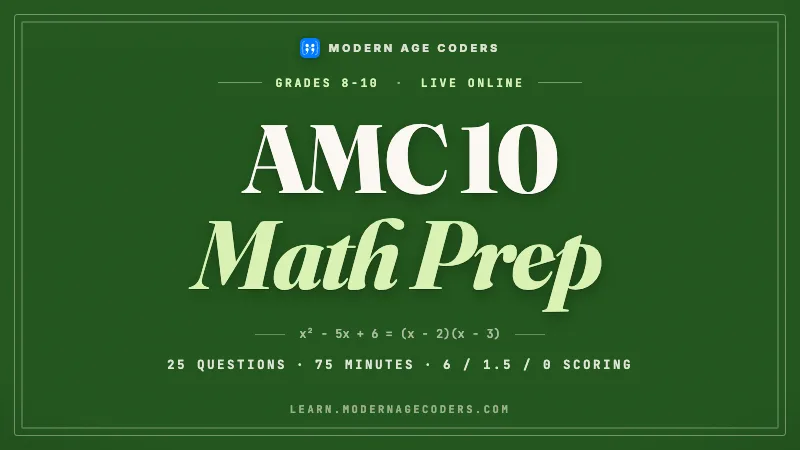
AMC10 / 01
The main course: 32 weeks from algebra and number theory to counting, probability and geometry, with timed 75-minute sets and a guessing plan built on the scoring rule.
Open the syllabus →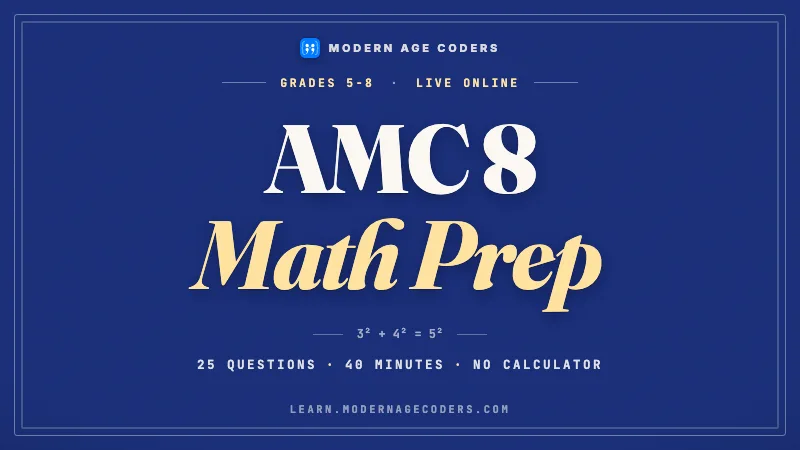
AMC10 / 02
For an S1 or S2 student not yet ready for 75 minutes of AMC 10 work. The shorter paper builds speed and accuracy first.
Open the syllabus →
AMC10 / 03
For students already scoring well who want proof-style problems and the longer path towards the AIME and beyond.
Open the syllabus →The paper
Both are 25-question, 75-minute multiple-choice papers from the Mathematical Association of America (MAA). The AMC 10 stops before trigonometry and advanced algebra; the AMC 12 includes them.
| AMC 10 | AMC 12 | |
|---|---|---|
| Questions and time | 25 multiple-choice, 75 minutes | 25 multiple-choice, 75 minutes |
| Calculator | Not allowed | Not allowed |
| Points | 6 right, 1.5 blank, 0 wrong; 150 maximum | The same |
| Who may sit it | Grade 10 or below, under 17.5 on contest day | Grade 12 or below, under 19.5 |
| Content | Elementary algebra, basic geometry, area and volume, elementary number theory and probability | The whole high school curriculum, including trigonometry, advanced algebra and advanced geometry, but no calculus |
| 2026 sittings | AMC 10A on 5 November, AMC 10B on 13 November | AMC 12A on 5 November, AMC 12B on 13 November |
Source: the MAA's rules and schedule for 2026-27, as verified when our AMC 10 syllabus was written (late August 2026). The MAA site refused our automated request in November 2026, so confirm any rule with the school or competition manager. A student may sit one A and one B contest, but not the AMC 10 and the AMC 12 on the same date.
Each November there are two versions, A and B, about a week apart. A student can sit one of each, for example the AMC 10A and then the AMC 10B, if the school or centre offers both. Some Hong Kong schools run only one, and their own rules may be stricter than the MAA's.
King George V School's page for 2026 is an example: it ran the AMC 10 and AMC 12 at school on Saturday 14 November 2026 at 9 am and told students they could take either contest, not both. Local arrangements like that are the ones that apply to your child.
For most students in S3 and S4 the AMC 10 is the right paper. It needs no trigonometry, and its later questions reward clever counting and geometry rather than heavy algebra.
An S4 student already comfortable with trigonometry and the algebra of functions can consider the AMC 12. We usually suggest staying on the AMC 10 while it is allowed, because a stronger result on the paper you fit beats a weak one on the harder paper.
Eligibility
The MAA rule has two parts, grade 10 or below and under 17.5 years on contest day, and both must hold. In Hong Kong terms that covers students up to about S4.
| American grade | Hong Kong local | English National Curriculum | IB programme | Paper that fits |
|---|---|---|---|---|
| Grade 8 | Secondary 2 | Year 9 | MYP year 3 | AMC 8, or AMC 10 if strong |
| Grade 9 | Secondary 3 | Year 10 | MYP year 4 | AMC 10 |
| Grade 10 | Secondary 4 | Year 11 | MYP year 5 | AMC 10, last year |
| Grade 11 | Secondary 5 | Year 12 | Diploma year 1 | AMC 12 only |
| Grade 12 | Secondary 6 | Year 13 | Diploma year 2 | AMC 12 only |
This line-up is our own and is rough at the edges; birth dates settle borderline cases. In British terms, the 2026 page from King George V School puts the same line in British terms: "the AMC10 is open to students in Years 11 and below", and the AMC 12 to "Years 13 and below".
Hong Kong families meet the AMC 10 through two doors. Students at international schools often find it on the school's list of extension activities. Students at local schools usually need to ask: some schools register a few strong students, and the Magic Square Association, the Hong Kong organiser of the Kangaroo contest, lists the AMC among the competitions it runs locally. We are not a competition manager and cannot register anyone. Our calendar of Hong Kong maths contests shows what else falls in the same school year.
Scoring
It depends on how many choices are still standing. A blank is worth 1.5 points; a guess is worth 6 points times the chance of being right. We worked the numbers out exactly.
| Choices still possible | A guess is worth, on average | A blank is worth | So |
|---|---|---|---|
| 5 (no idea) | 1.2 points | 1.5 points | Leave it blank |
| 4 (one ruled out) | 1.5 points | 1.5 points | Break even |
| 3 (two ruled out) | 2 points | 1.5 points | Guess |
| 2 (three ruled out) | 3 points | 1.5 points | Guess |
| 1 (sure) | 6 points | 1.5 points | Answer |
Our calculation: a guess among n remaining choices is right with probability 1/n, so it is worth 6/n points on average, compared with the fixed 1.5 for a blank. Scoring rule from the MAA, 2026-27.
A pure guess loses value. A guess after ruling out two choices gains it. So the real skill is elimination: a student who can cross out two wrong answers on a hard question should guess; a student who cannot should move on and leave it.
The table is about averages over many questions. On any single question a guess either wins 6 or loses the 1.5, which is why students who panic about one guess are worrying about the wrong thing.
Eleven blanks are worth 16.5 points, more than two and a half correct answers. Our planner below shows that 14 right answers with the other 11 left blank already reach 100.5.
One more fact from the same arithmetic: a total of exactly 100 is impossible, because every score is a multiple of 1.5 and 100 is not. Small facts like this are why we teach scoring as mathematics rather than as rules to memorise.
After the AMC 10
The American Invitational Mathematics Examination (AIME) is the next step after a high AMC score. In August 2026 the MAA announced new rules for the 2027 AIME.
Source: MAA announcement of 26 August 2026 on the 2027 AIME, as verified for our AMC 10 syllabus in late August 2026. We could not re-read it on maa.org in November 2026; confirm the details with your competition manager.
The fixed score makes the target concrete: 100 points from 150. From our scoring table, that is 14 correct answers with every other question left blank, or fewer correct answers and some well-chosen guesses. We use the number as a planning tool, never as a promise. Students aiming beyond the AIME will find the wider olympiad path on our maths olympiad classes page.
Our practice set
These problems are ours, written for this page in the AMC 10 style; none comes from an MAA paper. Each has a short route that needs no calculator, and a program checks the answers afterwards, along with the scoring table above.
1. 9 pairs. Clear the fractions: 6x + 6y = xy, so (x − 6)(y − 6) = 36. Positive factor pairs of 36 give 9 ordered pairs. Two negative factors cannot work, since each would be at least −5 and their product at most 25.
2. 260. 1030 − 1 is thirty nines. Taking away 2026 more changes only the last four digits, to 9999 − 2026 = 7973, so the number is 26 nines followed by 7973. The digit sum is 26 × 9 + 26 = 260.
3. 8/15. Count the complement. Seven of the ten numbers are not multiples of 3, so C(7, 2) = 21 of the C(10, 2) = 45 pairs avoid 3 entirely. The probability is 1 − 21/45 = 24/45 = 8/15.
Each solution turns the question into an easier one first: a product of brackets, a row of nines, a complement. That move, more than any formula, is what the middle of an AMC 10 paper tests.
# Our own AMC 10 scoring planner and practice check (Modern Age Coders).
# Scoring used: 25 questions, 6 points right, 1.5 blank, 0 wrong, five choices.
from fractions import Fraction as F
from itertools import combinations

BLANK = F(3, 2)
print("choices left | a guess is worth | a blank is worth | so")
for left in range(5, 0, -1):
    guess = F(6, left)
    verdict = "guess" if guess > BLANK else ("either" if guess == BLANK else "leave blank")
    print(f"{left:>12} | {float(guess):>16} | {float(BLANK):>16} | {verdict}")

# Fewest right answers that reach a target when every other question is blank.
for target in (75, 90, 100, 120):
    need = next(c for c in range(26) if 6 * c + BLANK * (25 - c) >= target)
    print(f"target {target}: {need} right + {25 - need} blank = {float(6 * need + BLANK * (25 - need))}")

# Can any mix of right, blank and wrong answers total exactly 100?
exact = [(r, b) for r in range(26) for b in range(26 - r) if 6 * r + BLANK * b == 100]
print("ways to score exactly 100:", len(exact))

# Our practice set, checked by brute force.
print("P1:", sum(1 for x in range(1, 100) for y in range(1, 100) if F(1, x) + F(1, y) == F(1, 6)))
print("P2:", sum(int(d) for d in str(10 ** 30 - 2027)))
pairs = list(combinations(range(1, 11), 2))
print("P3:", F(sum(1 for a, b in pairs if a * b % 3 == 0), len(pairs)))
Our own planner and checker. Fractions keep the arithmetic exact, so 6/4 really equals 3/2 and the break-even row is not a rounding accident. Run it with python3 amc10_points.py.
choices left | a guess is worth | a blank is worth | so
           5 |              1.2 |              1.5 | leave blank
           4 |              1.5 |              1.5 | either
           3 |              2.0 |              1.5 | guess
           2 |              3.0 |              1.5 | guess
           1 |              6.0 |              1.5 | guess
target 75: 9 right + 16 blank = 78.0
target 90: 12 right + 13 blank = 91.5
target 100: 14 right + 11 blank = 100.5
target 120: 19 right + 6 blank = 123.0
ways to score exactly 100: 0
P1: 9
P2: 260
P3: 8/15
The exact output. The table rows match the hand calculation, the target lines show the fewest correct answers with all else blank, and the three practice answers agree with the hand solutions.
Students who like checking ideas with a few lines of code can take that further in our maths through coding course, and the thinking-first habit behind the hand solutions is set out in we teach you how to think.
Coaching
The AMC 10 sits in November, early in the Hong Kong school year, so most preparation happens over the previous spring and summer. One-to-one lessons let each student work on their own weak topics.
From January to June we build the algebra, number theory and geometry the later questions assume, alongside schoolwork. Over the summer the focus turns to counting and probability, the topics local syllabuses touch least.
From September we move to full 75-minute sets of our own, each followed by a lesson on the misses and on which blanks and guesses were well chosen. In the last weeks before November the work is light and mostly review.
Every lesson is in English, with a mentor based in India; the AMC 10 is set in English too. With India two and a half hours behind Hong Kong in every season, an 8 pm Hong Kong lesson begins at 5:30 pm for the mentor, and Saturday 9 am becomes 6:30 am.
Nobody can honestly guarantee a score, an AIME place or an award, and we do not. We offer careful teaching and an honest view of your child's progress after every timed set.
How the AMC 8, 10 and 12 connect is covered in maths olympiad and AMC tutoring. Students who also sit the Education Bureau's school-team contest in January can read our HKMO preparation guide, and families with children at international schools may find our IB maths tutor and IGCSE maths tutor pages useful for the school side.
Progress
Our own measures, reported to parents after each timed set. They are not AMC results and predict none.
| Measure | What we look at | Good sign |
|---|---|---|
| First ten | Accuracy on the opening questions | Nine or ten right, steadily |
| Blank choice | Blanks left only with no idea at all | Fewer than two careless guesses a set |
| Elimination | Choices ruled out before guessing | Two crossed out before any guess |
| Counting | Complements, cases, symmetry | The method named before the work |
| Geometry | Sketches, similar triangles, areas | A clean figure for every geometry question |
| Planned total | Right answers plus blanks | Above the student's own target three sets running |
A blank is 1.5 points you keep.
Cross out two, then guess.
Ask how many blanks were chosen on purpose.
Spring and summer are when the AMC 10 is really prepared.
More courses
Nine further courses. In Hong Kong each runs one to one, live, with English as the teaching language.
AMC10 / C / 01
Trigonometry and advanced algebra added.
Open the syllabusAMC10 / C / 02
Pascal to Euclid papers for practice.
Open the syllabusAMC10 / C / 03
For a younger sibling starting out.
Open the syllabusAMC10 / S / 01
Extended and Additional Maths.
Open the syllabusAMC10 / S / 02
Analysis or Applications, SL or HL.
Open the syllabusAMC10 / S / 03
The counting and chance the AMC 10 loves.
Open the syllabusAMC10 / X / 01
Python as a second pair of eyes.
Open the syllabusAMC10 / X / 02
Contest problems solved with algorithms.
Open the syllabusAMC10 / X / 03
The language of informatics contests.
Open the syllabusHow classes run
Any day, any time, flexible: one to one at the hour that suits your family, weekdays or weekends.
Weekday evening
Late afternoon for the mentor, easy to keep every week.
Saturday morning
Long enough for a full 75-minute set and its review.
Summer
More lessons a month for counting and probability, if wanted.
The same mentor across the season.
Every line of working shared as it is written.
Written by our mentors, never copied from papers.
25 questions in 75 minutes, scored 6, 1.5 and 0.
Each blank and guess discussed after a set.
Progress and next steps after every set.
Student work
Projects by students in our longer courses around the world, shown in our student labs.

AI and ML
An AI nutrition coach that reads what you eat and works you toward a target.

AI and ML
A chatbot that answers mathematics and programming questions, built and deployed by a student.

AI and ML
An assistant that helps a young person recognise unsafe situations online.

Web app
A weather forecasting site with live conditions for any location.
Fees
Coaching is billed monthly and the fee shows here in Hong Kong dollars. You pay a month at a time and never a whole contest season in advance; if your payment method carries a gateway charge, checkout shows it before you agree.
Free first class
Free
no card required
One to one
$1,200 HKD
a month, eight live classes
What families say
Reviews from parents and students on Google, unedited.
★★★★★
"The one step solution for my son. Modern Age Coders make learning coding so simple that kids love it. The teachers explain complex concepts clearly with practical exercises and interactive content."
Ria Mukherjee
Parent
★★★★★
"Modern Age Coders has been a game-changer for me. I struggled to grasp IT concepts and coding before joining, but their classes transformed everything. I can now confidently write complex programs with ease."
Samriddha Mondal
Student
★★★★★
"One of the most wonderful education centres out there. Education is not limited to school syllabus but focuses on skill development."
Vansh Agarwal
Student
★★★★★
"My child Dhairya is really enjoying the Modern Age Coders classes. This is his first online class and he eagerly looks forward to it. I can already see his improvement, and the teachers are very cooperative."
Sonam Oswal
Parent of Dhairya
★★★★★
"Modern Age Coders have wonderful teachers who teach in a clear, easy and practical way. The teacher boosts students' confidence and inspires them to learn without hesitation."
Sonu Goyal
Parent
★★★★★
"I highly recommend this computer coding class! The teachers are incredibly knowledgeable and passionate about coding."
Ritu Kedia
Parent
AMC 10 questions
An MAA contest paper of 25 multiple-choice questions, 75 minutes long, sat without a calculator. Entrants must be in grade 10 or lower and younger than 17.5 on the day.
Each correct answer scores 6 points, each blank 1.5 and each wrong answer 0, out of 150. A pure guess is worth less than a blank on average; a guess after ruling out two choices is worth more.
Each November, in an A and a B version. In 2026 the AMC 10A was on 5 November and the AMC 10B on 13 November. Your school or competition manager sets the local day and time.
Roughly S4 and below at a local school, or Year 11 and below at a British-system school, as long as the student is under 17.5 on contest day. The mapping is approximate; the MAA rule decides.
Ask your child's school first; if it does not offer the AMC 10, look for a local competition manager, such as the Magic Square Association, which lists the AMC among its Hong Kong contests. Registration never goes through us.
The MAA announced a fixed qualifying score for 2027: 100 or more on the AMC 10, plus other eligibility rules. Ask your competition manager what applies to students in Hong Kong.
Most students in S3 and S4 should take the AMC 10, which needs no trigonometry. Students cannot sit the AMC 10 and AMC 12 on the same date.
No. Scores, AIME places and awards are not ours to promise; teaching and honest feedback are.
Yes, always: live online lessons in English, which is also the language the AMC 10 is written in. Mentors work from India, and lessons are not offered in Cantonese or Putonghua.
Any day, any time, flexible: one to one at the hour that suits your family, weekdays or weekends. For the mentor in India, a 7:30 pm Hong Kong start is 5 pm.
Each month separately, with the fee shown in Hong Kong dollars; a payment gateway charge, where one applies, appears at checkout before you commit.
Related
Pages Hong Kong AMC 10 families usually read next.
Where the AMC 8 and its neighbours fit.
Local contests dated by their organisers.
The Education Bureau's olympiad for school teams.
How the AMC papers fit together.
The longer path beyond multiple choice.
A live lesson, step by step.
Part of the guide: Every Hong Kong page
More guides: Coding and AI classes in Hong Kong · 中文:英文授課編程課程 · Start here: Online coding for kids · AI, vibe coding and AI agents: AI agents course · Coding subjects and courses: App development · By age and school level: Adults · HKDSE ICT and maths: DSE ICT elective guide · IB, IGCSE, A-level and SAT: A level Computer Science tutor · Guides for families: After-school coding · School holidays: AI summer course · Districts and areas: Causeway Bay
Start here
Let us know the school year, the curriculum and which AMC papers, if any, your child has already tried. In the free class the mentor works through a few of our own problems with your child, asks which they would have left blank and why, and suggests a plan for the coming November, live and one to one.
Want to see a lesson first? How we teach shows one, and all syllabuses are on the courses page.
WhatsApp us · +91 91233 66161 · connect@modernagecoders.com
All lessons happen live online, in English; our mentors are in India. For the quickest answer, WhatsApp us in English.
A priority demo is a full class of about 45 to 60 minutes. After the class the mentor sends a written skill report and a personal learning roadmap on WhatsApp. If you enrol, the demo fee is adjusted against your first month's fee. Share your demo Order ID with us on WhatsApp and we take it off.
Book a priority demo