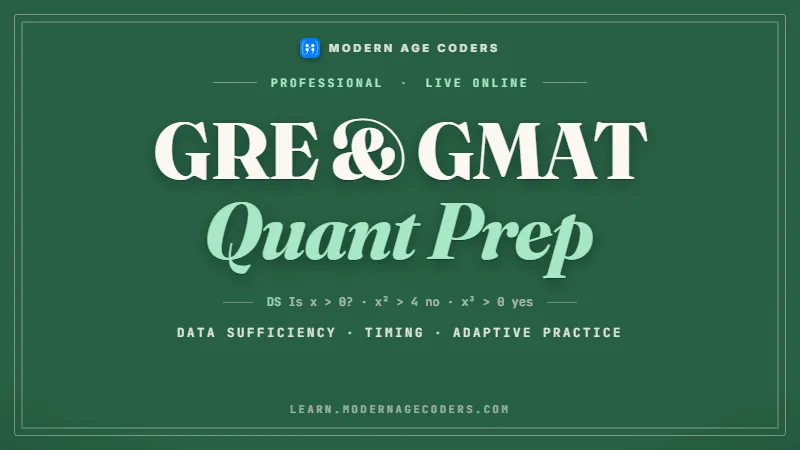
GRE & GMAT Quantitative Prep
The quantitative sections of both tests are built on school maths done under time pressure with tricks laid deliberately in the way. This course rebuilds the maths and then trains the exam.
Syllabus updated August 2026
Questions? WhatsApp +91 91233 66161 or email connect@modernagecoders.com
Recordings are free with a Google sign-in. These recordings show how we teach, not the exact syllabus of this course.
Our promise
The world's best learning experience, open to everyone.
- World-class instructorsEvery class is taught by an instructor who specialises in that exact field.
- No compromise on qualityEvery lesson, project and piece of feedback is held to the highest standard.
- Education for everyoneLearners aged 6 to 67, from first-time beginners to working professionals, in 25+ countries.
If you want the highest quality, Modern Age Coders is the right choice.
Book a Priority DemoHow long this course takes
This course runs 6 months (24 weeks) at 2 live classes/week + 4-5 hours practice. The range allows for background and pace: a complete beginner uses the full span, and a student with prior knowledge finishes sooner. The syllabus below is planned to the shorter end, with margin kept for revision.
For personalised duration planning, call +91 91233 66161 and we'll map a schedule to your goals.
At a glance
- Who it is for
- Adults preparing for graduate admissions; school maths is refreshed from the ground up.
- Prerequisites
- School maths up to about class 10, even if it is rusty. The course rebuilds arithmetic and algebra from the ground up, so being out of practice is expected and planned for, not a problem
- Format
- Live, interactive classes with a real instructor, never pre-recorded videos. Live classes run about one hour.
- Language
- English or Hindi, depending on the batch.
- Duration
- 6 months (24 weeks)
- Weekly commitment
- 2 live classes/week + 4-5 hours practice
- Class size
- Group batches of 5 to 10 students, mini batches of 3 to 4, or 1-on-1.
- Certificate
- Certificate from Modern Age Coders, awarded on passing the final assessment
- Watch first
- Free recordings of real classes for ages 13 and up, free with a Google sign-in. These recordings show how we teach, not the exact syllabus of this course.
- Live demo
- Optional. Enrol directly on this page, or book a Priority Demo: a full live class of about 45 to 60 minutes with a mentor reserved for you.
- Questions
- WhatsApp +91 91233 66161 or email connect@modernagecoders.com.
How we teach
Deep understanding. Real projects. Expert guidance.
Learn coding, AI and maths through careful explanations, practical demonstrations, and hands-on problem-solving. Our instructors guide you from the foundations to advanced ideas, helping you understand what happens, why it happens, and how to build it yourself.
You will explore concepts step by step, write and improve code, investigate mistakes, ask questions, and apply your knowledge to meaningful projects. Lessons are designed around active participation, thoughtful feedback, and growing independence.
Expert-led live teaching, with practical participation built into every lesson.
- Students explain their thinking.
- Instructors demonstrate, then guide practice.
- Learners code, solve, or build during lessons.
- Questions and misconceptions get attention.
- Assignments receive useful feedback.
- Progress is checked before advancing.
How to join GRE & GMAT Quantitative Prep: Live Maths Coaching
Four steps from this page to the first class. See a full class first with a Priority Demo, or choose a plan and enrol today.
Rated 4.9 across 547 Google reviews. Monthly billing, cancel any time.
How enrolment works
See a full class first (optional)
Book a Priority Demo: a live class of about 45 to 60 minutes with a mentor reserved for you, today or tomorrow. After the class the mentor sends a written skill report and a personal learning roadmap on WhatsApp. If you enrol, the demo fee is adjusted against your first month's fee. Share your demo Order ID with us on WhatsApp and we take it off.
Book a Priority DemoDemo fee ₹499Choose a plan
Group batch (5 to 10 students), mini batch (3 to 4 students, India only) or 1-on-1 with your own mentor. Every plan is live online, and each class runs about one hour. The cards below show classes per week and the monthly fee in your currency.
Enrol and pay the first month
Press Enrol Now on your plan, fill in the student's name, email and phone, and pay through secure Razorpay checkout: UPI, cards or net banking in India, and debit or credit card from any other country.
Fix your class timings
After payment, message us on WhatsApp or call +91 91233 66161 with the student's name, the course and your preferred time slot. We confirm the batch, send the class link and schedule the first class at your chosen time.
Billing is monthly and you can cancel any time.
International Students (Outside India)
Billed monthly in US dollars, the same price in every country. Contact us with any questions.
Questions before you enrol? Talk to our team.
Ask about class timings, the right level for your child, what they need to know already, or payment. Parents and adult learners can reach us on WhatsApp, by email or by phone.
Program Overview
The quantitative sections of the GRE and the GMAT do not test advanced mathematics. The GRE goes no higher than a second course in school algebra, and the GMAT Focus Edition covers arithmetic, algebra and statistics with no plane geometry at all. What makes them hard is that they test speed, careful reading and trap-awareness on maths most adults last touched years ago. This 6-month live course treats that honestly. The first two months rebuild the arithmetic and algebra foundation from the ground up, because a shaky foundation is where most lost marks actually come from. The middle two months cover the full content map of both exams: word problems, ratios and rates, exponents and roots, the geometry the GRE still tests, coordinate geometry, and the descriptive statistics both exams lean on. The final two months are pure exam craft: quantitative comparison for the GRE, data sufficiency and the GMAT Data Insights section, timing strategy, educated guessing, and full timed practice sets reviewed question by question.
We teach to the current formats, not the old ones. That means the shorter GRE introduced in September 2023, with its two quant sections of twelve and fifteen questions, and the GMAT Focus Edition with its three forty-five-minute sections and data sufficiency moved into Data Insights. A course still teaching the old GMAT with sentence correction and an in-quant data sufficiency block is a course teaching an exam that no longer exists.
What Makes This Program Different
- Taught to the current exams: the shorter GRE (from September 2023) and the GMAT Focus Edition, including data sufficiency now living in the Data Insights section, not the quant section
- Foundation rebuilt first: two full months of arithmetic and algebra before any exam tricks, because that is where most lost marks come from
- One course for both tests: the shared arithmetic, algebra, word-problem and statistics core taught once, then the GRE-specific and GMAT-specific pieces taught separately and clearly labelled
- Trap-awareness as a taught skill: the specific ways each exam sets bait, drilled until you see them coming
- Timed from the middle of the course, not just at the end, so pace becomes a habit rather than a panic
- Every full practice set reviewed question by question, with the focus on why the wrong answer was tempting
Your Learning Journey
Career Progression
Detailed Course Curriculum
Explore the complete week-by-week breakdown of what you'll learn in this comprehensive program.
Topics Covered
- A full diagnostic to locate your real starting point, not your assumed one
- How the current GRE and GMAT quant sections are actually built, question by question
- Integers, factors, multiples and the properties that questions hinge on
- Prime numbers, prime factorisation and why the exams love them
- Even, odd, positive, negative: the rules that turn a hard question easy
- Divisibility rules that save real seconds under time pressure
Projects You Build
- Personal weakness map: your diagnostic broken down by topic into a ranked list of what to fix first
Practice & Assignments
20 number-property questions, timed loosely at first, with every mistake tagged by cause: knowledge, careless, or misread
Topics Covered
- Fractions without a calculator: comparing, combining and simplifying at speed
- Decimals and place value, and converting fluently between the three forms
- Percentages, percentage change and the reversal trap that catches everyone
- Successive percentage changes and why they do not simply add
- Estimation as a real technique: when the exam wants an approximate answer
- The on-screen GRE calculator and the GMAT Data Insights calculator: when they help and when they waste time
Projects You Build
- Percentage trap set: ten deliberately baited percentage questions worked slowly, then reworked at speed
Practice & Assignments
24 fraction, decimal and percentage questions, half of them worded to hide which operation is needed
Topics Covered
- Ratios and how to scale them without losing the units
- Proportions and direct and inverse variation
- Rates: speed, work and price per unit, all as the same idea
- Mixtures and blends, a favourite of both exams
- Reading a multi-part ratio question without dropping a condition
- The bridge from ratios to the word problems of month 3
Projects You Build
- Rate reasoning: five real-world rate scenarios set up as equations before any number is plugged in
Practice & Assignments
20 ratio and rate questions, each one required to be set up in writing before it is solved
Topics Covered
- Exponent rules until they are automatic, not looked up
- Square roots, cube roots and simplifying surds
- Scientific notation and handling very large and very small numbers
- Absolute value and what it does to inequalities
- Number-sense shortcuts: last-digit tricks, sign tricks, magnitude checks
- Sanity-checking an answer in five seconds before you commit to it
Projects You Build
- Shortcut library: your own one-page sheet of the number-sense checks that will not fit in a calculator
Practice & Assignments
22 exponent and root questions, with a sanity-check written next to each final answer
Assessment
Month 1 checkpoint: a timed arithmetic and number-properties set graded on accuracy and on whether the timing held
Topics Covered
- Algebraic expressions: simplifying, expanding and factoring cleanly
- Solving linear equations and rearranging formulas under time
- Translating words into equations, the single most valuable exam skill
- Substitution and picking smart numbers to test answer choices
- Working backwards from the answer options when it is faster
- Common algebra traps and the misreads that trigger them
Projects You Build
- Translation drill: fifteen word phrases each converted to an equation, the step where most marks are won or lost
Practice & Assignments
24 algebra questions solved twice each: once by direct algebra, once by testing the options, to learn which is faster when
Topics Covered
- Systems of equations by substitution and elimination
- Inequalities and the sign-flip rule that quietly loses marks
- Compound inequalities and interval reasoning
- Absolute value equations and inequalities
- When a system has one solution, none, or infinitely many, and why the exam asks
- Recognising a system hiding inside a word problem
Projects You Build
- Two-variable challenge: a set of word problems that each resolve to a two-equation system, set up before solving
Practice & Assignments
20 systems and inequalities questions with the setup shown in full before any solving
Topics Covered
- Factoring quadratics and the common exam-friendly forms
- The quadratic formula and completing the square, used sparingly and correctly
- Functions and function notation without the fear
- Reading a function defined by a rule or a table
- Sequences: arithmetic and geometric, as the exams present them
- Spotting the quadratic buried in a word problem
Projects You Build
- Quadratic recognition: ten problems where the challenge is realising a quadratic is involved at all
Practice & Assignments
22 quadratics and functions questions, each opened by naming the structure before touching the algebra
Topics Covered
- Choosing between algebra, plugging in numbers, and testing options, deliberately
- Algebraic word problems: age, mixture, work and money set up cleanly
- Multi-step problems and keeping track without losing the thread
- Where the two exams differ in how they dress algebra questions
- Building a personal decision rule for which method to reach for
- Timed algebra: getting the right answer inside the clock
Projects You Build
- Method-choice audit: a mixed algebra set where you record which method you chose and whether it was the fastest available
Practice & Assignments
24 mixed algebra questions under a soft timer, reviewed for method choice as much as for the answer
Assessment
Month 2 checkpoint: a timed algebra section, marked on accuracy, timing and whether the fastest method was chosen
Topics Covered
- Distance, rate and time, including two-traveller and round-trip variants
- Work and combined-work problems set up without the classic error
- Mixture, interest and profit-and-loss problems
- Overlapping-sets problems and the two-way table that tames them
- Age and consecutive-integer problems
- A method for translating any dense word problem into a clean setup
Projects You Build
- Word-problem playbook: your own labelled template for each of the six recurring problem types
Practice & Assignments
24 word problems spanning all six types, each set up in writing before it is solved
Topics Covered
- Why this month matters for the GRE and not for the GMAT Focus quant section
- Lines, angles and the parallel-line rules the exam reuses constantly
- Triangles: properties, the Pythagorean theorem and the special right triangles
- Similar and congruent triangles and the ratios they give you
- Perimeter and area worked cleanly
- The figure-not-to-scale warning and how the GRE uses it against you
Projects You Build
- Triangle toolkit: a reference of every triangle fact the GRE reuses, drawn and annotated by you
Practice & Assignments
20 GRE-style geometry questions, GMAT-only students substituting an equivalent Data Insights set
Topics Covered
- Circles: radius, diameter, circumference, area, arcs and sectors
- Quadrilaterals and regular polygons and their angle sums
- Three-dimensional solids: volume and surface area of boxes, cylinders and spheres
- Inscribed and combined figures, a favourite GRE construction
- Estimating from a figure when exact computation is slow
- Knowing which formulas to memorise and which to reconstruct
Projects You Build
- Formula sheet, earned: build the geometry formula reference yourself, which is how it actually sticks
Practice & Assignments
20 circle, polygon and solid questions, each with a labelled diagram drawn before solving
Topics Covered
- The coordinate plane, distance and midpoint
- Slope and the equation of a line in its several forms
- Parallel and perpendicular lines by their slopes
- Why the GMAT Focus Edition counts coordinate geometry as algebra and still tests it
- Intersections, and reading a graph the exam gives you
- Reflections and simple transformations on the plane
Projects You Build
- Line investigation: a set of coordinate problems solved both algebraically and by sketching, to see which is faster where
Practice & Assignments
22 coordinate geometry questions relevant to both exams, since this topic survives on the GMAT as algebra
Assessment
Month 3 checkpoint: a timed section mixing word problems, GRE geometry and coordinate geometry
Topics Covered
- Mean, median, mode and range, and which one a question is really testing
- Weighted averages, a heavily tested and heavily missed idea
- Standard deviation conceptually: the exams test understanding, not hand calculation
- Quartiles, percentiles and the reasoning around them
- How adding or changing a value moves the mean and the median
- The statistics traps both exams set, catalogued
Projects You Build
- Average-shift study: a set of questions about how statistics change when the data changes, reasoned without brute force
Practice & Assignments
22 statistics questions weighted towards weighted averages and standard-deviation reasoning
Topics Covered
- The fundamental counting principle applied cleanly
- Permutations and combinations, and telling which the question wants
- Basic probability and the complement shortcut
- Probability with and without replacement
- Combined events and when to add versus multiply
- The exam-realistic level of difficulty, so you neither under nor over-prepare
Projects You Build
- Counting decision tree: your own flowchart for choosing between permutation, combination and direct counting
Practice & Assignments
20 counting and probability questions pitched at the exams' actual difficulty, not competition-maths depth
Topics Covered
- Reading tables, bar charts, line graphs and pie charts accurately and fast
- Multi-source questions where two graphs must be combined
- GRE data interpretation sets and how they are scored
- The visual and quantitative formats inside GMAT Data Insights
- Percentage and ratio reasoning applied to chart data
- Not being fooled by a chart drawn to mislead
Projects You Build
- Graph deconstruction: a real multi-graph data set answered, then examined for how it could have been misread
Practice & Assignments
20 data-interpretation questions across chart types, timed as the sets are on the real exams
Topics Covered
- Pulling the whole content map together into one map you can see
- A personal error log built from every month so far
- Your two or three recurring mistake patterns, named and targeted
- Pacing across a full section rather than a single question
- A pre-test routine for the quant section
- Setting a realistic target score band for your programme
Projects You Build
- First full timed quant section, GRE or GMAT to match your goal, followed by a written self-review
Practice & Assignments
One complete timed quant section plus a question-by-question review of every miss and every lucky guess
Assessment
Month 4 checkpoint: a full timed quant section scored, with an honest read on your current band and gap to target
Topics Covered
- The four answer choices of quantitative comparison and what each really means
- Why quantitative comparison rewards reasoning over full computation
- Testing cases: zero, one, negatives, fractions and the numbers that break patterns
- The must-not-compute mindset for a whole question type
- The specific traps built into quantitative comparison
- GMAT-only students spend this session on an equivalent problem-solving intensive
Projects You Build
- Case-testing drill: quantitative comparison questions solved purely by choosing the numbers that expose the answer
Practice & Assignments
24 quantitative comparison questions, no full calculation permitted where case-testing will do
Topics Covered
- Data sufficiency: the format that asks whether you can answer, not what the answer is
- The fixed five answer choices and a reliable order to eliminate them
- Why data sufficiency now lives in GMAT Data Insights, not the quant section
- The other Data Insights formats: table analysis, graphics interpretation, multi-source reasoning, two-part analysis
- The calculator that Data Insights allows and quant does not
- GRE-only students use this session to deepen data interpretation instead
Projects You Build
- Data sufficiency ladder: a graded set that builds the elimination habit from simple to genuinely tricky
Practice & Assignments
24 data sufficiency and Data Insights questions worked with the elimination framework applied every time
Topics Covered
- The real time budget: roughly one minute forty-five per GRE quant question, just over two minutes on GMAT quant
- The thirty-second rule for deciding to move on
- Educated guessing that beats random, and when to deploy it
- Section-level pacing rather than fighting for every single question
- Managing the adaptive nature of the GMAT and the section-adaptive GRE
- Recovering calmly from a question that goes wrong mid-section
Projects You Build
- Pacing plan: your written per-section time strategy, including your personal move-on triggers
Practice & Assignments
Timed blocks focused purely on pacing decisions, tracking how many move-on calls were correct
Topics Covered
- Mining your accumulated error log for the two or three patterns that cost the most
- Careless-error reduction as a trainable, measurable skill
- Rebuilding any content weakness the practice sections have exposed
- Distinguishing knowledge gaps from timing errors from misreads, because the fixes differ
- Re-attempting past misses cold to confirm the repair held
- Adjusting the target band with real evidence now in hand
Projects You Build
- Repair sprint: your top mistake pattern attacked with a focused set until the error rate on it visibly drops
Practice & Assignments
Targeted sets built from your own error log, retested a week later to prove the fix stuck
Assessment
Month 5 checkpoint: a full timed section compared against month 4 to measure real movement
Topics Covered
- A complete timed quant section under genuine exam conditions
- Question-by-question review focused on why the wrong answer was tempting
- Separating unlucky guesses from real knowledge, since only one needs fixing
- Updating the error log with the newest patterns
- Retiming the questions that were slow but correct
- Setting the single focus for the coming week
Projects You Build
- Full section one, reviewed in a written report: score, error breakdown and the one thing to fix next
Practice & Assignments
The full section plus a complete written review; slow-but-correct questions retimed to build margin
Topics Covered
- A second full timed section, rotating to the other exam if you are sitting both
- Sharpening the exam-specific formats: quantitative comparison or data sufficiency, whichever is yours
- Comparing this section against the last for direction of travel
- Fatigue management across a real testing block
- Fine-tuning the pacing plan with fresh data
- Locking in the guessing strategy so it is automatic on the day
Projects You Build
- Full section two, with a side-by-side comparison against section one and a revised pacing plan
Practice & Assignments
The second full section plus focused drilling on whichever format still leaks marks
Topics Covered
- A third full timed section to make exam pace feel ordinary
- Closing the last content gaps the three sections have exposed
- A calm, repeatable pre-section routine rehearsed until it is automatic
- Test-day logistics: what to expect at the centre or on the online exam
- Building the mental stamina for a full test, not just a section
- Confirming a realistic, evidence-based target for test day
Projects You Build
- Full section three, with the final short list of content gaps and a plan to close each one
Practice & Assignments
The third full section plus targeted repair of any content weakness still standing
Topics Covered
- A final mixed timed set drawing on everything the course covered
- The last pass over the error log, now much shorter than it started
- Your personal test-day playbook: pacing, guessing rules and pre-section routine on one page
- Managing exam nerves with preparation rather than hope
- A realistic score expectation grounded in your practice results
- Where to go next if you want to lift a strong score to an excellent one
Projects You Build
- Test-day playbook: a single sheet with your pacing plan, guessing rules, routine and target, ready for the exam
Practice & Assignments
A final timed set and a full walk-through of the test-day playbook
Assessment
Final review: a complete timed section, a progress summary from diagnostic to now, and certificate review
Projects You'll Build
Build a professional portfolio with A complete personal prep kit: weakness map, reference sheets, error log, pacing plan and a test-day playbook, plus multiple fully reviewed timed sections real-world projects.
Weekly Learning Structure
Certification & Recognition
Technologies & Skills You'll Master
Comprehensive coverage of the entire modern web development stack.
Support & Resources
Career Outcomes & Opportunities
Transform your career with industry-ready skills and job placement support.
Prerequisites
Who Is This Course For?
Career Paths After Completion
Salary & Market Context
The GRE and GMAT are gateways to graduate programmes, and it is those programmes, not this course, that connect to long-term career outcomes years later. The figures below are broad, publicly reported market ranges for the kinds of graduate paths these exams lead toward, shown purely for context. They are not a promise of any score, admission, or income, all of which depend on your application as a whole, the programme, the market and your own work. This course prepares you for the quantitative section and does not guarantee a score, an admission, or a salary.
Course Guarantees
Real students. Real moments. Real joy.
These are our actual student meetups. No stock photos, no filters. Swipe through and meet the community you'll be joining.







































What families say
Straight from the parents and students who learn with us. Rated 4.9 across 547 Google reviews.
“Mivaan enjoys the class. He understands the concepts and completes his tasks with excitement. He started taking interest in coding… truly amazing class.”
“I absolutely love it here! I made new friends and learned important valuable coding skills while having the fun of my life. It's not just coding here, it's outings, bonding and most importantly preparing you for your future. Definitely five stars.”
“What stands out most is how excited my son is before every class. He looks forward to learning, problem-solving, and sharing what he's built. I've noticed a big boost in his confidence!”
“Modern Age Coders has been a game-changer for me! I struggled to grasp IT concepts and coding before joining, but their classes transformed everything. I'm now the topper in my class and can confidently write complex programs with ease.”
“Modern Age Coder have wonderful teachers who teach in a clear, easy and practical way. The teacher boosts students' confidence, keeps them updated with technology, and inspires them to learn without hesitation.”
“The one step solution for my son. Modern Age Coders make learning coding so simple that kids love it.”
“Coding classes here make learning very interesting and conceptual. The teachers teach us in a very easy-to-understand and efficient manner.”
“One of the most wonderful education centres out there. Education is not limited to school syllabus but focuses on skill development. Learning here has been a wonderful journey and still continuing.”
“I highly recommend this computer coding class! The teachers are incredibly knowledgeable and passionate about coding. They make every session engaging and insightful.”
“My child Dhairya is really enjoying the Modern Age Coder IT classes. This is his first online class, and he eagerly looks forward to it.”
“Very good classes. Don't worry about coding. They teach the best, especially Shivam sir.”
“Very good classes. Makes learning very easy and interactive.”
Hear it from our students
Real parents and students in their own words, on our public YouTube channel.
Straight answers about GRE & GMAT Quantitative Prep: Live Maths Coaching
- Who should take this course?
- Adults preparing for graduate admissions; school maths is refreshed from the ground up. It suits mba applicants sitting the gmat focus edition who need to lift a quant score that stands between them and their target schools; applicants to masters and phd programmes sitting the gre, where a strong quant score matters most for quantitative and technical fields; candidates deciding between the two exams, or sitting both, who want the shared maths taught once and the differences taught clearly.
- What will they learn and build?
- The quantitative sections of the GRE and the GMAT do not test advanced mathematics. The GRE goes no higher than a second course in school algebra, and the GMAT Focus Edition covers arithmetic, algebra and statistics with no plane geometry at all. What makes them hard is that they test speed, careful reading and trap-awareness on maths most adults last touched years ago. This 6-month live course treats that honestly.
- How deeply are topics covered?
- The course runs 6 months (24 weeks) at 2 live classes/week + 4-5 hours practice, across 3 phases listed week by week in the syllabus below. A structured, well-paced curriculum that rebuilds the maths before drilling the exam, with hands-on practice every session.
- Who teaches it?
- Modern Age Coders mentors, who teach the live classes themselves. You can watch them at work in the free class recordings before you decide.
- How do practice, feedback and assessment work?
- Classwork every session, a task after every class, monthly reviews that mix in earlier topics, and a full mock paper as the final assessment that decides the certificate: real knowledge and real work, with a free retest after revision if needed. Doubt support between classes over WhatsApp, so a stuck question does not cost you a week. A certificate you earn by passing the final assessment, with a free retest after revision if needed.
- What does it cost?
- Three monthly plans: a group batch, a mini batch and 1-on-1. Prices are shown in your currency in the plans section. Monthly billing, cancel any time.
- When can classes take place?
- Live classes are scheduled around your week. Group batches meet at a fixed weekly slot; 1-on-1 students choose their own. International students are scheduled in their own timezone. Ask on WhatsApp for the current slots.
- Can I watch the teaching before deciding?
- Yes. Full recordings of real 13 and up classes are free to watch, free with a Google sign-in. These recordings show how we teach, not the exact syllabus of this course. Some classes are in English and some in Hindi; everyone follows at their own pace. Watch a class end to end, like you are in it. Sessions are interactive and each moment builds on the last.
- Can I enroll without a live demo?
- Yes. Choose a plan on this page and enrol directly; a demo is not required. If you would like to see a full class with a mentor first, book a Priority Demo.
- How do I reach you with a question?
- WhatsApp +91 91233 66161, email connect@modernagecoders.com, or call +91 91233 66161. Tell us the student's age and what they have learned so far, and we will point you to the right plan and batch.
Common Questions About GRE & GMAT Quantitative Prep: Live Maths Coaching
Get answers to the most common questions about this comprehensive program
Still have questions? We're here to help!
Contact UsRelated Courses You May Like
Continue your learning journey with these recommended programs
 Data and AI Analytics
Data and AI Analytics for Non-Programmers (Excel, Sheets, Power BI)
Live online data analytics for working professionals who do not code: clean and model data in Excel ...
Explore Course AI Coding Agents
Codex & Claude Code: AI Coding Agents for Professionals
Live online Codex + Claude Code masterclass for professionals. 24 mentor-led classes: CLIs, MCP, sub...
Explore CourseRelated Articles & Guides
Deepen your knowledge with these hand-picked articles
 Education
14 min read
Education
14 min read
Best Byju's Alternative for Kids and Teens in India (2026) - Live Classes, Coding + Maths
Looking for the best Byju's alternative in 2026? Compare top platforms like Modern Age Coders, White...
Read Article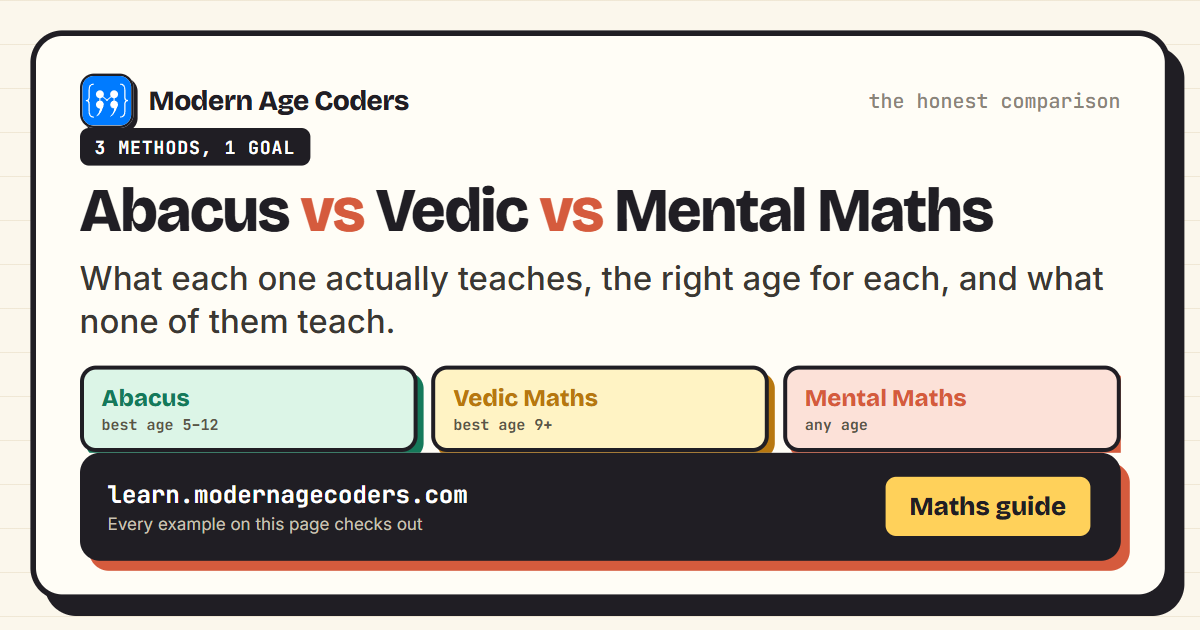 Mathematics
8 min read
Mathematics
8 min read
Abacus vs Vedic vs Mental Maths: A Clear Comparison
Abacus, Vedic maths, and mental maths compared: what each teaches, the right age, real worked exampl...
Read ArticleReady to start GRE & GMAT Quantitative Prep: Live Maths Coaching?
Book a Priority Demo to see a full live class with a mentor reserved for you, today or tomorrow. Or choose a plan and enrol now.
Questions? WhatsApp +91 91233 66161 or email connect@modernagecoders.com