AP Precalculus
A function-fluency course that happens to end in an AP exam, concentrated exactly where the exam is scored: Units 1 to 3.
Syllabus updated August 2026
Questions? WhatsApp +91 91233 66161 or email connect@modernagecoders.com
Recordings are free with a Google sign-in. These recordings show how we teach, not the exact syllabus of this course.
Our promise
The world's best learning experience, open to everyone.
- World-class instructorsEvery class is taught by an instructor who specialises in that exact field.
- No compromise on qualityEvery lesson, project and piece of feedback is held to the highest standard.
- Education for everyoneLearners aged 6 to 67, from first-time beginners to working professionals, in 25+ countries.
If you want the highest quality, Modern Age Coders is the right choice.
Book a Priority DemoHow long this course takes
This course runs 6 months (24 weeks) at 2 live classes/week + 4-5 hours practice. The range allows for background and pace: a complete beginner uses the full span, and a student with prior knowledge finishes sooner. The syllabus below is planned to the shorter end, with margin kept for revision.
For personalised duration planning, call +91 91233 66161 and we'll map a schedule to your goals.
At a glance
- Who it is for
- High school students preparing for AP Precalculus; a solid Algebra 2 background is assumed.
- Prerequisites
- A solid Algebra 2 background: comfort with function notation, factoring, exponents and basic graphing. This course does not re-teach Algebra 2 from scratch, though real gaps are patched as they surface
- Format
- Live, interactive classes with a real instructor, never pre-recorded videos. Live classes run about one hour.
- Language
- English or Hindi, depending on the batch.
- Duration
- 6 months (24 weeks)
- Weekly commitment
- 2 live classes/week + 4-5 hours practice
- Class size
- Group batches of 5 to 10 students, mini batches of 3 to 4, or 1-on-1.
- Certificate
- Certificate from Modern Age Coders, awarded on passing the final assessment
- Watch first
- Free recordings of real classes for ages 13 and up, free with a Google sign-in. These recordings show how we teach, not the exact syllabus of this course.
- Live demo
- Optional. Enrol directly on this page, or book a Priority Demo: a full live class of about 45 to 60 minutes with a mentor reserved for you.
- Questions
- WhatsApp +91 91233 66161 or email connect@modernagecoders.com.
How we teach
Deep understanding. Real projects. Expert guidance.
Learn coding, AI and maths through careful explanations, practical demonstrations, and hands-on problem-solving. Our instructors guide you from the foundations to advanced ideas, helping you understand what happens, why it happens, and how to build it yourself.
You will explore concepts step by step, write and improve code, investigate mistakes, ask questions, and apply your knowledge to meaningful projects. Lessons are designed around active participation, thoughtful feedback, and growing independence.
Expert-led live teaching, with practical participation built into every lesson.
- Students explain their thinking.
- Instructors demonstrate, then guide practice.
- Learners code, solve, or build during lessons.
- Questions and misconceptions get attention.
- Assignments receive useful feedback.
- Progress is checked before advancing.
How to join AP Precalculus: Units 1 to 3 and Full Exam Prep
Four steps from this page to the first class. See a full class first with a Priority Demo, or choose a plan and enrol today.
Rated 4.9 across 547 Google reviews. Monthly billing, cancel any time.
How enrolment works
See a full class first (optional)
Book a Priority Demo: a live class of about 45 to 60 minutes with a mentor reserved for you, today or tomorrow. After the class the mentor sends a written skill report and a personal learning roadmap on WhatsApp. If you enrol, the demo fee is adjusted against your first month's fee. Share your demo Order ID with us on WhatsApp and we take it off.
Book a Priority DemoDemo fee ₹499Choose a plan
Group batch (5 to 10 students), mini batch (3 to 4 students, India only) or 1-on-1 with your own mentor. Every plan is live online, and each class runs about one hour. The cards below show classes per week and the monthly fee in your currency.
Enrol and pay the first month
Press Enrol Now on your plan, fill in the student's name, email and phone, and pay through secure Razorpay checkout: UPI, cards or net banking in India, and debit or credit card from any other country.
Fix your class timings
After payment, message us on WhatsApp or call +91 91233 66161 with the student's name, the course and your preferred time slot. We confirm the batch, send the class link and schedule the first class at your chosen time.
Billing is monthly and you can cancel any time.
International Students (Outside India)
Billed monthly in US dollars, the same price in every country. Contact us with any questions.
Questions before you enrol? Talk to our team.
Ask about class timings, the right level for your child, what they need to know already, or payment. Parents and adult learners can reach us on WhatsApp, by email or by phone.
Program Overview
AP Precalculus is the newest AP mathematics course, and it is tested in a specific, slightly unusual way that changes how it should be prepared for. The classroom course covers four units, but the exam assesses only Units 1, 2 and 3. Unit 4, functions involving parameters, vectors and matrices, is taught across a full school year but does not appear on the exam at all. A prep course that spends real weeks drilling Unit 4 for exam purposes is spending time a student does not get back. This course concentrates its exam preparation exactly where the College Board tests: polynomial and rational functions, exponential and logarithmic functions, and trigonometric and polar functions.
The six-month structure follows the three tested units in order, with the later weeks given fully to exam craft once each unit's content is covered. Months 1 and 2 build Unit 1: rates of change, polynomial behaviour and zeros, rational functions with their asymptotes and holes, transformations, and choosing the right model for a data set. Months 3 and 4 build Unit 2: arithmetic and geometric sequences, exponential functions and modelling, function composition and inverses, and logarithms through to equation solving. Month 5 builds Unit 3: the unit circle, sinusoidal functions and modelling, tangent and the reciprocal trig functions, inverse trig, and polar coordinates and functions. Month 6 turns fully to exam mastery: the calculator versus no-calculator skill that decides pacing on both sections, free-response method drilled against real question types, and two full timed mock exams run under the hybrid digital format, multiple choice answered in the Bluebook app and free response handwritten in paper booklets. A short, clearly labelled preview of Unit 4 closes the final week for students continuing on to calculus, with the honest note attached that it is not assessed on this exam.
Every class is live and small, and the exam's calculator boundary, no calculator in Multiple Choice Part A, calculator required in Part B, calculator required again in Free Response Part A, then no calculator in Part B, is treated as a skill in its own right and drilled on both sides from week one, not left to the final month.
What Makes This Program Different
- Exam prep concentrated exactly where the College Board tests: Units 1, 2 and 3. Unit 4, functions involving parameters, vectors and matrices, is taught in the full course but is not assessed on the exam, and this course does not spend exam-prep weeks pretending otherwise
- The calculator and no-calculator boundary is taught as its own skill from week one: Multiple Choice Part A with no calculator and Part B with one, Free Response Part A with a calculator and Part B without, drilled deliberately on both sides of the line
- A real function-fluency course, not a formula-memorisation cram sheet: transformations, end behaviour, equivalent representations and modelling are practised until they are habits, because that fluency is exactly what AP Calculus assumes on day one
- Free-response method drilled against real question types: modelling justification, equation solving and graph reading, with partial credit understood the way the rubric actually awards it
- Hybrid digital exam readiness: multiple-choice pacing for the Bluebook app and genuine handwriting practice for the paper free-response booklets, so the test-day format itself holds no surprises
- Live, small batches where problems are worked and reasoning is checked in class, not lecture videos watched alone
Your Learning Journey
Career Progression
Detailed Course Curriculum
Explore the complete week-by-week breakdown of what you'll learn in this comprehensive program.
Topics Covered
- Function notation, domain and range refreshed from Algebra 2, plus a first look at the Bluebook digital exam environment
- Change in tandem: reading how one quantity's change drives another's from a table of values
- Average rate of change as the slope of a secant line over a stated interval
- Comparing rates of change across different intervals to describe where a function is increasing or decreasing
- Using a second layer of differences to notice when a rate of change is itself changing, an early signal of concavity
- Reading the same function's behaviour from a table, a graph and an equation, and checking that the three agree
Projects You Build
- Rate-of-change notebook: a function studied three ways, table, graph and average rate of change over five different intervals, with each answer interpreted in a sentence
Practice & Assignments
16 rate-of-change problems worked from tables and graphs, half requiring the interval to be chosen from a written description
Topics Covered
- Polynomial vocabulary: degree, leading coefficient and standard form, read at a glance
- Zeros of a polynomial function and what multiplicity does to the graph at each one
- Distinguishing a zero where the graph crosses the axis from one where it only touches
- Local maxima and minima, and intervals of increase and decrease read from a polynomial's graph
- Complex zeros and the fact that non-real zeros of a real polynomial always come in conjugate pairs
- Sketching a polynomial from its zeros, their multiplicities and its degree, before ever plotting a point
Projects You Build
- Zero-to-graph drill: eight polynomials sketched from a list of zeros and multiplicities alone, then checked point by point
Practice & Assignments
14 problems finding zeros, multiplicities and local behaviour, each sketch attempted before any calculator is used
Topics Covered
- End behaviour of a polynomial function read directly from its degree and leading coefficient
- Rational functions introduced as one polynomial divided by another, and why their behaviour differs from a polynomial's
- Horizontal asymptotes of a rational function from comparing numerator and denominator degree
- Slant asymptotes, which appear when the numerator's degree is exactly one more than the denominator's
- Zeros of a rational function found from the numerator, and why the denominator is never asked for a zero
- Describing end behaviour the way the exam expects it written, not just sketched
Projects You Build
- Asymptote hunt: twelve rational functions sorted into horizontal-asymptote, slant-asymptote or neither, then verified by long division where needed
Practice & Assignments
16 end-behaviour and asymptote problems across polynomials and rational functions, degree comparison written before any graphing
Topics Covered
- Vertical asymptotes of a rational function from the zeros of the denominator
- Holes: what happens when a factor cancels between numerator and denominator, and why that point still does not exist
- Telling an asymptote from a hole by algebra, not by guessing from a rough sketch
- Equivalent representations of a polynomial or rational expression, factored versus standard form, and what each reveals faster
- Rewriting a rational expression to expose its asymptotes, holes and end behaviour in a single step
- Choosing the representation that answers a given question fastest, a real time-saver under the no-calculator clock
Projects You Build
- Rewrite-and-reveal set: ten rational functions rewritten from standard to factored form specifically to expose a hidden hole or asymptote
Practice & Assignments
18 mixed Unit 1 problems on asymptotes, holes and equivalent forms, worked at no-calculator pace
Assessment
Month 1 checkpoint: a timed, no-calculator paper on rates of change, polynomial behaviour and rational functions, marked for reasoning as well as answers
Topics Covered
- Parent function shapes reviewed: linear, quadratic, cubic, square root and reciprocal
- Vertical and horizontal translations applied to a parent function's equation and graph
- Vertical and horizontal stretches and compressions, and how they interact with translations
- Reflections, and combining several transformations correctly in one rule
- Reading a transformed equation straight into a sketch without plotting points first
- Recovering the transformation from a before-and-after pair of graphs, a favourite exam question style
Projects You Build
- Transformation matching set: ten transformed graphs matched to their equations, then the reverse, equation to sketch, for the same ten
Practice & Assignments
20 transformation problems split evenly between equation-to-graph and graph-to-equation
Topics Covered
- Deciding whether a data table is better modelled as linear, polynomial or rational, from its pattern of change
- Using constant, changing or ratio-based differences to identify the right model family
- Stating the assumptions a chosen model makes, and saying honestly where it might not hold
- Fitting a model to a short data table and justifying the choice of model in writing
- The justify-your-model free-response style, where the reasoning earns as many points as the equation
- Common model-selection traps: data that looks exponential over a short interval but is not
Projects You Build
- Model justification write-up: two data tables modelled and the choice of model defended in four written sentences each
Practice & Assignments
10 model-selection problems, a written justification required for every answer, not just an equation
Topics Covered
- Factoring polynomial and rational expressions at exam speed, not textbook speed
- Polynomial long division and how a leftover remainder connects to a slant asymptote
- Combining rational expressions and simplifying without silently losing a domain restriction
- Solving polynomial and rational equations cleanly, checking every solution against the original domain
- Sign analysis on a number line for solving rational inequalities
- The domain-restriction mistakes that quietly cost marks on an otherwise correct answer
Projects You Build
- Domain-safe solving set: eight rational equations and inequalities solved with every excluded value stated before the algebra begins
Practice & Assignments
18 equation and inequality problems, domain restrictions written first on every single one
Topics Covered
- Pulling Unit 1 together: rates of change, polynomial behaviour, rational functions and equivalent forms
- The multiple-choice section as it is now: 40 questions, 2 hours, worth 62.5 percent of the score
- Part A: 28 questions in 80 minutes with no calculator, fluency without a crutch
- Part B: 12 questions in 40 minutes with a graphing calculator required
- Recognising on sight which Unit 1 questions reward hand analysis and which are faster on a calculator
- A personal error log started here, tagged by unit and by calculator or no-calculator part, and grown for the rest of the course
Projects You Build
- First timed multiple-choice block on Unit 1, split into a no-calculator half and a calculator half, reviewed question by question
Practice & Assignments
A timed Unit 1 multiple-choice set at exam pace, both parts, followed by a written review of every miss
Assessment
Unit 1 assessment: a timed multiple-choice section on polynomial and rational functions, run in two parts, calculator and no-calculator, with the error log updated
Topics Covered
- Arithmetic sequences as discrete linear change, and the common difference that defines one
- Geometric sequences as discrete exponential change, and the common ratio that defines one
- Telling an arithmetic pattern from a geometric one directly from a table, before writing any formula
- Moving from a geometric sequence to a continuous exponential function
- The general exponential function form and what its starting value and base each control
- Growth versus decay, read straight from whether the base is greater than or less than one
Projects You Build
- Sequence-to-function bridge: four geometric sequences extended into continuous exponential models, with the jump from discrete to continuous explained in writing
Practice & Assignments
16 sequence problems, half arithmetic and half geometric, each one converted into a formula from a table alone
Topics Covered
- Domain, range and end behaviour of an exponential function
- Percent change and how it connects directly to the growth or decay factor in the equation
- Rewriting an exponential expression with a different base without changing what it represents
- Transformations of exponential functions, applied the same way as any other parent function
- Why an exponential function's average rate of change scales rather than stays constant across equal-length intervals
- Spotting an exponential pattern in a table from that scaling behaviour, before any equation is written
Projects You Build
- Percent-change translator: eight real-world growth and decay descriptions rewritten as exponential equations, base and starting value identified from the words alone
Practice & Assignments
18 exponential-function problems mixing percent change, rewriting bases and reading behaviour from tables
Topics Covered
- Setting up an exponential model from a context: identifying the starting value and the rate
- Interpreting the parameters of a fitted exponential model back in the words of the original problem
- Competing function model validation: choosing between linear, polynomial and exponential from how a data set actually changes
- Checking a proposed model against the given data points before trusting it further
- The build-a-model and justify-your-choice free-response style, and what earns the reasoning point
- Recognising when a model is being used outside a domain where it still makes sense
Projects You Build
- Model face-off: one data set modelled two competing ways, exponential and polynomial, with a written case for which one actually fits
Practice & Assignments
12 modelling problems, each requiring both a model and a two-to-three sentence justification
Topics Covered
- Composing two functions and evaluating the result from a table, a graph, or an equation
- Interpreting what a composition means in a real-world context, not just computing it
- Inverse functions: what it actually means for one function to undo another
- Finding an inverse algebraically and confirming it graphically as a reflection over y = x
- The domain restriction a function needs before a true inverse exists
- Why exponential and logarithmic functions are built as a natural inverse pair, setting up the second half of this unit
Projects You Build
- Inverse verification set: six functions inverted algebraically, then checked both by composing and graphically, by reflecting
Practice & Assignments
14 composition and inverse problems, each inverse checked by composing it back with the original
Assessment
Month 3 checkpoint: a timed paper on sequences, exponential functions and modelling, composition and inverses
Topics Covered
- Defining the logarithm as the inverse of an exponential function, not as an isolated new rule
- Converting fluently between exponential form and logarithmic form in both directions
- The common logarithm and the natural logarithm, and when each one is the natural choice
- Domain and range of a logarithmic function, and why the domain excludes zero and negative numbers
- Graphing a logarithmic function directly from its exponential parent by reflecting over y = x
- Vertical asymptotes of logarithmic graphs, and why they sit exactly where the exponential's horizontal asymptote was
Projects You Build
- Exponential-log translation set: twelve equations converted between exponential and logarithmic form, evaluated by hand where the values are friendly
Practice & Assignments
16 problems converting between forms and sketching logarithmic graphs from their exponential parents
Topics Covered
- The product, quotient and power properties of logarithms, and where each one comes from
- Expanding a single logarithmic expression into several, and condensing several back into one
- The change-of-base formula and exactly when a calculator needs it
- The property-application mistakes the exam sets on purpose, misapplying a rule that only works one way
- Using log properties to simplify an expression before solving, which is almost always faster than solving first
- Transformations of logarithmic functions, applied the same way as exponential ones
Projects You Build
- Expand-and-condense drill: ten logarithmic expressions expanded fully, then condensed back, each check confirming the two forms are equal
Practice & Assignments
18 logarithm-property problems, half expanding and half condensing, plus 4 change-of-base calculator problems
Topics Covered
- Solving exponential equations by matching bases when possible
- Solving exponential equations by taking a logarithm of both sides when bases will not match
- Solving logarithmic equations and checking every solution against the original domain for extraneous answers
- Exponential and logarithmic inequalities, solved and expressed in interval form
- Semi-log plots: why data that looks exponential on a normal grid becomes a straight line on a semi-log scale
- Reading a semi-log plot to recover the original exponential model's parameters
Projects You Build
- Extraneous-solution audit: eight logarithmic equations solved, with every solution checked back in the original equation and any extraneous root explained
Practice & Assignments
20 equation and inequality problems across exponential and logarithmic functions, extraneous-solution checks required throughout
Topics Covered
- Pulling Unit 2 together: sequences, exponential functions, composition, inverses and logarithms
- A first full look at the free-response section: 4 questions, 1 hour, worth 37.5 percent of the score
- Part A of free response: 2 questions, 30 minutes, graphing calculator required
- Part B of free response: 2 questions, 30 minutes, no calculator allowed
- The style of exponential and logarithmic modelling question that tends to appear in free response
- Writing a modelling justification in full sentences, since the reasoning point is scored separately from the equation
Projects You Build
- First free-response attempt: one Unit 2 style modelling question answered under time and self-scored against a sample rubric
Practice & Assignments
A timed Unit 2 multiple-choice set at exam pace plus one full free-response attempt, reviewed for both content and communication
Assessment
Unit 2 assessment: a timed section on exponential and logarithmic functions, run in calculator and no-calculator parts, with the error log updated
Topics Covered
- The unit circle built from angle, radius one, and the coordinates it defines as cosine and sine
- Radians as the natural unit for angle measure, and fluent conversion between radians and degrees
- Special angles and the exact sine and cosine values worth having memorised, not looked up
- Periodicity: why sine and cosine repeat, and what a period of two-pi actually means
- Sine and cosine graphed directly from the unit circle, point by point at first, then from pattern
- Amplitude, period and midline read from a sinusoidal graph or straight from its equation
Projects You Build
- Unit-circle-to-graph build: the sine and cosine graphs constructed point by point from the unit circle, then compared to the pattern-based shortcut
Practice & Assignments
20 unit-circle and radian-conversion problems, exact values required wherever the angle is a special one
Topics Covered
- The general sinusoidal function form and what amplitude, period, midline and phase shift each control
- Phase shift and exactly how it moves a sine or cosine graph left or right
- Building a sinusoidal model from a context description: extracting amplitude, period, midline and phase from words
- Sinusoidal context and data modelling questions in the free-response style
- Reading a sinusoidal model's parameters back out of a real-world description, the reverse skill
- Checking a fitted sinusoidal model against given data points before trusting it
Projects You Build
- Sinusoidal modelling write-up: two real-world periodic scenarios, tides and temperature style, modelled with a full equation and parameters explained in words
Practice & Assignments
14 sinusoidal modelling problems, amplitude, period, midline and phase identified separately before the equation is assembled
Topics Covered
- The tangent function: its period, its vertical asymptotes and how its graph differs from sine and cosine
- Secant, cosecant and cotangent as reciprocal functions, graphed from their sine and cosine parents
- Inverse trigonometric functions and the restricted domains that make them true functions
- Using an inverse trig function to solve for an angle in a real context
- Solving trigonometric equations over a stated interval, finding every solution, not just one
- Trigonometric inequalities and expressing the solution as an interval
Projects You Build
- Solve-and-verify set: ten trigonometric equations solved over a stated interval, every solution checked back on the unit circle
Practice & Assignments
18 problems across tangent, reciprocal trig functions and inverse trig, solution intervals stated before solving begins
Topics Covered
- Trig identities as equivalent representations: the Pythagorean identity and the reciprocal identities
- Rewriting a trigonometric expression into an equivalent form that reveals its behaviour faster
- Polar coordinates: converting a point between polar and rectangular form in both directions
- Polar functions and their graphs: circles, roses and limacons recognised at a glance from their equation
- Reading symmetry and key features, maximum distance, zeros, directly from a polar graph
- How a polar function's periodic behaviour connects back to everything studied in this unit
Projects You Build
- Polar gallery: six polar functions graphed and identified by family, circle, rose or limacon, with symmetry and key points labelled
Practice & Assignments
16 problems mixing trig identity rewriting and polar coordinate conversion, plus 4 polar-graph identification questions
Assessment
Unit 3 assessment: a timed section on trigonometric and polar functions, run in calculator and no-calculator parts
Topics Covered
- Mapping all four exam parts precisely: MC Part A, 28 questions, 80 minutes, no calculator; MC Part B, 12 questions, 40 minutes, calculator required; FRQ Part A, 2 questions, 30 minutes, calculator; FRQ Part B, 2 questions, 30 minutes, no calculator
- Building genuine no-calculator fluency: exact values, factoring and algebraic manipulation done by hand at speed
- Calculator strategy for Part B: what a graphing calculator is actually good for, and what it cannot substitute for
- Pacing each part on its own terms, roughly two minutes a question in Part A and just over three in Part B
- Recognising at a glance which part of the exam a released question is drawn from, and adjusting method accordingly
- A first timed multiple-choice block mixing both parts, reviewed question by question with each miss tagged by cause
Projects You Build
- Timed mixed multiple-choice block, Part A followed immediately by Part B, reviewed with every miss tagged calculator, no-calculator, concept or pacing
Practice & Assignments
A timed multiple-choice set at full exam pace across both parts, followed by a written review of every wrong and every guessed answer
Topics Covered
- The free-response rubric mindset: where partial credit lives and how to secure it even on a question you cannot fully finish
- Justification writing: what actually earns the communication point on a modelling question, in plain, specific sentences
- A Unit 1 style free-response task: justifying a polynomial or rational model against given data
- A Unit 2 style free-response task: building an exponential or logarithmic model and solving an equation from it
- A Unit 3 style free-response task: building a sinusoidal model from a context description
- Self-scoring a free-response answer against a sample rubric, and naming exactly which point was lost and why
Projects You Build
- Three timed free-response responses, one from each tested unit, each self-scored against a sample rubric with lost points named
Practice & Assignments
Timed free-response practice across all three units, every attempt scored for both the answer and the justification
Topics Covered
- Running a complete timed mock in the real order: Multiple Choice Part A, Part B, then Free Response Part A, Part B
- Working under hybrid-digital conditions: multiple choice answered in a Bluebook-style flow, free response handwritten on paper
- Scoring the mock and converting the raw result toward the 1 to 5 scale
- Reviewing errors sorted by unit, Units 1, 2 and 3, to see where the real gaps sit
- Reviewing errors sorted by part, so a calculator-dependent weakness is not confused with a content gap
- Naming the single biggest gap the mock revealed and building one week's plan to close it
Projects You Build
- Full mock exam one, scored and reviewed, with a written breakdown of performance by unit and by calculator or no-calculator part
Practice & Assignments
The full timed mock plus a complete review, every missed multiple-choice question re-worked correctly by hand
Topics Covered
- A second complete timed mock, run fully under exam conditions from Multiple Choice Part A through Free Response Part B
- Comparing the two mocks directly to see real direction of travel, not just a single score
- The test-day routine: the Bluebook app for multiple choice, the paper booklet for free response, and timing across all four parts
- A realistic, evidence-based target score built from both mocks, not a guess
- An optional, clearly labelled preview of Unit 4, functions involving parameters, vectors and matrices, for students continuing on to calculus; this content is not tested on the AP Precalculus exam and is covered only as a bridge forward
- Where to go next: AP Calculus AB or BC, or a next mathematics course, chosen honestly from where this course leaves you
Projects You Build
- Full mock exam two, scored and reviewed, ending in a one-page test-day plan built from both mocks' results
Practice & Assignments
The second full mock plus targeted repair of any remaining weak topic from either mock
Assessment
Final assessment: a complete timed mock exam covering Units 1 through 3, a progress summary from week 1 to now, and certificate review
Projects You'll Build
Build a professional portfolio with Dozens of worked problem sets plus three scored free responses and two complete timed mock exams, all mapped to Units 1 through 3 real-world projects.
Weekly Learning Structure
Certification & Recognition
Technologies & Skills You'll Master
Comprehensive coverage of the entire modern web development stack.
Support & Resources
Career Outcomes & Opportunities
Transform your career with industry-ready skills and job placement support.
Prerequisites
Who Is This Course For?
Career Paths After Completion
Course Guarantees
Real students. Real moments. Real joy.
These are our actual student meetups. No stock photos, no filters. Swipe through and meet the community you'll be joining.







































What families say
Straight from the parents and students who learn with us. Rated 4.9 across 547 Google reviews.
“Mivaan enjoys the class. He understands the concepts and completes his tasks with excitement. He started taking interest in coding… truly amazing class.”
“I absolutely love it here! I made new friends and learned important valuable coding skills while having the fun of my life. It's not just coding here, it's outings, bonding and most importantly preparing you for your future. Definitely five stars.”
“What stands out most is how excited my son is before every class. He looks forward to learning, problem-solving, and sharing what he's built. I've noticed a big boost in his confidence!”
“Modern Age Coders has been a game-changer for me! I struggled to grasp IT concepts and coding before joining, but their classes transformed everything. I'm now the topper in my class and can confidently write complex programs with ease.”
“Modern Age Coder have wonderful teachers who teach in a clear, easy and practical way. The teacher boosts students' confidence, keeps them updated with technology, and inspires them to learn without hesitation.”
“The one step solution for my son. Modern Age Coders make learning coding so simple that kids love it.”
“Coding classes here make learning very interesting and conceptual. The teachers teach us in a very easy-to-understand and efficient manner.”
“One of the most wonderful education centres out there. Education is not limited to school syllabus but focuses on skill development. Learning here has been a wonderful journey and still continuing.”
“I highly recommend this computer coding class! The teachers are incredibly knowledgeable and passionate about coding. They make every session engaging and insightful.”
“My child Dhairya is really enjoying the Modern Age Coder IT classes. This is his first online class, and he eagerly looks forward to it.”
“Very good classes. Don't worry about coding. They teach the best, especially Shivam sir.”
“Very good classes. Makes learning very easy and interactive.”
Hear it from our students
Real parents and students in their own words, on our public YouTube channel.
Straight answers about AP Precalculus: Units 1 to 3 and Full Exam Prep
- Who should take this course?
- High school students preparing for AP Precalculus; a solid Algebra 2 background is assumed. It suits students taking ap precalculus at school who want a structured, exam-focused course and real problem-solving alongside their class; students whose school does not offer ap precalculus and who are preparing for the exam independently; students aiming for a strong score who want free-response drilling against a real rubric and full timed mock exams under hybrid-digital conditions.
- What will they learn and build?
- AP Precalculus is the newest AP mathematics course, and it is tested in a specific, slightly unusual way that changes how it should be prepared for. The classroom course covers four units, but the exam assesses only Units 1, 2 and 3. Unit 4, functions involving parameters, vectors and matrices, is taught across a full school year but does not appear on the exam at all.
- How deeply are topics covered?
- The course runs 6 months (24 weeks) at 2 live classes/week + 4-5 hours practice, across 3 phases listed week by week in the syllabus below. A structured curriculum that concentrates on the units the AP Precalculus exam actually tests, with hands-on problem-solving in every session.
- Who teaches it?
- Modern Age Coders mentors, who teach the live classes themselves. You can watch them at work in the free class recordings before you decide.
- How do practice, feedback and assessment work?
- Classwork every session, a task after every class, monthly reviews that mix in earlier topics, and a full mock paper as the final assessment that decides the certificate: real knowledge and real work, with a free retest after revision if needed. Doubt support between classes over WhatsApp, so a stuck problem does not cost you a week. A certificate you earn by passing the final assessment, with a free retest after revision if needed.
- What does it cost?
- Three monthly plans: a group batch, a mini batch and 1-on-1. Prices are shown in your currency in the plans section. Monthly billing, cancel any time.
- When can classes take place?
- Live classes are scheduled around your week. Group batches meet at a fixed weekly slot; 1-on-1 students choose their own. International students are scheduled in their own timezone. Ask on WhatsApp for the current slots.
- Can I watch the teaching before deciding?
- Yes. Full recordings of real 13 and up classes are free to watch, free with a Google sign-in. These recordings show how we teach, not the exact syllabus of this course. Some classes are in English and some in Hindi; everyone follows at their own pace. Watch a class end to end, like you are in it. Sessions are interactive and each moment builds on the last.
- Can I enroll without a live demo?
- Yes. Choose a plan on this page and enrol directly; a demo is not required. If you would like to see a full class with a mentor first, book a Priority Demo.
- How do I reach you with a question?
- WhatsApp +91 91233 66161, email connect@modernagecoders.com, or call +91 91233 66161. Tell us the student's age and what they have learned so far, and we will point you to the right plan and batch.
Common Questions About AP Precalculus: Units 1 to 3 and Full Exam Prep
Get answers to the most common questions about this comprehensive program
Still have questions? We're here to help!
Contact UsRelated Courses You May Like
Continue your learning journey with these recommended programs
 Advanced Placement Mathematics
AP Statistics: Exam Prep with the Investigative Task
Live online AP Statistics exam prep: all nine AP units, the Investigative Task, free-response rubric...
Explore Course Foundation Mathematics
JEE Foundation Maths Class 8-10: Proofs & Problem Solving
JEE foundation maths course for Class 8-10: NCERT-aligned depth, geometry proof skills, olympiad-sty...
Explore CourseRelated Articles & Guides
Deepen your knowledge with these hand-picked articles
 Programming
11 min read
Programming
11 min read
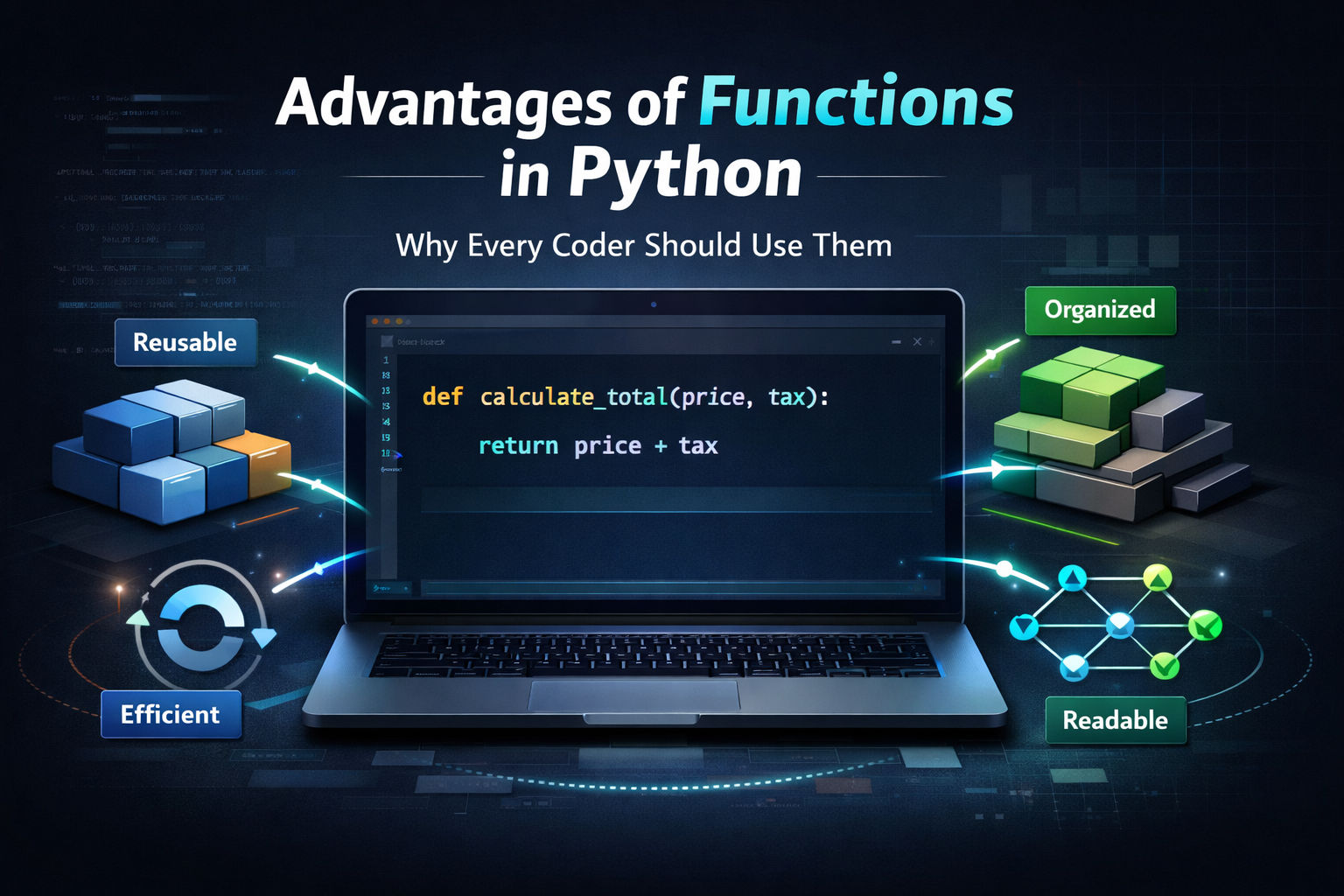
Advantages of Functions in Python: 8 Benefits With Examples
The advantages of functions in Python for students: reusability, less repetition, readability, easie...
Read Article Programming
7 min read
Programming
7 min read
Python Lambda Functions: When to Use Them, 10 Examples
Lambda functions in Python explained: the anatomy, the key argument, map and filter, when not to use...
Read ArticleReady to start AP Precalculus: Units 1 to 3 and Full Exam Prep?
Book a Priority Demo to see a full live class with a mentor reserved for you, today or tomorrow. Or choose a plan and enrol now.
Questions? WhatsApp +91 91233 66161 or email connect@modernagecoders.com