JEE Foundation Maths for Class 8-10
Class 11 physics and maths punish shaky algebra. This course is where the algebra stops being shaky.
Syllabus updated August 2026
Questions? WhatsApp +91 91233 66161 or email connect@modernagecoders.com
Recordings are free with a Google sign-in. These recordings show how we teach, not the exact syllabus of this course.
Our promise
The world's best learning experience, open to everyone.
- World-class instructorsEvery class is taught by an instructor who specialises in that exact field.
- No compromise on qualityEvery lesson, project and piece of feedback is held to the highest standard.
- Education for everyoneLearners aged 6 to 67, from first-time beginners to working professionals, in 25+ countries.
If you want the highest quality, Modern Age Coders is the right choice.
Book a Priority DemoHow long this course takes
This course runs 12 months (48 weeks) at 2 live classes/week + 3-4 hours of problem sets. The range allows for background and pace: a complete beginner uses the full span, and a student with prior knowledge finishes sooner. The syllabus below is planned to the shorter end, with margin kept for revision.
For personalised duration planning, call +91 91233 66161 and we'll map a schedule to your goals.
At a glance
- Who it is for
- Class 8 to 10 students, batched by class.
- Prerequisites
- Comfortable with the previous class's school maths. The week 1 diagnostic finds the gaps and the early weeks patch them
- Format
- Live, interactive classes with a real instructor, never pre-recorded videos. Live classes run about one hour.
- Language
- English or Hindi, depending on the batch.
- Duration
- 12 months (48 weeks)
- Weekly commitment
- 2 live classes/week + 3-4 hours of problem sets
- Class size
- Group batches of 5 to 10 students, mini batches of 3 to 4, or 1-on-1.
- Certificate
- Certificate from Modern Age Coders, awarded on passing the final assessment
- Watch first
- Free recordings of real classes for ages 13 and up, free with a Google sign-in. These recordings show how we teach, not the exact syllabus of this course.
- Live demo
- Optional. Enrol directly on this page, or book a Priority Demo: a full live class of about 45 to 60 minutes with a mentor reserved for you.
- Questions
- WhatsApp +91 91233 66161 or email connect@modernagecoders.com.
How we teach
Deep understanding. Real projects. Expert guidance.
Learn coding, AI and maths through careful explanations, practical demonstrations, and hands-on problem-solving. Our instructors guide you from the foundations to advanced ideas, helping you understand what happens, why it happens, and how to build it yourself.
You will explore concepts step by step, write and improve code, investigate mistakes, ask questions, and apply your knowledge to meaningful projects. Lessons are designed around active participation, thoughtful feedback, and growing independence.
Expert-led live teaching, with practical participation built into every lesson.
- Students explain their thinking.
- Instructors demonstrate, then guide practice.
- Learners code, solve, or build during lessons.
- Questions and misconceptions get attention.
- Assignments receive useful feedback.
- Progress is checked before advancing.
How to join JEE Foundation Maths Class 8-10: Proofs & Problem Solving
Four steps from this page to the first class. See a full class first with a Priority Demo, or choose a plan and enrol today.
Rated 4.9 across 547 Google reviews. Monthly billing, cancel any time.
How enrolment works
See a full class first (optional)
Book a Priority Demo: a live class of about 45 to 60 minutes with a mentor reserved for you, today or tomorrow. After the class the mentor sends a written skill report and a personal learning roadmap on WhatsApp. If you enrol, the demo fee is adjusted against your first month's fee. Share your demo Order ID with us on WhatsApp and we take it off.
Book a Priority DemoDemo fee ₹499Choose a plan
Group batch (5 to 10 students), mini batch (3 to 4 students, India only) or 1-on-1 with your own mentor. Every plan is live online, and each class runs about one hour. The cards below show classes per week and the monthly fee in your currency.
Enrol and pay the first month
Press Enrol Now on your plan, fill in the student's name, email and phone, and pay through secure Razorpay checkout: UPI, cards or net banking in India, and debit or credit card from any other country.
Fix your class timings
After payment, message us on WhatsApp or call +91 91233 66161 with the student's name, the course and your preferred time slot. We confirm the batch, send the class link and schedule the first class at your chosen time.
Billing is monthly and you can cancel any time.
International Students (Outside India)
Billed monthly in US dollars, the same price in every country. Contact us with any questions.
Questions before you enrol? Talk to our team.
Ask about class timings, the right level for your child, what they need to know already, or payment. Parents and adult learners can reach us on WhatsApp, by email or by phone.
Program Overview
Most students who struggle in JEE preparation do not struggle with Class 11 topics; they struggle with Class 8 to 10 topics that were never made solid. Fractions handled nervously, identities half-remembered, geometry never actually proved. A foundation course exists to fix that before it costs anything, and this one does it honestly: no rank promises, no 'future IITian' theatre, just the school syllabus taught deeper than school goes, plus the problem-solving habits that entrance exams eventually demand.
The 12-month plan runs in four phases. First, numbers and algebra at real depth: divisibility and remainders, exponents and surds, identities and factorisation, equations and inequalities. Second, geometry as a proof discipline, congruence, similarity, circles, because writing a correct proof is the closest a school student comes to real mathematical thinking. Third, mensuration, introductory trigonometry and coordinate geometry, the toolkit chapters. Fourth, the part school never teaches: problem-solving heuristics, olympiad-style questions, and a full timed MCQ phase in the style of NTSE-type talent exams and entrance papers, with error logs and review clinics.
Content is NCERT-aligned and batched by class, so a Class 8 student and a Class 10 student meet the same ideas at different depths. School marks tend to improve as a side effect; the actual product is a student who reaches Class 11 with nothing to repair.
What Makes This Program Different
- NCERT-aligned but deeper: every chapter is taken past the textbook stopping point, into the why and the harder problem forms
- Proof skills taught deliberately: given, to prove, construction, proof, drilled until writing a geometry argument feels normal
- A genuine problem-solving phase: heuristics like working backwards, small cases and clean diagrams, practised on olympiad-style questions
- A full timed MCQ phase with error logs: elimination, option testing and time budgeting, the craft entrance exams actually test
- Honest positioning: this is foundation, not JEE coaching, and we say plainly that nobody can promise selections or ranks
- Batched by class: Class 8, 9 and 10 groups meet the same arc at the right depth, so nobody is drowned or bored
Your Learning Journey
Career Progression
Detailed Course Curriculum
Explore the complete week-by-week breakdown of what you'll learn in this comprehensive program.
Topics Covered
- Diagnostic paper: arithmetic, fractions, basic algebra and geometry from earlier classes
- Integers, rationals and irrationals, and how to prove a number belongs where it does
- Decimal expansions: terminating, recurring, and converting recurring decimals to fractions
- Representing surds on the number line
- Density: finding rationals and irrationals between any two numbers
- Comparing numbers cleverly: without calculators, by squaring or bounding
Projects You Build
- Number-line dossier: one page classifying 20 assorted numbers with a one-line justification each
Practice & Assignments
30 classification and conversion problems, including 5 recurring-decimal conversions written out in full
Topics Covered
- Divisibility rules for 2 through 11, proved rather than just stated
- Primes, composites and prime factorisation as the master tool
- HCF and LCM: computation, the product relationship, and word problems
- Remainder thinking: what is left when powers are divided, kept concrete
- Digit problems: unit digits of large powers, digit sums
- First olympiad-style flavour: divisibility puzzles with small numbers
Projects You Build
- Divisibility rule proof sheet: the rules for 3, 9 and 11 explained in the student's own words with examples
Practice & Assignments
25 divisibility and HCF-LCM problems plus 5 unit-digit puzzles, hardest two attempted before class discussion
Assessment
Month 1 test: a 25-mark paper on number systems mixing standard questions with two puzzle-style problems
Topics Covered
- Laws of exponents for integer and rational powers, with the proofs sketched
- Negative and fractional exponents handled without fear
- Surds: simplifying, adding, and rationalising denominators including two-term denominators
- Comparing surds and exponential expressions by clever bounding
- Scientific notation and orders of magnitude
- Exam forms: simplify-this-monster questions and how to dismantle them
Projects You Build
- Simplification gauntlet: 10 layered exponent-surd expressions reduced step by step, each step justified
Practice & Assignments
35 exponent and surd problems including 8 rationalisations and 5 comparison questions without a calculator
Topics Covered
- The square and cube identities, derived, visualised, and drilled
- Sum and difference of cubes, and the three-variable identity for a cubed sum
- Factorisation strategy: common factors, grouping, splitting the middle term, identities
- The remainder theorem and factor theorem, introduced with numeric checks
- Evaluating expressions cleverly: 99 squared, 101 cubed via identities
- Identity-based olympiad-style problems: finding values without finding variables
Projects You Build
- Identity map: every identity in the phase on one sheet with a numeric example and one exam use each
Practice & Assignments
30 factorisations across all five strategies plus 8 evaluate-cleverly problems, strategy named before each
Assessment
Month 2 test: a 30-mark paper on exponents, surds and identities including two multi-step simplifications
Topics Covered
- Linear equations in one variable, including fractional and bracketed forms
- Word-problem craft: translating ages, digits, mixtures and motion into equations
- Pairs of linear equations: substitution and elimination done cleanly
- Consistency: when systems have one, many or no solutions, seen graphically
- Parameter questions: for what value of k does the system break
- Checking solutions as a habit, not an afterthought
Projects You Build
- Translation drill sheet: 12 word problems converted to equations before any are solved
Practice & Assignments
25 equations and systems plus 8 word problems, with the check step written for every answer
Topics Covered
- Linear inequalities: solving, representing on the number line, and the sign-flip rule proved
- Compound conditions: and versus or, read carefully
- Quadratic equations by factorisation: the bridge from identities to solving
- The idea of a discriminant, previewed for the Class 10 batch
- Absolute value as distance, kept geometric and gentle
- Phase consolidation: mixed algebra sets that do not announce their chapter
Projects You Build
- Personal error log opened: every phase 1 test miss classified as concept, method or slip, used all year
Practice & Assignments
20 inequalities and 15 factorisation-solved quadratics, plus one mixed set of 15 unannounced problems
Assessment
Phase 1 milestone: a 40-mark numbers-and-algebra paper, one third of it in MCQ format as a preview of phase 4
Topics Covered
- Angles on a line, vertically opposite angles, and angles with parallel lines
- The triangle angle-sum result and exterior angle theorem, proved
- What a proof is: statements, reasons, and why 'it looks true' is not enough
- The four-part format: given, to prove, construction, proof
- Angle chasing: finding unknown angles in layered figures
- Drawing honest figures: large, labelled, and not misleadingly special
Projects You Build
- First proof portfolio entries: angle-sum and exterior-angle proofs written in full four-part format
Practice & Assignments
20 angle-chasing figures of rising difficulty plus 2 proofs, every figure redrawn by hand before solving
Topics Covered
- Congruence criteria: SAS, ASA, AAS, SSS and RHS, and why AAA fails
- Choosing the right criterion: reading the figure for what is actually given
- Isosceles triangle results, proved both directions
- Inequalities in a triangle: bigger side, bigger angle, and the triangle inequality
- Multi-step congruence proofs: proving parts equal via congruent triangles
- Common proof errors: assuming the conclusion, circular reasoning, unstated steps
Projects You Build
- Criterion sorting sheet: 12 figures matched to their congruence criterion with the given parts marked
Practice & Assignments
15 congruence problems including 5 full proofs, each proof peer-checked against the four-part format
Assessment
Month 4 test: a 25-mark geometry paper with two full proofs marked strictly on structure and justification
Topics Covered
- Similar triangles: the AA, SSS and SAS similarity criteria
- The basic proportionality theorem and its converse
- How similarity scales lengths and areas differently, seen with numbers first
- The Pythagoras theorem proved by similarity, and its converse
- Applications: heights via shadows, distances across rivers, ladders and slopes
- Pythagorean triples and spotting them fast in MCQs
Projects You Build
- Proof portfolio extended: BPT and the similarity proof of Pythagoras written in full
Practice & Assignments
20 similarity and Pythagoras problems including 3 proofs and 5 real-setting applications
Topics Covered
- The parallelogram theorems: sides, angles and diagonals, proved and reversed
- Tests for a parallelogram: which minimal facts force the shape
- Rectangle, rhombus and square as parallelograms with extra conditions
- The midpoint theorem and its converse, with applications
- Multi-step figures: midpoints inside triangles inside parallelograms
- Proof strategy: what to construct when the figure refuses to yield
Projects You Build
- Quadrilateral family tree: the shapes and the exact conditions separating them, made by the student
Practice & Assignments
18 quadrilateral problems including 4 proofs, plus 5 midpoint-theorem applications
Assessment
Month 5 test: a 25-mark paper on similarity and quadrilaterals with two proofs and one construction-strategy question
Topics Covered
- Chords: equal chords, distances from the centre, the perpendicular from the centre
- The central angle theorem: the angle at the centre doubles the angle at the arc
- Angles in the same segment, and the angle in a semicircle
- Cyclic quadrilaterals and their opposite angles
- Tangents: perpendicularity to the radius and equal tangents from an external point
- Angle chasing in circle figures, the entrance-exam favourite
Projects You Build
- Circle theorem atlas: every theorem drawn, stated and proved or justified on the student's own pages
Practice & Assignments
20 circle problems from single-theorem to three-theorem figures, plus 2 full proofs
Topics Covered
- Hard multi-step figures mixing congruence, similarity, quadrilaterals and circles
- Auxiliary constructions: when and what to draw, taught as a decision, not magic
- Working backwards from what must be proved
- Olympiad-style geometry: problems where the figure is the puzzle
- Timed geometry MCQs: answering from the figure without full proofs
- Phase review: the proof portfolio completed and audited
Projects You Build
- Workshop set: 6 multi-step geometry problems solved with the construction decision written out for each
Practice & Assignments
One timed 15-question geometry MCQ set plus 4 workshop problems, error log updated with figure-reading misses
Assessment
Phase 2 milestone: a 40-mark geometry paper, half proofs and half timed MCQs, with a one-on-one proof review
Topics Covered
- Areas of triangles: half base times height, and Heron's formula for when heights hide
- Areas of parallelograms, trapeziums and rhombuses, derived not memorised
- Circles, sectors and segments, with arc lengths
- Composite figures: decomposing shaded regions cleanly
- Same base, same parallels: area relationships without any measuring
- Estimation checks: is that area plausible for that figure
Projects You Build
- Decomposition sheet: 8 shaded-region problems with the cut lines drawn and named before any formula is used
Practice & Assignments
22 area problems including 5 Heron applications and 5 composite figures, decomposition stated in one line each
Topics Covered
- Surface areas and volumes: cube, cuboid, cylinder, cone, sphere, hemisphere
- Combined solids and which surfaces vanish at the joins
- Melting and recasting problems: volume as the conserved quantity
- Scaling laws: double the length, four times the area, eight times the volume
- Unit discipline across centimetres, metres and litres
- MCQ forms: ratio-based mensuration questions solved without computing either quantity
Projects You Build
- Scaling experiment write-up: one solid scaled by 2 and by 3, with areas and volumes tabulated and the pattern stated
Practice & Assignments
18 solid problems including 4 recasting and 4 ratio questions, units checked on every line
Assessment
Month 7 test: a 25-mark mensuration paper mixing computation, ratio reasoning and one composite figure
Topics Covered
- The six trigonometric ratios in a right triangle and the naming logic
- Exact values at 0, 30, 45, 60 and 90 degrees, rebuilt from two triangles rather than memorised
- Finding all ratios from one, with Pythagoras doing the work
- The fundamental identity and its rearrangements
- Proving simple identities with a fixed strategy list
- Ratio MCQs at speed: value questions in under a minute
Projects You Build
- Two-triangle derivation page: the 30-60-90 and 45-45-90 triangles built and every standard value read off them
Practice & Assignments
30 ratio evaluations and 6 identity proofs, plus one 10-question timed MCQ set on values
Topics Covered
- Angles of elevation and depression on honest, labelled figures
- Single-triangle problems: towers, poles, kites and slopes
- Two-triangle problems: two observation points and moving observers
- Choosing the ratio that solves in one step
- Rounding sensibly and sanity-checking against the figure
- Where trigonometry goes in Class 11: a preview, not a syllabus
Projects You Build
- Figure-first set: 8 heights and distances problems where the marked figure is drawn and approved before solving
Practice & Assignments
15 heights and distances problems including 4 two-triangle setups, every figure labelled with the given angle
Assessment
Month 8 test: a 25-mark trigonometry paper of ratios, identities and applications, one third MCQ
Topics Covered
- The Cartesian plane: plotting, quadrants and reading coordinates fluently
- The distance formula from Pythagoras, derived and drilled
- Classifying triangles and quadrilaterals by computed distances
- The section formula and midpoints, with internal division problems
- Ratios from coordinates: where the axes cut a segment
- Sketch-first habit: every coordinate problem starts with a drawing
Projects You Build
- Coordinate gallery: 6 figures plotted, classified and verified by distances, presented on graph paper
Practice & Assignments
25 distance and section formula problems, each with a labelled sketch, plus 5 classification questions
Topics Covered
- Slope as steepness: computing it and reading it from a sketch
- Parallel and perpendicular slopes, kept concrete
- Collinearity by slope and by distance, two roads to one answer
- Coordinate proofs: choosing axes cleverly to make geometry easy
- Mixed coordinate MCQs under time
- Phase review: the toolkit chapters consolidated onto revision sheets
Projects You Build
- Coordinate proof piece: one classical geometry fact proved by placing coordinates well, written up in full
Practice & Assignments
20 slope and collinearity problems plus one timed 12-question coordinate MCQ set, error log updated
Assessment
Phase 3 milestone: a 40-mark paper across mensuration, trigonometry and coordinates, half MCQ, fully reviewed
Topics Covered
- Understand, plan, execute, check: the honest version of problem solving
- Trying small cases and looking for the pattern that survives
- Working backwards from what is asked
- Drawing the right diagram, and redrawing when it misleads
- Parity and simple invariants: what cannot change no matter the moves
- Olympiad-style number and algebra problems using the heuristics, difficulty honest but humane
Projects You Build
- Solution journal opened: every hard problem written up with the heuristic used and the dead ends kept, not erased
Practice & Assignments
8 problems for the week, chosen to need different heuristics; write-ups matter more than answer counts
Topics Covered
- Systematic listing: counting without missing and without double-counting
- The multiplication principle and simple arrangements
- Combinations kept concrete: choosing teams and handshakes
- The pigeonhole principle through puzzles
- Logic puzzles: knights, liars and truth tables lite
- Where these ideas reappear: Class 11 permutations and combinations, and reasoning sections of talent exams
Projects You Build
- Counting problem set write-up: 5 counting problems solved twice, once by listing and once by principle, results reconciled
Practice & Assignments
12 counting and logic problems with full write-ups in the solution journal
Assessment
Month 10 checkpoint: a 20-mark problem-solving paper where method write-ups earn marks alongside answers
Topics Covered
- How MCQ setters build wrong options, and what that tells the solver
- Elimination: discarding options by sign, size, units or parity
- Option testing: substituting answers back instead of solving forwards
- Special values: choosing convenient numbers for variable-heavy questions
- Estimation as a weapon: bounding the answer before computing it
- When to solve honestly: questions where shortcuts are traps
Projects You Build
- Technique tally: 30 MCQs solved with the technique noted per question, then tallied to see each student's habits
Practice & Assignments
Three 15-question topic-wise MCQ sets under time, error log updated with technique choices, not just misses
Topics Covered
- Time budgeting: marks per minute and the discipline of moving on
- Sectional MCQ sets across algebra, geometry, mensuration, trigonometry and coordinates
- The two-pass strategy: bank the easy questions first
- Guessing policy: when unanswered beats wrong, and reading the paper's rules
- Error log analytics: which topic, which technique, which minute of the section
- Building each student's personal weak-topic drill plan for the mock month
Projects You Build
- Error log analysis report: the student's own two-page summary of their MCQ patterns going into the mocks
Practice & Assignments
Four timed sectional sets across the fortnight, each reviewed the same week, drill plan agreed with the teacher
Assessment
Month 11 checkpoint: one full-length topic-mixed MCQ paper under exam timing, fully debriefed
Topics Covered
- Full-length foundation mocks in the style of NTSE-type talent exams and entrance papers
- Exam-day routine rehearsed: instructions, bubbling, rough-work discipline
- Review clinic after every mock: every miss classified and assigned a fix
- Score movement read honestly: trends matter, single papers do not
- Targeted drills between mocks from each student's plan
- Stamina: holding accuracy in the last quarter of a long paper
Projects You Build
- Mock file: each paper filed with its marked script, error classification and one-line fix per miss
Practice & Assignments
One additional mock at home under honest timing, self-marked and brought to the review clinic
Topics Covered
- Two final mocks under strict conditions, spaced for recovery
- The readiness map: every topic rated from the year's evidence, no vibes
- The solution journal and proof portfolio reviewed as a body of work
- What Class 11 changes: pace, abstraction, and how this foundation meets it
- Keeping the edge: a weekly problem habit for the months after the course
- Course close: one-on-one review with each family
Projects You Build
- Personal readiness map: topic-by-topic strengths and fixes, built from the error log and mock file
- Completed solution journal: a year of hard problems with the student's own write-ups
Practice & Assignments
Light targeted drills only, set individually from the final error log
Assessment
Course milestone: final full-length mock and readiness review with the family, plus certificate review
Projects You'll Build
Build a professional portfolio with A year-long body of work: proof portfolio, solution journal, error log, mock file and readiness map real-world projects.
Weekly Learning Structure
Certification & Recognition
Technologies & Skills You'll Master
Comprehensive coverage of the entire modern web development stack.
Support & Resources
Career Outcomes & Opportunities
Transform your career with industry-ready skills and job placement support.
Prerequisites
Who Is This Course For?
Career Paths After Completion
Course Guarantees
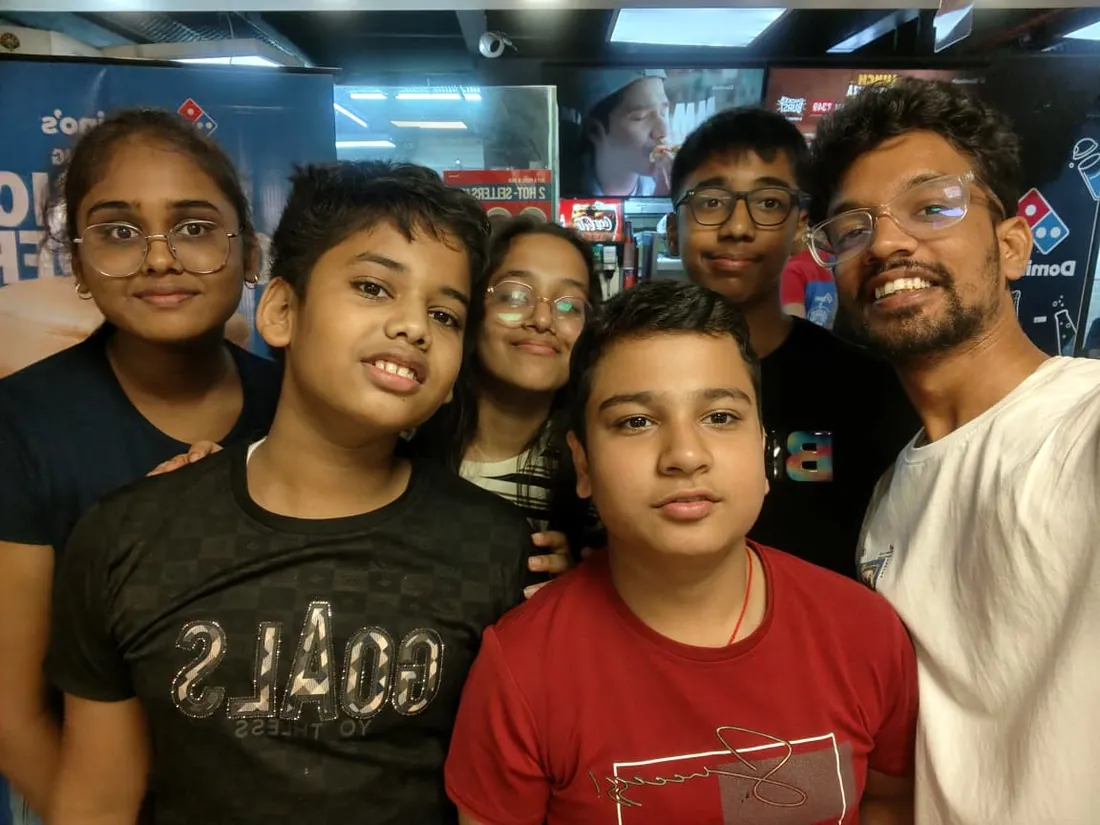
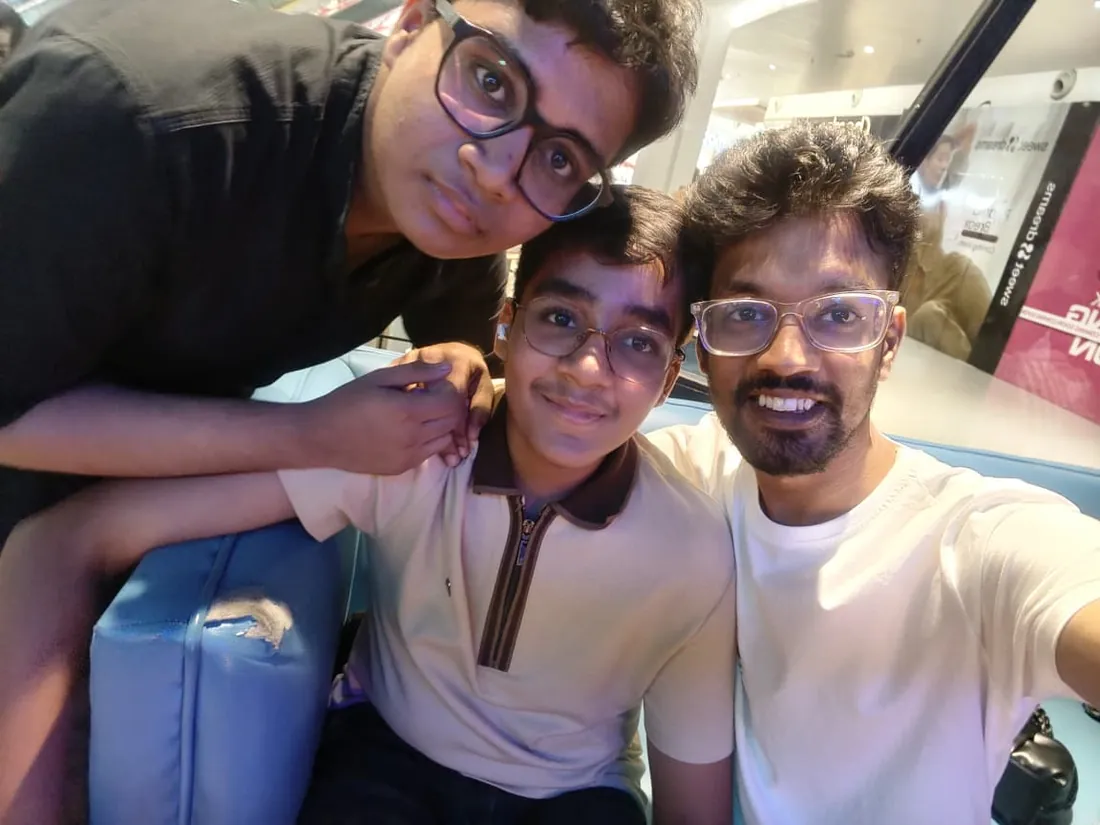
Real students. Real moments. Real joy.
These are our actual student meetups. No stock photos, no filters. Swipe through and meet the community you'll be joining.





































What families say
Straight from the parents and students who learn with us. Rated 4.9 across 547 Google reviews.
“Mivaan enjoys the class. He understands the concepts and completes his tasks with excitement. He started taking interest in coding… truly amazing class.”
“I absolutely love it here! I made new friends and learned important valuable coding skills while having the fun of my life. It's not just coding here, it's outings, bonding and most importantly preparing you for your future. Definitely five stars.”
“What stands out most is how excited my son is before every class. He looks forward to learning, problem-solving, and sharing what he's built. I've noticed a big boost in his confidence!”
“Modern Age Coders has been a game-changer for me! I struggled to grasp IT concepts and coding before joining, but their classes transformed everything. I'm now the topper in my class and can confidently write complex programs with ease.”
“Modern Age Coder have wonderful teachers who teach in a clear, easy and practical way. The teacher boosts students' confidence, keeps them updated with technology, and inspires them to learn without hesitation.”
“The one step solution for my son. Modern Age Coders make learning coding so simple that kids love it.”
“Coding classes here make learning very interesting and conceptual. The teachers teach us in a very easy-to-understand and efficient manner.”
“One of the most wonderful education centres out there. Education is not limited to school syllabus but focuses on skill development. Learning here has been a wonderful journey and still continuing.”
“I highly recommend this computer coding class! The teachers are incredibly knowledgeable and passionate about coding. They make every session engaging and insightful.”
“My child Dhairya is really enjoying the Modern Age Coder IT classes. This is his first online class, and he eagerly looks forward to it.”
“Very good classes. Don't worry about coding. They teach the best, especially Shivam sir.”
“Very good classes. Makes learning very easy and interactive.”
Hear it from our students
Real parents and students in their own words, on our public YouTube channel.
Straight answers about JEE Foundation Maths Class 8-10: Proofs & Problem Solving
- Who should take this course?
- Class 8 to 10 students, batched by class. It suits students in class 8 to 10 who intend to attempt jee or similar entrances and want the base built before class 11 raises the stakes; students who find school maths easy and are bored, and need harder problems rather than more of the same; students who can compute but have never been taught to prove, which is most students.
- What will they learn and build?
- Most students who struggle in JEE preparation do not struggle with Class 11 topics; they struggle with Class 8 to 10 topics that were never made solid. Fractions handled nervously, identities half-remembered, geometry never actually proved.
- How deeply are topics covered?
- The course runs 12 months (48 weeks) at 2 live classes/week + 3-4 hours of problem sets, across 4 phases listed week by week in the syllabus below. A structured, well-paced curriculum taught step by step, with hands-on practice in every session.
- Who teaches it?
- Modern Age Coders mentors, who teach the live classes themselves. You can watch them at work in the free class recordings before you decide.
- How do practice, feedback and assessment work?
- Classwork every session, a problem set after every class, monthly reviews that mix in earlier topics, and a full mock paper as the final assessment that decides the certificate: real understanding, with a free retest after revision if needed. Doubt support between classes over WhatsApp, so you are never left stuck. A certificate you earn by passing the final assessment, with a free retest after revision if needed.
- What does it cost?
- Three monthly plans: a group batch, a mini batch and 1-on-1. Prices are shown in your currency in the plans section. Monthly billing, cancel any time.
- When can classes take place?
- Live classes are scheduled around your week. Group batches meet at a fixed weekly slot; 1-on-1 students choose their own. International students are scheduled in their own timezone. Ask on WhatsApp for the current slots.
- Can I watch the teaching before deciding?
- Yes. Full recordings of real 13 and up classes are free to watch, free with a Google sign-in. These recordings show how we teach, not the exact syllabus of this course. Some classes are in English and some in Hindi; everyone follows at their own pace. Watch a class end to end, like you are in it. Sessions are interactive and each moment builds on the last.
- Can I enroll without a live demo?
- Yes. Choose a plan on this page and enrol directly; a demo is not required. If you would like to see a full class with a mentor first, book a Priority Demo.
- How do I reach you with a question?
- WhatsApp +91 91233 66161, email connect@modernagecoders.com, or call +91 91233 66161. Tell us the student's age and what they have learned so far, and we will point you to the right plan and batch.
Common Questions About JEE Foundation Maths Class 8-10: Proofs & Problem Solving
Get answers to the most common questions about this comprehensive program
Still have questions? We're here to help!
Contact UsRelated Courses You May Like
Continue your learning journey with these recommended programs
 Data Science
Data Science for Teens: Python & Your First ML Models
Live online data science course for teens (14-18): pandas, cleaning real datasets, matplotlib, stati...
Explore Course Data Science
Trading Automation Course: Bots, Backtesting & Systems
Trading automation course for adults and professionals: build, backtest and deploy automated trading...
Explore CourseRelated Articles & Guides
Deepen your knowledge with these hand-picked articles
 Mathematics
8 min read
Mathematics
8 min read
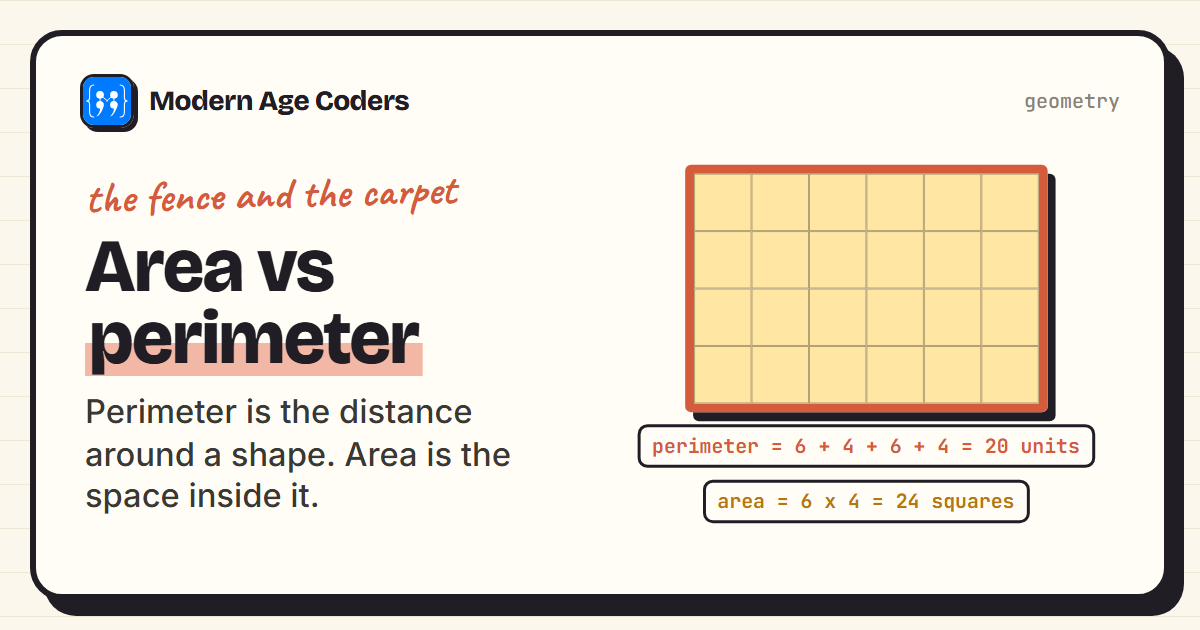
Area and Perimeter: The Difference, Explained Simply
Area vs perimeter explained: what each measures, formulas and units, why one perimeter can give diff...
Read Article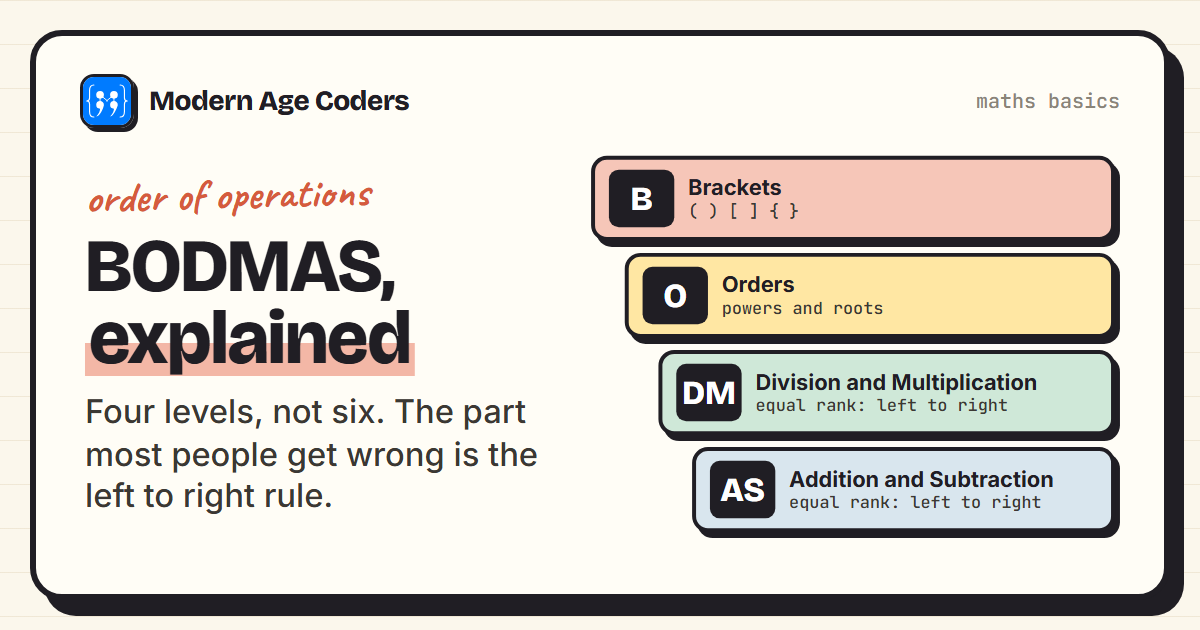 Mathematics
9 min read
Mathematics
9 min read
BODMAS Rule Explained: The Left to Right Step
BODMAS explained with worked examples: what each letter means, the left to right rule most people mi...
Read ArticleReady to start JEE Foundation Maths Class 8-10: Proofs & Problem Solving?
Book a Priority Demo to see a full live class with a mentor reserved for you, today or tomorrow. Or choose a plan and enrol now.
Questions? WhatsApp +91 91233 66161 or email connect@modernagecoders.com