PCAP: Certified Associate in Python Programming
Every exam objective taught properly, then drilled against the real format, so you sit the exam already knowing you will pass.
Syllabus updated August 2026
Questions? WhatsApp +91 91233 66161 or email connect@modernagecoders.com
Recordings are free with a Google sign-in. These recordings show how we teach, not the exact syllabus of this course.
Fees and enrolment
How to join PCAP Certification Prep: Certified Associate in Python Programming
Choose how you want to pay, pick a plan and press Enrol. We then fix your class timing with you.
Rated 4.9 across 547 Google reviews. Monthly billing, cancel any time.
How enrolment works
Pick a plan
Group (15 to 20 students), Mini Batch (up to 6, India only) or 1-on-1 with your own mentor. Billing is monthly.
Press Enrol and pay
Fill in the student's name, email and phone, then pay securely: UPI, cards or net banking in India, or a debit or credit card from any other country.
Fix your class timing
After paying, WhatsApp or call +91 91233 66161 with the student's name and your preferred time. We confirm the batch or 1-on-1 slot and send the class link.
Start learning
Join your first live class at the time you chose. Your mentor takes it from there.
Want to see a class first? Book a Priority Demo: a live class of about 45 to 60 minutes with a mentor reserved for you. If you enrol, the demo fee is adjusted against your first month's fee. Share your demo Order ID with us on WhatsApp and we take it off.
Billing is monthly and you can cancel any time.
International Students (Outside India)
Billed monthly in US dollars, the same price in every country. Contact us with any questions.
Questions before you enrol? Talk to our team.
Ask about class timings, the right level for your child, what they need to know already, or payment. Parents and adult learners can reach us on WhatsApp, by email or by phone.
Our promise
The world's best learning experience, open to everyone.
- World-class instructorsEvery class is taught by an instructor who specialises in that exact field.
- No compromise on qualityEvery lesson, project and piece of feedback is held to the highest standard.
- Education for everyoneLearners aged 6 to 67, from first-time beginners to working professionals, in 25+ countries.
If you want the highest quality, Modern Age Coders is the right choice.
Book a Priority DemoHow long this course takes
This course runs 4 months (16 weeks), joinable any month at 2 live classes/week + weekly coding practice and mock questions. The range allows for background and pace: a complete beginner uses the full span, and a student with prior knowledge finishes sooner. The syllabus below is planned to the shorter end, with margin kept for revision.
For personalised duration planning, call +91 91233 66161 and we'll map a schedule to your goals.
At a glance
- Who it is for
- Anyone with basic Python (PCEP level or equivalent) preparing for the PCAP associate certification.
- Prerequisites
- None. The course starts from the beginning.
- Format
- Live, interactive online classes with a real mentor, never pre-recorded videos. Live classes run about one hour.
- Language
- English or Hindi, depending on the batch.
- Duration
- 4 months (16 weeks), joinable any month
- Weekly commitment
- 2 live classes/week + weekly coding practice and mock questions
- Class size
- Group batches of 15 to 20 students, mini batches of up to 6, or 1-on-1.
- Certificate
- Certificate from Modern Age Coders, awarded on passing the final assessment
- Watch first
- Free recordings of real classes for ages 13 and up, free with a Google sign-in. These recordings show how we teach, not the exact syllabus of this course.
- Live demo
- Optional. Enrol directly on this page, or book a Priority Demo: a full live class of about 45 to 60 minutes with a mentor reserved for you.
- Questions
- WhatsApp +91 91233 66161 or email connect@modernagecoders.com.
How we teach
Deep understanding. Real projects. Expert guidance.
Learn coding, AI and maths through careful explanations, practical demonstrations, and hands-on problem-solving. Our instructors guide you from the foundations to advanced ideas, helping you understand what happens, why it happens, and how to build it yourself.
You will explore concepts step by step, write and improve code, investigate mistakes, ask questions, and apply your knowledge to meaningful projects. Lessons are designed around active participation, thoughtful feedback, and growing independence.
Expert-led live teaching, with practical participation built into every lesson.
- Students explain their thinking.
- Instructors demonstrate, then guide practice.
- Learners code, solve, or build during lessons.
- Questions and misconceptions get attention.
- Assignments receive useful feedback.
- Progress is checked before advancing.
Program Overview
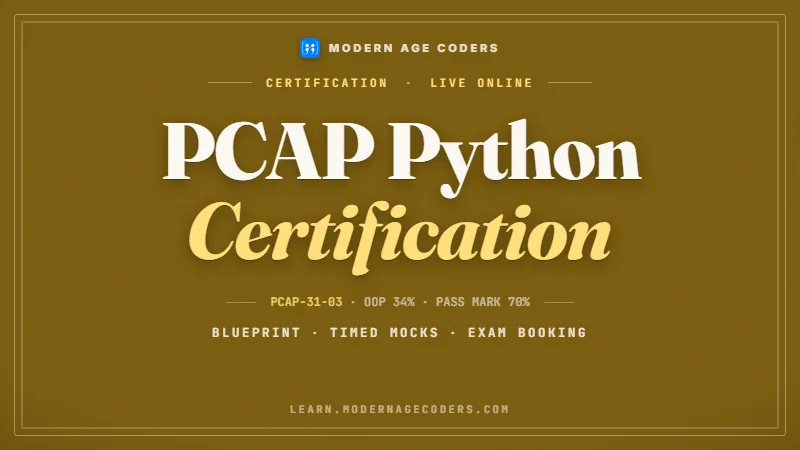
PCAP, the Certified Associate in Python Programming, is the Python Institute's associate-level credential and the natural step up from PCEP. It is a genuine test of Python fluency rather than a quiz: the current PCAP-31-03 exam is 40 questions in single-choice and multiple-choice form, taken in 65 minutes, with a pass mark of 70 percent, which means at least 28 correct answers. It is delivered through Pearson VUE test centres or OnVUE online proctoring, and the exam fee is set by the Python Institute (currently around USD 295), paid directly to them.
What makes PCAP harder than it looks is that it examines the parts of Python most self-taught programmers skip. Modules and packages. Exception handling done properly, not a bare try block. String methods in detail. Object-oriented Python including class variables and inheritance. Generators, closures and list comprehensions. File processing. Plenty of working developers write Python daily and still miss these, because everyday scripting never forces them.
This course covers every objective in that list and treats the exam format as a skill of its own. You write real code every week, then answer questions in the exact style the exam uses, including the ones designed to punish a guess. The last month is full timed mocks with question-by-question review, so by the time you book the test you already know your score range.
What Makes This Program Different
- Built around the current PCAP-31-03 objectives: modules and packages, exceptions, strings, OOP, generators and closures, and file processing
- Taught as real Python first and exam technique second, so the knowledge survives after the certificate
- The exam format is practised deliberately: 40 questions in 65 minutes at a 70 percent pass mark leaves no room for slow reading
- Covers the topics self-taught programmers usually miss, which is exactly where PCAP candidates fail
- Full timed mock exams with question-by-question review and an error log, so weak areas are fixed before test day
- Live, small batches where your code is reviewed on the spot, not recorded videos watched alone
Your Learning Journey
Career Progression
Detailed Course Curriculum
Explore the complete week-by-week breakdown of what you'll learn in this comprehensive program.
Topics Covered
- import, from-import, and aliasing, and how each affects the namespace
- What actually happens when Python imports a module
- The __name__ variable and the main guard
- Where Python looks for modules, and sys.path
- Exam traps around name collisions and shadowing
Projects You Build
- Write a small multi-module program and import across it every supported way
Practice & Assignments
20 exam-style questions on imports and namespaces
Topics Covered
- math, random, platform and datetime as the exam uses them
- Reading the documentation quickly and correctly
- Predicting output from unfamiliar standard-library calls
- Common function signatures worth memorising
- Where the exam prefers a specific idiom
Projects You Build
- Solve a set of tasks using only the standard library, no third-party packages
Practice & Assignments
20 output-prediction questions on standard-library calls
Topics Covered
- How a package differs from a module
- The role of __init__.py
- Nested packages and relative versus absolute imports
- pip and dependency basics at exam depth
- Structuring a small package correctly
Projects You Build
- Build a small package with nested sub-packages and import from it correctly
Practice & Assignments
15 package-structure and import questions
Assessment
Timed section test on modules and packages
Topics Covered
- Strings as immutable sequences, and what that implies
- Slicing, including negative indices and steps
- The string methods the exam actually tests, in detail
- Escape sequences, raw strings and formatting
- Comparing strings, and the ordering rules
Projects You Build
- Write a text-processing utility using only string methods, no regular expressions
Practice & Assignments
25 string-method and slicing questions, mostly output prediction
Topics Covered
- try, except, else and finally, and the exact order they run in
- The built-in exception hierarchy and why the order of except clauses matters
- Catching specific exceptions instead of bare except
- raise, and re-raising inside a handler
- Predicting which handler catches what
Projects You Build
- Take a fragile script and make it robust with correctly ordered handlers
Practice & Assignments
20 exception-flow questions, mostly trace-the-output
Topics Covered
- Defining your own exception classes
- Inheriting from the right base exception
- assert and where it belongs
- Exception chaining and context
- Writing code that fails clearly rather than silently
Projects You Build
- Design a small exception hierarchy for a described domain and use it properly
Practice & Assignments
15 custom-exception questions
Assessment
Timed section test on exception handling
Topics Covered
- Lists, tuples, dictionaries and sets, and the exam-relevant differences
- Mutability and the aliasing traps the exam loves
- Copying: assignment versus shallow versus deep
- Dictionary methods and safe key access
- Sorting with keys and reverse
Projects You Build
- Solve a data-shaping task choosing the right structure at each step and justifying it
Practice & Assignments
25 questions on aggregates, heavy on mutability traps
Topics Covered
- Positional, keyword and default arguments
- *args and **kwargs and how they bind
- Scope, the LEGB rule, and the global and nonlocal keywords
- The mutable-default-argument trap
- Recursion at exam depth
Projects You Build
- Write functions exercising every argument form, then predict their behaviour before running them
Practice & Assignments
25 scope and argument-binding questions
Assessment
End-of-phase test across everything so far, in exam format
Topics Covered
- Defining classes, __init__, and instance attributes
- Instance variables versus class variables, the single biggest PCAP trap
- How attribute lookup actually resolves
- Name mangling and the single and double underscore conventions
- Adding attributes dynamically and what that does
Projects You Build
- Build a class where class and instance variables are deliberately contrasted, then predict every output
Practice & Assignments
25 questions on class versus instance attributes
Topics Covered
- Single and multiple inheritance
- Method resolution order and how Python decides
- Overriding, and calling the parent with super()
- isinstance and issubclass, and when each is correct
- Polymorphism in practice
Projects You Build
- Design a class hierarchy with overriding and demonstrate the resolution order
Practice & Assignments
25 inheritance and MRO questions
Topics Covered
- __str__ and __repr__ and the difference the exam tests
- Operator overloading with special methods
- __dict__, and inspecting objects at runtime
- Properties and controlled attribute access
- Composition versus inheritance
Projects You Build
- Write a class with operator overloading and full introspection support
Practice & Assignments
20 special-method questions
Assessment
Timed OOP section test in exam format
Topics Covered
- Working through the OOP question styles the exam repeats
- Reading unfamiliar class code quickly and accurately
- Spotting the deliberate misdirection in the options
- Common wrong answers and why they look right
- Building speed without losing accuracy
Projects You Build
- A full OOP-only mock section, reviewed question by question
Practice & Assignments
40 mixed OOP questions under time
Topics Covered
- List, dictionary and set comprehensions, including conditions
- The iterator protocol: __iter__ and __next__
- Generator functions and the yield keyword
- Generator expressions and lazy evaluation
- Why a generator is not a list, and what breaks if you forget
Projects You Build
- Rewrite an eager data pipeline as a lazy generator pipeline and compare behaviour
Practice & Assignments
25 comprehension and generator output questions
Topics Covered
- Lambda functions and their limits
- Closures, and what a nested function captures
- nonlocal in a closure
- map, filter and sorted with key functions
- Functions as first-class objects
Projects You Build
- Build a small closure-based counter and function factory
Practice & Assignments
20 closure and lambda questions
Assessment
Timed section test on generators and closures
Topics Covered
- Opening files: modes, and text versus binary
- Reading with read, readline and readlines, and iterating a file
- Writing and appending safely
- The with statement and why it is the correct idiom
- Handling file exceptions properly, tying back to Phase 1
Projects You Build
- Write a program that reads, transforms and writes files with full error handling
Practice & Assignments
20 file-processing questions
Topics Covered
- Full mocks at the real format: 40 questions in 65 minutes
- Pacing so no question is left unread, since there is no penalty for answering
- Eliminating options systematically on multiple-response questions
- Turning the error log into a final revision list
- Booking the exam: Pearson VUE test centre or OnVUE online proctoring
Projects You Build
- Three complete timed mock exams, each reviewed question by question
Practice & Assignments
Repeated full mocks until you clear 70 percent consistently with margin
Assessment
Final full mock scored against the 70 percent pass mark, with a go or no-go recommendation
Projects You'll Build
Build a professional portfolio with 50+ projects real-world projects.
Weekly Learning Structure
Certification & Recognition
Technologies & Skills You'll Master
Comprehensive coverage of the entire modern web development stack.
Career Outcomes & Opportunities
Transform your career with industry-ready skills and job placement support.
Prerequisites
Who Is This Course For?
Career Paths After Completion
Course Guarantees
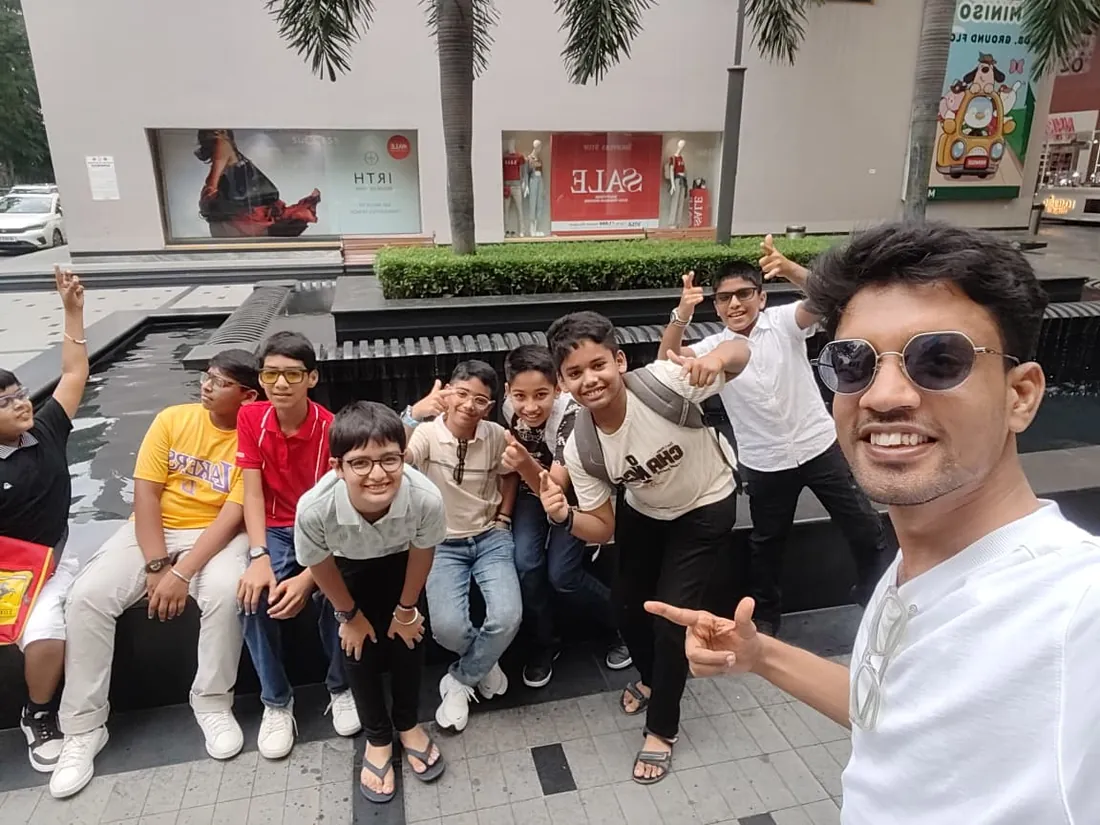
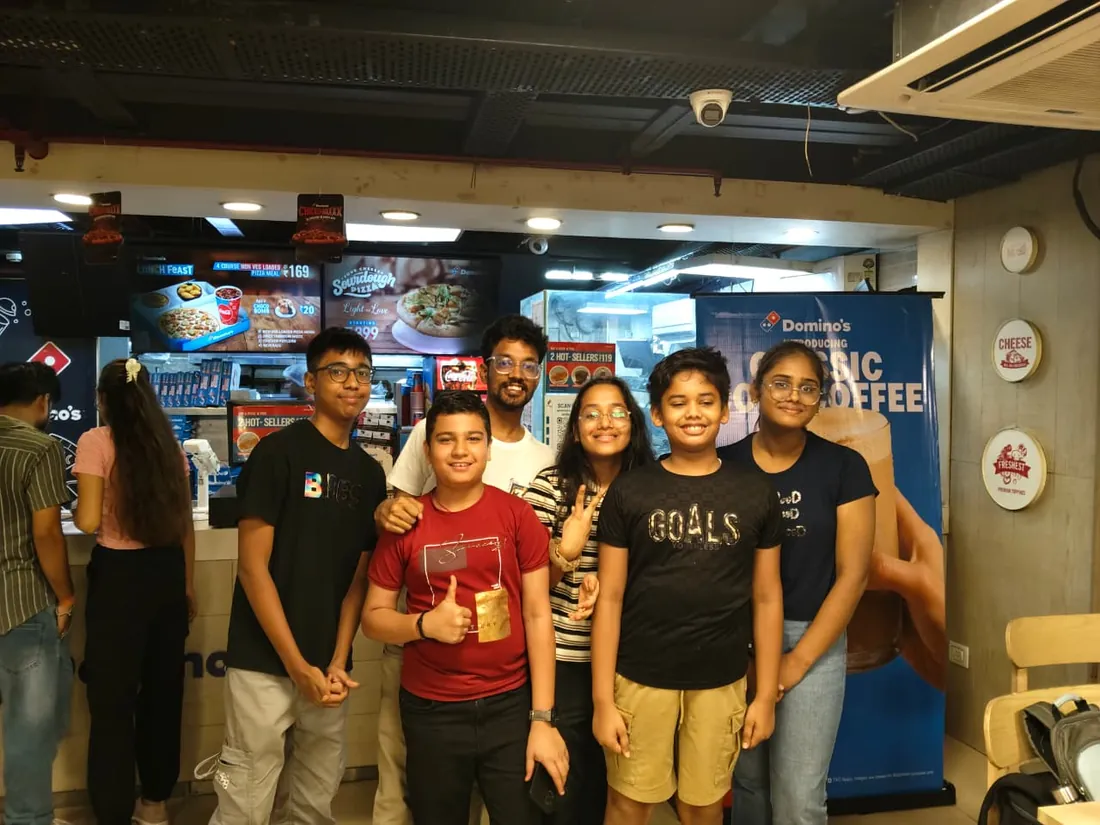
Real students. Real moments. Real joy.
These are our actual student meetups. No stock photos, no filters. Swipe through and meet the community you'll be joining.





































What families say
Straight from the parents and students who learn with us. Rated 4.9 across 547 Google reviews.
“Mivaan enjoys the class. He understands the concepts and completes his tasks with excitement. He started taking interest in coding… truly amazing class.”
“I absolutely love it here! I made new friends and learned important valuable coding skills while having the fun of my life. It's not just coding here, it's outings, bonding and most importantly preparing you for your future. Definitely five stars.”
“What stands out most is how excited my son is before every class. He looks forward to learning, problem-solving, and sharing what he's built. I've noticed a big boost in his confidence!”
“Modern Age Coders has been a game-changer for me! I struggled to grasp IT concepts and coding before joining, but their classes transformed everything. I'm now the topper in my class and can confidently write complex programs with ease.”
“Modern Age Coder have wonderful teachers who teach in a clear, easy and practical way. The teacher boosts students' confidence, keeps them updated with technology, and inspires them to learn without hesitation.”
“The one step solution for my son. Modern Age Coders make learning coding so simple that kids love it.”
“Coding classes here make learning very interesting and conceptual. The teachers teach us in a very easy-to-understand and efficient manner.”
“One of the most wonderful education centres out there. Education is not limited to school syllabus but focuses on skill development. Learning here has been a wonderful journey and still continuing.”
“I highly recommend this computer coding class! The teachers are incredibly knowledgeable and passionate about coding. They make every session engaging and insightful.”
“My child Dhairya is really enjoying the Modern Age Coder IT classes. This is his first online class, and he eagerly looks forward to it.”
“Very good classes. Don't worry about coding. They teach the best, especially Shivam sir.”
“Very good classes. Makes learning very easy and interactive.”
Hear it from our students
Real parents and students in their own words, on our public YouTube channel.
Straight answers about PCAP Certification Prep: Certified Associate in Python Programming
- Who should take this course?
- Anyone with basic Python (PCEP level or equivalent) preparing for the PCAP associate certification.
- What will they learn and build?
- PCAP, the Certified Associate in Python Programming, is the Python Institute's associate-level credential and the natural step up from PCEP. It is a genuine test of Python fluency rather than a quiz: the current PCAP-31-03 exam is 40 questions in single-choice and multiple-choice form, taken in 65 minutes, with a pass mark of 70 percent, which means at least 28 correct answers.
- How deeply are topics covered?
- The course runs 4 months (16 weeks), joinable any month at 2 live classes/week + weekly coding practice and mock questions, across 3 phases listed week by week in the syllabus below.
- Who teaches it?
- Modern Age Coders mentors, who teach the live classes themselves. You can watch them at work in the free class recordings before you decide.
- How do practice, feedback and assessment work?
- Classwork in every session and homework after every class. Classwork every session, a task after every class, monthly reviews that mix in earlier topics, and a full mock paper as the final assessment that decides the certificate: real knowledge and real work, with a free retest after revision if needed. A certificate you earn by passing the final assessment, with a free retest after revision if needed.
- What does it cost?
- Three monthly plans: a group batch, a mini batch and 1-on-1. Prices are shown in your currency in the plans section. Monthly billing, cancel any time.
- When can classes take place?
- Live classes are scheduled around your week. Group batches meet at a fixed weekly slot; 1-on-1 students choose their own. International students are scheduled in their own timezone. Ask on WhatsApp for the current slots.
- Can I watch the teaching before deciding?
- Yes. Full recordings of real 13 and up classes are free to watch, free with a Google sign-in. These recordings show how we teach, not the exact syllabus of this course. Some classes are in English and some in Hindi; everyone follows at their own pace. Watch a class end to end, like you are in it. Sessions are interactive and each moment builds on the last.
- Can I enroll without a live demo?
- Yes. Choose a plan on this page and enrol directly; a demo is not required. If you would like to see a full class with a mentor first, book a Priority Demo.
- How do I reach you with a question?
- WhatsApp +91 91233 66161, email connect@modernagecoders.com, or call +91 91233 66161. Tell us the student's age and what they have learned so far, and we will point you to the right plan and batch.
Common Questions About PCAP Certification Prep: Certified Associate in Python Programming
Get answers to the most common questions about this comprehensive program
Still have questions? We're here to help!
Contact UsRelated Courses You May Like
Continue your learning journey with these recommended programs
 Python Certification
PCEP and PCAP Python Certification Course
Live online preparation for the Python Institute PCEP and PCAP certifications, built so that the rep...
Explore Course App Development
App Development Course: Flutter, iOS & Android
App development course for college students and professionals: Flutter as the production stack, Fire...
Explore CourseRelated Articles & Guides
Deepen your knowledge with these hand-picked articles
 Career
8 min read
Career
8 min read
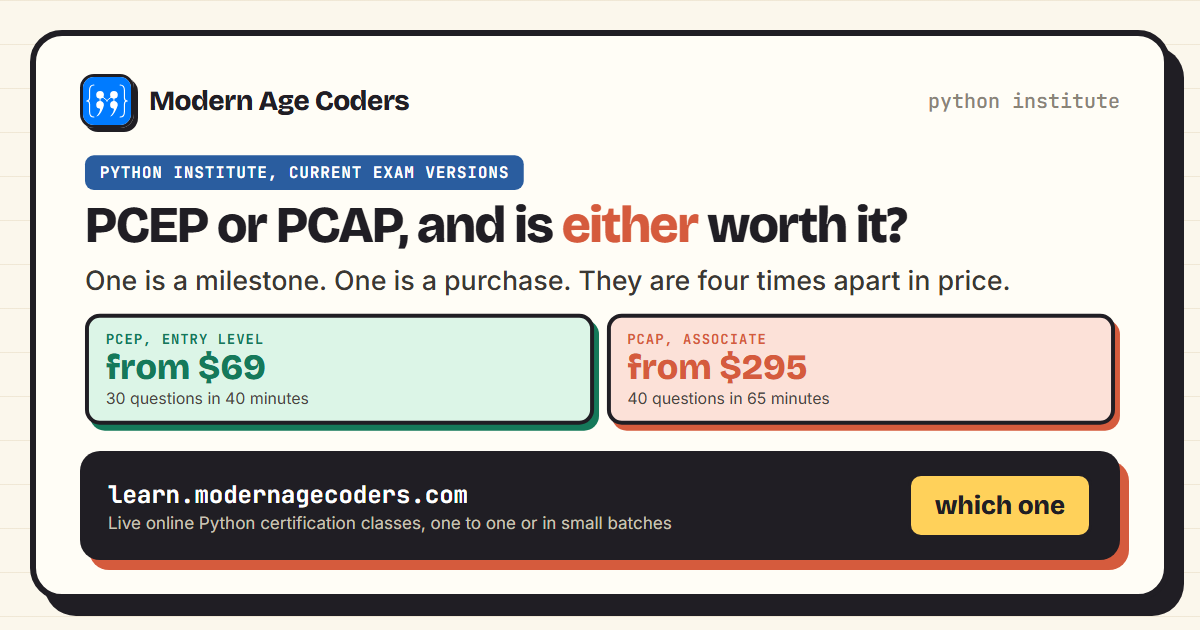
PCEP vs PCAP: Which Python Certification Is Worth It?
The two Python Institute certifications are four times apart in price and test different things. An ...
Read Article Technology
26 min read
Technology
26 min read
Best Data Science Courses in India for Students and Professionals in 2026
Comprehensive guide to the best data science courses in India for 2026. Compare IITs, IIMs, online p...
Read ArticleReady to start PCAP Certification Prep: Certified Associate in Python Programming?
Book a Priority Demo to see a full live class with a mentor reserved for you, today or tomorrow. Or choose a plan and enrol now.
Questions? WhatsApp +91 91233 66161 or email connect@modernagecoders.com