Knowing more formulas doesn't help. Competition math rewards a different way of thinking.
A student who aces school math often hits a wall on the AMC, and it confuses everyone. The reason is simple: school trains you to recognise which taught method applies, while a competition problem is built so that no taught method obviously applies. The whole challenge is finding the path yourself.
Drilling more formulas does almost nothing for this. You can't memorize your way to a clever insight.
What actually works is learning the moves that generate insight, trying small cases, looking for symmetry, reframing a hard count as an easier one, working backward from the answer. These are concrete, nameable techniques, not magic.
That's what we coach. We give your child hard problems, watch how they attack them, and build the problem-solving toolkit and the patience that competition math is genuinely made of.
The part of the AMC nobody tells international families
We coach the mathematics. We cannot enter your child for the competition, and neither can anyone else outside the MAA's own route. Here is that route, and every published 2026-27 date, from the MAA's pages as read in September 2026.
| What | When or how | Where we read it |
|---|---|---|
| AMC 10 A and AMC 12 A | Thursday 5 November 2026 | maa.org, read via archived copies of 5 to 21 Sep 2026 |
| AMC 10 B and AMC 12 B | Friday 13 November 2026 | maa.org, read via archived copies of 5 to 21 Sep 2026 |
| AMC 8 | 21 to 27 January 2027, the school picks a day in the window | maa.org, read via archived copies of 5 to 21 Sep 2026 |
| AIME (invitation only) | 5 or 6 February 2027; new for 2027: 15 questions in two parts of 90 minutes each, integer answers from 0 to 999, taken at a Pearson testing centre, $85 plus tax paid by the family, and only students aged 13 and over are eligible | maa.org, read via archived copies of 5 to 21 Sep 2026 |
| USAMO and USAJMO (invitation only) | 20 to 21 March 2027; qualification "will be primarily based on AIME scores" | maa.org, read via archived copies of 5 to 21 Sep 2026 |
| Who qualifies for AIME | Set scores rather than percentages: 100 or above on AMC 10, 85 or above on AMC 12. AMC 8 does not lead to AIME | maa.org, read via archived copies of 5 to 21 Sep 2026 |
| Age and grade limits | AMC 8: grade 8 and below, under 15.5 on the day. AMC 10: grade 10 and below, under 17.5. AMC 12: grade 12 and below, under 19.5 | maa.org, read via archived copies of 5 to 21 Sep 2026 |
| Entry in the United States and Canada | Through a school, university, math circle or learning centre registered as a competition manager. "Students and parents do not register directly with the MAA." A family without a participating school is told to check local colleges, math circles or learning centres | maa.org, read via archived copies of 5 to 21 Sep 2026 |
| Entry everywhere else | The MAA states the competitions "will only be offered to schools with USA, Canada, APO/FPO/DPO mailing addresses, and schools registered with one of our AMC international partners." Families in India, the UAE and the Gulf, the UK and Europe, Singapore and South-East Asia, and Australia and New Zealand enter through the International Group Leader the MAA names for their region on its AMC International page, never through the MAA directly and never through us | maa.org, read via archived copies of 5 to 21 Sep 2026 |
| Fees | Paid by the school or competition manager, not the family, for AMC 8, 10 and 12 in the US and Canada: $55 early bird, $75 regular, $115 late per competition, plus per-student bundles. AIME: $85 plus tax, paid by the family to Pearson. International group leaders set their own fees, which the MAA does not control | maa.org, read via archived copies of 5 to 21 Sep 2026 |
A naming trap: the AMC on this page is the MAA's American Mathematics Competitions. Australia's AMC is the Australian Mathematics Competition, a different contest from a different organiser with its own page on this site. Never mix their dates or rules.
We teach how to attack a problem, not which formula to recall.
Insight is a set of habits. We make each one explicit and practised.
Build the toolkit of moves
Small cases, symmetry, invariants, complementary counting, working backward, the recurring techniques that crack contest problems, taught one at a time.
Coach the struggle, not just the answer
We watch your child wrestle with a problem and intervene at the right moment, building the persistence that separates strong competitors from the rest.
Go deep in each topic
Number theory, combinatorics, algebra and olympiad geometry, each explored until your child owns the standard ideas and can combine them.
Rehearse under contest conditions
Timed sets from past AMC, MATHCOUNTS and AIME papers, plus the strategy of guessing, skipping and scoring that the contests reward.
A counting problem: won by reframing, not grinding.
The problem: "How many positive integers from 1 to 100 are divisible by neither 2 nor 5?" A student starts listing or trying to count the ones that qualify, slow and error-prone.
The reframe we teach. Counting what you don't want is often far easier than counting what you do. So instead of counting the survivors, count the ones to remove, using inclusion-exclusion:
divisible by 5: 20
divisible by both (i.e. by 10): 10
removed = 50 + 20 − 10 = 60 (don't double-count the 10s)
survivors = 100 − 60 = 40
The whole problem turns on one habit, "is it easier to count the complement?", plus knowing not to double-count overlaps. No formula was memorized; a way of looking was applied. This is the texture of competition math, and it's exactly what we train: a small set of powerful reframings your child reaches for automatically when a problem looks impossible.
Competitive programming and competition math are siblings.
Decompose & reframe
The strongest coders win by reframing a problem into one they can solve. It's the identical move behind cracking an AMC question.
Invariants & structure
Spotting what stays fixed while everything else changes solves olympiad problems and verifies algorithms alike.
Comfort with hard
Both reward a student who can sit calmly with a problem they don't yet know how to solve. That comfort is the real prize.
We're Modern Age Coders, and competitive programming runs in our DNA. The same problem-solving instincts power both fields, which is why olympiad-trained students so often become exceptional programmers, and vice versa.
The competition topics, from AMC 8 to AIME.
Pitched to your child's contest and division, with depth that travels upward.
Number theory
Divisibility, modular arithmetic, primes, Diophantine reasoning and the number-sense that AMC and AIME lean on heavily.
Combinatorics
Counting techniques, complementary counting, casework, pigeonhole, and the probability problems contests love.
Algebra
Clever factoring, polynomials and their roots, inequalities, functional thinking and substitutions that collapse hard problems.
Olympiad geometry
Angle chasing, similar triangles, power of a point, and the constructions that turn a baffling figure into a solvable one.
Problem-solving heuristics
Small cases, symmetry, invariants, extremal arguments and working backward, the meta-skills that generalise across every topic.
Contest strategy
Time management, when to guess or skip, AIME's exact-integer format, and how to qualify and progress through the pipeline.
The right fit: and an honest word on what to expect.
This fits the middle schooler starting MATHCOUNTS or AMC 8, the high schooler chasing an AIME qualification, and the young student who's clearly ahead and bored by school math. What matters most isn't raw talent. It's genuine appetite for hard problems.
What's realistic. Competition results build over seasons, not weeks. Most students see their problem-solving deepen steadily, and ambitious goals like AIME qualification are reachable for committed students over time. We'll be honest about the timeline and never sell a guaranteed medal.
What we won't do
- Promise a specific score, qualification or medal.
- Drill formulas in place of real problem-solving.
- Push a child who isn't enjoying it.
- Pretend insight can be crammed the week before a contest.
A long game, coached one to one.
1:1, live
One student, one coach, real-time video with a shared whiteboard for working hard problems together.
8 sessions a month
Two each week, around an hour, on a topic arc built for the long term.
Your time zone
All six US zones, around school and contest schedules.
Contest ramp
Timed past-paper practice and strategy before each competition.
One simple price. No contract.
1:1 Private Coaching
$150 / month
- 8 live one-to-one sessions a month (2 per week, 1 hour each)
- 4 live one-to-one sessions a month (1 per week, 1 hour each)
- The same coach building a long-term arc
- Pitched to your child's contest and division
- Past-paper practice · cancel any time
Small-Group Cohort
$100 / month
- 8 live small-group sessions a month (2 per week, 1 hour each)
- A few keen students solving together
- Same coaching approach, lower price
- Great for a math-club crew · cancel any time
Want the structured competition path laid out? Explore the Olympiad & Competition Mathematics Masterclass →
Coaches who've solved these problems and love them.
Competition coaching can't be faked. Our olympiad coaches have genuine problem-solving backgrounds and, just as importantly, the patience to let a student struggle productively instead of rushing to the answer. They know when to hint and when to wait, the hardest part of the craft.
Your child keeps the same coach, who builds a deliberate arc across topics and knows exactly which kinds of problems still trip them up.
"My son struggled with math for years. Integrating it into coding projects has transformed his understanding and confidence. Highly recommended!"
Shewta Singh, mother of Ishan · verified Google review
How we differ from the alternatives.
| What matters | Modern Age Coders | Problem-set books | Large online classes |
|---|---|---|---|
| Coaches your child's actual struggle | Yes, live 1:1 | No | Rarely |
| Teaches heuristics, not formulas | Yes | Implicitly | Varies |
| Same coach, long-term arc | Yes | N/A | Usually not |
| Adapts pace to the student | Fully | You self-pace | Fixed schedule |
| Monthly price | $150 (1:1) / $100 (group) | $20–40 | $200–500+ |
Great problem books are essential and we use them. What a book can't do is watch your child get stuck and give the one nudge that teaches them to get unstuck themselves.
Everything you might be wondering.
Which competitions do you coach for?
AMC 8, AMC 10, AMC 12, MATHCOUNTS, and the AIME pathway for those who qualify. We coach the problem-solving that carries across all of them and tailor practice to the contest and division.
Is competition math different from school math?
Very. School math applies a known method; competition math asks you to find one nobody handed you. We teach that creative, exploratory problem-solving. It's learnable.
My child is strong at school math but new to competitions. Is that fine?
That's the most common starting point. We build the competition habits, patience, trying cases, looking for structure, starting where your child is.
Can you help my child qualify for AIME?
We coach toward it honestly. It's realistic for many committed students over time, depending on starting level and practice. We set an honest target and build the problem-solving.
How much does it cost?
The fees for private 1-on-1 and small-group classes are shown in your own currency in the pricing section of this page. Billing is monthly, there is no contract and you can cancel any time.
Can we try a class before enrolling?
Yes. Book a Priority Demo: a full live class of about 45 to 60 minutes, today or tomorrow, with a mentor reserved for your child. After the class the mentor sends a written skill report and a personal learning roadmap on WhatsApp. If you enrol, the demo fee is adjusted against your first month's fee.
What ages and grades is this for?
Roughly grades 5–12: MATHCOUNTS and AMC 8 for middle school, AMC 10/12 and AIME for high school. We also stretch younger students who are ahead.
Will my child keep the same coach?
Yes, one mentor building a long-term arc who knows which problem types still need work.
Are sessions live?
Yes, live, one-to-one, with a shared whiteboard. Coaching the struggle only works in real time.
Isn't this just for math geniuses?
No. The students who do well usually learned to enjoy struggling with hard problems, not natural prodigies. That enjoyment is teachable.
Does competition math help with the SAT or admissions?
Yes, indirectly, the SAT/ACT feel easy afterward, and strong AMC/AIME results signal on competitive applications. The deeper benefit is how the student learns to think.
What time zones do you cover?
All six US time zones; two weekly slots around school.
Book a free olympiad coaching trial.
We'll hand your child a couple of competition problems, see how they think, and show you the path we'd build toward their next contest. No card needed.
More math tutoring from Modern Age Coders.
Real student projects
What our students actually build
Every one is a real, live project shipped by a Modern Age Coders student. Explore more in Student Labs.
 AI & MLBookDesk: AI Book Summaries & QuizzesType in any book name and author, and BookDesk pulls together the book's details, a clear summary and a custom quiz to test what you've learned, a genuinely useful study companion. Anika built it as a full-stack AI application, powered by Google Gemini with a live database behind it.by AnikaOpen the live project ↗
 AI & MLHairSync: AI Hairstyle Try-OnUpload a clear photo and try on any hairstyle before you commit, wolf cuts, curtain bangs, fades, braids and dozens of trending looks, rendered onto your own face by AI in seconds. Kriti vibe-coded this virtual try-on studio from a single idea into a working app.by KritiOpen the live project ↗
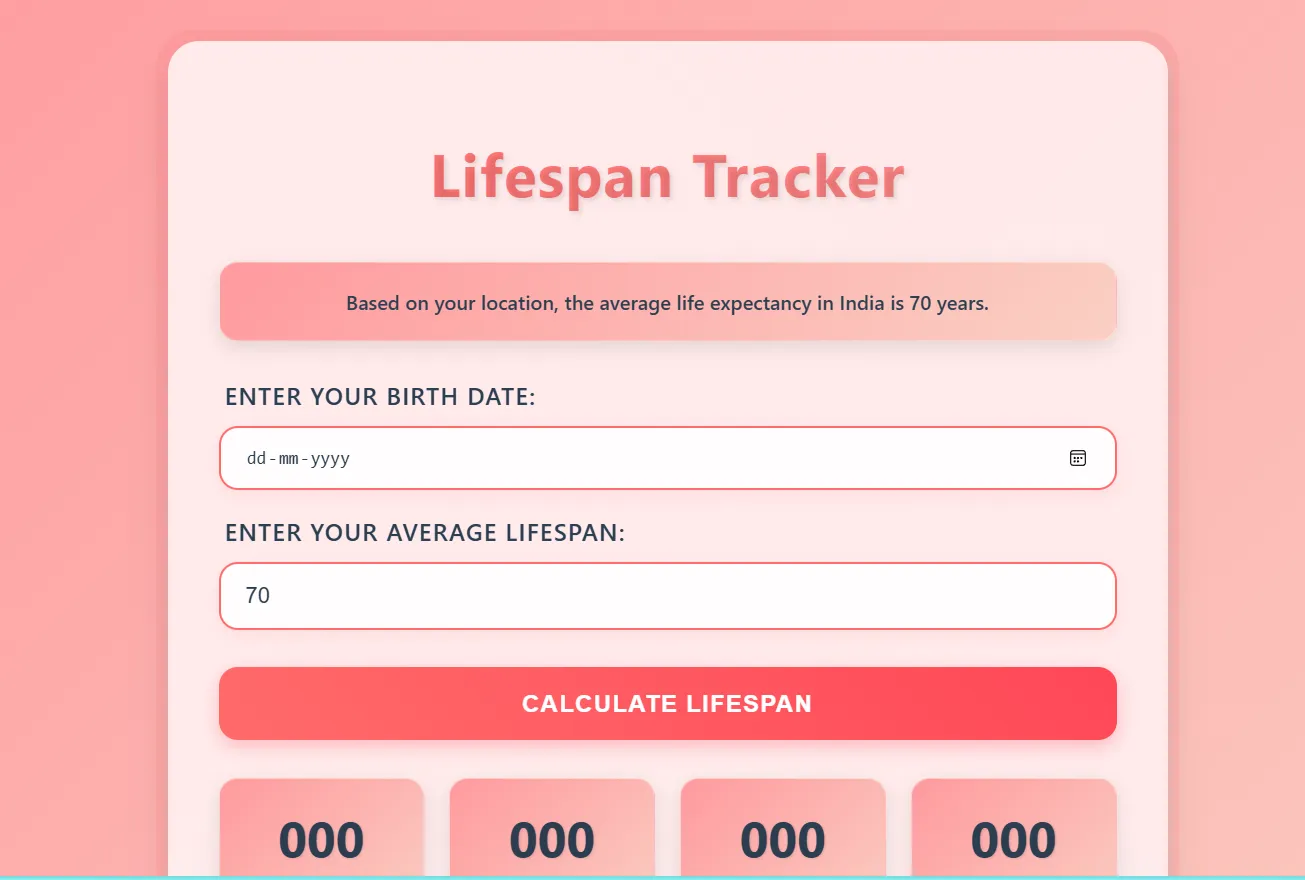 ToolLife Span TrackerAn interactive web tool that calculates expected lifespan, shows days, months and years lived, and visualises remaining time to motivate better habits.by ManayOpen the live project ↗