United Kingdom · Live online · Ages 6 to 67

AI and machine learning classes in the United Kingdom, for pupils who want to build the system rather than operate it

Paying for extra teaching is ordinary in Britain now. Almost none of it puts a young person in front of a real dataset and asks them to fit something to it. Our pupils in London, Manchester, Leeds, Bristol, Cardiff, Glasgow and Belfast write Python, load published government figures, train a model on them, and then say out loud how far wrong it is. Live lessons, one teacher who stays with the batch, on British clock time.

Teaching since 2020 · 10,000+ students in 25+ countries · every lesson taught live, in person, by a human

The short answer

Modern Age Coders teaches live online AI and machine learning to learners anywhere in the United Kingdom, from age 6 to age 67, in groups of five to eight or else privately. The route starts at Python and the statistics that sit under machine learning, and finishes with a trained model whose error the pupil can state and defend. Group teaching is USD 40 a month, about £30, and one to one is USD 100 a month, about £75. The first lesson costs nothing and needs no card.

The catalogue

Twelve courses, and the right one depends on what a learner can already write

A ten year old in Year 6, a Year 11 pupil three months from a GCSE paper, and a graduate moving out of finance into data work do not need one syllabus delivered at three speeds. They need three syllabuses. Each card leads to a syllabus set out week by week, with the fees, the timings and the projects that go with it.

I

Children, ages 6 to 12

Typed code from the first lesson, and a truthful account of what a model is

UK / KIDS / 01

Python and AI for Kids

Primary age children type a real language rather than dragging coloured blocks. Turtle drawings, then small games, then the moment that matters: a computer shown twenty examples and working out the rule itself.

Open the syllabus

UK / KIDS / 02

AI Literacy for Kids

Where an assistant's sentences come from, why a wrong answer arrives with the same confidence as a right one, and how to test a claim before repeating it in the playground.

Open the syllabus

UK / KIDS / 03

Vibe Coding for Kids

A child briefs an AI tool to make a game, then has to read what came back and mend the parts that do not work. Writing the brief takes two minutes. Reading the output is where the term is actually spent.

Open the syllabus
II

Teenagers, ages 13 to 18

From first syntax to a prediction with a number attached to how wrong it is

UK / TEEN / 01

AI and Machine Learning for Teens

The course this page is really about. Python, the mathematics the subject genuinely needs, classical algorithms, neural networks, then vision and language work. Each stage ends with something trained rather than something revised.

Open the syllabus

UK / TEEN / 02

Data Science for Teens

The unglamorous majority of the work happens before any model exists. Reading files, reconciling columns that disagree, plotting until the shape appears, and finding the one row whose units were entered in thousands.

Open the syllabus

UK / TEEN / 03

Python for Teens

Two years running from a blank file to files, APIs, classes and tests. The entry point for a teenager who has done no programming and wants the AI route afterwards on ground that will hold.

Open the syllabus

UK / TEEN / 04

Vibe Coding for Teens

Genuine web and Python builds made with an assistant at your elbow, plus the harder discipline of auditing whatever it hands back. Ship the link, then walk a stranger through every decision inside it.

Open the syllabus
III

University students and working professionals

Depth, generative systems, and the part where it goes into production

UK / PRO / 01

AI and Machine Learning Masterclass

Regression, clustering, deep networks, the discipline of a training run, validation that would survive a reviewer, and the deployment stage short courses skip because it is the awkward one.

Open the syllabus

UK / PRO / 02

Generative AI: LLMs, RAG and Agents

How a large language model is trained and fine tuned, how retrieval grounds it against documents it never saw in training, and how an agent is fenced in so that its failures are loud rather than quiet.

Open the syllabus

UK / PRO / 03

Python and AI Automation

For people already in a job who want the useful half up front. Machine learning and language processing pointed at the reporting, the reconciliations and the spreadsheets that currently eat a Friday afternoon.

Open the syllabus

UK / PRO / 04

Data Science Masterclass

Statistics, SQL, features, modelling and the writing that carries them, closing with a portfolio built for somebody deciding whether to interview you rather than somebody awarding a grade.

Open the syllabus

UK / PRO / 05

Data Structures and Algorithms

The gate at every serious engineering interview in the country, and the reason a script that handled four rows of rail statistics still behaves when it meets seven and a half million. Taught as problem solving rather than recall.

Open the syllabus

UK / ALL / 06

Browse the full catalogue

We also teach mathematics from first counting through to degree level, together with web, app and game building and exam preparation. Everything is live and everything runs on British time.

Open all courses

What you actually build

Did the railway improve, or did it stop running the trains that would have been late?

Every country we teach into gets a first project built on its own published figures, because a model about something visible from the window is a model a pupil will argue with. Britain gets the railway. The Office of Rail and Road publishes quarterly passenger rail performance statistics for Great Britain, compiled from Network Rail data, across four releases covering the 2025 to 2026 financial year. All of it is free, public, and carries the regulator's own warnings about how to read it.

Office of Rail and Road, passenger rail performance, Great Britain, 2025 to 2026
Quarter Trains planned Recorded station stops Stops within 3 min Time to 3 On Time PPM Full cancellations Part cancellations Cancellations score Severely disrupted days
Apr to Jun 20251.9m21.6m18.6m86.3%69.0%87.1%41,00039,3003.2%6
Jul to Sep 20251.9m21.8m18.5m84.8%66.8%85.4%50,90043,2003.7%15
Oct to Dec 20251.9m21.1m17.2m81.5%62.2%82.6%51,50046,4004.0%16
Jan to Mar 20261.9m21.3m18.4m86.4%68.8%87.1%40,80039,3003.2%6

Every figure above is published by the regulator, and three cross checks confirm a correctly typed table before any modelling starts: the four Time to 3 values average 84.75 against a published annual 84.8 per cent, the four cancellation scores average 3.525 against a published 3.5 per cent, and four quarters of 1.9 million planned trains give the published annual 7.6 million across 24 operators.

Severely disrupted days, daily cancellations at or above 5 per cent, with the regulator's stated cause
DateCancellationsCause as published
1 Jul 20255.4%Infrastructure issues, high temperatures
12 Jul 20256.4%Infrastructure issues, high temperatures
13 Jul 20255.7%Infrastructure issues, high temperatures
20 Jul 20255.2%Infrastructure issues, high temperatures
4 Aug 20255.8%Storm Floris
12 Aug 20256.0%Infrastructure issues, high temperatures
13 Aug 20256.0%Infrastructure issues, high temperatures
3 Oct 20258.4%Storm Amy
4 Oct 20256.8%Storm Amy
14 Nov 20256.6%Storm Claudia
29 Nov 20257.5%Overhead line trip at Alexandra Palace
1 Dec 20255.4%Track circuit failure at London Blackfriars
4 Dec 20255.1%Track circuit failure at London Blackfriars
8 Dec 20256.5%Track circuit failure at London Blackfriars
27 Dec 20256.9%Fatality at Balham, points failure at Cardiff Central

Forty three days across the year cleared the 5 per cent threshold. Two patterns show up in the sample above. Six entries share one cause, infrastructure struggling in heat, clustered across July and August. Three December entries are one piece of equipment, a track circuit at London Blackfriars, failing three times inside eight days. Named storms are a third category and behave differently, because the Met Office announces them in advance.

Then comes the reason we chose this dataset over a tidier one. Time to 3 and On Time are percentages of recorded station stops made by trains that ran. A cancelled train never produces a station stop, so it can never be counted as late. Compare the second quarter with the third: 21.8 million recorded stops at 3.7 per cent cancellations, then 21.1 million stops at 4.0 per cent, on planned volumes that both round to 1.9 million. The worst quarter of the year had the smallest measuring denominator.

The regulator flags two further layers itself. Trains cut from the timetable before it is finalised at 22:00 the previous evening never enter the planned count, which is why an adjusted cancellation measure is published beside the official one, 3.3 against 3.2 per cent in the first quarter. And around 96 per cent of station stops are recorded, with no estimate made for the missing 4 per cent.

pandasscikit-learn matplotlibfeature leakage survivorship biascategorical encoding

  1. Type the headline table by hand, then prove you typed it correctly

    Four rows, eleven columns, from the four quarterly releases. Typing beats downloading here, because it forces a pupil to read every column heading. Before any model exists, run the three validation checks. The 1.9 million is rounded in all four quarters, so the annual total is the only precise arithmetic check available, and knowing that is part of the lesson.

  2. Build the daily table from the disruption appendix

    Each release lists every severely disrupted day with its date, its daily cancellation percentage and the regulator's written cause. Forty three rows for the year. Most pupils have never met a dataset where a column is a sentence written by a person, and deciding what to do with that sentence is the work.

  3. Turn written causes into categories, and notice what repeats

    Named storm, high temperature, points or track circuit failure, overhead line, possession overrun, fatality, crew shortage. Tagged, the structure appears: one asset at London Blackfriars produced three severe days in early December, and heat produced six across July and August. A repeated single point of failure and a weather regime are different signals, and a model should learn them separately.

  4. Fit the naive model and enjoy it for ten minutes

    Predict the daily cancellation percentage from month and cause category. Write down the R squared. It will look respectable, and the pupil should be allowed to feel pleased, because the next step works far better on somebody who was pleased a moment ago.

  5. Break it deliberately by adding a feature that should not be there

    Add Time to 3 as a predictor. Accuracy jumps. Ask why, and keep asking until the pupil reaches it themselves: cancelled trains were removed from the denominator Time to 3 is computed over, so the feature is partly a function of the target. That is leakage rather than signal. Take it out and watch the score fall back.

  6. Put a number on the survivorship effect

    Set the July to September quarter against October to December. Planned volume rounds to 1.9 million in both, yet recorded station stops fall from 21.8 million to 21.1 million while cancellations rise from 3.7 to 4.0 per cent. The pupil writes one sentence saying where roughly 700,000 stops went and what their absence does to a punctuality percentage. One sentence, and it has to be right.

  7. Rebuild it honestly and publish the caveats with the result

    Predict the cancellation score using only what was knowable before the timetable was finalised at 22:00 the previous evening: weather forecast, day of week, planned volume, scheduled engineering possessions. Report the adjusted measure beside the official one, and state that around 4 per cent of station stops go unrecorded with no estimate made for them, exactly as the regulator does. The finished notebook goes online at a link, which is worth more in a UCAS personal statement than a certificate, because an admissions tutor can open it.

The distinction

The word AI is doing two very different jobs on this page

We teach both halves, in that order, and we tell parents plainly which one is still worth something in ten years. Driving a product is a product skill, and the products get rebuilt every year or two. Fitting a model is a mathematical skill, and mathematics is not rebuilt.

Using AI tools

  • Ask in English, read what comes back, ask again in different words
  • Learn the interface of whichever assistant the household is paying for this year
  • The test of success is whether the output looks convincing
  • Almost nothing carries across when the model behind the product is swapped out
  • Six weeks of anyone's life, honestly measured
  • We cover it early and briefly, including how to catch an answer that is wrong and sure of itself

Building AI

  • Find the data, check it against the publisher's own totals, and write down what you excluded
  • Pick an algorithm knowing which assumption about the world it quietly makes for you
  • Fit it, then report the error in the unit the data arrived in
  • Tell a bad dataset apart from bad features and a bad model when the score disappoints
  • Put it somewhere public and watch it meet inputs nobody planned for
  • Built on probability, matrices and Python, none of which get deprecated

The gap between those two columns is exactly the gap the British state is now trying to close. A national action plan, a 225 million pound supercomputer in Bristol, five designated growth zones and a 187 million pound skills programme are not staffed by people who are fluent in a chat interface. They are staffed by people who can take a published dataset and get something correct out of it.

The market you are already in

Britain already buys tutoring at scale. Very little of it teaches building

The Sutton Trust published its Private Tutoring report in February 2026, based on an Ipsos Young People Omnibus of 3,214 interviews with pupils aged 11 to 17 in state secondaries in England and Wales. It is the best picture available of what British families actually do, and two of its numbers get confused constantly.

29 per cent of secondary pupils have ever had private tutoring. That is a lifetime figure, up from 18 per cent when the series began twenty years ago and from 27 per cent in 2019. The separate current figure is 11 per cent, meaning pupils tutored in the survey year. Providers routinely quote the first as though it were the second. Both are real and they measure different things.

Where you live changes the answer more than anything else. 45 per cent of London pupils have had private tutoring, against 27 per cent across the rest of England and 24 per cent in Wales. Split it by settlement and it is 33 per cent urban against 19 per cent rural. That 14 point gap is not about how much rural families want extra teaching. It is about whether a specialist happens to live within driving distance, a supply constraint that online delivery removes outright.

Demand also concentrates hard in time. Year 11 is the peak at 25 per cent, with Year 10 at 10 per cent. The GCSE run in is when British families reach for help, which says two things: the buying behaviour exists at scale, and it arrives late. A pupil who starts building in Year 9 is buying something different from a pupil buying revision in Year 11.

The report also breaks the figures down by background. 64 per cent of Black pupils and 50 per cent of Asian pupils have had private tutoring, against 20 per cent of White pupils, and in deprived areas the same ordering holds at 65, 43 and 10 per cent. By household income the gap is narrower than most people assume: 23 per cent among the worst off and 30 per cent among the best off.

Meanwhile the free alternative is shrinking. School based one to one and small group tutoring reached 20 per cent of pupils, down from 22 per cent in 2023, and 2025 teacher polling found 58 per cent of schools had cut back their offer on the previous year. Unlike private tutoring, school provision is not skewed towards the capital: London sits at 17 per cent, below the national average.

Read those two trends together and the position is straightforward. Something schools were providing is being withdrawn, paid provision replaces it, and the families least well served by in person paid provision are the ones outside the big cities. That is the gap a live online school is built to sit in.

29%

Of secondary pupils have ever had private tutoring, up from 18% twenty years ago

45% vs 19%

London pupils against rural pupils, the gap online delivery is built to close

25%

Year 11, the peak year, against 10% in Year 10. Demand clusters on the GCSE run in

22% to 20%

School provided tutoring since 2023, with 58% of schools reducing their offer in 2025

Why now, in Britain

The Action Plan, the supercomputer and the five growth zones

The AI Opportunities Action Plan was published on 13 January 2025 as command paper CP1241, written by Matt Clifford CBE and commissioned by Peter Kyle, Secretary of State for Science, Innovation and Technology. It carries 50 numbered recommendations across three sections: investing in the foundations of AI infrastructure, driving adoption across the economy, and building national champions. Government accepted all 50 and published its response the same day. Two commitments give the scale: expanding AI Research Resource capacity at least twentyfold by 2030, and a long term infrastructure plan backed by a ten year investment commitment.

Compute followed. Isambard-AI launched at the University of Bristol in July 2025, a 225 million pound government investment running 5,448 NVIDIA GH200 Grace Hopper Superchips at over 200 petaflops. In 2025 it was the most powerful university based supercomputer in the world and the eleventh fastest machine anywhere. With Dawn at the University of Cambridge it takes national AI Research Resource capacity to 23 AI exaFLOPs.

Five AI Growth Zones are designated as of 2026, led by the Department for Science, Innovation and Technology and built to clear the practical blockers on data centre construction through prioritised grid connections, streamlined planning and investment ready sites. Culham in Oxfordshire came first, a 100 megawatt data centre with longer term ambitions towards 500 megawatts, followed by the North East Combined Authority with two sites, Cobalt Park and Blyth, then North Wales, South Wales, and North Lanarkshire at the end of January 2026.

The education hook is TechFirst, a 187 million pound national AI and digital skills programme announced by the Prime Minister at London Tech Week on 8 June 2025, delivered by the Department for Science, Innovation and Technology and modelled on the National Cyber Security Centre's CyberFirst. TechYouth, at 24 million pounds, aims to support 1 million secondary school pupils by 2028. TechGrad, at 96.8 million pounds, funds AI, cyber and computer science scholarships for 1,000 undergraduates a year. TechExpert, at 48.4 million pounds, provides 10,000 pound grants to 500 PhD students. TechLocal, at 18 million pounds, seeds community provision through regional panels. Industry partnerships with NVIDIA, Google and Microsoft target 7.5 million UK workers with AI skills by 2030.

On governance, the AI Safety Institute set up at the Bletchley Park summit in November 2023 was renamed the AI Security Institute on 14 February 2025, announced by Peter Kyle at the Munich Security Conference three days after the Paris AI Action Summit. The remit narrowed onto security implicated risks: malicious cyber attacks, cyber fraud and cybercrime.

A child who is twelve today turns twenty two in 2036, which is roughly when the first cohort raised entirely inside this policy environment reaches the job market.

86,139

People employed in AI related roles in the UK in 2024, up 33% on 2023

5,800+

UK AI companies counted by DSIT, an 85% increase across two years

5,448

NVIDIA GH200 Superchips inside Isambard-AI at the University of Bristol

£187m

TechFirst, the national AI and digital skills programme announced on 8 June 2025

Who is actually hiring, and where

The Department for Science, Innovation and Technology published its Artificial Intelligence Sector Study 2024 on 3 September 2025, built on secondary data analysis plus responses from 298 AI companies and 52 in depth interviews. It counted more than 5,800 AI companies in the UK, an 85 per cent increase over two years, and 86,139 people in AI related employment in 2024, up 33 per cent on the year before. Sector revenue reached 23.9 billion pounds, up 68 per cent, and gross value added 11.8 billion pounds, up 103 per cent. Employment grew faster than company count, which means existing firms are scaling teams rather than the total being inflated by new startups forming.

The cluster, and the parts of it outside London

The Knowledge Quarter around King's Cross is the anchor. Google DeepMind, Isomorphic Labs, Meta, Wayve in autonomous driving and Synthesia in AI video all sit inside the same few streets. In April 2026 the cluster thickened again: as reported by CNBC on 16 April 2026, OpenAI announced its first permanent London office and Anthropic announced a major UK expansion, quadrupling its London headcount from roughly 200 staff towards around 800. The public compute, though, is deliberately elsewhere. Isambard-AI sits in Bristol and Dawn in Cambridge, and the five growth zones exist to pull data centre investment out of the South East. For a family in Newcastle, Wrexham or Motherwell, that is the practical point.

School and university

Four education systems, four sets of codes, and the same thing missing from all of them

The United Kingdom is not one education system, and a provider that quietly assumes England will get a Scottish family's timetable wrong by weeks. Here is the map we plan against, with the specification codes written out, because a code is checkable and a marketing claim is not.

England, Wales and Northern Ireland

The JCQ boards here are AQA, Pearson Edexcel, OCR, WJEC and Eduqas, and CCEA. At GCSE the live Computer Science specifications for 2026 entry are AQA 8525, OCR J277 and Pearson Edexcel 1CP2, first taught in 2020 and first examined in 2022, covering systems architecture, memory and storage, computer networks, network security, systems software, algorithms, programming fundamentals and Boolean logic. At A level they are AQA 7517, with AS 7516, and OCR H446, the AQA one carrying a Non-Exam Assessment called the Computing Practical Project.

Results days are fixed by JCQ and identical across boards: A level, AS and T Level on Thursday 13 August 2026, GCSE on Thursday 20 August 2026, with centres receiving them under restricted release the day before. GCSE Computer Science entries fell 4.4 per cent in summer 2025, boys down 5.2 per cent and girls down 1.5 per cent, so the female share rose to 22.6 per cent from 21.9 per cent. Independent and international schools additionally enter pupils for Cambridge International AS and A Level Computer Science 9618.

Scotland

Scotland has a different awarding body, a different ladder and a different calendar. Qualifications Scotland replaced the Scottish Qualifications Authority on 1 December 2025, becoming a legal entity under the Education (Scotland) Act 2025, with no immediate change to the exams. The ladder runs National 5, Higher and Advanced Higher Computing Science. Higher carries course code C816 76 with course assessment code X816 76, and Advanced Higher carries C816 77. The 2026 diet ran from 22 April to 2 June and results were issued on Tuesday 4 August, nine days ahead of A level results in England, so a Scottish pupil's whole revision cycle sits earlier.

Now the sentence that matters most here. None of those specifications, in any of the four systems, teaches machine learning. A school teaching model building is adding to the curriculum rather than duplicating it, and naming the codes is how a parent tells one from the other.

Imperial College London, and the maths gate

Imperial's MEng Computing in Artificial Intelligence and Machine Learning is four years under UCAS code G700. The minimum entry standard is A*A*A to A*AAA, including A* in Mathematics, plus either A*A in two further subjects or AAA in three, with Further Mathematics preferred. The typical offer is A*A*A* on three A levels and A*A*AA on four, and the Test for Mathematics for University Admission is required. Imperial does not accept ICT, Business Studies, General Studies or Critical Thinking, and recommends Computer Science, Further Mathematics and Physics.

The University of Edinburgh

Edinburgh's BSc with Honours in Artificial Intelligence is also four years, alongside a combined BSc in Artificial Intelligence and Computer Science. A levels run from A*A*A* down to AAB with Mathematics at A, plus English at GCSE grade C or 4. On the International Baccalaureate it is 43 points with 777 at Higher Level down to 34 points with 665, with Mathematics at Higher Level 6 and only the Analysis and Approaches course accepted, plus English at Standard Level 5.

For Scottish applicants it is AAAAA at Higher, achievement by the end of S5 preferred, with BBB in a single year across S4 to S6, Mathematics at A and National 5 English at grade C. The detail that catches families out: Higher Applications of Mathematics is not accepted in place of Higher Mathematics, and Advanced Higher Mathematics is recommended. The widening access route asks ABB at A level, AABB at Higher by the end of S6, or 32 points with 655 at Higher Level. Mathematics qualifications must have been achieved no more than two academic years before entry.

Side by side, the two universities say the same thing. Mathematics is the gate. Not coding, not a folder of AI tool screenshots, not a certificate. That is why our teens route teaches the statistics and linear algebra inside the machine learning instead of parking them in a separate subject to be endured.

How the classes run

British clock time, including the hour that moves in October

This is the fact most often got wrong about scheduling into Britain. Right now the United Kingdom is on British Summer Time, UTC plus one, and India is 4 hours 30 minutes ahead. The 5 hours 30 minutes figure everyone quotes is the winter gap. British Summer Time began on 29 March 2026 and ends at 02:00 on Sunday 25 October 2026, when Britain returns to Greenwich Mean Time and the gap widens. India runs no daylight saving, so a British lesson time never moves in your diary and always moves by an hour in ours, twice a year.

16:30 to 17:30

Tuesday and Thursday. UK school days typically end between 15:15 and 15:45, so this catches pupils shortly after they get home.

18:00 to 19:00

Wednesday evening. The slot most teenagers pick, after homework and before the evening closes down.

Saturday 09:30 to 11:00

The weekend workshop, ninety minutes rather than sixty, and the easiest slot to hold on to across a whole term.

The same three slots either side of the clock change on 25 October 2026
Slot UK now, BST India now, IST UK from 25 Oct, GMT India from 25 Oct, IST
Tuesday and Thursday16:30 to 17:3021:00 to 22:0016:30 to 17:3022:00 to 23:00
Wednesday evening18:00 to 19:0022:30 to 23:3018:00 to 19:0023:30 to 00:30
Saturday workshop09:30 to 11:0014:00 to 15:3009:30 to 11:0015:00 to 16:30

What a session is

A live hour, or ninety minutes at the weekend, with one teacher who remembers what this particular pupil could not get working last Wednesday. Screens go both ways, so the teacher sees the code being typed and interrupts at the moment the misunderstanding appears rather than discovering it in a submission three days later. A batch is five to eight pupils, with private teaching available if a family prefers it.

What goes home between lessons is a thing to make, not a sheet to complete, and it comes back half broken, which is the useful state. Questions during the week reach the same teacher directly rather than an inbox somebody else is monitoring.

The British year, which is four different years

England has no national term dates, and that matters operationally. The Department for Education sets a minimum of 190 teaching days, but local authorities, academy trusts, free schools and independent schools each fix their own calendar, so half term can differ by a week between neighbouring boroughs. One published 2026 to 2027 example, the Royal Borough of Greenwich, runs its autumn term from 4 September to 18 December 2026, with half term in the week of 26 to 30 October 2026 and the Christmas holiday from Monday 21 December 2026 to Friday 1 January 2027. Scotland runs a different year entirely, back in mid August and finished in late June.

What does not vary are the results days: A level, AS and T Level on Thursday 13 August 2026, GCSE on Thursday 20 August 2026, and Scotland on Tuesday 4 August 2026. September brings the enrolment spike as term opens. October half term and Easter are the two natural windows for an intensive. January to May is the revision peak, with Scottish demand arriving earlier because the diet opens on 22 April.

Enrolment itself is continuous. A pupil can start in the second week of November or the first week of June and the batch will take them, because the teacher works from where each person actually is rather than from where a term plan says they ought to be.

Student work

Work our students published, at addresses you can open right now

Each of the four below is a running application on the open web, made by a pupil in these classes and left up afterwards. Open them, click through them, try to break them. More of them sit in Student Labs.

NutriLife AI nutrition coach project screenshot

AI and ML

NutriLife, an AI nutrition coach

A coach that takes what you have eaten and works you back towards a target, carried from first sketch to public link by one pupil.

by Bhavya · Open the live project

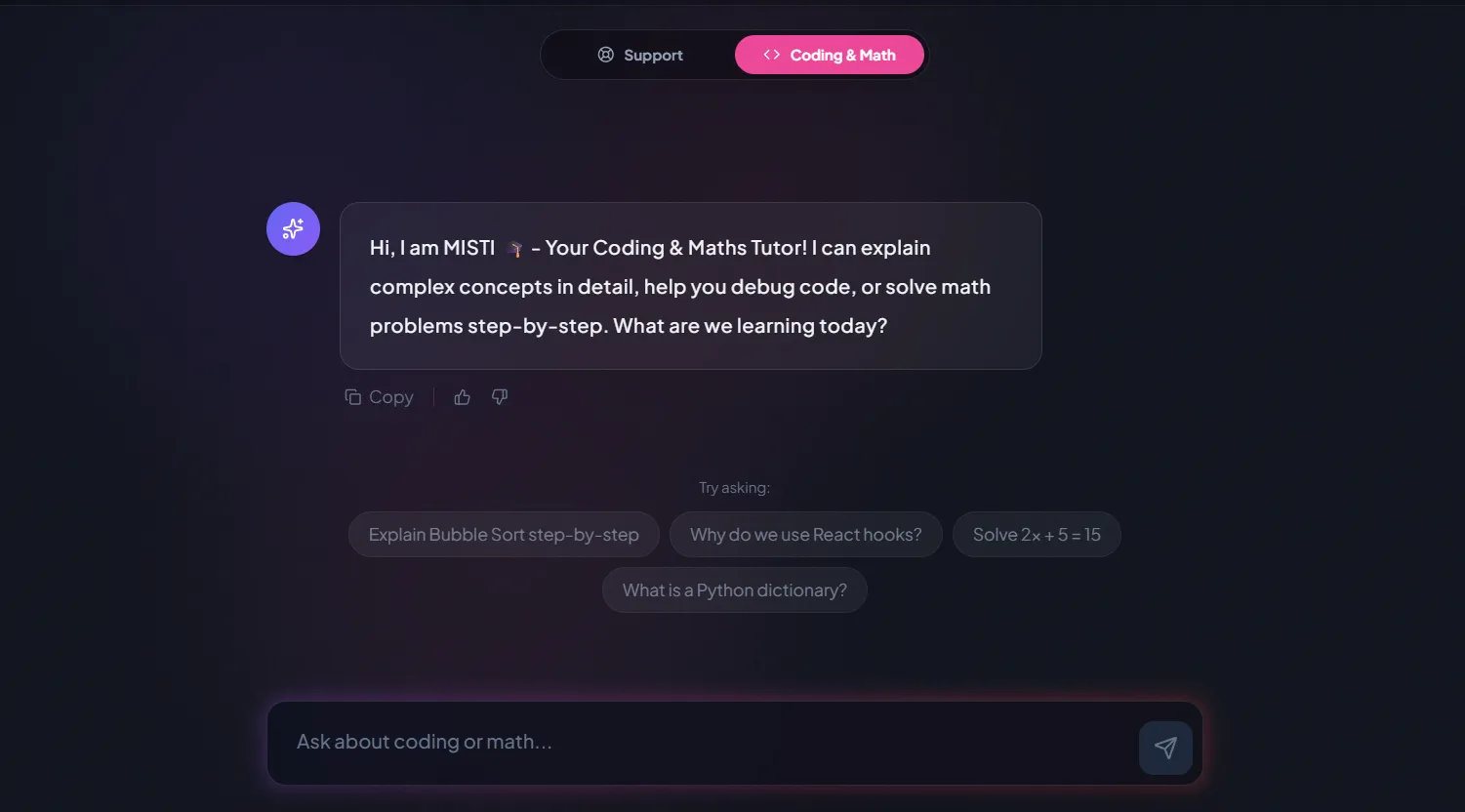
Misti AI chatbot for maths and coding screenshot

AI and ML

Misti, an AI chatbot for maths and coding

A study bot that fields maths and programming questions and answers them, written and deployed by a pupil.

by Harshit · Open the live project

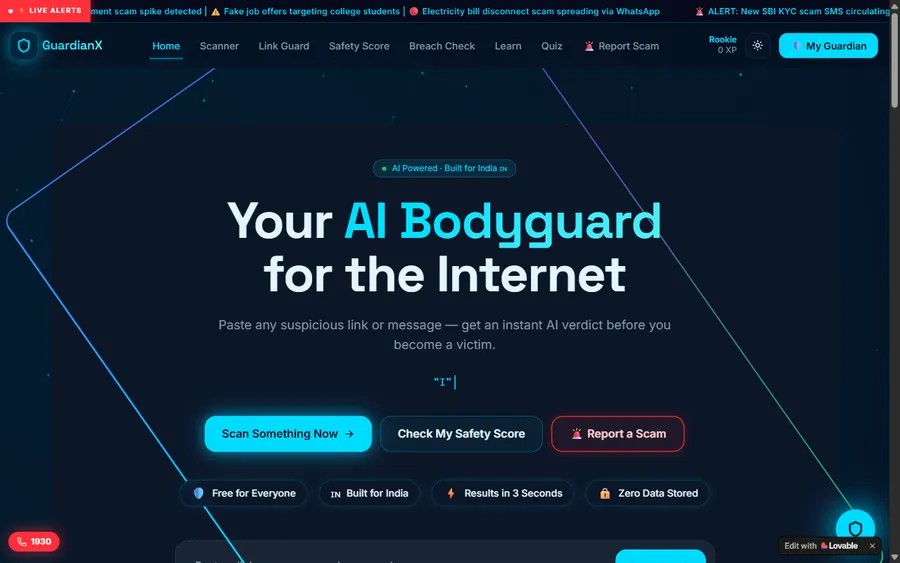
GuardianX AI internet safety assistant screenshot

AI and ML

GuardianX, an AI safety assistant

An assistant built to help a young person notice when a situation online has turned unsafe, designed and shipped by a pupil.

by Vivaan · Open the live project

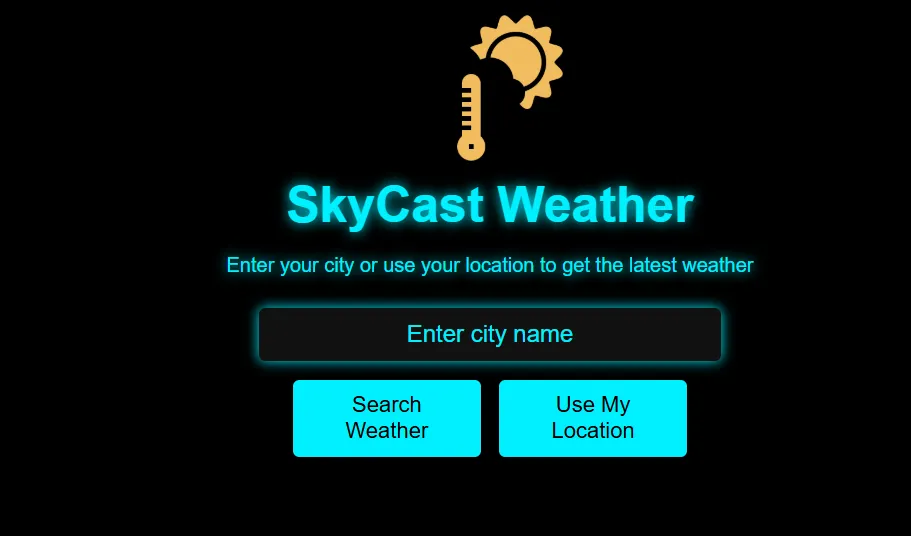
SkyCast weather forecast app screenshot

Data and forecasting

SkyCast, a weather app

A weather application running on live data feeds, and the nearest relative of the rail disruption project described above.

by Krish · Open the live project

Fees

Fees, in pounds and in the dollars they are set in

We price in US dollars and convert, rather than quoting a pound figure and revising it every few months. At a market rate of 1.3308 dollars to the pound on 24 July 2026, USD 40 comes to £30.06 and USD 100 to £75.14, so the published prices are £30 and £75. Billing is monthly. There is no joining fee, no term commitment and no minimum number of months.

Free first class

£0

USD 0, no card needed

  • A genuine lesson taught by a teacher, not a call from sales
  • Doubles as a level check, so week two starts in the right place
  • Sit in, watch it, decide afterwards
Book it

Group batch

£30

USD 40 a month

  • Five to eight pupils, and one teacher who stays with them
  • Taught live on camera, with nothing pre-recorded
  • A build task each week, and the teacher reads the code that comes back
  • Certificate on completion
Start here

One to one

£75

USD 100 a month

  • Private teaching, at your pace and in your diary
  • Suits GCSE and Higher years, and adults with few free evenings
  • Syllabus rebuilt around the goal you name
Enquire

One caveat we would rather state than hide. The rate above is a mid market quote, so once a bank adds its own spread the amount leaving the account is slightly larger. Sterling moved between 1.33095 and 1.34765 across the week to 24 July 2026, which puts USD 40 between £29.68 and £30.05 and USD 100 between £74.20 and £75.13. That is a swing of under 50 pence in a week, which is why round numbers are safe to print. Over the past month the pound strengthened 0.93 per cent, and across twelve months it was down 0.89 per cent.

What families say

What families wrote, unprompted, on Google

The average across 547 Google reviews is 4.9. The six below are reproduced as they were left. Nobody here drafted them, edited them or asked for them.

★★★★★

"The one step solution for my son. Modern Age Coders make learning coding so simple that kids love it."

Ria Mukherjee

Parent

★★★★★

"Modern Age Coders has been a game-changer for me! I struggled to grasp IT concepts and coding before joining, but their classes transformed everything."

Samriddha Mondal

Student

★★★★★

"One of the most wonderful education centres out there. Education is not limited to school syllabus but focuses on skill development. Learning here has been a wonderful journey and still continuing."

Vansh Agarwal

Student

★★★★★

"My child Dhairya is really enjoying the Modern Age Coder IT classes. This is his first online class, and he eagerly looks forward to it. I can see his improvement."

Sonam Oswal

Parent of Dhairya

★★★★★

"I highly recommend this computer coding class! The teachers are incredibly knowledgeable and passionate about coding. They make every session engaging and insightful."

Ritu Kedia

Parent

★★★★★

"Modern Age Coders have wonderful teachers who teach in a clear, easy and practical way. The teacher boosts students' confidence and inspires them to learn without hesitation."

Sonu Goyal

Parent

Questions from the UK

The eight questions British parents ask before they book

Is this just GCSE and A level Computer Science tutoring under another name?

No. The live GCSE specifications for 2026 entry are AQA 8525, OCR J277 and Pearson Edexcel 1CP2, and at A level AQA 7517 and OCR H446. Between them they cover systems architecture, memory and storage, computer networks, network security, systems software, algorithms, programming fundamentals and Boolean logic. Not one of them contains machine learning. What we teach sits outside the specification rather than repeating it, and it is built so that a pupil is not pulled away from the coursework their school actually marks.

My child is in Scotland. How does this work alongside Higher Computing Science?

Scotland is a separate system and we plan it separately. Qualifications Scotland became the national awarding body on 1 December 2025 under the Education (Scotland) Act 2025, replacing the Scottish Qualifications Authority, with no immediate change to the exams themselves. Higher Computing Science carries course code C816 76, with course assessment code X816 76, and Advanced Higher carries C816 77. The 2026 diet ran from 22 April to 2 June and results were issued on Tuesday 4 August 2026, nine days before A level results in England. A Scottish pupil therefore reaches peak revision weeks earlier than an English classmate, and the timetable is built to that.

What mathematics does my child actually need for an AI degree?

More than most families expect, and the gate is mathematics rather than coding. Imperial College London asks for A* in Mathematics on its MEng Computing in Artificial Intelligence and Machine Learning, UCAS code G700, inside a minimum entry standard of A*A*A to A*AAA, and it requires the Test for Mathematics for University Admission. Imperial does not accept ICT, Business Studies, General Studies or Critical Thinking. The University of Edinburgh asks for Mathematics at A on its BSc in Artificial Intelligence and states plainly that Higher Applications of Mathematics is not accepted in place of Higher Mathematics. A Scottish pupil can pass a maths Higher and still be locked out of that degree.

Will TechFirst give my child this at school for free?

TechFirst is a 187 million pound national AI and digital skills programme announced by the Prime Minister at London Tech Week on 8 June 2025 and delivered by the Department for Science, Innovation and Technology. Its schools strand, TechYouth, holds 24 million pounds and aims to reach 1 million secondary pupils by 2028. Divide the one figure by the other and the shape of it becomes clear. It is a national exposure and awareness programme, and a welcome one. It is not a year of weekly live teaching with the same teacher, a real dataset and a model you have to defend. The two sit alongside each other rather than replacing each other.

What happens to lesson times when the clocks change on 25 October 2026?

Your lesson stays exactly where it is in British time and moves by an hour in Indian time. Britain is on British Summer Time until 02:00 on Sunday 25 October 2026, which is UTC plus one hour, and India is 4 hours 30 minutes ahead of that. From that Sunday morning Britain returns to Greenwich Mean Time, UTC plus zero, and the gap widens to 5 hours 30 minutes, because India does not operate daylight saving at all. A 16:30 lesson in Britain is 21:00 in India through the summer and 22:00 in India through the winter. Nothing moves in your diary.

We are not in London. Is a paid class worth it out here?

The Sutton Trust survey published in February 2026 found that 45 per cent of secondary pupils in London have ever had private tutoring, against 27 per cent across the rest of England and 24 per cent in Wales. The urban figure is 33 per cent and the rural figure is 19 per cent. That 14 point gap is a supply problem rather than a demand problem, because an in person specialist has to be within driving distance of your house. Live online teaching deletes the driving distance. A pupil in rural Northumberland and a pupil in Islington sit in the same batch and get the same teacher.

What does this cost in pounds?

A group batch of five to eight pupils is USD 40 a month, which is about 30 pounds, and one to one teaching is USD 100 a month, about 75 pounds. Those conversions use a market rate of 1.3308 US dollars to the pound on 24 July 2026. It is a mid market rate before any card or foreign exchange spread, so a card billed in dollars settles a little above the arithmetic. Sterling traded between 1.33095 and 1.34765 in the week to 24 July 2026, which moves the two figures by under 50 pence across the whole week, so 30 pounds and 75 pounds are honest published prices. The first lesson is free and needs no card.

Can a beginner really build a working machine learning model?

Yes, and the project we use to prove it runs on British government statistics. The Office of Rail and Road publishes quarterly passenger rail performance figures for Great Britain. A pupil types four rows of published numbers into a spreadsheet, checks them against the regulator's own annual totals, then predicts the daily cancellations score. The interesting part is the trap inside the data. Punctuality is measured across station stops that actually happened, so a cancelled train can never be recorded as late. The worst quarter of 2025 to 2026 carried roughly 700,000 fewer recorded station stops than the quarter before it. A pupil who can explain why that flatters the punctuality figure has understood survivorship bias from real published data rather than from a textbook.

Start here

Claim the free first lesson

Leave a number and a mentor rings you back, usually the same day, at a British hour rather than at ours. The first lesson is taught, not sold. It also serves as a level check, so that your child begins where they actually are instead of where the average twelve year old is.

Would rather read first? Have a look at how we teach, the full course catalogue, or what pupils have built in Student Labs.

No card. No obligation. We call, we do not spam.