SOLVE / YOUNG / 01
Maths Through Coding
School maths made visible and testable.
Open the syllabusIreland · Problem solving · Ages 6 to 67
Problem solving is the skill parents most often say they want, and the one hardest to buy. It cannot be handed over in a lesson; it is built by meeting problems whose answer is not obvious and being taught a method for getting started. Irish education says so in as many words. The Leaving Certificate Mathematics syllabus defines problem solving as "engaging in a task for which the solution is not immediately obvious", and adds that the point is "the mathematical knowledge and skills that can be learned in the process of obtaining an answer, rather than on the answer itself". The Junior Cycle Mathematics specification asks students to decompose a problem "into manageable parts", the exact move a programmer makes a dozen times a day. And Ireland's PISA 2022 results contain a detail worth knowing: of the four things measured in mathematics, the one Irish students do least well is formulating, which means turning a real situation into something you can calculate with. This page explains all of that, with the caveats the researchers themselves insist on, and then shows the method our classes use.
Teaching live since 2020 · more than 10,000 students · a method, not a talent
In short
Problem solving is taught as a method: read the problem properly, break it into parts, solve a smaller version, generalise, then judge the result. Irish curriculum documents ask for exactly this, from the Junior Cycle outcome about decomposing a problem into manageable parts to the Leaving Certificate definition of a task whose solution is not immediately obvious. Coding is unusually good practice for it, because every attempt is tested immediately. Modern Age Coders teaches it live online, for ages 6 to 67, in groups of five to ten placed by level or one to one. The first class is free; continuing costs USD 100 a month in a group or USD 150 a month with a teacher to yourself. We make no promises about exam results.
Start here
One for teenagers, one for college students and adults, one for younger children. Each card opens the syllabus.
SOLVE / 01
Problems whose answers are not obvious, worked through with a method rather than guesswork, week after week.
Open the syllabus →
SOLVE / 02
For college students and adults: the classic structures, and how to reason about what a solution costs before writing it.
Open the syllabus →
SOLVE / 03
For younger learners: school maths turned into small programs, so a method can be seen working instead of memorised.
Open the syllabus →What PISA shows
PISA tests fifteen-year-olds across the OECD. Ireland's national report was published by the Educational Research Centre in December 2023. Here are its headline figures, and then the detail that matters for problem solving.
| Domain | Ireland | OECD average | Change since 2018 |
|---|---|---|---|
| Mathematics | 491.6 | 472.4 | Down 8.0 points, while the OECD fell 14.9 |
| Reading | 516.0 | 475.6 | Down 2.1 points, not statistically significant |
| Science | 503.8 | 484.6 | Up 7.7 points, statistically significant |
PISA splits mathematics into four processes. Irish students score highest on interpreting (494.9) and employing (493.6), lower on reasoning (489.8), and lowest on formulating (486.8).
Formulating is the step where you turn a messy real situation into something you can actually calculate with. It is also the step a programmer performs every time they take a vague idea and decide what the program must do first.
The report is blunt about a limitation. In 2022, 1,689 students, 22.1% of the sample, did not participate or were absent, against 868 students, 12.8%, in 2018. The report says Ireland's performance must be read "with consideration of the upward bias in the estimates for Ireland".
So these numbers are useful, and they are not precise. Anyone quoting them without that sentence is not being straight with you.
19.0% of students in Ireland performed below Level 2 in mathematics, against an OECD average of 31.1%. That is a real strength of the system.
7.2% reached the highest levels, slightly below the OECD average of 8.7%, and 28 countries and economies had a larger share of top performers.
Ireland did not sit the PISA 2022 creative thinking test, taking only the questionnaire. Any article giving Ireland a creative-thinking rank has it wrong.
Source: Education in a Dynamic World: the performance of students in Ireland in PISA 2022, Educational Research Centre, December 2023, read 16 September 2026. The creative-thinking point is confirmed against OECD PISA in Focus No. 125, whose list of the 64 participating countries does not include Ireland.
In the curriculum
Problem solving is not an extra in Irish mathematics. It is written into the specification as an element in its own right, with learning outcomes attached.
| Outcome | What the student does | The same move in code |
|---|---|---|
| U.7 | Make sense of a given problem and, if necessary, mathematise a situation | Decide what the program must actually produce |
| U.8 | Apply knowledge and skills to solve a problem, including decomposing it into manageable parts | Split the work into functions you can test one at a time |
| U.9 | Interpret the solution in terms of the original question | Check the output answers the question that was asked |
| U.10 | Evaluate different possible solutions, their reasonableness, improvements and limitations | Compare approaches for speed, clarity and edge cases |
The specification defines the element itself as students being able to "investigate patterns, formulate conjectures, and engage in tasks in which the solution is not immediately obvious, in familiar and unfamiliar contexts".
Its rationale names the company problem solving keeps: the course develops "understanding, fluency, reasoning, computational thinking and problem solving". Computational thinking is in the maths curriculum, not only the computing one.
At senior cycle, the Leaving Certificate Mathematics syllabus, a 180-hour course of study, says students "learn to analyse the problem and break it down into manageable steps, to reflect on their strategies and those of others and to adjust their own approaches where necessary".
It also distinguishes the kind of task that builds the skill: "Problem-solving tasks activate creative mathematical thinking processes as opposed to imitative thinking processes activated by routine tasks." Routine exercises do not do this work.
Sources: Junior Cycle Mathematics specification and the Leaving Certificate Mathematics syllabus, read 16 September 2026. The third column is our own mapping, not part of either document. We do not teach the maths courses and make no claim about exam performance.
The method
The method is the same for a seven year old making a game and an adult writing a data pipeline. Only the problems grow.
| Move | A child of eight | A teenager | An adult |
|---|---|---|---|
| Read it properly | Says back what the game should do | Writes the requirement in one sentence | Lists the inputs, outputs and constraints |
| Break it up | One part: make the cat move | Functions, each doing one thing | Modules with clear boundaries |
| Solve a smaller case | Make it work for one level | Run it on three rows of data | Prototype on a sample before the full set |
| Generalise | Make it work for every level | Handle the awkward cases too | Handle scale, errors and bad input |
| Judge it | Is it fun, does it break? | Is it right, is it readable? | Is it correct, fast enough, maintainable? |
Our teachers are trained to wait. A learner who is stuck and then finds a way forward has learned something a demonstration cannot teach.
Most beginners attack the whole problem at once. Solving the two-row version, by hand if needed, is the single most useful habit we teach.
The learner predicts the outcome before running the code, so every run tests their reasoning and not only their typing.
Where do AI tools come in? After the method is secure. A learner who can decompose a problem can use a tool to speed up a part they already understand, and can spot when its answer is wrong.
The habits that keep that honest are on understand the code, do not copy-paste, and the wider argument on learn to think, not just use AI tools.
The rungs
A learner moves up when the teacher sees the rung used unprompted, not when a number of weeks has passed.
| Rung | The learner can |
|---|---|
| 1. Restate | Say what the problem is asking, in their own words |
| 2. Decompose | Break it into parts that can be solved separately |
| 3. Reduce | Solve a smaller version first and check it by hand |
| 4. Generalise | Extend the working solution to all the cases |
| 5. Evaluate | Compare approaches and defend the one chosen |
A surprising share of wrong programs solve a problem nobody asked about. Restating catches that in thirty seconds, before an hour is spent.
The subjects these rungs run through are set out on the coding roadmap.
The same five moves are what technical interviews test, which is why our college and adult students work on them directly.
For students in Irish third level, coding for college students takes this further.
The catalogue
Grouped by stage. The free first class decides where a learner starts.
SOLVE / YOUNG / 01
School maths made visible and testable.
Open the syllabusSOLVE / YOUNG / 02
Breaking a task into steps, with blocks.
Open the syllabusSOLVE / YOUNG / 03
First typed code, first real debugging.
Open the syllabusSOLVE / TEEN / 01
The method, practised weekly on hard problems.
Open the syllabusSOLVE / TEEN / 02
Fluency, so the problem gets the attention.
Open the syllabusSOLVE / TEEN / 03
A stricter language that rewards planning.
Open the syllabusSOLVE / ADULT / 01
Choosing a structure for a reason you can state.
Open the syllabusSOLVE / ADULT / 02
From beginner to writing real programs alone.
Open the syllabusSOLVE / ADULT / 03
Building fast with AI while reading every line.
Open the syllabusHow the classes run
Every class is live, because the teaching happens in the pause after a question. Our teachers work from India, whose clock stays put all year, so they are four and a half hours ahead of Irish time through the summer and five and a half once Ireland turns its clocks back in late October.
After school
Primary and secondary learners, Irish time.
Evening
College students and working adults.
Weekend
Longer problem sessions and project work.
A real problem, worked through with a teacher, ending with an honest view of the right level.
Learners at one level, comparing approaches to the same problem each week.
For learners who want a faster pace or prefer to think without an audience.
Hints before answers, and the smallest hint that will do.
Tasks where the route is not given, because routine exercises build different skills.
Learners keep their attempts, so improvement in method is visible over a term.
Student work
Four finished projects from our students, each one a problem somebody chose to take on. More are collected on the student labs page.
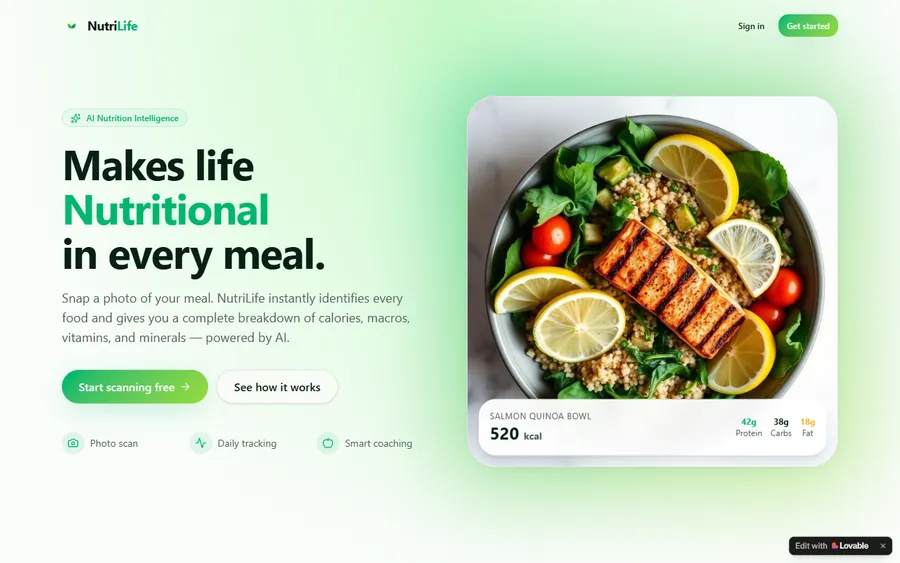
AI and ML
An AI nutrition coach that reads what you eat and works you toward a target.
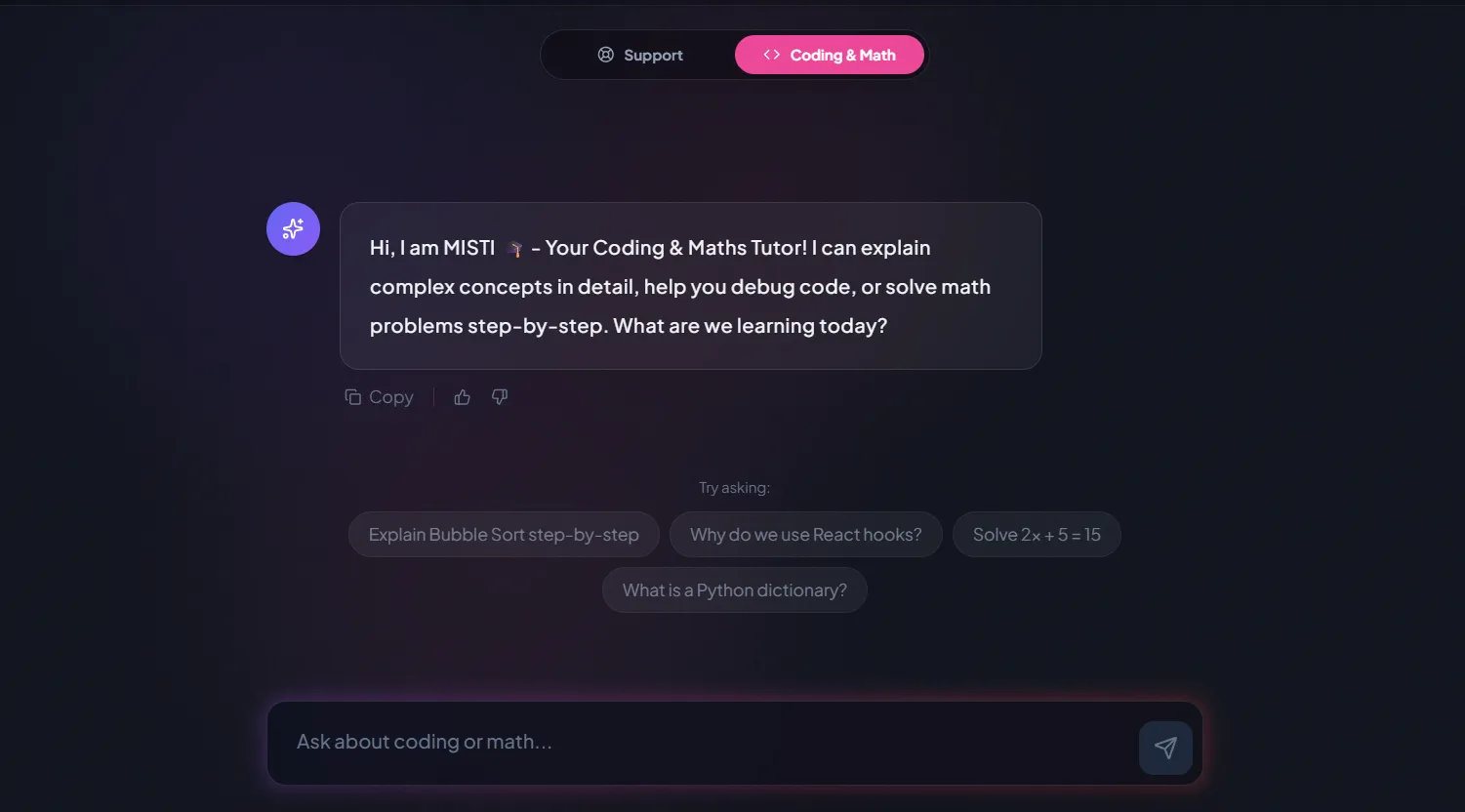
AI and ML
A chatbot that answers mathematics and programming questions, built and deployed by a student.
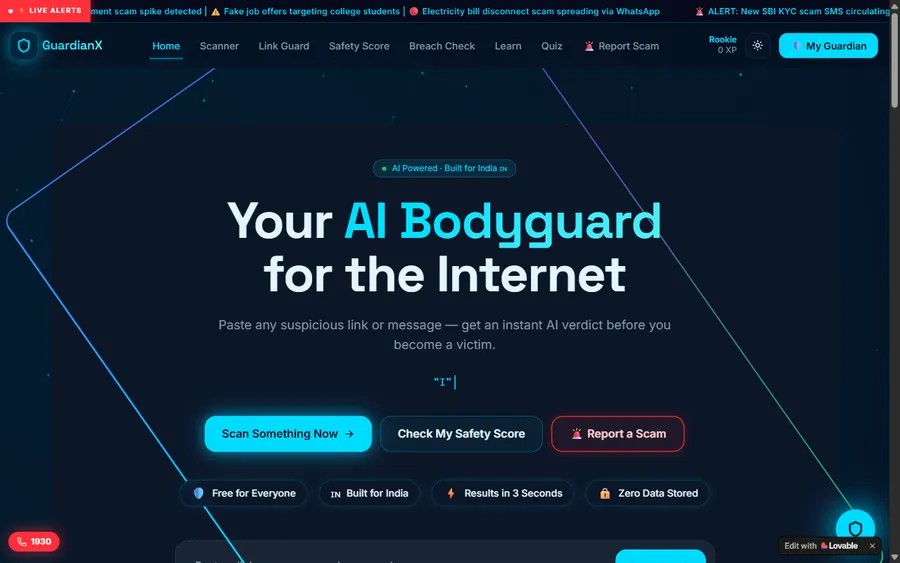
AI and ML
An assistant that helps a young person recognise unsafe situations online.
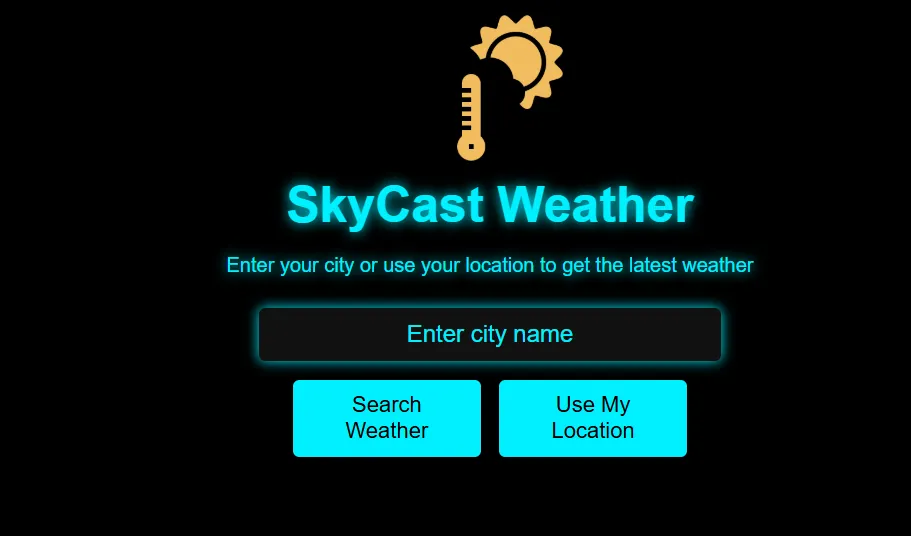
Web app
A weather forecasting site with live conditions for any location.
Fees
A single monthly price in US dollars, the same in every country outside India and the same at every age. Nothing to pay to enrol, and no term or year to sign up for.
Free first class
USD 0
no card required
Group batch
USD 100
a month, billed in US dollars
One to one
USD 150
a month, billed in US dollars
What families say
From our Google reviews, unedited and unpaid, written by the families who sat through the lessons.
★★★★★
"The one step solution for my son. Modern Age Coders make learning coding so simple that kids love it. The teachers explain complex concepts clearly with practical exercises and interactive content."
Ria Mukherjee
Parent
★★★★★
"Modern Age Coders has been a game-changer for me. I struggled to grasp IT concepts and coding before joining, but their classes transformed everything. I can now confidently write complex programs with ease."
Samriddha Mondal
Student
★★★★★
"One of the most wonderful education centres out there. Education is not limited to school syllabus but focuses on skill development."
Vansh Agarwal
Student
★★★★★
"My child Dhairya is really enjoying the Modern Age Coders classes. This is his first online class and he eagerly looks forward to it. I can already see his improvement, and the teachers are very cooperative."
Sonam Oswal
Parent of Dhairya
★★★★★
"Modern Age Coders have wonderful teachers who teach in a clear, easy and practical way. The teacher boosts students' confidence and inspires them to learn without hesitation."
Sonu Goyal
Parent
★★★★★
"I highly recommend this computer coding class! The teachers are incredibly knowledgeable and passionate about coding."
Ritu Kedia
Parent
Questions
The method can. Restating, decomposing, solving a smaller case, generalising and evaluating are moves that improve with practice, and the Irish maths curriculum names several of them as learning outcomes.
We make no promises about grades or exam results. What we teach is a method for approaching problems, which many families find helps across subjects.
Irish fifteen-year-olds averaged 491.6 in PISA 2022 against an OECD average of 472.4, though the national report notes an upward bias, since 22.1% of the sample did not participate or were absent.
Of the four PISA processes, formulating scored lowest at 486.8. That is the step of turning a real situation into something you can calculate with, and it is the step coding practises constantly.
There is no Irish score. Ireland took only the questionnaire part of the PISA 2022 creative thinking assessment, not the test, so any published Irish rank for it is mistaken.
From six, where problem solving means breaking a task into steps with blocks. Typed code and harder problems usually follow around ten.
No. Competition problems are one source of practice, but the aim here is a method a learner uses on their own projects, school work and later at work.
The first class is free. After that a group place is USD 100 a month and one-to-one lessons are USD 150 a month, billed in US dollars, with no enrolment fee.
After school, evenings or weekends at a weekly hour agreed in the free class. Our teachers are four and a half hours ahead of Irish time in summer and five and a half in winter.
We phone at a reasonable Irish hour and book the free class. There is no charge unless the learner carries on.
Elsewhere on this site
Pages that share this argument.
Thinking in the Irish curriculum.
Keeping the learning when tools help.
The secondary years.
Where these skills lead.
The research on teaching.
The national page.
Start here
Leave a number and we will call at a time that works in Ireland. In the free class the learner takes on a real problem with a teacher who hints rather than tells, and you get an honest view of where they are.
Prefer to read first? Try how we teach, the list of courses or the projects our students finished.
WhatsApp us · +91 91233 66161 · contact@modernagecoders.com
A WhatsApp message is free from an Irish number and usually gets the quickest answer. The number is Indian because our team is based in India; we hold no premises in Ireland.