UCS / MTH / 01
Waterloo math contests
Contest-style reasoning with problems our teachers wrote.
Open the syllabusUniversity of Toronto · St. George, Mississauga, Scarborough · Read 22 October 2026
The University of Toronto runs computer science on three campuses, and an Ontario student applies to each one separately, with its own OUAC code. The prerequisites overlap but are not identical, the supplementary application is described differently on different U of T pages, and only two campuses publish an average. This page lays out what each source said when we read it on 22 October 2026, side by side and unreconciled where the sources disagree. Admission rules change between cycles, so check every line on U of T’s own pages in the autumn your teen applies. We teach the math and programming; we do not forecast decisions.
Since 2020 · 10,000+ students · Calculus and Vectors and computer science, taught live
In short
U of T offers computer science at St. George (OUAC code TAD), Mississauga (TMX) and Scarborough (TXC). On 22 October 2026 all three listed ENG4U or EAE4U and MCV4U for Ontario students, Mississauga and Scarborough added MHF4U, and St. George listed a supplemental application as required. Modern Age Coders teaches that math, and the programming beside it, in Ontario Grade 12 University Math, a live online course run as a group class or one to one.
Prepare for the work itself
Every campus lists Calculus and Vectors, two list Advanced Functions, and first-year computer science assumes a student can already think in code. These courses cover that ground.
UCS / 01
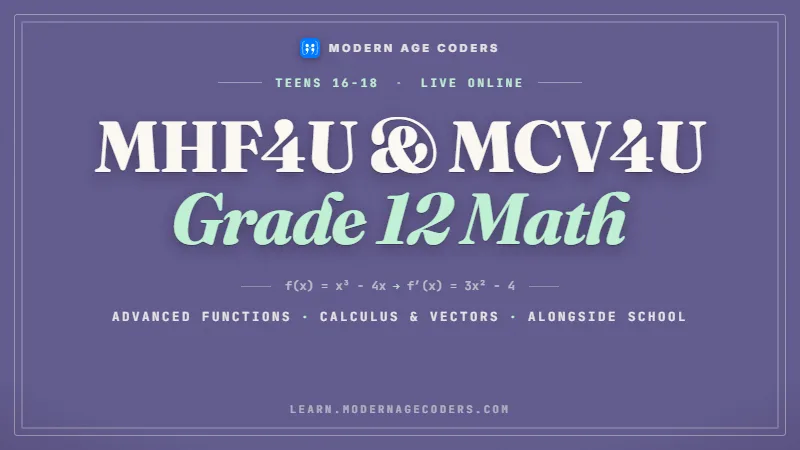
MHF4U and MCV4U in step with the school course, with every result explained and checked a second way.
Open the syllabus →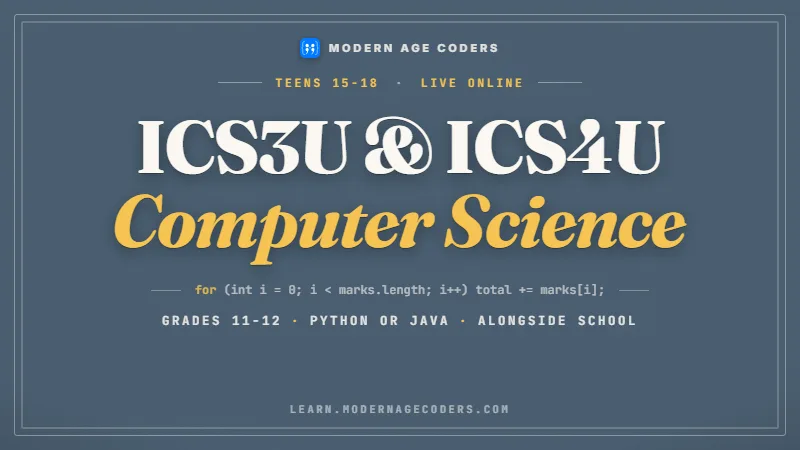
UCS / 02
A second teacher for ICS3U or ICS4U: tracing, testing and program design in the school’s language.
Open the syllabus →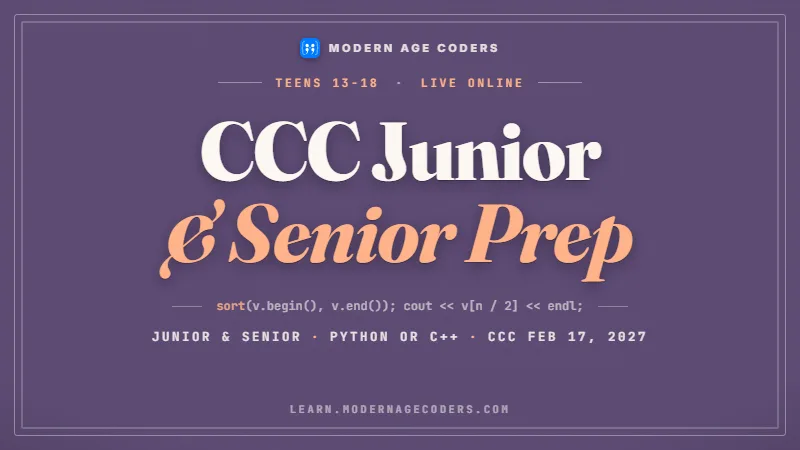
UCS / 03
Original algorithm problems under time pressure, for students who want harder thinking than the course sets.
Open the syllabus →TAD, TMX, TXC
U of T’s central Future Students page lists all three campuses on one page, in the Ontario requirements view. This table copies it, then adds what each campus says on its own site.
| St. George | Mississauga | Scarborough | |
|---|---|---|---|
| OUAC code | TAD | TMX | TXC |
| Faculty or division | Faculty of Arts & Science | U of T Mississauga | U of T Scarborough |
| English | ENG4U / EAE4U | ENG4U / EAE4U | ENG4U / EAE4U |
| Calculus and Vectors | MCV4U | MCV4U | MCV4U |
| Advanced Functions | Not listed on the central page | MHF4U | MHF4U |
| Recommended | None listed | Math of Data Management, MDM4U | None listed |
| Supplemental application | Required (central page) | Required (UTM’s own page) | See the supplementary section below |
| Degrees and options | BCS: Major, Specialist; HBSc: Minor | BCS: Major, Specialist; HBSc: Minor | BCS: Major, Specialist; HBSc: Minor |
| Work-integrated learning | Option available | Option available | Option available |
For all three campuses the central page states the base requirement the same way: an “Ontario Secondary School Diploma (OSSD) with six subjects at the 4U/M level, including English”. It adds a line that catches some families out: “The co-op component of Grade 12 courses will not be used for admission purposes”.
The course codes are Ontario’s, and U of T labels them itself: English is ENG4U, with EAE4U accepted as the alternative for that line; Calculus & Vectors is MCV4U; Advanced Functions is MHF4U; Math of Data Management is MDM4U.
On the central page, St. George lists English and Calculus and Vectors only, while Mississauga and Scarborough each list Advanced Functions as well. We report that as printed and draw no conclusion about admission from it. The Ontario mathematics curriculum (revised 2007) settles the practical side: it says Advanced Functions must be taken before or at the same time as Calculus and Vectors, so a St. George applicant with MCV4U has MHF4U anyway.
What it does show is that a student cannot read one campus’s list and assume it covers the others. Each OUAC code is a separate application with its own published list.
Sources: U of T Future Students, Computer Science (Ontario requirements, all three campuses), U of T Mississauga, Computer Science and U of T Scarborough, Computer Science, read 22 October 2026. The central page states no admission year, so we give the date we read it. We have no affiliation with the University of Toronto.
Direct entry
Both campus sites carry a warning that matters for anyone thinking of starting elsewhere and transferring in.
| Campus | Wording on the campus page |
|---|---|
| Mississauga (TMX) | “Entry to the Computer Science admission category is gained directly from high school.” Transfer students who have completed any post-secondary studies, including at other U of T divisions, “are not eligible for admission to the Computer Science admission category.” The Specialist and Major are “open only to those applying directly from high school.” |
| Scarborough (TXC) | “Please note: Computer Science is direct from high school only. If you have any post-secondary education, you are not eligible for admission.” |
| St. George (TAD) | The Arts & Science admission page that would describe this did not load for us (a bot check), so we report nothing for St. George here |
On the two campus pages we read, a student cannot take a year of another program and then apply into computer science as a transfer. The Grade 12 application is the entry point, so the Grade 12 courses and the supplementary application are where the effort belongs.
Families sometimes assume a gap year of college or university courses can only help. On these two pages, any post-secondary study makes a student ineligible for the computer science admission category.
Scarborough’s page says that in the Specialist, “More than half of the credits needed for your degree will be in Computer Science.” It lists five streams: Comprehensive, Artificial Intelligence and Machine Learning, Entrepreneurship, Information Systems and Software Engineering.
Mississauga’s page describes computer science research areas including human-computer interaction, software engineering, numerical analysis, machine learning and cryptography. Both are real computer science degrees with heavy mathematics, which is why the math prerequisites exist.
Supplementary applications
This is where U of T’s own pages are least consistent, so we quote each one and add nothing. The Join U of T applicant portal is the final word for each applicant.
| Page | What it says |
|---|---|
| future.utoronto.ca, Computer Science, St. George column | Supplemental Application: Required |
| future.utoronto.ca, Computer Science, Mississauga and Scarborough columns | No supplemental application row shown |
| future.utoronto.ca, Dates and Deadlines, 2027 admissions | Under Arts & Science, U of T St. George: “Computer Science Supplementary Application due February 1”. Under U of T Scarborough: “Supplementary Application Form due February 1 (required for some program areas)” |
| future.utoronto.ca, Supplemental Applications | Lists a “Computer Science Supplemental Application” under the Faculty of Arts & Science |
| utm.utoronto.ca, Computer Science | “A supplementary application is required.” |
St. George is described as requiring one on every central page we read. Mississauga’s own page says one is required even though the central program page shows no such row. For Scarborough, the deadlines page says its form is required for some program areas without naming them on that page.
We are not in a position to resolve that, and guessing would not help a family. The applicant portal lists each student’s required items after they apply, and that list is the one to follow.
U of T’s supplemental applications page says “Most programs only require your academic results for admission.” Where a program does ask for more, the page says applicants may need to “answer short-answer or essay questions, provide a personal profile or even submit a video response.”
Whatever the format, the answers must be the student’s own. We teach coding and math, and we do not produce or revise application material of any kind.
Sources: U of T Future Students, Computer Science, U of T Dates and Deadlines, U of T Supplemental Applications and U of T Mississauga, Computer Science, read 22 October 2026.
Published grade ranges
The central program page lists no average for any campus. Two campus sites publish a range in their own words. We copy those words exactly and do not compare one campus with another.
| Campus | Label on the page | What it says |
|---|---|---|
| Mississauga (TMX) | Competitive Average | Mid to High 80s |
| Scarborough (TXC) | Approximate grade requirements | Minimum 70% English; High 90s overall (co-op); Low 90s overall |
| St. George (TAD) | Not published on the pages we could read | Not stated |
A published range describes past applicants in general terms. It is not a threshold, and a campus that also requires a supplementary application reads more than grades. Turning these numbers into advice about any one student’s chances would be guesswork presented as fact, so we do not do it, and no one on our team will.
Scarborough distinguishes the co-op version of the program from the regular one, and lists a separate minimum for English. Families should read that whole block on the campus page rather than our summary of it.
They say the required Grade 12 courses carry weight, which is not news but is worth acting on early. Advanced Functions and Calculus and Vectors are demanding courses, and marks in them come from understanding, not from last-minute drilling.
That is the part we can help with. Our Grade 12 math teaching aims at a student who can explain why a derivative rule works, check a vector answer geometrically, and recover when a question is phrased in an unfamiliar way.
A worked example, ours
Requirements written as “ENG4U / EAE4U” are really sets of alternatives: any one course from the set satisfies that line. That makes a campus list easy to check in code, and writing the checker is a good exercise in sets. The plans below are invented. The program only compares course codes with the lists as published; it says nothing about admission.
alts & plan is the intersection; an empty intersection means nothing in the plan satisfies that line.# Which listed U of T CS prerequisites does a course plan cover? (ours)
# Each requirement is a set of alternatives: any one course in the set satisfies it.
# Lists copied from future.utoronto.ca, Ontario requirements, read 22 October 2026.
CAMPUSES = {
"St. George (TAD)": [{"ENG4U", "EAE4U"}, {"MCV4U"}],
"Mississauga (TMX)": [{"ENG4U", "EAE4U"}, {"MHF4U"}, {"MCV4U"}],
"Scarborough (TXC)": [{"ENG4U", "EAE4U"}, {"MCV4U"}, {"MHF4U"}],
}
def uncovered(plan, requirements):
"""Return the requirements that no course in the plan satisfies."""
return [" / ".join(sorted(alts)) for alts in requirements if not (alts & plan)]
plans = {
"Plan A": {"EAE4U", "MHF4U", "MCV4U", "ICS4U", "SPH4U", "MDM4U"},
"Plan B": {"ENG4C", "MHF4U", "MCV4U", "ICS4U", "SPH4U", "SCH4U"},
"Test C": {"ENG4U", "MCV4U", "ICS4U", "SPH4U", "SCH4U", "MDM4U"},
}
for name, plan in plans.items():
print(name)
for campus, reqs in CAMPUSES.items():
gaps = uncovered(plan, reqs)
print(" " + campus + ":", "all listed courses in plan" if not gaps else "not in plan: " + ", ".join(gaps))Output for Plan A: all listed courses in plan, on all three campuses. Plan B: not in plan: EAE4U / ENG4U, on all three, because ENG4C is a college-preparation (C) English, not a U course. Test C: all listed courses in plan at St. George; not in plan: MHF4U at Mississauga and Scarborough.
| Plan | What is different | What the checker reports |
|---|---|---|
| Plan A | EAE4U instead of ENG4U, plus MHF4U and MCV4U | Every listed line covered on all three campuses: EAE4U satisfies the English set |
| Plan B | ENG4C, a college-preparation (C) English, instead of a U English | The English line uncovered everywhere: a C course is not in the set |
| Test C | A plan built to fail, with no MHF4U | Covered at St. George on the central page’s list; MHF4U missing at the other two |
The intersection test is one line, but the modelling decision behind it is the real lesson: a slash in a requirement means or, and a list of requirements means and. Students who see that structure can read any university’s requirements, and any software specification, more carefully.
Test C is the kind of input good programmers write first. It is deliberately unrealistic, a plan without Advanced Functions, and its only job is to prove the checker notices a difference between campuses that a quick reading might miss.
The checker knows the course lists we copied on one day. It does not know the six-course rule, marks, the supplementary application or any later change U of T makes. A green line from it means only that the codes match.
Treat it as a reading aid. The authoritative check is U of T’s own page and, after applying, the applicant portal.
2027 admissions
U of T’s deadline table is headed 2027 admissions and gives each date as a day and month. We copy them in that form.
| Step | Arts & Science, St. George | U of T Mississauga | U of T Scarborough |
|---|---|---|---|
| Recommended early application date | November 7 | November 7 | November 7 |
| Application deadline | January 15 | January 15 | January 15 |
| Supporting documents deadline | February 1 | February 1 | February 1 |
| Supplemental application | Computer Science Supplementary Application due February 1 | Not listed in this table | Supplementary Application Form due February 1 (required for some program areas) |
U of T says applicants who apply by November 7 and complete the next steps in the Join U of T portal by December 1 can be considered in the first admission round as well as later ones. It also says decisions “will be released beginning in January and continue through to late May.”
For an Ontario Grade 12 student in the 2026 to 2027 school year, that makes November the month to finish the application itself, so that December and January can go to schoolwork and any supplementary application.
Each campus has its own OUAC code, so a student interested in computer science at two or three campuses lists each one. The prerequisites table above shows why that is worth doing carefully: a plan that matches one campus’s list may leave a line uncovered at another.
The application goes through the Ontario Universities’ Application Centre. U of T says that about a week after applying, students receive an email explaining how to log into their applicant portal.
Source: U of T Dates and Deadlines, 2027 admissions tables and FAQ, read 22 October 2026.
Choosing, ours
These questions are ours. None of them is about which campus is easier, because nothing we read supports an answer to that, and it is the wrong question anyway.
For the Ontario Grade 11 course that many future computer science students take first, see our ICS3U help page. For the contest some students try alongside Grade 12, see CCC preparation.
Grade 12 math, honestly assessed
Our own stages, from teaching MCV4U to students who went on to university computer science. They describe understanding, which is what first-year math tests.
| Stage | A sign you are here |
|---|---|
| 1. Pattern matcher | Differentiates correctly when the question looks like the last one |
| 2. Explainer | Says why the chain rule works, using a picture or a small example |
| 3. Checker | Verifies an answer independently, by graph, estimate or substitution |
| 4. Transferer | Uses rates of change and vectors on a problem from physics or code |
Ask your teen how they know an answer is right. A stage 3 student has a method; a stage 1 student says it matched the back of the book.
Moving from stage 1 to stage 2 takes patient questioning, and it is the step a busy classroom has least time for.
After every calculus question, spend thirty seconds on a sanity check. It is the cheapest habit in mathematics.
Write a short program that estimates a derivative numerically and compare it with your exact answer. You will understand both better.
The catalogue
Every course is taught live by a regular teacher, as a batch class or privately, around the school term.
UCS / MTH / 01
Contest-style reasoning with problems our teachers wrote.
Open the syllabusUCS / MTH / 02
Rebuilding algebra and functions before Grade 12.
Open the syllabusUCS / MTH / 03
For students whose school offers AP alongside MCV4U.
Open the syllabusUCS / PRG / 01
Types, classes and objects, for ICS4U and beyond.
Open the syllabusUCS / PRG / 02
Memory, speed and the language of many contests.
Open the syllabusUCS / PRG / 03
Data structures chosen for a reason.
Open the syllabusUCS / SPC / 01
The ideas behind Scarborough’s AI stream, built by hand.
Open the syllabusUCS / SPC / 02
Statistics and Python on real data sets.
Open the syllabusUCS / SPC / 03
How software teams track every change.
Open the syllabusHow classes run
Weekdays or weekends, flexible: choose your batch, or for a very personalised plan choose 1-on-1 at your convenience, weekend mornings or weekdays.
Weekdays
Evenings in Eastern time, fixed when the batch is chosen.
Weekends
Morning classes that leave the afternoon for homework.
1-on-1
Timed around unit tests and the January exam weeks.
Continuity from the first unit to the exam.
The units your teen’s teacher sets, in that sequence.
No rule used without knowing why it holds.
Short programs that test each new idea.
We never touch application writing.
Batch class of 15 to 20 students, or private.
Student work
Work by students we have taught, each one built and explained by its maker. See more on the student labs page.

AI and ML
An AI nutrition coach that reads what you eat and works you toward a target.

AI and ML
A chatbot that answers mathematics and programming questions, built and deployed by a student.

AI and ML
An assistant that helps a young person recognise unsafe situations online.

Web app
A weather forecasting site with live conditions for any location.
Fees
The trial class is free. Families who continue pay one monthly fee for eight live classes, displayed with its currency code, and may leave at the end of any month; there is no term to sign up for.
Free first class
Free
no card required
Group batch
$100 USD
a month, eight live classes
One to one
$150 USD
a month, eight live classes
What families say
Google reviews from parents and students, as they wrote them.
★★★★★
"The one step solution for my son. Modern Age Coders make learning coding so simple that kids love it. The teachers explain complex concepts clearly with practical exercises and interactive content."
Ria Mukherjee
Parent
★★★★★
"Modern Age Coders has been a game-changer for me. I struggled to grasp IT concepts and coding before joining, but their classes transformed everything. I can now confidently write complex programs with ease."
Samriddha Mondal
Student
★★★★★
"One of the most wonderful education centres out there. Education is not limited to school syllabus but focuses on skill development."
Vansh Agarwal
Student
★★★★★
"My child Dhairya is really enjoying the Modern Age Coders classes. This is his first online class and he eagerly looks forward to it. I can already see his improvement, and the teachers are very cooperative."
Sonam Oswal
Parent of Dhairya
★★★★★
"Modern Age Coders have wonderful teachers who teach in a clear, easy and practical way. The teacher boosts students' confidence and inspires them to learn without hesitation."
Sonu Goyal
Parent
★★★★★
"I highly recommend this computer coding class! The teachers are incredibly knowledgeable and passionate about coding."
Ritu Kedia
Parent
Common questions
On 22 October 2026, U of T's Future Students page listed ENG4U or EAE4U and MCV4U for St. George (TAD); ENG4U or EAE4U, MHF4U and MCV4U for Mississauga (TMX), with MDM4U recommended; and ENG4U or EAE4U, MCV4U and MHF4U for Scarborough (TXC). All three also need an OSSD with six 4U or M courses including English.
They are the OUAC codes students use to apply. TAD is computer science in the Faculty of Arts and Science at St. George, TMX is U of T Mississauga and TXC is U of T Scarborough. Each is a separate application.
U of T's central page listed one as required for St. George, and its deadlines page gave the Computer Science Supplementary Application a February 1 date for 2027 admissions. Mississauga's own page also said one is required. Scarborough's form was described as required for some program areas. Follow the applicant portal checklist.
The central program page lists none. Mississauga's campus page gave a competitive average of mid to high 80s, and Scarborough's gave approximate requirements of low 90s overall, high 90s for co-op and at least 70 per cent in English. We quote these and make no prediction about any applicant.
Not according to the campus pages we read. Mississauga says entry to its computer science admission category is directly from high school and transfer students with post-secondary study are not eligible. Scarborough says computer science is direct from high school only.
None of the three campus lists on U of T's central page names a computer science course. The listed requirements are English and math courses. A computer science course is still useful preparation for the work.
For 2027 admissions, U of T's deadlines table listed January 15 as the application deadline for Arts and Science at St. George, Mississauga and Scarborough, with November 7 as the recommended early date and February 1 for supporting documents.
U of T's central page says the co-op component of Grade 12 courses will not be used for admission purposes. The base requirement is six subjects at the 4U or M level, including English.
No. We do not produce or revise application material of any kind. We teach Grade 12 math and programming so that a student's own skills and projects are real.
Weekdays or weekends, flexible: choose your batch, or for a very personalised plan choose 1-on-1 at your convenience, weekend mornings or weekdays. Classes run on Eastern time, and the hour is reconfirmed after the 1 November 2026 change and again after 14 March 2027.
Elsewhere on this site
Pages for Ontario families planning ahead.
Live classes for students across the city.
Every age, every level, the whole province.
Where all our Canada pages start.
Grade 11 computer science in Python or Java.
Advanced Functions and Calculus and Vectors.
The national programming contest.
Contest math for Grades 7 to 12.
Reading a program before running it.
Inside a live class.
Start here
Send us the Grade 12 courses your teen is taking, the unit they are on and any code they have written. The first lesson works on that material directly.
Prefer to read first? The MHF4U and MCV4U course page lists the units, and how we teach describes a class from start to finish.
WhatsApp us · +91 91233 66161 · connect@modernagecoders.com
Our teachers work from India and teach live over video, so families in the Toronto area or anywhere in Ontario simply log on. WhatsApp reaches us fastest.
A priority demo is a full class of about 45 to 60 minutes. After the class the mentor sends a written skill report and a personal learning roadmap on WhatsApp. If you enrol, the demo fee is adjusted against your first month's fee. Share your demo Order ID with us on WhatsApp and we take it off.
Book a priority demo