Table of Contents
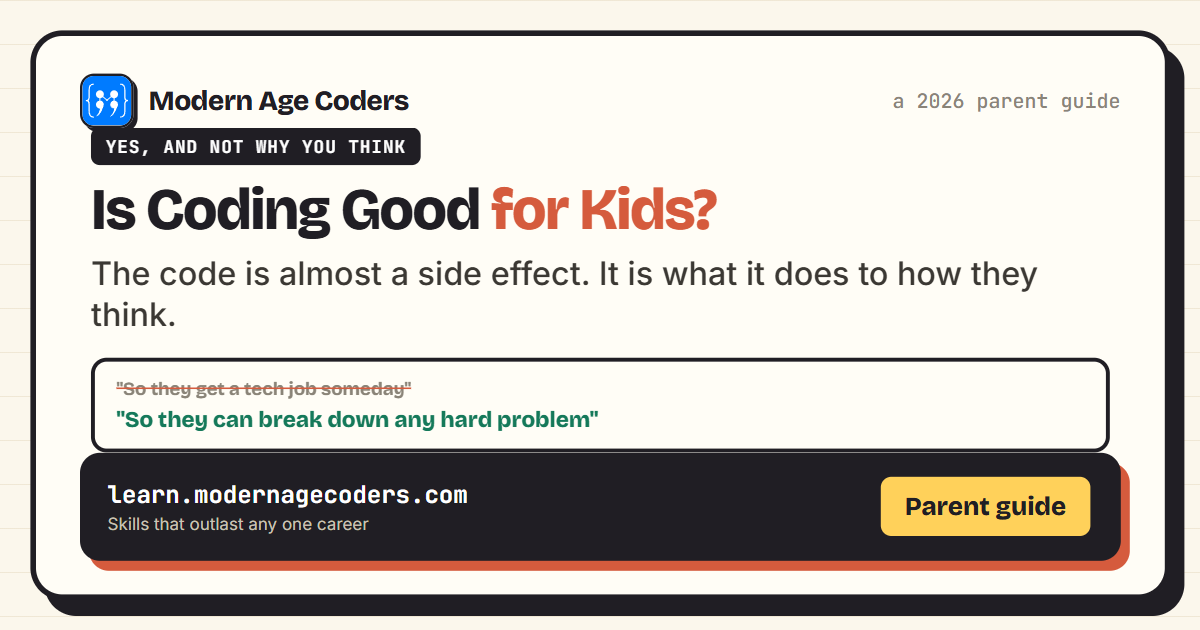
Most parents ask whether coding is good for their child hoping to hear that it leads to a high-paying tech job one day. It might. But that is the weakest reason to start, and it is not why the parents who see the biggest change keep their children in class.
Coding is good for kids because of what it does to how they think. The code is almost a side effect. Here is what that actually means, and how to tell the real benefits from the marketing.
The short answer
Yes. For most children, learning to code builds a set of thinking habits that help far beyond the screen: breaking a big problem into small steps, reasoning logically, staying patient when something does not work, and building things of their own instead of only using what others made. Those habits show up in maths, in schoolwork, and in how a child approaches anything hard.
The point of coding for a child is not to produce a junior software engineer. It is to grow a young person who can look at a problem, break it down, and calmly work it out. Coding just happens to be one of the best training grounds for that.
What coding actually teaches a child, beyond code
- Breaking problems into steps. A computer only does exactly what it is told, in order. To make anything work, a child has to break a fuzzy goal into precise steps. That is one of the most transferable skills there is.
- Logical thinking. If this, then that. Coding makes cause and effect concrete, which strengthens the same reasoning children use in maths and science.
- Resilience with mistakes. Code almost never works the first time. A child learns that a bug is not failure, it is information, and that fixing it is the normal path to success. That mindset is priceless.
- Creativity that builds. Instead of only watching videos or playing games others made, a child makes their own game, story or app. They move from consuming screens to creating with them.
- Focus and patience. Getting a program to work rewards sustained attention, which many children find easier to practise when the payoff is something they built themselves.
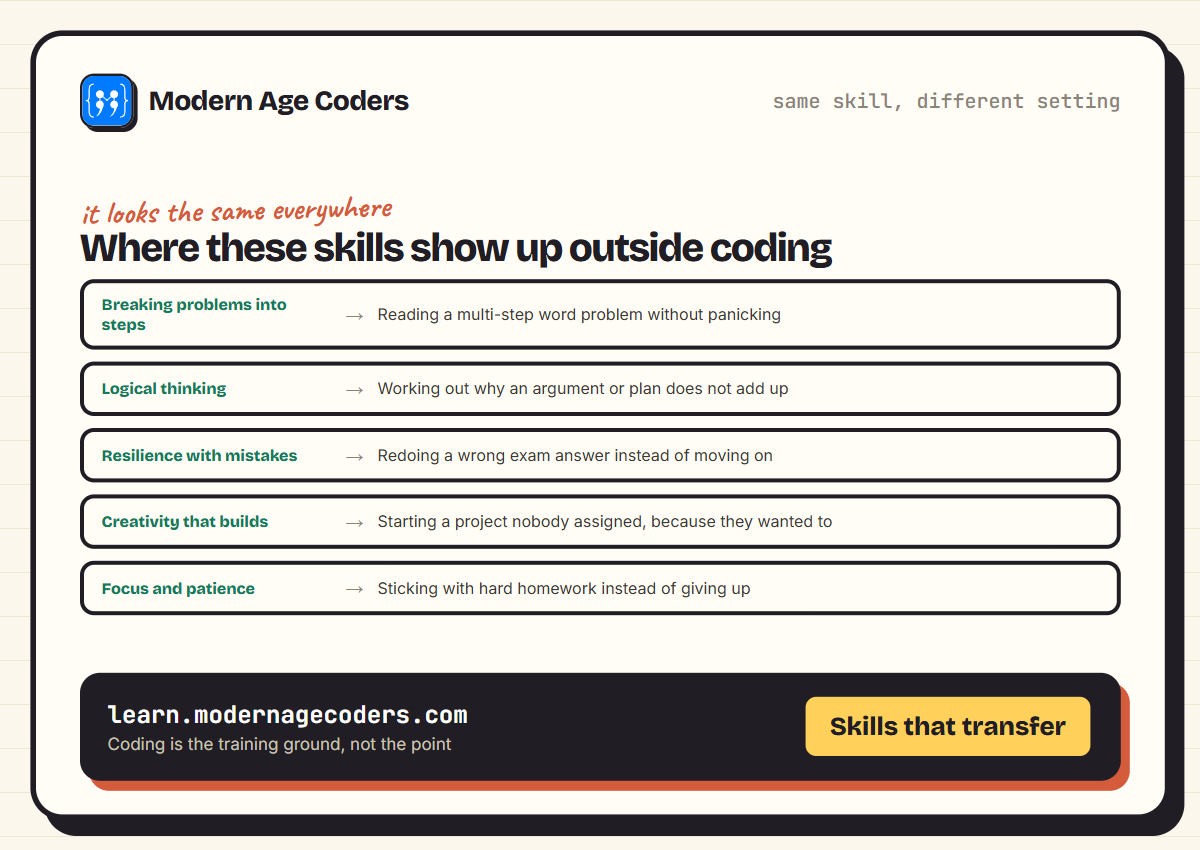
| Skill | Shows up in coding as | Shows up outside coding as |
|---|---|---|
| Breaking problems into steps | Turning a game idea into a sequence of exact instructions | Reading a multi-step word problem in maths without panicking |
| Logical thinking | If this happens, then do that | Working out why an argument or plan does not add up |
| Resilience with mistakes | A program that crashes on line one, then works after a fix | Redoing a wrong exam answer instead of just moving on |
| Creativity that builds | Making an original game instead of only playing one | Starting a project nobody assigned, because they wanted to |
| Focus and patience | Debugging the same stubborn error for twenty minutes | Sticking with a hard piece of homework instead of giving up |
Does coding help with school and maths?
Yes, and maths is the clearest link. Coding uses the same core skills maths does: patterns, logic, breaking problems into steps, and precision. When a child writes a program that uses coordinates, scoring or repetition, abstract maths turns into something they can see run on the screen, which makes it click. Many children who found maths dull discover it is far more interesting when they are using it to build something. The two subjects reinforce each other, which is why we teach coding and maths together as one skill.
At what age can a child start?
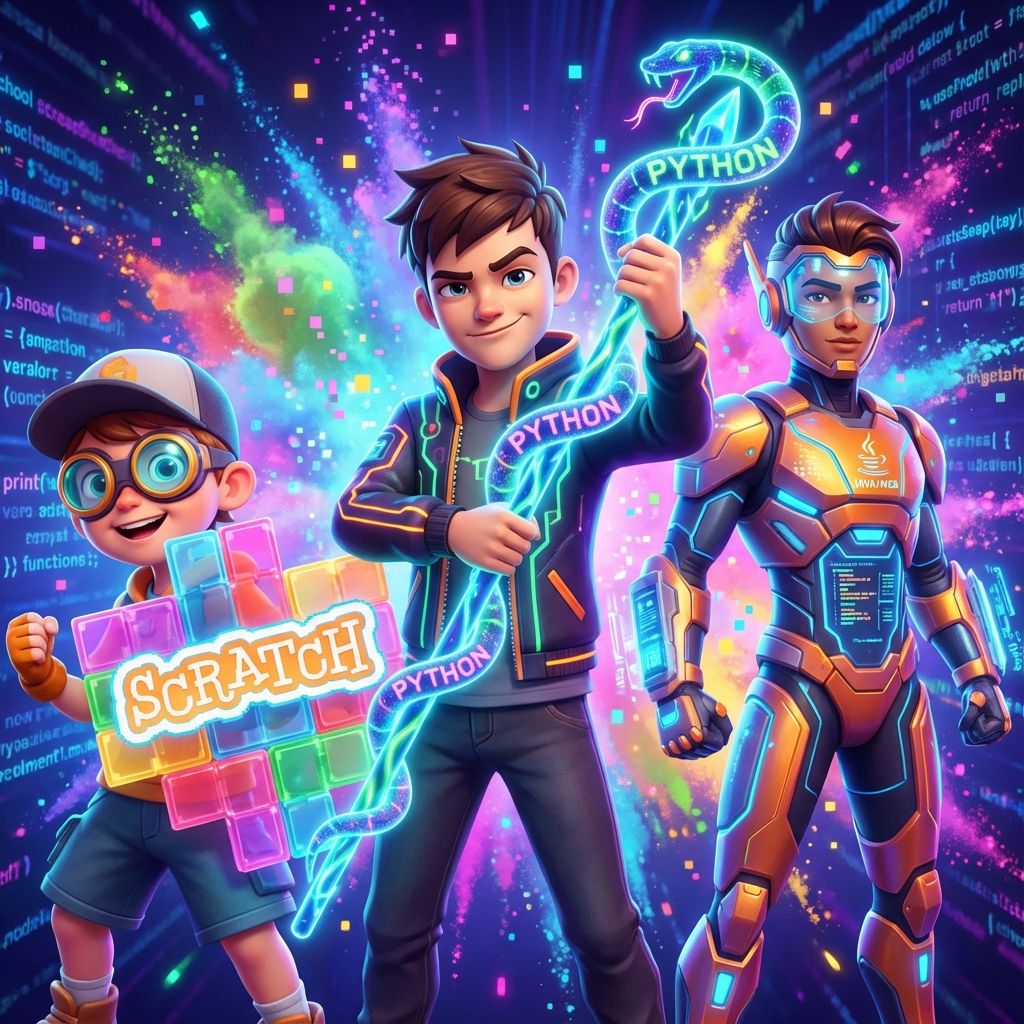
Children can begin as young as 6 with visual, block-based tools like Scratch, where they build programs by snapping colourful blocks together and never have to worry about typing or syntax. This teaches the logic of coding through play. Around the ages of 11 to 13, most children are ready to move to a real text language such as Python. The right starting point depends on the child, not just the birthday, which is why a good teacher matches the level to the learner rather than the age on a form.
Because blocks need almost no typing, keyboard skills can wait. Many children are ready to learn touch typing around 7 or 8, which fits well with the later move to typed code.
Is it just more screen time?
This is a fair worry, and the honest answer is that not all screen time is equal. There is a real difference between a child passively scrolling videos and a child actively building a game they designed. Coding is creative, focused screen time, closer to writing or drawing than to watching. It turns the screen from something that entertains a child into a tool the child controls. Live classes with a mentor also keep the time purposeful, because there is a person guiding the work rather than an app left to run on its own.
Coding versus just using apps
Plenty of apps promise to teach a child to code by themselves. Some are a fine first spark. But an app cannot notice when a child is confused, cannot answer why, and cannot push a child past the point where they would otherwise quit. Real understanding tends to come from a person who watches the child work, asks the right question at the right moment, and helps them fix their own mistakes. That is the difference between a child who copies steps and a child who genuinely understands.
Children do not need another app that teaches them to copy code. They need a mentor who teaches them to think.
, Shivam Khemka, Founder of Modern Age Coders
The bottom line
Coding is good for kids because it teaches them to think, build and persevere, and those benefits last whatever they grow up to do. The best results come from real teaching, not an app left alone. At Modern Age Coders we teach coding and maths together, live and in small batches, for ages 6 to 67, and we are rated 4.9 across 547 Google reviews. There is a free demo class before you pay, so you can see how your child responds before deciding anything.
Yes. For most children the biggest benefits are the thinking habits it builds: breaking problems into steps, logical reasoning, patience with mistakes, and creating rather than only consuming. Those skills help across school, maths and any future career, whether or not the child becomes a programmer.
Children can start as young as 6 with visual, block-based tools like Scratch that teach the logic of coding through play, without typing or syntax. Most are ready to move to a text language such as Python around ages 11 to 13. The best starting point depends on the individual child, so a good teacher matches the level to the learner.
Yes, especially with maths and problem solving. Coding uses the same core skills as maths, patterns, logic, precision and breaking problems into steps, and it makes abstract concepts concrete by turning them into things a child can see run. Many children engage with maths more once they use it to build something.
Not all screen time is equal. Coding is active, creative and focused, closer to writing or drawing than to passively watching videos. It turns the screen into a tool the child controls. Live classes with a mentor keep the time purposeful, because a person is guiding the work rather than leaving an app to run alone.
An app can be a good first spark, but it cannot notice when a child is confused, answer why, or push them past the point where they would give up. Real understanding usually comes from a mentor who watches the child work and helps them fix their own mistakes, which is the difference between copying steps and truly understanding.
It often does. Coding and maths share the same foundations, and writing programs that use coordinates, scoring or repetition turns abstract maths into something visible and hands-on. Teaching coding and maths together, as one connected skill, tends to strengthen both.