Table of Contents
"Should I start with Python or Java?" is one of the most common questions from new programmers and from parents choosing a class. Both are excellent, widely used, and good for a career. They are also different enough that the choice changes what the first few months feel like: how quickly a beginner builds something that works, how mistakes show up, and which exams and jobs the skills lead to.
Rather than list opinions, we wrote the same programs in both languages and ran them: a word counter to compare how much code each needs, a deliberate type mistake to show how each language reports it, and a timed loop to compare speed. Every output below is real, from Python and from a Java 22 compiler. Then comes a plain recommendation by age, exam and goal.
The short comparison
| Python | Java | |
|---|---|---|
| Hello world | 1 line | 5 lines, inside a class |
| Types | Dynamic: decided while running | Static: declared and checked before running |
| Errors | Found when the line runs | Many found by the compiler first |
| Speed | Slower for heavy loops | Much faster for heavy loops |
| Best known for | Data, AI, automation, scripting, teaching | Android, large business systems, back ends |
| School exams | CBSE Class 11 and 12 Computer Science | ICSE Computer Applications, AP Computer Science A |
The same program in both languages
Here is a program that counts how many times each word appears in a sentence, first in Python:
text = "the cat sat on the mat the end"
counts = {}
for word in text.split():
    counts[word] = counts.get(word, 0) + 1
for word, n in sorted(counts.items()):
print(word, n)cat 1
end 1
mat 1
on 1
sat 1
the 3And the same program in Java:
import java.util.Map;
import java.util.TreeMap;

public class WordCount {
    public static void main(String[] args) {
        String text = "the cat sat on the mat the end";
        Map<String, Integer> counts = new TreeMap<>();
        for (String word : text.split(" ")) {
            counts.put(word, counts.getOrDefault(word, 0) + 1);
        }
        for (Map.Entry<String, Integer> e : counts.entrySet()) {
            System.out.println(e.getKey() + " " + e.getValue());
        }
    }
}cat 1
end 1
mat 1
on 1
sat 1
the 3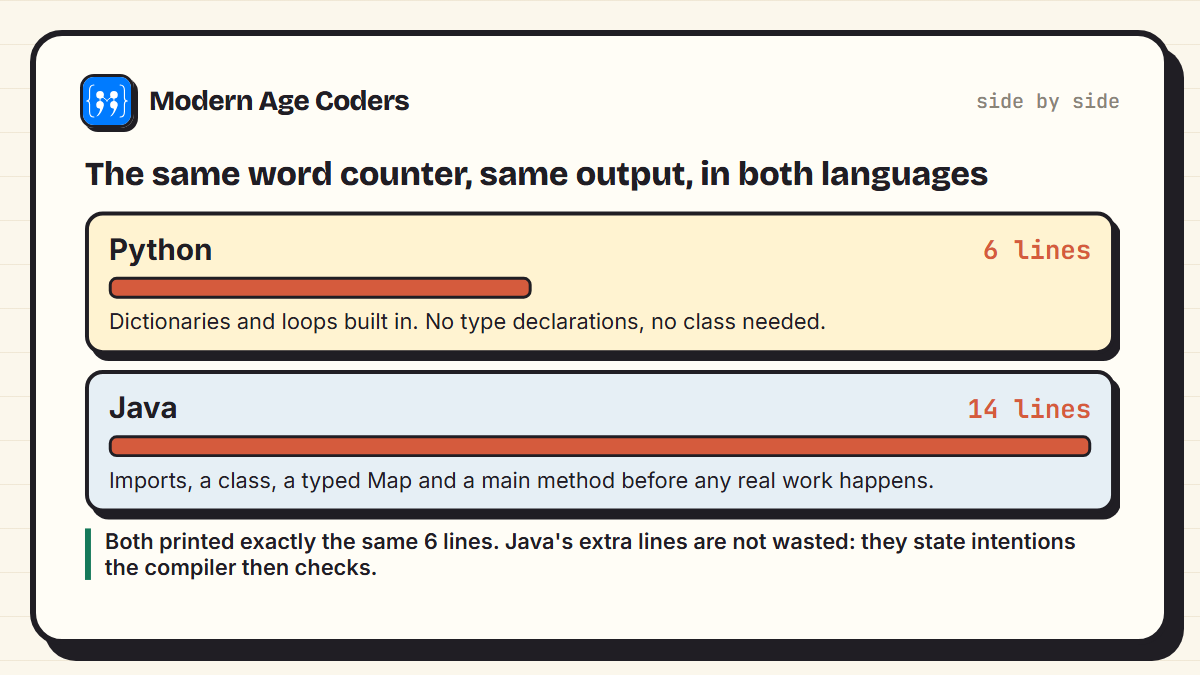
Both print exactly the same result. The Python version is 6 lines and the Java version is 14. The difference is not padding. Java asks you to declare things up front: that this code lives in a class, that the map holds strings and whole numbers, and where the program starts. Python lets you skip all of that and just describe the work.
For a complete beginner, that difference matters a lot. In Python, a first-week student can write something useful. In Java, a first-week student has to accept several lines of ceremony they do not yet understand before anything happens. Neither is wrong, but Python has a gentler first month.
How each language catches mistakes
The biggest real difference is typing. In Java every variable has a declared type, and the compiler checks every line before the program is allowed to run. In Python, types are only checked when a line actually runs. Here is the same mistake, putting text into a number, in each language.
public class Marks {
    public static void main(String[] args) {
        int marks = "ninety";
        System.out.println(marks + 5);
    }
}Marks.java:3: error: incompatible types: String cannot be converted to int
int marks = "ninety";
^
1 errormarks = "ninety"
print("the program has started")
print(marks + 5)the program has started
Traceback (most recent call last):
File "marks.py", line 3, in <module>
print(marks + 5)
~~~~~~^~~
TypeError: can only concatenate str (not "int") to str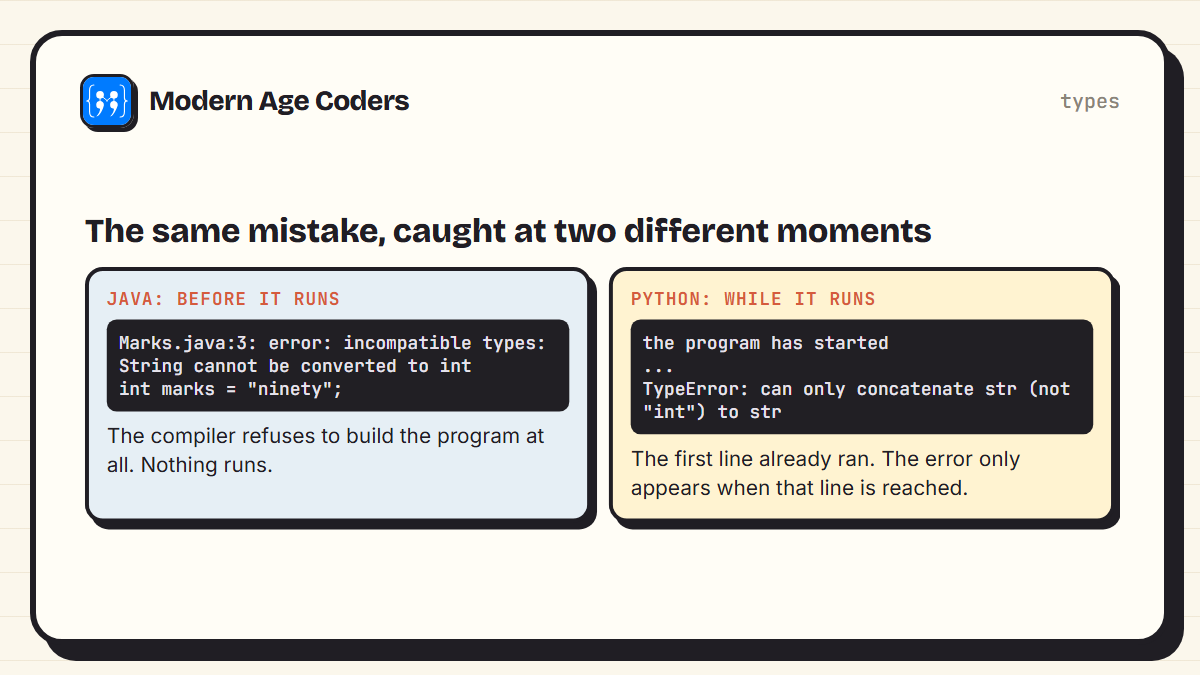
Java refused to build the program at all, pointing at the exact line. Python started happily, printed its first line, and only failed when it reached the bad one. In a big program that line might run once a month, which is why large companies building huge systems often prefer languages like Java. For a beginner, Python's approach means fewer rules before you can start, and Java's means more help catching a certain kind of mistake early.
Learning one makes the second much easier
Loops, conditions, functions, lists and objects exist in both languages. A student who learns one properly usually picks up the other in weeks, not months. The first language matters less than learning it well, which is why the choice should follow your next goal.
Speed: does it matter for a beginner?
Java is generally much faster than standard Python for heavy computation, because Java code is compiled and optimised while it runs. Here is a loop that does ten million small calculations, timed in both languages on the same machine:
from time import perf_counter
start = perf_counter()
total = 0
for i in range(10_000_000):
    total += i * i % 7
print(total, f"{perf_counter() - start:.2f} s")19999999 1.24 spublic class Speed {
public static void main(String[] args) {
long start = System.nanoTime();
long total = 0;
for (int i = 0; i < 10_000_000; i++) {
total += (long) i * i % 7;
}
System.out.printf("%d %.2f s%n", total, (System.nanoTime() - start) / 1e9);
}
}19999999 0.02 s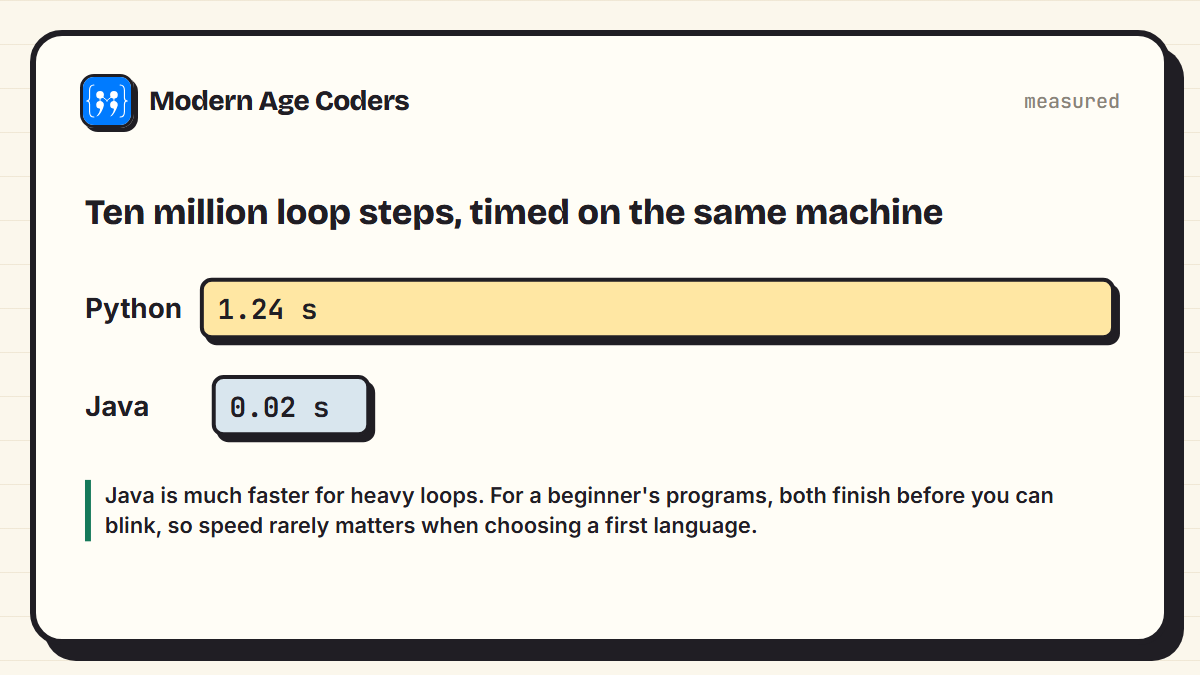
Both computed exactly the same total. Python took 1.24 seconds and Java 0.02. That gap is real and matters in performance-heavy software and competitive programming. For a beginner's programs, which usually finish in a fraction of a second either way, it rarely matters. And in data science and AI, Python programs mostly call libraries written in fast languages underneath, which is how Python became the language of machine learning despite being slower on its own.
What the first month looks like in each
The practical difference shows up most clearly in the first few weeks. Here is a realistic picture for a complete beginner practising a few hours a week in each language.
| Week | Starting with Python | Starting with Java |
|---|---|---|
| 1 | Printing, variables, input, a small calculator | Understanding class and main, printing, variables with types |
| 2 | if/else, loops, a number guessing game | if/else, loops, Scanner for input |
| 3 | Lists and dictionaries, a to-do list or quiz | Arrays and methods, ArrayList |
| 4 | Files and functions, a small real project | Classes and objects, a simple program built from several classes |
Python learners usually reach a program they are proud of sooner. Java learners usually understand objects and types earlier, because the language puts them in front of you from the first line. Both paths meet in the middle: by month three, a good Python learner is writing classes and a good Java learner is writing useful programs. If you want the Python side in detail, our step-by-step Python library lays out every stage.
Which exams and courses use which
- ICSE Class 9 and 10 Computer Applications is taught in Java, using BlueJ. Our top 20 Java programs for ICSE Class 10 covers the exam programs.
- CBSE Class 11 and 12 Computer Science uses Python. See our Python programs for CBSE Class 12.
- AP Computer Science A in the United States is taught and examined in Java.
- GCSE and IGCSE Computer Science let schools choose a language, and Python is the most common choice.
- University computer science often starts with Python, Java or C, and most degrees teach more than one.
If an exam is coming up, that decides it: learn the language the exam uses.
Which should you learn first?
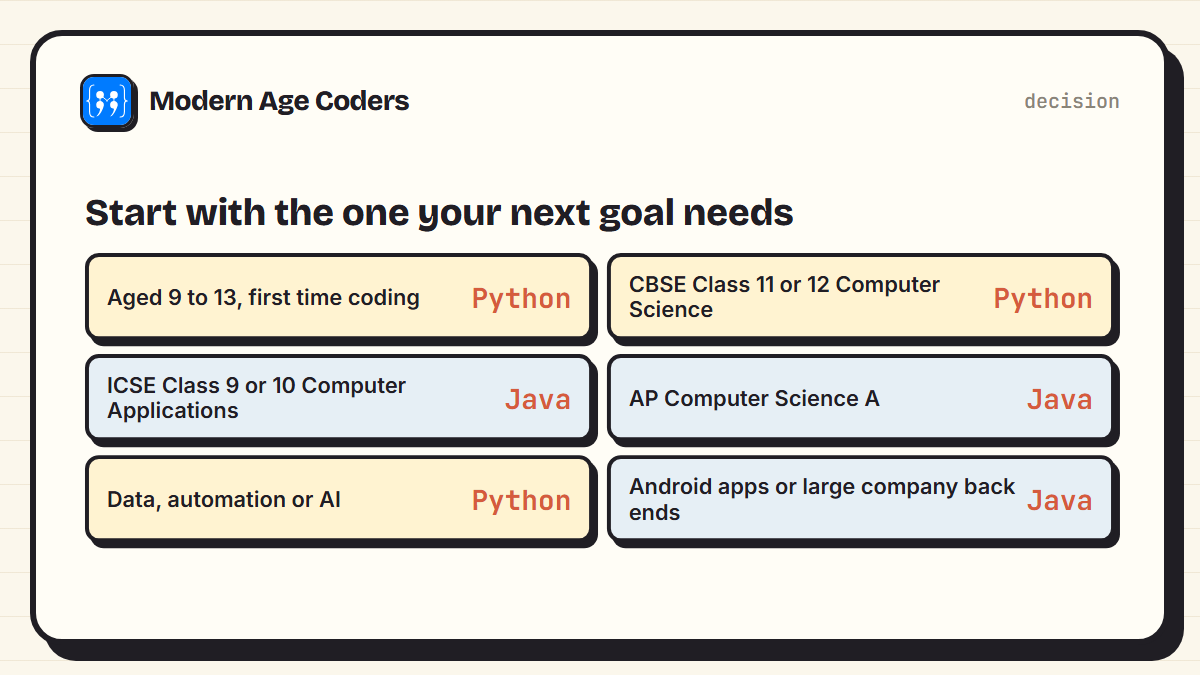
- Ages 9 to 13, or anyone completely new: Python. Less ceremony, faster wins, and it is used for everything from games to AI. Our guide to how long it takes to learn Python sets realistic expectations.
- ICSE students, AP Computer Science A students: Java, because that is what is examined.
- Interested in data, automation or AI: Python, without much debate.
- Interested in Android apps or large enterprise systems: Java, or Kotlin, which runs on the same platform.
- Aiming for competitive programming or placements: either, but many students end up adding C++ or Java later for speed.
Pick the language your next goal needs. The second one will take a fraction of the time.
How we teach it
We teach both languages in live classes, one to one or in small groups of 5 to 10. Python is the usual starting point for younger learners and complete beginners, and Java for ICSE, AP and students heading towards large-scale software. Either way, lessons follow the principles on our how we teach page, including tracing code line by line until a student can predict every step. See Python from the ground up and Java for ICSE students.
Frequently asked questions
For beginners, yes. Python needs less code to do the same thing, has no type declarations and no required class structure, so learners can build working programs sooner. Java is not hard, but it asks you to understand more rules before your first program runs.
Both lead to good jobs. Python dominates data, AI and automation roles, while Java is widely used in large company back ends and Android. Choose the one that matches the kind of work you want, and expect to learn more than one language over a career.
Generally yes for heavy computation. In our test of ten million loop steps, Java was many times faster on the same machine. For beginner programs the difference is rarely noticeable, and Python's data and AI libraries run fast code underneath.
ICSE Class 9 and 10 Computer Applications uses Java with BlueJ. CBSE Class 11 and 12 Computer Science uses Python. Students should learn the language their board examines.
Yes, and it is a common path. The core ideas, variables, loops, conditions, functions and objects, carry over directly. The main new things to learn are static types, classes as the structure of every program, and compiling before running.
Yes. Java remains one of the most widely used languages in large businesses, banking systems, Android development and university courses, and AP Computer Science A is examined in Java.
Many children start Java around 13 to 15, often because their school or exam uses it. Younger children usually do better starting with Scratch or Python and moving to Java later.