Table of Contents
- Why "how long" has five different answers
- From hours to calendar time
- How to know you have reached each milestone
- How long it takes by age
- How long it takes by goal
- A 12-week plan for complete beginners
- What makes it take longer, and what makes it faster
- Does AI make learning Python faster?
- How we teach Python
- Frequently asked questions
Most people who type this question want a number, and most answers give one without saying what it measures. "Six weeks" is true if you mean writing a working program that asks for your name and prints a greeting. "Two years" is true if you mean getting hired as a developer. Both answers are honest. Neither is useful until you know which finish line you are aiming at.
So this guide does it properly. It splits "learning Python" into five milestones you can actually test yourself against, puts an hour estimate on each, turns those hours into calendar time for different schedules, and then shows the specific habits that make the same number of hours go much further. It applies whether you are a parent planning for a 12-year-old, a college student, or an adult starting from zero at 45.
Why "how long" has five different answers
Python is a small language with an enormous ecosystem around it. You can learn the core language, the part every Python programmer uses, in a few months. What takes years is everything built on top of it: web frameworks, data libraries, machine learning, testing, databases, working in a team. When someone says they "know Python" they might mean any point on that line.
The milestones below are the ones we use when planning a learner's path. Each one is defined by what you can do, not by which topics you have seen, because seeing a topic and being able to use it without help are very different things.
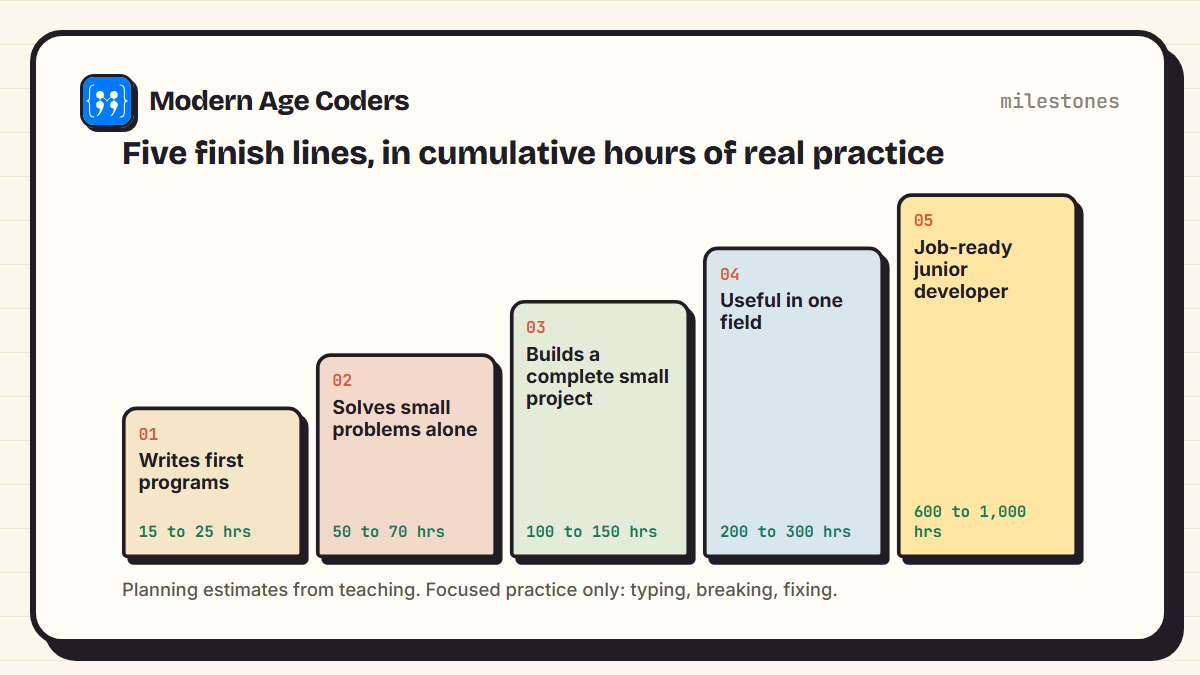
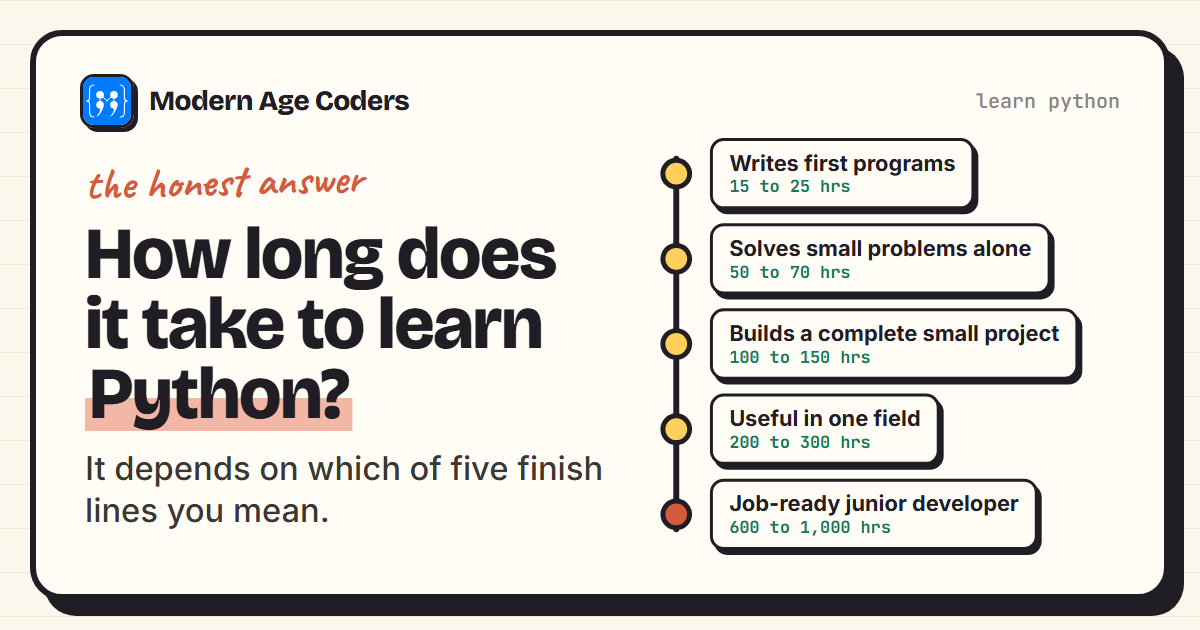
| Milestone | You can... | Cumulative hours |
|---|---|---|
| 1. First programs | Write and run short programs with variables, input, if/else and loops | 15 to 25 |
| 2. Small problems, unaided | Solve a new small problem with functions, lists, strings and dictionaries, without copying a solution | 50 to 70 |
| 3. A complete small project | Plan and finish a program that reads files, handles errors and is split into functions | 100 to 150 |
| 4. Useful in one field | Do real work in one area, such as automation, data analysis, web back ends or beginner AI | 200 to 300 |
| 5. Job-ready | Build, test and explain projects with Git, SQL and a framework, well enough to pass an interview | 600 to 1,000 |
These are planning estimates from teaching, not measured averages, and we would rather give you a range we believe than a precise figure that is invented. They assume focused practice: typing code, getting it wrong, fixing it. An hour of watching a video counts for much less than an hour of that.
From hours to calendar time
Hours are the honest unit, but you live in weeks and months. The conversion is simple enough to do in Python, which is a nice first taste of why the language is useful. This takes the middle of each range and divides by a weekly schedule:
milestones = {
    "Writes first programs": 20,
    "Solves small problems alone": 60,
    "Builds a complete small project": 125,
    "Useful in one field": 250,
    "Job-ready junior developer": 800,
}

print(f"{'hours per week':<34}" + "".join(f"{h:>8}" for h in (2, 4, 7, 10)))
for name, hours in milestones.items():
    row = ""
    for per_week in (2, 4, 7, 10):
        weeks = hours / per_week
        row += f"{round(weeks):>7}w"
print(f"{name:<34}{row}")hours per week 2 4 7 10
Writes first programs 10w 5w 3w 2w
Solves small problems alone 30w 15w 9w 6w
Builds a complete small project 62w 31w 18w 12w
Useful in one field 125w 62w 36w 25w
Job-ready junior developer 400w 200w 114w 80w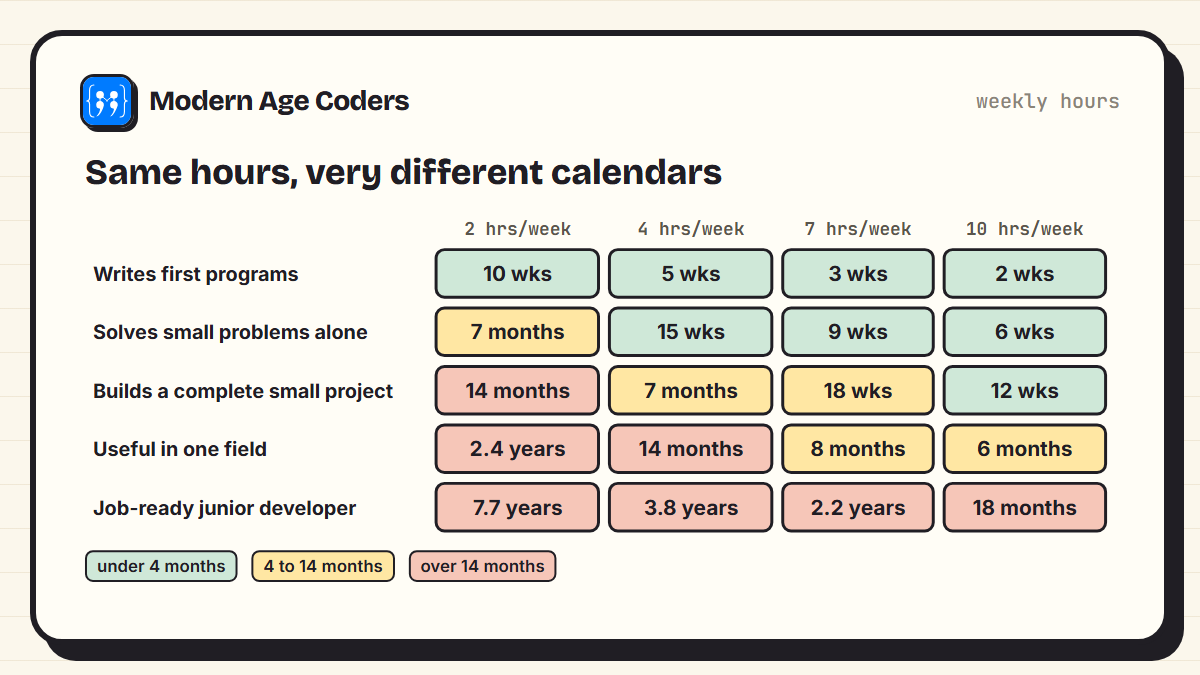
Two things jump out. First, the early milestones are reachable on almost any schedule. Even at two hours a week, which is one class plus a little homework, a learner writes real programs within about ten weeks. Second, the job-ready row is not a realistic target at low weekly hours. At four hours a week it works out to nearly four years, and in that time the gaps between sessions cost you more than the sessions teach. If employment is the goal, the schedule has to be closer to ten hours a week or more.
Schedule shape matters as much as total hours
Three 40-minute sessions beat one two-hour session, even though the total is the same. Spacing practice out is one of the best-supported findings in learning research: a 2013 review of study techniques by Dunlosky and colleagues rated distributed practice as one of only two techniques with high utility. Forgetting a little between sessions and then recalling it is exactly what makes it stick.
How to know you have reached each milestone
Here is the part most guides skip. You do not need a certificate to know where you are. You need a task that only someone at that level can do without help. Close every tab, set a timer, and try these.
Milestone 2 test: count the words in a sentence
Write a function that takes a sentence and returns how many times each word appears, ignoring capital letters and punctuation. If you can do this in under twenty minutes without searching, you are at milestone 2. Here is one solution and what it prints:
def word_counts(sentence):
    counts = {}
    for word in sentence.lower().split():
        word = word.strip(".,!?")
        counts[word] = counts.get(word, 0) + 1
    return counts

result = word_counts("The cat sat. The cat ran! A dog sat.")
for word, n in sorted(result.items(), key=lambda pair: (-pair[1], pair[0])):
print(word, n)cat 2
sat 2
the 2
a 1
dog 1
ran 1Nothing in it is advanced. What it tests is whether you can combine a loop, a string method, a dictionary and a function into one working idea, which is exactly the skill that separates someone who has seen Python from someone who can use it. If you want more tasks at this level, our 35 basic Python programs are graded from easy to hard.
Milestone 3 test: a class report from a file
Read a CSV file of student marks, print each student's average and best subject, and name the top student. It is small, but it has the shape of real work: data comes in from outside, gets cleaned into the right types, and turns into an answer somebody wanted.
import csv, io

# In a real project this would be open("marks.csv"); a string keeps the example self-contained
data = io.StringIO("""name,maths,science,english
Aarav,78,85,69
Meera,92,88,95
Kabir,55,61,72
""")

rows = list(csv.DictReader(data))
subjects = ["maths", "science", "english"]

for row in rows:
    marks = [int(row[s]) for s in subjects]
    average = sum(marks) / len(marks)
    best = subjects[marks.index(max(marks))]
    print(f"{row['name']:<6} average {average:5.1f}  best subject: {best}")

top = max(rows, key=lambda r: sum(int(r[s]) for s in subjects))
print("Top of the class:", top["name"])Aarav average 77.3 best subject: science
Meera average 91.7 best subject: english
Kabir average 62.7 best subject: english
Top of the class: MeeraIf you can write something like this from a blank file, and then extend it when asked ("now add a pass or fail column") without starting over, you have reached milestone 3. Most self-taught learners who feel stuck are sitting between milestones 2 and 3, and the missing piece is almost always finishing a project rather than learning another topic.
How long it takes by age
Age changes the pace less than people expect and the shape of learning more. The estimates below are for reaching milestone 2, solving small problems alone, with regular live classes.
- Ages 8 to 11: usually 6 to 9 months after some block coding. Children this age learn Python well, but typing speed and reading long error messages slow them down, so sessions of 45 to 60 minutes work better than longer ones. If your child has not coded before, our guide to Scratch versus Python explains when to switch.
- Ages 12 to 17: about 3 to 5 months. Teenagers can handle abstract ideas like functions and dictionaries quickly, and school maths helps. The usual obstacle is consistency around exams, not ability.
- College students: 2 to 4 months, often faster if they already know another language. The risk here is rushing to libraries and frameworks before the core is solid.
- Working adults: 3 to 5 months on 4 to 6 hours a week. Adults are good at seeing why something matters and bad at protecting their practice time. Fixed class slots help more than motivation does. Our coding classes for adults are built around that.
We teach every age from 6 to 67, and the learners who finish are rarely the fastest ones. They are the ones who kept a steady weekly rhythm for long enough to reach milestone 3.
How long it takes by goal
If you know why you are learning, you can stop at the right milestone instead of guessing. This table maps common goals to what you actually need.
| Your goal | What you need beyond core Python | Stop at |
|---|---|---|
| CBSE Class 11 and 12 Computer Science | Functions, file handling (text, binary, CSV), a stack, and connecting Python to MySQL | Milestone 3 |
| Automating spreadsheets and files at work | The csv and os modules, then openpyxl or pandas | Milestone 3 to 4 |
| Data analysis | pandas, matplotlib, basic statistics | Milestone 4 |
| Machine learning and AI | NumPy, pandas, scikit-learn, and school-level algebra and statistics | Milestone 4, then more |
| Web back ends | Flask or Django, HTML basics, SQL | Milestone 4 |
| A junior developer job | Git, SQL, a framework, testing, three finished projects you can explain | Milestone 5 |
A note for Indian families: ICSE Computer Applications is taught in Java, not Python, while CBSE uses Python in Classes 11 and 12. If exams are the goal, match the language to the board. Our Python for CBSE Class 12 course follows the 083 syllabus directly.
A 12-week plan for complete beginners
If you are starting from nothing and can give about five hours a week, this is a realistic first quarter. It reaches milestone 2 and gets you started on milestone 3.
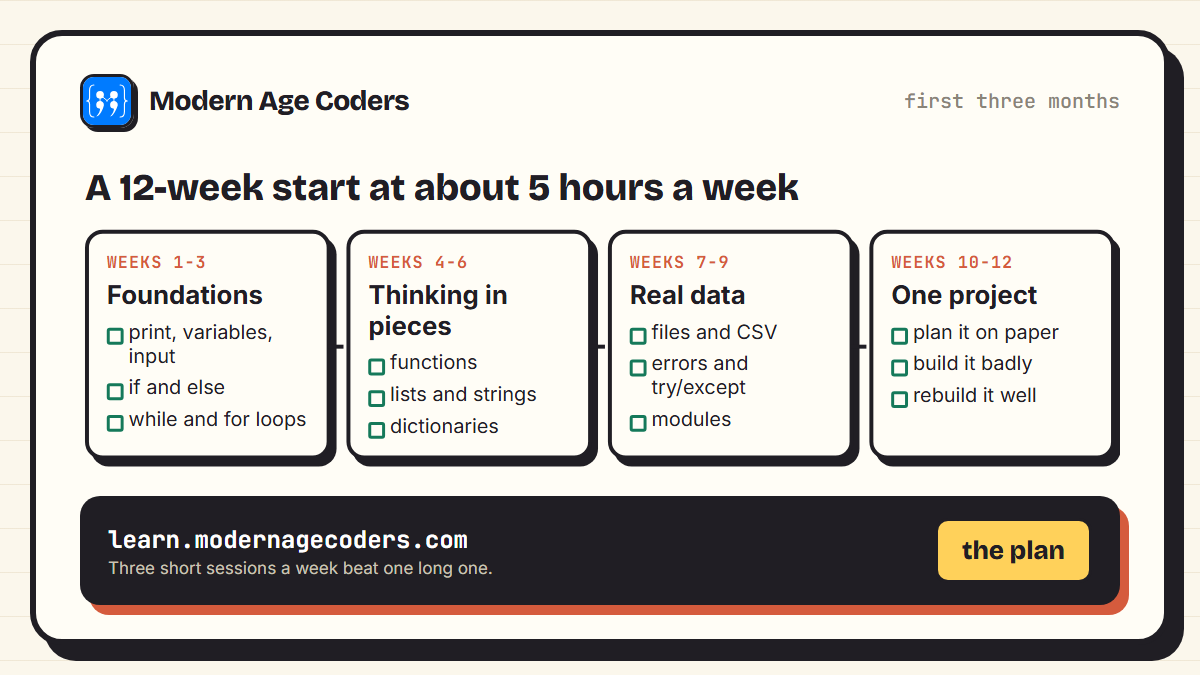
- Weeks 1 to 3, foundations. print, variables, input, if and else, while and for loops. Write at least one small program every session, even if it is only a times table printer.
- Weeks 4 to 6, thinking in pieces. Functions first, then lists, strings and dictionaries. The goal is to stop writing one long script and start writing small named pieces.
- Weeks 7 to 9, real data. Reading and writing files, CSV, handling errors with try and except, and importing modules. This is where programs start to feel useful.
- Weeks 10 to 12, one project. Choose something small you actually want, like a marks tracker, a quiz, or an expense log. Plan it on paper, build a rough version, then rebuild it cleanly. Finishing matters more than ambition.
For the free material to go with it, our step-by-step Python library lists every tutorial in order, from variables to object-oriented programming.
What makes it take longer, and what makes it faster
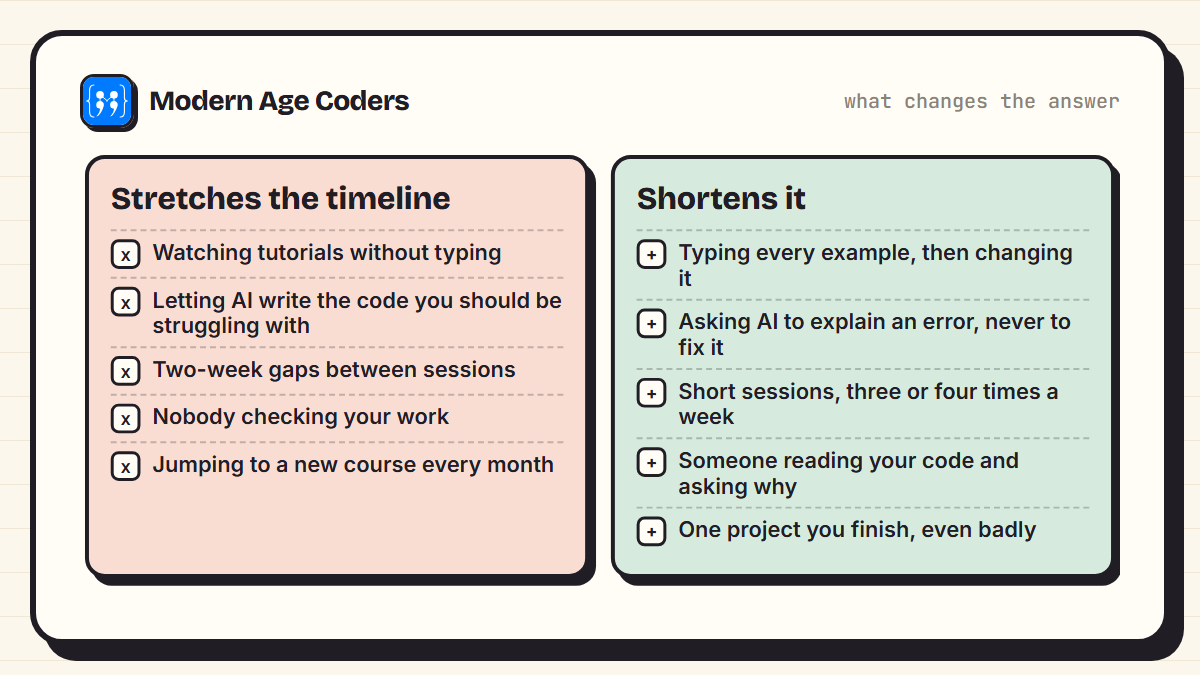
Python is not a hard language. When learning it takes much longer than the estimates above, the cause is almost always one of a handful of habits.
- Tutorial loops. Watching someone else code feels like progress and mostly is not. The rule we use: never watch more than ten minutes without typing something yourself.
- Long gaps. A two-week break costs more than two weeks. You spend the next session relearning instead of moving forward.
- No feedback. Code that works can still be badly built, and nobody learns that alone. A teacher or experienced friend reading your code and asking "why did you do it this way?" speeds things up more than any resource.
- Switching courses. Every new course restarts at variables. Finishing one mediocre course beats starting five good ones.
Does AI make learning Python faster?
It can, and it can also make it much slower while feeling faster. AI coding tools are excellent at explaining an error message, suggesting why a loop runs one time too many, or giving you three more practice problems like the one you just solved. Used that way, they are a patient tutor available at midnight.
Used to write the code for you, they skip the exact struggle that builds the skill. You get working programs and no ability to write the next one. It is common for a learner to reach what looks like milestone 3 in a month with heavy AI help, then be unable to write a ten-line function in an interview. If you want the longer version of this argument, read vibe coding versus learning to code properly.
A simple rule for AI while learning
Ask it to explain, never to fix. Paste the error, ask what it means and where to look, then fix it yourself. If you ever paste code you could not have written, rewrite it from memory the next day.
The question is not how fast you can get through Python. It is how long you can keep showing up until it gets easy.
How we teach Python
Our Python classes are live, in small groups of 5 to 10 learners or one to one, and they follow the principles on our how we teach page: learning by building rather than memorising, and staying with one idea until it genuinely clicks. That is exactly what moves a learner from one milestone to the next. Beginners start with Python from the ground up, and learners heading towards AI move on to AI and machine learning with Python.
If you are not sure where you or your child would start, a free trial class is the quickest way to find out. The teacher will set a short task, see which milestone you are at, and suggest a realistic schedule.
Frequently asked questions
You can reach the first milestone in a month, writing short programs with variables, conditions and loops, at around five hours a week. Solving new problems on your own usually takes two to three months, and building complete projects takes longer. A month is a good start, not a finish.
For most people, 30 to 60 minutes a day of hands-on practice works better than long weekend sessions. Short, frequent practice keeps what you learned yesterday fresh and fits around school or work. Consistency beats intensity.
No. Python has simple, readable syntax and is one of the most common first languages in schools and universities. The difficult part is not the language but learning to break a problem into steps, and that skill takes practice in any language.
Plan on roughly 200 to 300 hours: core Python first, then pandas, charts and basic statistics. At five to seven hours a week that is about eight to twelve months. Machine learning on top of that takes longer and needs school-level algebra and statistics.
Yes. Many children aged 9 to 11 learn Python well, especially after some block coding. Expect slower progress than an adult because of typing and reading error messages, and keep sessions to 45 to 60 minutes.
Usually 600 to 1,000 hours in total, because a job needs more than Python: Git, SQL, a framework, testing and several finished projects. At ten hours a week that is roughly 14 to 23 months. At four hours a week it is not realistic.
Python is usually the easier first language, and JavaScript is the language of the web. Both are good choices. We compare them with real code in our Python versus JavaScript guide.