Table of Contents
Ask ten programmers whether to learn Python or JavaScript first and you will get ten confident, contradictory answers, usually matching whichever one pays their rent. So let us skip the tribal loyalty. Both are excellent first languages, both sit at the top of every popularity survey, and both will still be worth knowing a decade from now. The real question is not which language is better. It is which one points at the things you want to build.
This comparison stays honest the same way our other guides do: by running the code. Every snippet below, Python and JavaScript alike, was executed while writing this post, and the outputs you see are what actually came back.
The short answer, up front
Want to build things you can see in a browser, websites, games, interactive pages? Start with JavaScript. Want data, AI, automation, or a gentler first month? Start with Python. Cannot decide? Start with Python, add JavaScript within the year. This is a sequencing choice, not a marriage.
The Same Program in Both Languages
Before any opinions, look at the two languages doing identical work: greet a list of students and count them.
Python:
students = ["Asha", "Rohan", "Meera"]

for name in students:
    print("Welcome,", name)

print("Total students:", len(students))
Welcome, Asha
Welcome, Rohan
Welcome, Meera
Total students: 3JavaScript:
const students = ["Asha", "Rohan", "Meera"];

for (const name of students) {
    console.log("Welcome,", name);
}

console.log("Total students:", students.length);
Welcome, Asha
Welcome, Rohan
Welcome, Meera
Total students: 3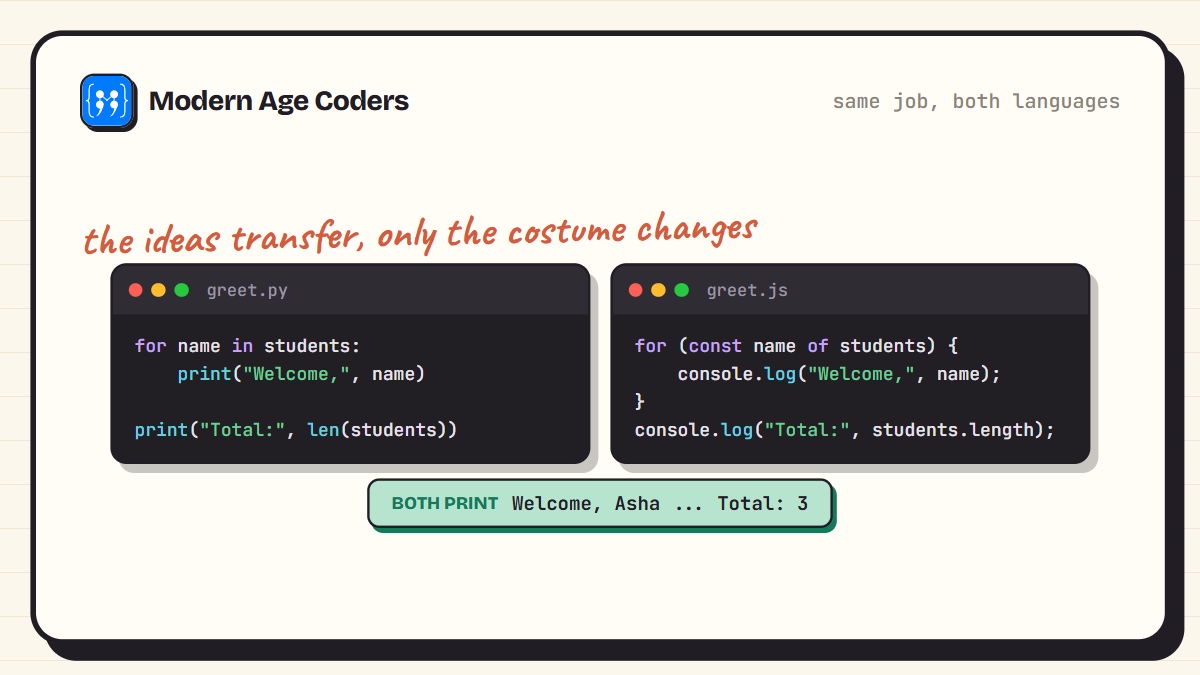
Identical output, and honestly, similar code. That is the first big secret of this debate: the concepts, variables, loops, functions, conditions, are the same in both. Learn them once in either language and most of your knowledge travels free of charge to the other.
How They Feel to Write
Python organises code with indentation and almost no punctuation, which is why it famously reads like slightly stiff English. JavaScript wraps blocks in braces and ends statements with semicolons, which feels noisier at first but is the convention most other big languages share, so it pays forward if you later touch Java, C++, or C#.
For a complete beginner, Python's surface is simply calmer: fewer symbols to mistype, fewer ways for a missing brace to ruin an evening. JavaScript's compensation is instant gratification: your very first lines can move buttons and change colours in a real web page, no installation, because every browser already speaks it.
Where Each Language Actually Lives
This is the part that should drive your decision, because languages are not abstract skills. They are tickets to territories.
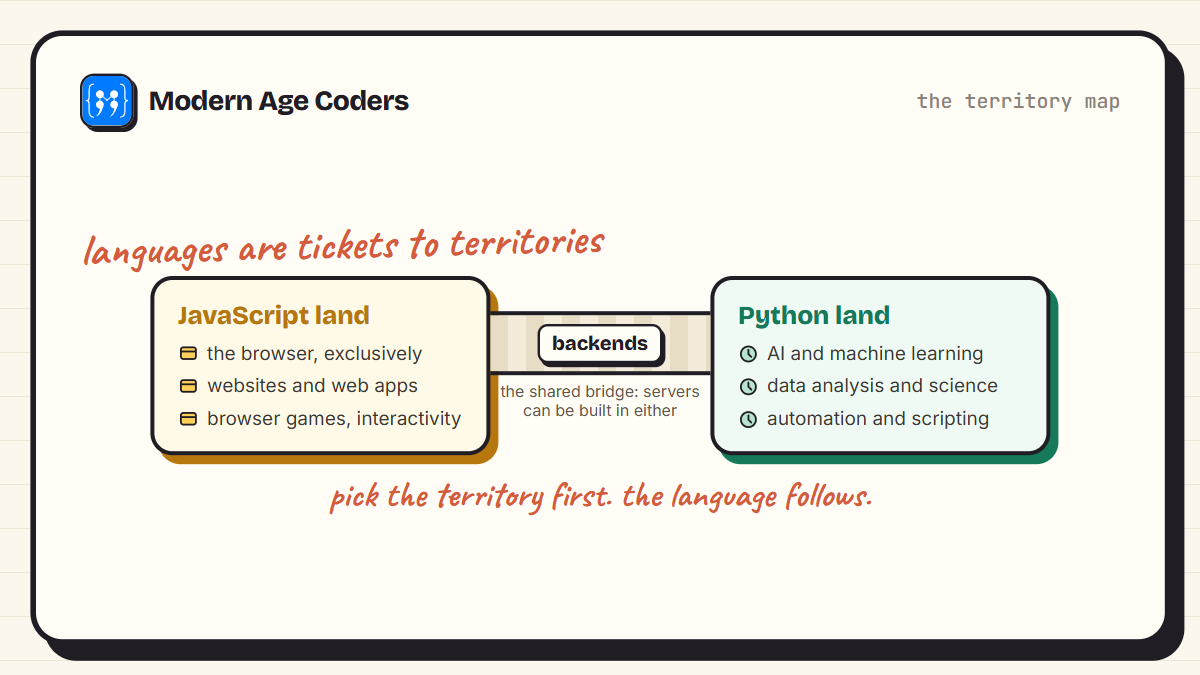
- JavaScript owns the browser. It is the only language web pages run natively, so front-end work, interactive sites, browser games, all of it goes through JavaScript. With Node.js it builds servers too, and frameworks like React power most modern web apps.
- Python owns data and AI. Machine learning, data analysis, scientific computing, and most AI tooling live in Python, through libraries like pandas, NumPy, and PyTorch. It is also the default language for automation scripts and a favourite for backends.
- Both build backends. The server behind a website can happily be either. This shared middle is why web companies usually end up employing both.
The Personality Differences, Demonstrated
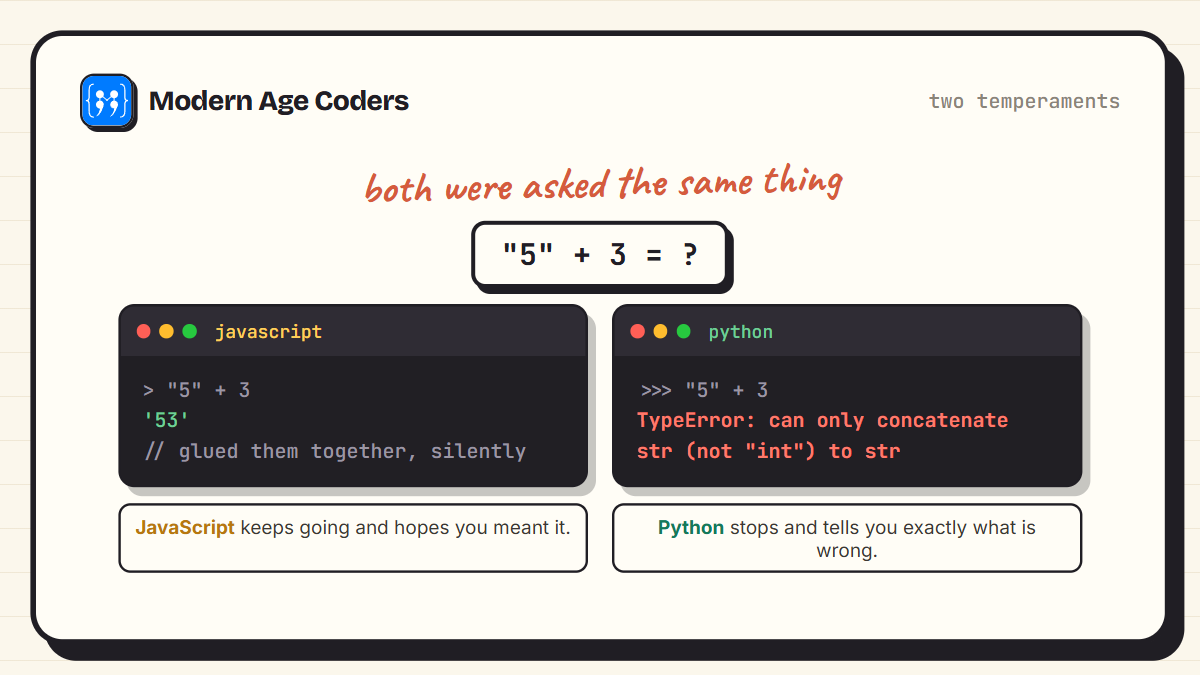
The deepest practical difference is temperament. JavaScript tries very hard to keep going, quietly converting types when they do not match. Python refuses and tells you. Watch both languages meet the same questionable request: adding the text "5" to the number 3.
JavaScript keeps going:
console.log("5" + 3);
console.log("5" - 3);
console.log(0.1 + 0.2);
53
2
0.30000000000000004Adding glued the text and number into "53", yet subtracting did arithmetic and gave 2. Both silently. This flexibility is famous, and it is why JavaScript programmers lean on the strict === comparison and a linter to stay safe.
Python refuses:
print("5" + 3)Traceback (most recent call last):
File "example.py", line 1, in <module>
print("5" + 3)
~~~~^~~
TypeError: can only concatenate str (not "int") to strA clear, immediate error naming the problem. For a learner this is a gift: mistakes surface where they happen, not three steps later as a mysterious "53". If you want to mix text and numbers in Python, you convert on purpose.
print(0.1 + 0.2)
print("5" + str(3))   # you must convert on purpose
0.30000000000000004
53And notice the first line: 0.1 + 0.2 is slightly off in Python too. That one is not a language quirk at all, it is how computers store decimal numbers, and both languages share it equally.
If you want to see exactly what the computer stores for 0.1, and the five ways to handle it in real code, our guide to why 0.1 + 0.2 is not 0.3 walks through it with outputs from both languages.
Speed, Jobs, and Other Things People Argue About
Speed: in most published benchmarks, JavaScript's V8 engine outruns standard Python. And for a beginner this matters almost none at all. Nothing you build in your first two years will be slow because of the language, and Python's heavy data work happens inside C-powered libraries anyway. Choose with your goals, not with benchmark charts.
Jobs: both languages sit near the top of every hiring survey, so neither is a career mistake. The split is by field: web development roles assume JavaScript without asking, while data, AI, and machine learning roles assume Python the same way. Backend roles come in both flavours. In other words, the job market repeats the territory map above.
Learning curve: Python is gentler for the first month; JavaScript is more motivating if visible results keep you going. Honest trade, no winner.
So Which Should You Learn First?
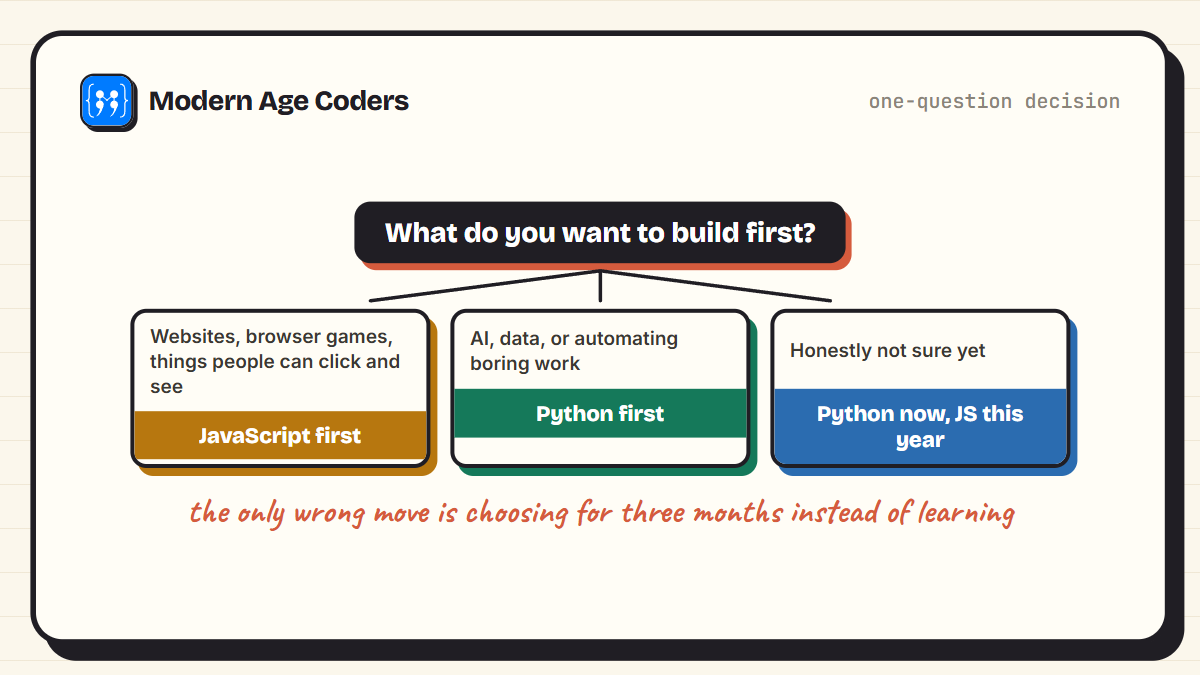
- You want to make websites, browser games, things people can click: JavaScript first. The browser feedback loop will keep you hooked, and the skill goes straight into real projects.
- You are drawn to AI, data, or automating boring work: Python first. You will be doing genuinely useful things within weeks, and every AI course you meet later will assume it.
- You are a school student or a complete beginner with no strong pull either way: Python first for the calmer syntax, then JavaScript in your first year, once loops and functions feel natural. That order, concepts in Python, visible projects in JavaScript, is exactly how our coding roadmap sequences it.
- You already know one of them: learn the other. This is the one question where both camps agree.
The trap to avoid
The only wrong move is spending three months choosing instead of learning. A learner who picked the worse-fitting language and started today will outrun a perfect chooser every single time. Pick by destination, start this week, and switch costs you far less than you fear.
Frequently Asked Questions
Python's syntax is calmer: indentation instead of braces, fewer symbols, clearer error messages. JavaScript is slightly bumpier but rewards you with instant visual results in the browser. Most learners find Python easier in month one and the difference mostly gone by month three.
JavaScript. It is the only language browsers run natively, so front-end web work requires it regardless of what else you know. HTML and CSS alongside it, then a framework like React later.
Python, without much debate. The entire mainstream AI and data ecosystem, pandas, NumPy, PyTorch, scikit-learn, is Python-first, and nearly every course and tutorial in the field assumes it.
Not any more. Through Node.js it runs servers, build tools, and desktop apps, and frameworks extend it to mobile. But its unique, irreplaceable territory is still the browser, which is why web work is its strongest claim.
In most benchmarks standard Python runs slower than JavaScript's V8 engine, yes. In practice a beginner will not feel it, and Python's data libraries do their heavy lifting in fast compiled code underneath. Language choice for a learner should follow goals, not benchmarks.
You can, but most learners do better sequencing them: get loops, functions, and conditions solid in one language, then pick up the second in a few weeks. The concepts transfer almost entirely; only the syntax needs relearning.
For younger children, block coding first, then Python for its forgiving syntax. Teens who are motivated by making websites and games often do brilliantly starting with JavaScript instead, because they can show friends what they built. Motivation beats syntax every time.
Very commonly, yes. A typical web product has a JavaScript front end, a backend in either language, and Python handling data and machine learning behind the scenes. That is why learning both, in either order, is a normal career path rather than an unusual one.
Two Languages, One Decision, Zero Drama
Here is the ending most versus articles will not give you: this choice is temporary. Serious programmers end up reading both of these languages within a few years, because the web speaks one and data speaks the other. All you are choosing today is your first territory. Pick the one whose projects you actually want to exist, and start.
And whichever door you pick, our free step-by-step Python library lays out the full staged path the moment you choose Python.
If Python is your opening move, our Python from the ground up course and the beginner's guide are built for exactly that. If JavaScript is, start with JavaScript basics. And if you would rather have a teacher help you sequence the whole journey, our live coding courses guide learners aged 6 to 67 through both.