Table of Contents
- How to compile and run a C program
- All 53 C programs at a glance
- Basics: output, input, variables and operators
- Decisions: if, else and switch
- Loops and number programs
- Pattern programs
- Arrays and matrices
- Strings
- Functions, recursion, pointers, structures and files
- Common mistakes beginners make in C
- Practice list: C programs to try on your own
- Which C programs to learn first
- How we teach it
- Frequently asked questions
Here are 53 C programs for beginners, each with its full code and the exact output it printed when we compiled and ran it. They start with Hello World and simple input, then move through if-else and switch, loops and number programs, patterns, arrays and matrices, strings, and finally functions, recursion, pointers, structures and files. Work through them in order and you will have practised every topic a first C course or exam covers.
Each program is short, self-contained and uses fixed sample values, so it runs the moment you compile it. A few read input with scanf(), and for those the output box shows exactly what appeared on screen, including what we typed. At the end you will find the mistakes beginners make most often, and a practice list to try on your own.
How these were tested
Every program was saved as a .c file, compiled with cc -std=c11 -Wall -Wextra (Apple clang 17) with zero warnings, and run in a terminal. The output boxes are copied from that run, character for character. GCC on Windows or Linux gives the same output, except the sizeof program, whose sizes depend on the system.
How to compile and run a C program
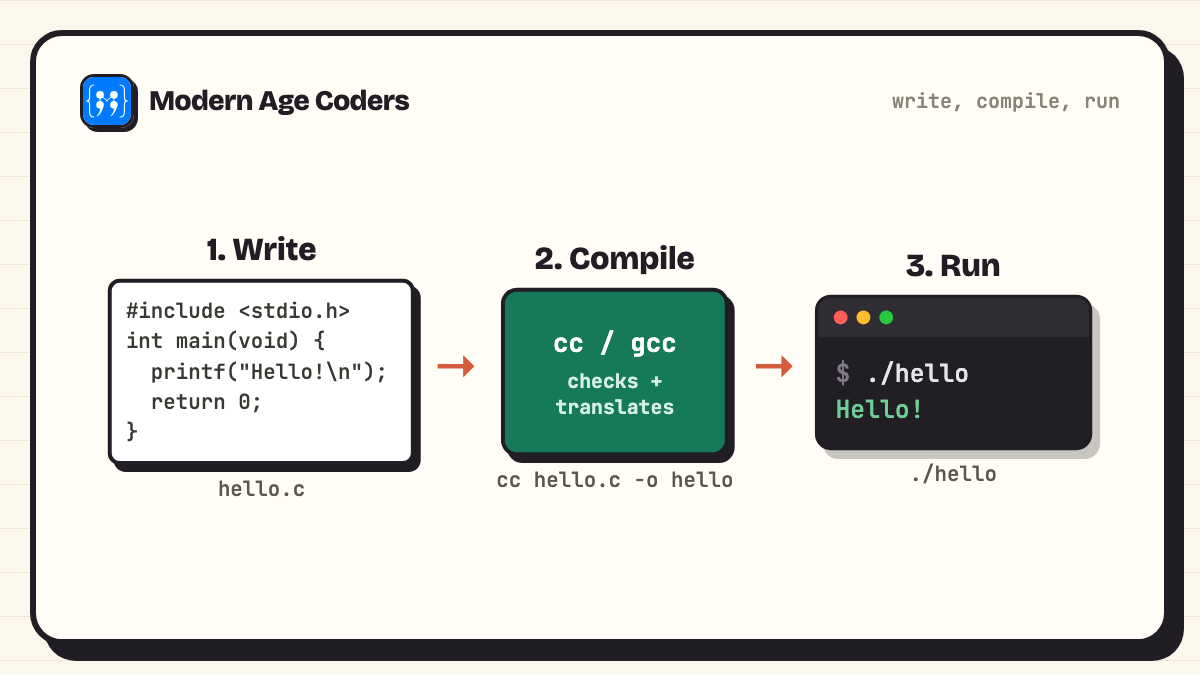
C is a compiled language: a compiler turns your source file into a program your computer can run, and then you run that program. You need a compiler once, and then it is two commands per program.
- Windows: install a GCC compiler such as MinGW-w64, or an IDE that bundles one, such as Code::Blocks.
- Mac: run
xcode-select --installin Terminal to get clang (theccandgcccommands both work after that). - Linux: GCC is usually installed already; if not, install the
gccorbuild-essentialpackage. - No install at all: an online C compiler works for every program here except the file program, which needs a real folder to write to.
cc hello.c -o hello      # compile (use gcc on Windows or Linux)
./hello                  # run (on Windows: hello.exe)
If the compiler prints an error, read the first one only, fix it, and compile again. Later errors are often caused by the first.
All 53 C programs at a glance
Use this as a practice checklist. The programs get harder as the numbers go up, so a complete beginner can work straight down the list.
| No. | Program | Topic |
|---|---|---|
| 1 | Hello, World | Basics |
| 2 | Add two numbers entered by the user | Basics |
| 3 | Swap two numbers using a third variable | Basics |
| 4 | Swap two numbers without a third variable | Basics |
| 5 | Size of the basic data types | Basics |
| 6 | Area and circumference of a circle | Basics |
| 7 | Simple interest | Basics |
| 8 | Celsius to Fahrenheit | Basics |
| 9 | ASCII value of a character | Basics |
| 10 | Even or odd | Decisions |
| 11 | Largest of three numbers | Decisions |
| 12 | Leap year check | Decisions |
| 13 | Vowel or consonant using switch | Decisions |
| 14 | Grade from marks | Decisions |
| 15 | Simple calculator using switch | Decisions |
| 16 | Roots of a quadratic equation | Decisions |
| 17 | Sum of the first n natural numbers | Loops and number programs |
| 18 | Factorial of a number | Loops and number programs |
| 19 | Multiplication table | Loops and number programs |
| 20 | Fibonacci series | Loops and number programs |
| 21 | Prime number check | Loops and number programs |
| 22 | All prime numbers from 1 to 50 | Loops and number programs |
| 23 | Reverse a number | Loops and number programs |
| 24 | Palindrome number | Loops and number programs |
| 25 | Armstrong numbers from 100 to 999 | Loops and number programs |
| 26 | Sum and count of digits | Loops and number programs |
| 27 | GCD and LCM of two numbers | Loops and number programs |
| 28 | Power of a number using a loop | Loops and number programs |
| 29 | Right triangle of stars | Pattern programs |
| 30 | Pyramid of stars | Pattern programs |
| 31 | Floyd's triangle | Pattern programs |
| 32 | Number triangle | Pattern programs |
| 33 | Sum and average of an array | Arrays and matrices |
| 34 | Largest and smallest element | Arrays and matrices |
| 35 | Reverse an array | Arrays and matrices |
| 36 | Linear search | Arrays and matrices |
| 37 | Bubble sort | Arrays and matrices |
| 38 | Binary search | Arrays and matrices |
| 39 | Second largest element | Arrays and matrices |
| 40 | Addition of two matrices | Arrays and matrices |
| 41 | Transpose of a matrix | Arrays and matrices |
| 42 | Multiplication of two matrices | Arrays and matrices |
| 43 | Length of a string without strlen() | Strings |
| 44 | Reverse a string | Strings |
| 45 | Palindrome string | Strings |
| 46 | Count vowels, consonants, digits and spaces | Strings |
| 47 | Convert a string to uppercase | Strings |
| 48 | A function that returns a value | Functions, recursion, pointers, structures and files |
| 49 | Factorial using recursion | Functions, recursion, pointers, structures and files |
| 50 | Swap two numbers using pointers | Functions, recursion, pointers, structures and files |
| 51 | Pointers and arrays | Functions, recursion, pointers, structures and files |
| 52 | Structure for student records | Functions, recursion, pointers, structures and files |
| 53 | Write to a file and read it back | Functions, recursion, pointers, structures and files |
C programs for beginners as a PDF
To keep a printable copy, open this page and press Ctrl+P (Cmd+P on a Mac), then choose "Save as PDF". Every program and output prints in order. You will learn far more, though, by typing each program yourself and comparing your output with ours.
Basics: output, input, variables and operators
Every C program starts in main(), prints with printf() and reads with scanf(). These nine programs are the grammar the rest of the list is built on.
1. Hello, World
Task: Print a message on the screen.
#include <stdio.h>

int main(void) {
    printf("Hello, World!\n");
    return 0;
}Hello, World!#include <stdio.h> brings in printf(). \n moves to a new line, and return 0 tells the system the program finished normally.
2. Add two numbers entered by the user
Task: Read two integers with scanf() and print their sum.
#include <stdio.h>

int main(void) {
    int a, b;
    printf("Enter two numbers: ");
    scanf("%d %d", &a, &b);
    printf("Sum = %d\n", a + b);
    return 0;
}Enter two numbers: 25 17
Sum = 42&a passes the address of a, so scanf() can store the number there. Forgetting the & is a classic crash.
3. Swap two numbers using a third variable
Task: Swap the values of two variables.
#include <stdio.h>

int main(void) {
    int a = 10, b = 20, temp;
    printf("Before: a = %d, b = %d\n", a, b);
    temp = a;
    a = b;
    b = temp;
    printf("After:  a = %d, b = %d\n", a, b);
    return 0;
}Before: a = 10, b = 20
After: a = 20, b = 104. Swap two numbers without a third variable
Task: Swap two integers using only addition and subtraction.
#include <stdio.h>

int main(void) {
    int a = 7, b = 3;
    a = a + b;   /* a = 10 */
    b = a - b;   /* b = 7  */
    a = a - b;   /* a = 3  */
    printf("a = %d, b = %d\n", a, b);
    return 0;
}a = 3, b = 7A favourite interview question. In real code, use the temporary variable: it is clearer and cannot overflow.
5. Size of the basic data types
Task: Print how many bytes each basic data type uses on this computer.
#include <stdio.h>

int main(void) {
    printf("char:   %zu byte\n", sizeof(char));
    printf("int:    %zu bytes\n", sizeof(int));
    printf("float:  %zu bytes\n", sizeof(float));
    printf("double: %zu bytes\n", sizeof(double));
    printf("long:   %zu bytes\n", sizeof(long));
    return 0;
}char: 1 byte
int: 4 bytes
float: 4 bytes
double: 8 bytes
long: 8 bytesThese are the sizes on our test machine, a 64-bit Mac. char is always 1 byte, but int and long can differ on other systems; on 64-bit Windows, long is 4 bytes.
6. Area and circumference of a circle
Task: Find the area and circumference of a circle of radius 7.
#include <stdio.h>

#define PI 3.14159

int main(void) {
    float r = 7.0f;
    printf("Area = %.2f\n", PI * r * r);
    printf("Circumference = %.2f\n", 2 * PI * r);
    return 0;
}Area = 153.94
Circumference = 43.98#define creates a constant before compiling. %.2f prints two decimal places.
7. Simple interest
Task: Calculate simple interest for principal 10000, rate 6.5% and 3 years.
#include <stdio.h>

int main(void) {
    float p = 10000, r = 6.5, t = 3;
    float si = p * r * t / 100;
    printf("Simple interest = %.2f\n", si);
    return 0;
}Simple interest = 1950.008. Celsius to Fahrenheit
Task: Convert a temperature from Celsius to Fahrenheit.
#include <stdio.h>

int main(void) {
    float c = 37.5;
    float f = c * 9 / 5 + 32;
    printf("%.1f C = %.1f F\n", c, f);
    return 0;
}37.5 C = 99.5 F9. ASCII value of a character
Task: Print the ASCII code of a character, and the character for a code.
#include <stdio.h>

int main(void) {
    char ch = 'A';
    printf("ASCII value of %c is %d\n", ch, ch);
    printf("Character for 98 is %c\n", 98);
    return 0;
}ASCII value of A is 65
Character for 98 is bA char is stored as a small number. %c prints it as a character, %d as the number.
Decisions: if, else and switch
Programs that choose. Watch the difference between = (assign) and == (compare); mixing them up is the most common beginner bug in C.
10. Even or odd
Task: Read a number and say whether it is even or odd.
#include <stdio.h>

int main(void) {
    int n;
    printf("Enter a number: ");
    scanf("%d", &n);
    if (n % 2 == 0)
        printf("%d is even\n", n);
    else
        printf("%d is odd\n", n);
    return 0;
}Enter a number: 47
47 is odd11. Largest of three numbers
Task: Find the largest of three numbers using if-else.
#include <stdio.h>

int main(void) {
    int a = 42, b = 87, c = 19;
    if (a >= b && a >= c)
        printf("Largest = %d\n", a);
    else if (b >= c)
        printf("Largest = %d\n", b);
    else
        printf("Largest = %d\n", c);
    return 0;
}Largest = 8712. Leap year check
Task: Check whether some years are leap years.
#include <stdio.h>

int main(void) {
    int years[] = {1900, 2000, 2024, 2026};
    for (int i = 0; i < 4; i++) {
        int y = years[i];
        if ((y % 4 == 0 && y % 100 != 0) || y % 400 == 0)
            printf("%d is a leap year\n", y);
        else
            printf("%d is not a leap year\n", y);
    }
    return 0;
}1900 is not a leap year
2000 is a leap year
2024 is a leap year
2026 is not a leap year1900 is divisible by 4 but also by 100 (and not 400), so it is not a leap year. Testing the edge cases is the point of this program.
13. Vowel or consonant using switch
Task: Use a switch statement to classify a character.
#include <stdio.h>

int main(void) {
    char ch = 'e';
    switch (ch) {
        case 'a': case 'e': case 'i': case 'o': case 'u':
        case 'A': case 'E': case 'I': case 'O': case 'U':
            printf("%c is a vowel\n", ch);
            break;
        default:
            printf("%c is a consonant\n", ch);
    }
    return 0;
}e is a vowelStacking several case labels lets them share one block of code.
14. Grade from marks
Task: Print a grade for given marks using an if-else ladder.
#include <stdio.h>

int main(void) {
    int marks = 76;
    char grade;
    if (marks >= 90) grade = 'A';
    else if (marks >= 75) grade = 'B';
    else if (marks >= 60) grade = 'C';
    else if (marks >= 40) grade = 'D';
    else grade = 'F';
    printf("Marks %d, grade %c\n", marks, grade);
    return 0;
}Marks 76, grade B15. Simple calculator using switch
Task: Perform +, -, * or / on two numbers based on an operator.
#include <stdio.h>

int main(void) {
    double a, b;
    char op;
    printf("Enter expression (e.g. 8 * 5): ");
    scanf("%lf %c %lf", &a, &op, &b);
    switch (op) {
        case '+': printf("Result = %.2f\n", a + b); break;
        case '-': printf("Result = %.2f\n", a - b); break;
        case '*': printf("Result = %.2f\n", a * b); break;
        case '/':
            if (b != 0) printf("Result = %.2f\n", a / b);
            else printf("Cannot divide by zero\n");
            break;
        default: printf("Unknown operator\n");
    }
    return 0;
}Enter expression (e.g. 8 * 5): 22 / 7
Result = 3.14%lf reads a double in scanf(). The space before %c skips the space you typed before the operator.
16. Roots of a quadratic equation
Task: Find the roots of ax² + bx + c = 0 using the discriminant.
#include <stdio.h>
#include <math.h>

int main(void) {
    double a = 1, b = -5, c = 6;
    double d = b * b - 4 * a * c;
    if (d > 0) {
        printf("Two real roots: %.2f and %.2f\n",
               (-b + sqrt(d)) / (2 * a), (-b - sqrt(d)) / (2 * a));
    } else if (d == 0) {
        printf("One real root: %.2f\n", -b / (2 * a));
    } else {
        printf("Complex roots: %.2f + %.2fi and %.2f - %.2fi\n",
               -b / (2 * a), sqrt(-d) / (2 * a), -b / (2 * a), sqrt(-d) / (2 * a));
    }
    return 0;
}Two real roots: 3.00 and 2.00sqrt() lives in math.h. On Linux you may need to add -lm when compiling to link the maths library.
Loops and number programs
for, while and do-while, used on the number problems every C course and exam returns to.
17. Sum of the first n natural numbers
Task: Add 1 + 2 + ... + n with a for loop.
#include <stdio.h>

int main(void) {
    int n = 100, sum = 0;
    for (int i = 1; i <= n; i++)
        sum += i;
    printf("Sum of 1 to %d = %d\n", n, sum);
    return 0;
}Sum of 1 to 100 = 505018. Factorial of a number
Task: Find n! using a loop.
#include <stdio.h>

int main(void) {
    int n = 10;
    unsigned long long fact = 1;
    for (int i = 2; i <= n; i++)
        fact *= i;
    printf("%d! = %llu\n", n, fact);
    return 0;
}10! = 3628800Factorials grow fast. An int overflows after 12!, so we use unsigned long long, which holds up to 20!.
19. Multiplication table
Task: Print the multiplication table of 7.
#include <stdio.h>

int main(void) {
    int n = 7;
    for (int i = 1; i <= 10; i++)
        printf("%d x %2d = %2d\n", n, i, n * i);
    return 0;
}7 x 1 = 7
7 x 2 = 14
7 x 3 = 21
7 x 4 = 28
7 x 5 = 35
7 x 6 = 42
7 x 7 = 49
7 x 8 = 56
7 x 9 = 63
7 x 10 = 70%2d pads numbers to two characters so the columns line up.
20. Fibonacci series
Task: Print the first 15 Fibonacci numbers.
#include <stdio.h>

int main(void) {
    int a = 0, b = 1;
    for (int i = 0; i < 15; i++) {
        printf("%d ", a);
        int next = a + b;
        a = b;
        b = next;
    }
    printf("\n");
    return 0;
}0 1 1 2 3 5 8 13 21 34 55 89 144 233 377 21. Prime number check
Task: Check whether a number is prime.
#include <stdio.h>

int main(void) {
    int n;
    printf("Enter a number: ");
    scanf("%d", &n);
    int isPrime = n > 1;
    for (int i = 2; i * i <= n; i++) {
        if (n % i == 0) {
            isPrime = 0;
            break;
        }
    }
    printf("%d is %s\n", n, isPrime ? "prime" : "not prime");
    return 0;
}Enter a number: 97
97 is primeThe loop runs only while i * i <= n, so 97 needs just 8 checks instead of 95.
22. All prime numbers from 1 to 50
Task: Print every prime number up to 50 using nested loops.
#include <stdio.h>

int main(void) {
    for (int n = 2; n <= 50; n++) {
        int isPrime = 1;
        for (int i = 2; i * i <= n; i++)
            if (n % i == 0) { isPrime = 0; break; }
        if (isPrime) printf("%d ", n);
    }
    printf("\n");
    return 0;
}2 3 5 7 11 13 17 19 23 29 31 37 41 43 47 23. Reverse a number
Task: Reverse the digits of a number using a while loop.
#include <stdio.h>

int main(void) {
    int n = 12345, rev = 0;
    while (n != 0) {
        rev = rev * 10 + n % 10;
        n /= 10;
    }
    printf("Reversed = %d\n", rev);
    return 0;
}Reversed = 54321n % 10 gives the last digit and n / 10 removes it, because integer division in C drops the decimal part.
24. Palindrome number
Task: Check whether a number reads the same backwards.
#include <stdio.h>

int main(void) {
    int n = 1221, original = n, rev = 0;
    while (n > 0) {
        rev = rev * 10 + n % 10;
        n /= 10;
    }
    if (rev == original)
        printf("%d is a palindrome\n", original);
    else
        printf("%d is not a palindrome\n", original);
    return 0;
}1221 is a palindrome25. Armstrong numbers from 100 to 999
Task: Print all three-digit Armstrong numbers (the sum of the cubes of the digits equals the number).
#include <stdio.h>

int main(void) {
    for (int n = 100; n <= 999; n++) {
        int t = n, sum = 0;
        while (t > 0) {
            int d = t % 10;
            sum += d * d * d;
            t /= 10;
        }
        if (sum == n) printf("%d ", n);
    }
    printf("\n");
    return 0;
}153 370 371 407 26. Sum and count of digits
Task: Find the sum of the digits of a number and how many digits it has, using do-while.
#include <stdio.h>

int main(void) {
    int n = 90817, sum = 0, count = 0;
    do {
        sum += n % 10;
        count++;
        n /= 10;
    } while (n > 0);
    printf("Digits = %d, sum = %d\n", count, sum);
    return 0;
}Digits = 5, sum = 25A do-while loop always runs at least once, so the number 0 correctly counts as one digit.
27. GCD and LCM of two numbers
Task: Find the GCD with Euclid's algorithm, then the LCM.
#include <stdio.h>

int main(void) {
    int a = 48, b = 180, x = a, y = b;
    while (y != 0) {
        int r = x % y;
        x = y;
        y = r;
    }
    printf("GCD = %d\n", x);
    printf("LCM = %d\n", a / x * b);
    return 0;
}GCD = 12
LCM = 720Dividing before multiplying (a / x * b) keeps the numbers small and avoids overflow.
28. Power of a number using a loop
Task: Calculate base to the power exp without pow().
#include <stdio.h>

int main(void) {
    int base = 3, exp = 5;
    long result = 1;
    for (int i = 0; i < exp; i++)
        result *= base;
    printf("%d^%d = %ld\n", base, exp, result);
    return 0;
}3^5 = 243Pattern programs
Nested loops: the outer loop picks the row, the inner loop prints what is on it.
29. Right triangle of stars
Task: Print a right-angled triangle of stars with 5 rows.
#include <stdio.h>

int main(void) {
    for (int i = 1; i <= 5; i++) {
        for (int j = 1; j <= i; j++)
            printf("* ");
        printf("\n");
    }
    return 0;
}*
* *
* * *
* * * *
* * * * * 30. Pyramid of stars
Task: Print a centred pyramid with 5 rows.
#include <stdio.h>

int main(void) {
    int n = 5;
    for (int i = 1; i <= n; i++) {
        for (int s = 1; s <= n - i; s++)
            printf(" ");
        for (int j = 1; j <= 2 * i - 1; j++)
            printf("*");
        printf("\n");
    }
    return 0;
} *
***
*****
*******
*********Each row has n − i spaces and 2i − 1 stars. Work out those two formulas on paper first and the code writes itself.
31. Floyd's triangle
Task: Print Floyd's triangle with 5 rows.
#include <stdio.h>

int main(void) {
    int k = 1;
    for (int i = 1; i <= 5; i++) {
        for (int j = 1; j <= i; j++)
            printf("%3d", k++);
        printf("\n");
    }
    return 0;
} 1
2 3
4 5 6
7 8 9 10
11 12 13 14 1532. Number triangle
Task: Print rows 1, 1 2, 1 2 3 and so on.
#include <stdio.h>

int main(void) {
    for (int i = 1; i <= 5; i++) {
        for (int j = 1; j <= i; j++)
            printf("%d ", j);
        printf("\n");
    }
    return 0;
}1
1 2
1 2 3
1 2 3 4
1 2 3 4 5 Arrays and matrices
An array stores many values of one type under one name. Indexes start at 0, and C does not check them for you, so stay inside the size you declared.
33. Sum and average of an array
Task: Find the sum and average of the elements of an array.
#include <stdio.h>

int main(void) {
    int a[] = {12, 45, 7, 23, 56, 89, 34};
    int n = sizeof(a) / sizeof(a[0]);
    int sum = 0;
    for (int i = 0; i < n; i++)
        sum += a[i];
    printf("Sum = %d\n", sum);
    printf("Average = %.2f\n", (float)sum / n);
    return 0;
}Sum = 266
Average = 38.00sizeof(a) / sizeof(a[0]) counts the elements. The (float) cast stops integer division from cutting off the decimals.
34. Largest and smallest element
Task: Find the largest and smallest values in an array.
#include <stdio.h>

int main(void) {
    int a[] = {34, -5, 78, 12, 99, 0, 41};
    int n = 7, max = a[0], min = a[0];
    for (int i = 1; i < n; i++) {
        if (a[i] > max) max = a[i];
        if (a[i] < min) min = a[i];
    }
    printf("Largest = %d, smallest = %d\n", max, min);
    return 0;
}Largest = 99, smallest = -535. Reverse an array
Task: Reverse an array in place by swapping from both ends.
#include <stdio.h>

int main(void) {
    int a[] = {1, 2, 3, 4, 5, 6};
    int n = 6;
    for (int i = 0, j = n - 1; i < j; i++, j--) {
        int t = a[i];
        a[i] = a[j];
        a[j] = t;
    }
    for (int i = 0; i < n; i++)
        printf("%d ", a[i]);
    printf("\n");
    return 0;
}6 5 4 3 2 1 36. Linear search
Task: Search for a value in an array, one element at a time.
#include <stdio.h>

int main(void) {
    int a[] = {15, 8, 42, 23, 4, 16};
    int n = 6, key = 23, pos = -1;
    for (int i = 0; i < n; i++) {
        if (a[i] == key) {
            pos = i;
            break;
        }
    }
    if (pos >= 0)
        printf("%d found at index %d\n", key, pos);
    else
        printf("%d not found\n", key);
    return 0;
}23 found at index 337. Bubble sort
Task: Sort an array in ascending order using bubble sort.
#include <stdio.h>

int main(void) {
    int a[] = {64, 34, 25, 12, 22, 11, 90};
    int n = 7;
    for (int i = 0; i < n - 1; i++)
        for (int j = 0; j < n - 1 - i; j++)
            if (a[j] > a[j + 1]) {
                int t = a[j];
                a[j] = a[j + 1];
                a[j + 1] = t;
            }
    printf("Sorted: ");
    for (int i = 0; i < n; i++)
        printf("%d ", a[i]);
    printf("\n");
    return 0;
}Sorted: 11 12 22 25 34 64 90 After each pass the largest remaining value has "bubbled" to the end, which is why the inner loop gets shorter by one each time (n - 1 - i).
38. Binary search
Task: Search a sorted array by halving the range each step.
#include <stdio.h>

int main(void) {
    int a[] = {3, 9, 14, 21, 35, 47, 58, 62, 77, 90};
    int n = 10, key = 58, low = 0, high = n - 1, steps = 0;
    while (low <= high) {
        int mid = (low + high) / 2;
        steps++;
        if (a[mid] == key) {
            printf("%d found at index %d in %d steps\n", key, mid, steps);
            return 0;
        } else if (a[mid] < key) {
            low = mid + 1;
        } else {
            high = mid - 1;
        }
    }
    printf("%d not found\n", key);
    return 0;
}58 found at index 6 in 4 stepsBinary search only works on sorted data. Each step throws away half of what is left, so 1,000 items need at most 10 steps.
39. Second largest element
Task: Find the second largest distinct value in one pass.
#include <stdio.h>

int main(void) {
    int a[] = {12, 35, 1, 10, 34, 35, 1};
    int n = 7, first = a[0], second = -1;
    for (int i = 1; i < n; i++) {
        if (a[i] > first) {
            second = first;
            first = a[i];
        } else if (a[i] < first && a[i] > second) {
            second = a[i];
        }
    }
    printf("Largest = %d, second largest = %d\n", first, second);
    return 0;
}Largest = 35, second largest = 3435 appears twice. The a[i] < first check stops the duplicate from being counted as the second largest. (Starting second at −1 assumes the values are not negative.)
40. Addition of two matrices
Task: Add two 2 by 3 matrices.
#include <stdio.h>

int main(void) {
    int a[2][3] = {{1, 2, 3}, {4, 5, 6}};
    int b[2][3] = {{6, 5, 4}, {3, 2, 1}};
    for (int i = 0; i < 2; i++) {
        for (int j = 0; j < 3; j++)
            printf("%d ", a[i][j] + b[i][j]);
        printf("\n");
    }
    return 0;
}7 7 7
7 7 7 41. Transpose of a matrix
Task: Swap the rows and columns of a 2 by 3 matrix.
#include <stdio.h>

int main(void) {
    int a[2][3] = {{1, 2, 3}, {4, 5, 6}};
    for (int j = 0; j < 3; j++) {
        for (int i = 0; i < 2; i++)
            printf("%d ", a[i][j]);
        printf("\n");
    }
    return 0;
}1 4
2 5
3 6 Reading columns in the outer loop prints the 3 by 2 transpose without needing a second array.
42. Multiplication of two matrices
Task: Multiply a 2 by 3 matrix by a 3 by 2 matrix.
#include <stdio.h>

int main(void) {
    int a[2][3] = {{1, 2, 3}, {4, 5, 6}};
    int b[3][2] = {{7, 8}, {9, 10}, {11, 12}};
    int c[2][2] = {0};
    for (int i = 0; i < 2; i++)
        for (int j = 0; j < 2; j++)
            for (int k = 0; k < 3; k++)
                c[i][j] += a[i][k] * b[k][j];
    for (int i = 0; i < 2; i++)
        printf("%d %d\n", c[i][0], c[i][1]);
    return 0;
}58 64
139 154Entry (i, j) is row i of the first matrix times column j of the second, added up: 1×7 + 2×9 + 3×11 = 58.
Strings
In C a string is an array of char ending in a hidden '\0' character. Doing these by hand first shows you what library functions like strlen() really do.
43. Length of a string without strlen()
Task: Count the characters in a string by looking for the terminating '\0'.
#include <stdio.h>

int main(void) {
    char s[] = "Programming";
    int len = 0;
    while (s[len] != '\0')
        len++;
    printf("Length of \"%s\" = %d\n", s, len);
    return 0;
}Length of "Programming" = 1144. Reverse a string
Task: Reverse a string in place.
#include <stdio.h>
#include <string.h>

int main(void) {
    char s[] = "beginner";
    int n = strlen(s);
    for (int i = 0; i < n / 2; i++) {
        char t = s[i];
        s[i] = s[n - 1 - i];
        s[n - 1 - i] = t;
    }
    printf("%s\n", s);
    return 0;
}rennigeb45. Palindrome string
Task: Check whether a word is a palindrome.
#include <stdio.h>
#include <string.h>

int main(void) {
    char s[] = "racecar";
    int n = strlen(s), ok = 1;
    for (int i = 0; i < n / 2; i++)
        if (s[i] != s[n - 1 - i]) { ok = 0; break; }
    printf("%s %s a palindrome\n", s, ok ? "is" : "is not");
    return 0;
}racecar is a palindrome46. Count vowels, consonants, digits and spaces
Task: Classify every character in a sentence.
#include <stdio.h>
#include <ctype.h>

int main(void) {
    char s[] = "Room 204 has 3 windows and 2 doors";
    int v = 0, c = 0, d = 0, sp = 0;
    for (int i = 0; s[i]; i++) {
        char ch = tolower(s[i]);
        if (ch == 'a' || ch == 'e' || ch == 'i' || ch == 'o' || ch == 'u') v++;
        else if (isalpha(ch)) c++;
        else if (isdigit(ch)) d++;
        else if (ch == ' ') sp++;
    }
    printf("Vowels %d, consonants %d, digits %d, spaces %d\n", v, c, d, sp);
    return 0;
}Vowels 8, consonants 14, digits 5, spaces 7ctype.h provides tolower(), isalpha() and isdigit(). The loop condition s[i] stops at '\0', which counts as false.
47. Convert a string to uppercase
Task: Change lowercase letters to uppercase using ASCII arithmetic.
#include <stdio.h>

int main(void) {
    char s[] = "hello, c learners";
    for (int i = 0; s[i] != '\0'; i++)
        if (s[i] >= 'a' && s[i] <= 'z')
            s[i] = s[i] - 32;
    printf("%s\n", s);
    return 0;
}HELLO, C LEARNERSIn ASCII, each lowercase letter is exactly 32 more than its capital ('a' is 97, 'A' is 65).
Functions, recursion, pointers, structures and files
The ideas that make C, C: functions that call themselves, addresses you can pass around, your own data types, and saving data to a file.
48. A function that returns a value
Task: Write a function that returns the larger of two numbers, and call it.
#include <stdio.h>

int max(int a, int b) {
    return a > b ? a : b;
}

int main(void) {
    printf("max(8, 13) = %d\n", max(8, 13));
    printf("max(-4, -9) = %d\n", max(-4, -9));
    return 0;
}max(8, 13) = 13
max(-4, -9) = -449. Factorial using recursion
Task: Find factorials with a function that calls itself.
#include <stdio.h>

long fact(int n) {
    if (n <= 1)
        return 1;          /* base case stops the recursion */
    return n * fact(n - 1);
}

int main(void) {
    for (int i = 1; i <= 6; i++)
        printf("%d! = %ld\n", i, fact(i));
    return 0;
}1! = 1
2! = 2
3! = 6
4! = 24
5! = 120
6! = 720Every recursive function needs a base case. Without if (n <= 1), fact() would call itself until the program crashed.
50. Swap two numbers using pointers
Task: Write a swap function that changes the caller's variables.
#include <stdio.h>

void swap(int *x, int *y) {
    int t = *x;
    *x = *y;
    *y = t;
}

int main(void) {
    int a = 5, b = 9;
    swap(&a, &b);
    printf("a = %d, b = %d\n", a, b);
    return 0;
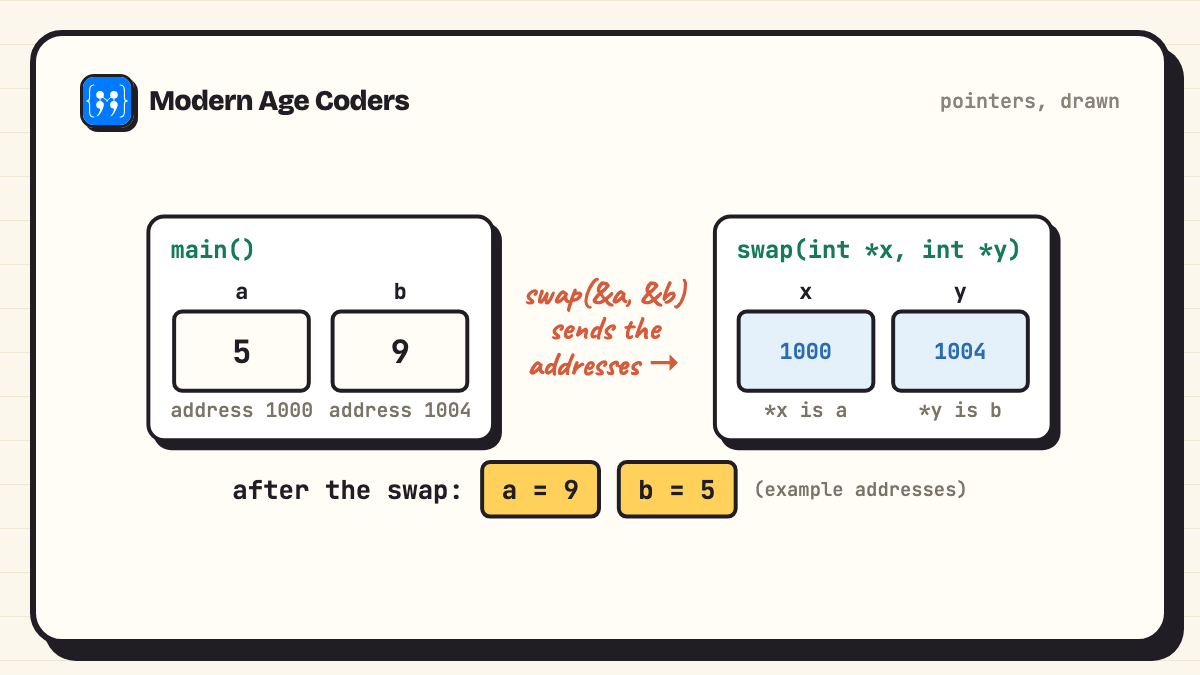
}a = 9, b = 5C passes copies of arguments. Passing the addresses (&a, &b) lets the function reach the original variables through *x and *y.
51. Pointers and arrays
Task: Walk through an array using a pointer instead of an index.
#include <stdio.h>

int main(void) {
    int a[] = {10, 20, 30, 40};
    int *p = a;                 /* same as &a[0] */
    for (int i = 0; i < 4; i++)
        printf("*(p + %d) = %d\n", i, *(p + i));
    printf("a[2] and *(a + 2) are both %d\n", *(a + 2));
    return 0;
}*(p + 0) = 10
*(p + 1) = 20
*(p + 2) = 30
*(p + 3) = 40
a[2] and *(a + 2) are both 30An array name works like a pointer to its first element, and a[i] is just a shorter way to write *(a + i).
52. Structure for student records
Task: Store and print student records using a struct.
#include <stdio.h>

struct Student {
    int roll;
    char name[20];
    float marks;
};

int main(void) {
    struct Student s[3] = {
        {1, "Ananya", 88.5f},
        {2, "Rahul", 74.0f},
        {3, "Sneha", 91.0f},
    };
    int top = 0;
    for (int i = 0; i < 3; i++) {
        printf("%d %-8s %.1f\n", s[i].roll, s[i].name, s[i].marks);
        if (s[i].marks > s[top].marks) top = i;
    }
    printf("Topper: %s\n", s[top].name);
    return 0;
}1 Ananya 88.5
2 Rahul 74.0
3 Sneha 91.0
Topper: SnehaA struct groups different types under one name. %-8s left-aligns the name in 8 characters so the marks line up.
53. Write to a file and read it back
Task: Write three lines to a text file, then read and print them.
#include <stdio.h>

int main(void) {
    FILE *fp = fopen("notes.txt", "w");
    if (fp == NULL) {
        printf("Could not open file\n");
        return 1;
    }
    fprintf(fp, "Line 1: C is fast\n");
    fprintf(fp, "Line 2: C is close to the hardware\n");
    fprintf(fp, "Line 3: C is everywhere\n");
    fclose(fp);

    char line[100];
    fp = fopen("notes.txt", "r");
    while (fgets(line, sizeof(line), fp) != NULL)
        printf("%s", line);
    fclose(fp);
    return 0;
}Line 1: C is fast
Line 2: C is close to the hardware
Line 3: C is everywhereAlways check that fopen() did not return NULL, and always fclose() what you open. fgets() returns NULL at the end of the file.
Common mistakes beginners make in C
Most C bugs in a first course are the same handful. Check for these before anything else:
- Missing & in scanf():
scanf("%d", n)compiles with only a warning, then crashes or reads garbage. It must be&n. - = instead of ==:
if (x = 5)assigns 5 and is always true. Turn on warnings (-Wall) and the compiler will point it out. - A semicolon after if or for:
for (i = 0; i < 5; i++);runs an empty loop, then the block below runs once. - Integer division:
7 / 2is 3 in C. Make one side a float (7.0 / 2) when you want 3.5. - Going past the end of an array: an array of size 5 has indexes 0 to 4. C will not stop you reading
a[5]; it just gives you whatever is there. - Forgetting the '\0': a string of 5 letters needs an array of at least 6 chars.
- Wrong format specifier:
%dfor int,%ffor float or double in printf,%lffor double in scanf,%cfor char,%sfor strings.
Predict, then run
Before you run any program on this page, write down what you think it will print. When you are wrong, you have found exactly the line you did not understand. That habit does more for your C than reading ten more programs.
Practice list: C programs to try on your own
Each of these uses only ideas from the programs above. Try them without looking anything up, then compare your approach with the nearest program in the list.
- Print all even numbers between 1 and 50 (use
i += 2). - Read a number and print its multiplication table up to 20.
- Check whether a number is a perfect number (equal to the sum of its divisors, like 28).
- Count how many times a given digit appears in a number.
- Convert a decimal number to binary using a loop and an array.
- Print an inverted pyramid of stars.
- Find the sum of the elements on the main diagonal of a 3 by 3 matrix.
- Remove all spaces from a string.
- Write a recursive function for the nth Fibonacci number.
- Store 5 books in an array of structs and print the most expensive one.
- Sort an array in descending order with selection sort.
- Count the lines, words and characters in a text file.
Which C programs to learn first
If you are a school student or in your first semester of BCA, B.Tech or B.Sc, this order works well:
- Week 1: programs 1 to 16 (basics and decisions).
- Week 2: programs 17 to 32 (loops, number programs and patterns).
- Week 3: programs 33 to 42 (arrays and matrices).
- Week 4: programs 43 to 53 (strings, functions, recursion, pointers, structures and files).
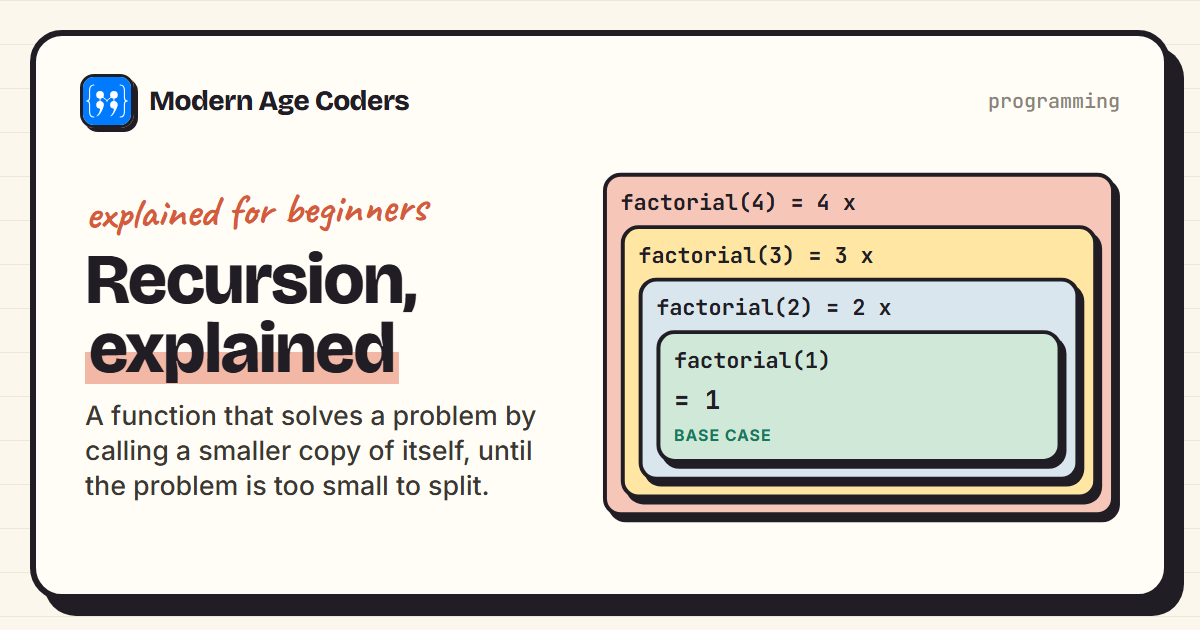
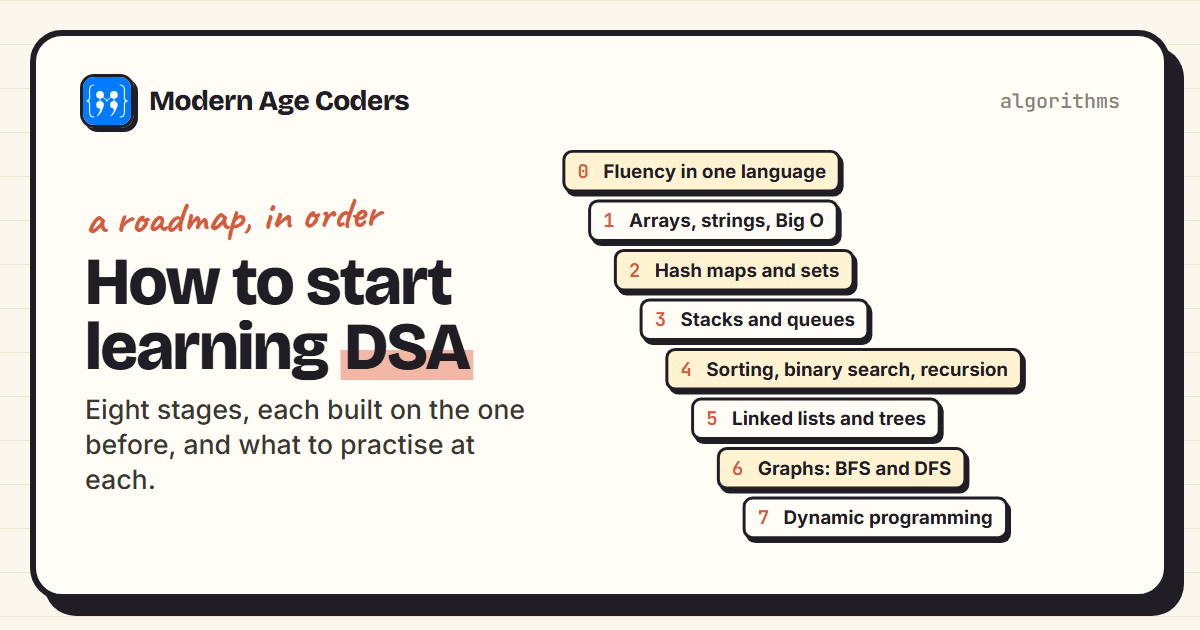
Recursion and pointers are where most beginners slow down, and that is normal. Our guide to recursion for beginners walks through what happens on each call, and how to start learning data structures and algorithms shows where these programs lead next.
How we teach it
Our how we teach page sets out the method: students explain their thinking, trace a loop line by line until they can predict every step, and treat mistakes as data rather than failures. In C that means drawing the memory boxes for a pointer before writing *x, and reading a compiler error out loud before fixing it. Our C programming course for college beginners builds from these programs to pointers, memory and real projects, and our learn coding from first principles page explains the approach. The first class is free.
Frequently asked questions
Hello World, adding two numbers, swapping two numbers, even or odd, largest of three numbers, leap year, factorial, Fibonacci series, prime number check, reversing a number, palindrome, multiplication table, and simple star patterns. All of them are on this page with their output.
Save the code in a file ending in .c, compile it with cc or gcc (for example cc hello.c -o hello), then run the program it creates (./hello on Mac or Linux, hello.exe on Windows). An IDE such as Code::Blocks does both steps with one button.
C is harder than Python because you manage more details yourself, such as data types, array sizes and memory. That is also why it teaches how computers really work. If you are under about 12, a gentler first language usually makes more sense.
C++ began as an extension of C, so most of these programs work in C++ too. C++ adds classes and objects, references, function overloading, templates and the standard library (string, vector, map). Our C++ programs for beginners page has the C++ versions.
Quality beats quantity. If you can write the 53 programs here from memory, explain each line, and solve the 12 practice problems on your own, you have covered a full first course in C.
If you double-click the .exe, the window closes when the program ends. Run it from a terminal (Command Prompt or PowerShell) instead, or run it from your IDE, which keeps the window open.
Usually a leftover newline from the previous scanf(). When you read a character with %c, put a space before it (" %c") to skip whitespace, as in the calculator program.
Use your browser: open this page, press Ctrl+P or Cmd+P and choose Save as PDF. Every program and output prints in order.
Moving on to C++? Our C++ programs for beginners covers the same ground with classes, strings, vectors and the standard library.