Table of Contents
- How to compile and run a C++ program
- All 54 C++ programs at a glance
- Basics: cout, cin, variables and operators
- Decisions: if, else and switch
- Loops and number programs
- Pattern programs
- Arrays and vectors
- Strings
- Functions, references and recursion
- Classes and objects (OOP)
- The standard library, exceptions and files
- C programs vs C++ programs: what changes
- Common mistakes beginners make in C++
- Practice list: C++ programs to try on your own
- Which C++ programs to learn first
- How we teach it
- Frequently asked questions
Here are 54 C++ programs for beginners, each with its full code and the exact output it printed when we compiled it as C++17 and ran it. They begin with cout, cin and basic operators, then cover decisions, loops and number programs, patterns, arrays and vectors, strings, functions and recursion, classes and objects, and the standard library (sort, map, set), exceptions and files.
Every program is complete: copy it into a .cpp file, compile, and you should see the same output. Programs that read input show the screen exactly as it looked, including what we typed. If you already know C, the C++ style here (strings, vectors, references and classes) is the part to focus on; if you are new to both, our C programs for beginners list covers the shared basics more slowly.
How these were tested
Every program was saved as a .cpp file, compiled with c++ -std=c++17 -Wall -Wextra (Apple clang 17) with zero warnings, and run in a terminal. The output boxes are copied from that run. g++ on Windows or Linux gives the same output, except where we say sizes can differ.
How to compile and run a C++ program
C++ is compiled: the compiler turns your .cpp file into a program, and then you run that program.
- Windows: install g++ through MinGW-w64, or use an IDE that includes a compiler, such as Code::Blocks or Visual Studio.
- Mac: run
xcode-select --installto get clang; thec++andg++commands both work after that. - Linux: install the
g++orbuild-essentialpackage.
c++ -std=c++17 hello.cpp -o hello   # compile (g++ works the same way)
./hello                             # run (on Windows: hello.exe)
The -std=c++17 flag matters for a few programs here: gcd(), lcm() and the [word, count] loop in the map program need C++17 or newer.
All 54 C++ programs at a glance
Use this as a practice checklist. The programs get harder as the numbers go up, so a complete beginner can work straight down the list.
| No. | Program | Topic |
|---|---|---|
| 1 | Hello, World | Basics |
| 2 | Add two numbers entered by the user | Basics |
| 3 | Swap two numbers | Basics |
| 4 | Data types and sizeof | Basics |
| 5 | Area and perimeter of a rectangle | Basics |
| 6 | Celsius to Fahrenheit with fixed decimals | Basics |
| 7 | Arithmetic operators and integer division | Basics |
| 8 | Even or odd | Decisions |
| 9 | Largest of three numbers | Decisions |
| 10 | Leap year check | Decisions |
| 11 | Calculator using switch | Decisions |
| 12 | Grade from marks | Decisions |
| 13 | Sum of the first n natural numbers | Loops and number programs |
| 14 | Factorial | Loops and number programs |
| 15 | Fibonacci series | Loops and number programs |
| 16 | Prime number check | Loops and number programs |
| 17 | Reverse a number and check for a palindrome | Loops and number programs |
| 18 | Armstrong numbers | Loops and number programs |
| 19 | GCD and LCM | Loops and number programs |
| 20 | Sum of digits with do-while | Loops and number programs |
| 21 | Multiplication table | Loops and number programs |
| 22 | Right triangle of stars | Pattern programs |
| 23 | Pyramid of stars | Pattern programs |
| 24 | Diamond of stars | Pattern programs |
| 25 | Pascal's triangle | Pattern programs |
| 26 | Sum, average, largest and smallest in an array | Arrays and vectors |
| 27 | Vector basics | Arrays and vectors |
| 28 | Reverse a vector | Arrays and vectors |
| 29 | Linear search in a vector | Arrays and vectors |
| 30 | Bubble sort | Arrays and vectors |
| 31 | Binary search | Arrays and vectors |
| 32 | Matrix multiplication with 2D vectors | Arrays and vectors |
| 33 | String basics | Strings |
| 34 | Palindrome string | Strings |
| 35 | Count vowels, consonants and words | Strings |
| 36 | Read a full line of text | Strings |
| 37 | Change case and reverse words | Strings |
| 38 | Pass by value vs pass by reference | Functions, references and recursion |
| 39 | Function overloading | Functions, references and recursion |
| 40 | Default arguments | Functions, references and recursion |
| 41 | Recursion: factorial, power and sum of digits | Functions, references and recursion |
| 42 | Tower of Hanoi | Functions, references and recursion |
| 43 | A first class: Rectangle | Classes and objects (OOP) |
| 44 | Bank account class with validation | Classes and objects (OOP) |
| 45 | Constructors and destructors | Classes and objects (OOP) |
| 46 | Inheritance | Classes and objects (OOP) |
| 47 | Polymorphism with virtual functions | Classes and objects (OOP) |
| 48 | Operator overloading | Classes and objects (OOP) |
| 49 | Function templates | Classes and objects (OOP) |
| 50 | Sorting with std::sort | The standard library, exceptions and files |
| 51 | Word frequency with map | The standard library, exceptions and files |
| 52 | Remove duplicates with set | The standard library, exceptions and files |
| 53 | Exception handling | The standard library, exceptions and files |
| 54 | Write and read a file with fstream | The standard library, exceptions and files |
C++ programs for beginners as a PDF
To keep a printable copy, open this page and press Ctrl+P (Cmd+P on a Mac), then choose "Save as PDF". Every program and output prints in order. You will learn far more, though, by typing each program yourself and comparing your output with ours.
Basics: cout, cin, variables and operators
C++ prints with cout and reads with cin, both from <iostream>. Start here even if you know C: the style is different.
1. Hello, World
Task: Print a message on the screen.
#include <iostream>
using namespace std;

int main() {
    cout << "Hello, World!" << endl;
    return 0;
}Hello, World!using namespace std; lets you write cout instead of std::cout. It is fine in small programs; larger projects usually write std:: in full.
2. Add two numbers entered by the user
Task: Read two integers with cin and print their sum.
#include <iostream>
using namespace std;

int main() {
    int a, b;
    cout << "Enter two numbers: ";
    cin >> a >> b;
    cout << "Sum = " << a + b << endl;
    return 0;
}Enter two numbers: 38 4
Sum = 42cin >> a >> b reads two values separated by a space or a new line. No & is needed, unlike scanf() in C.
3. Swap two numbers
Task: Swap two variables with a temporary variable and with std::swap.
#include <iostream>
using namespace std;

int main() {
    int a = 4, b = 11;
    int temp = a;
    a = b;
    b = temp;
    cout << "After manual swap: a = " << a << ", b = " << b << endl;
    swap(a, b);
    cout << "After std::swap:   a = " << a << ", b = " << b << endl;
    return 0;
}After manual swap: a = 11, b = 4
After std::swap: a = 4, b = 114. Data types and sizeof
Task: Print the size of the common data types and a value of each.
#include <iostream>
using namespace std;

int main() {
    int i = 42;
    double d = 3.14159;
    char c = 'Z';
    bool ok = true;
    string s = "C++";
    cout << "int " << i << " uses " << sizeof(i) << " bytes" << endl;
    cout << "double " << d << " uses " << sizeof(d) << " bytes" << endl;
    cout << "char " << c << " uses " << sizeof(c) << " byte" << endl;
    cout << "bool " << ok << " uses " << sizeof(ok) << " byte" << endl;
    cout << "string " << s << " has " << s.size() << " characters" << endl;
    return 0;
}int 42 uses 4 bytes
double 3.14159 uses 8 bytes
char Z uses 1 byte
bool 1 uses 1 byte
string C++ has 3 charactersA bool prints as 1 or 0 unless you add boolalpha. Sizes can differ between systems; these are from a 64-bit Mac.
5. Area and perimeter of a rectangle
Task: Calculate the area and perimeter of a rectangle.
#include <iostream>
using namespace std;

int main() {
    double length = 12.5, width = 4.0;
    cout << "Area = " << length * width << endl;
    cout << "Perimeter = " << 2 * (length + width) << endl;
    return 0;
}Area = 50
Perimeter = 336. Celsius to Fahrenheit with fixed decimals
Task: Convert temperatures and print them with one decimal place.
#include <iostream>
using namespace std;
#include <iomanip>

int main() {
    double celsius[] = {-40, 0, 36.6, 100};
    cout << fixed << setprecision(1);
    for (double c : celsius)
        cout << setw(6) << c << " C = " << setw(6) << c * 9 / 5 + 32 << " F" << endl;
    return 0;
} -40.0 C = -40.0 F
0.0 C = 32.0 F
36.6 C = 97.9 F
100.0 C = 212.0 Ffixed and setprecision(1) from <iomanip> control decimals; setw(6) pads each number to 6 characters so the columns line up. At −40 both scales agree.
7. Arithmetic operators and integer division
Task: Show what each arithmetic operator gives for 17 and 5.
#include <iostream>
using namespace std;

int main() {
    int a = 17, b = 5;
    cout << "a + b = " << a + b << endl;
    cout << "a - b = " << a - b << endl;
    cout << "a * b = " << a * b << endl;
    cout << "a / b = " << a / b << "   (integer division)" << endl;
    cout << "a % b = " << a % b << "   (remainder)" << endl;
    cout << "a / 5.0 = " << a / 5.0 << endl;
    return 0;
}a + b = 22
a - b = 12
a * b = 85
a / b = 3 (integer division)
a % b = 2 (remainder)
a / 5.0 = 3.4Two int values divide to an int, so 17 / 5 is 3. Make one side a decimal (5.0) to get 3.4.
Decisions: if, else and switch
The same decision tools as C, with bool as a real type and string values you can compare with ==.
8. Even or odd
Task: Read a number and say whether it is even or odd.
#include <iostream>
using namespace std;

int main() {
    int n;
    cout << "Enter a number: ";
    cin >> n;
    if (n % 2 == 0)
        cout << n << " is even" << endl;
    else
        cout << n << " is odd" << endl;
    return 0;
}Enter a number: 1024
1024 is even9. Largest of three numbers
Task: Find the largest of three numbers with if-else, then with max().
#include <iostream>
using namespace std;
#include <algorithm>

int main() {
    int a = 31, b = 76, c = 54;
    int largest;
    if (a >= b && a >= c) largest = a;
    else if (b >= c) largest = b;
    else largest = c;
    cout << "Largest (if-else): " << largest << endl;
    cout << "Largest (max):     " << max({a, b, c}) << endl;
    return 0;
}Largest (if-else): 76
Largest (max): 76max({a, b, c}) takes a list in braces and needs <algorithm>.
10. Leap year check
Task: Check several years using a bool function.
#include <iostream>
using namespace std;

bool isLeap(int y) {
    return (y % 4 == 0 && y % 100 != 0) || y % 400 == 0;
}

int main() {
    for (int y : {1900, 2000, 2024, 2025})
        cout << y << (isLeap(y) ? " is" : " is not") << " a leap year" << endl;
    return 0;
}1900 is not a leap year
2000 is a leap year
2024 is a leap year
2025 is not a leap year11. Calculator using switch
Task: Perform an arithmetic operation chosen by the user.
#include <iostream>
using namespace std;

int main() {
    double a, b;
    char op;
    cout << "Enter expression (e.g. 6 * 7): ";
    cin >> a >> op >> b;
    switch (op) {
        case '+': cout << a + b << endl; break;
        case '-': cout << a - b << endl; break;
        case '*': cout << a * b << endl; break;
        case '/':
            if (b == 0) cout << "Cannot divide by zero" << endl;
            else cout << a / b << endl;
            break;
        default: cout << "Unknown operator" << endl;
    }
    return 0;
}Enter expression (e.g. 6 * 7): 9 * 12
10812. Grade from marks
Task: Print a grade for each mark in a list.
#include <iostream>
using namespace std;

int main() {
    int marks[] = {95, 81, 67, 49, 30};
    for (int m : marks) {
        char g;
        if (m >= 90) g = 'A';
        else if (m >= 75) g = 'B';
        else if (m >= 60) g = 'C';
        else if (m >= 40) g = 'D';
        else g = 'F';
        cout << m << " -> " << g << endl;
    }
    return 0;
}95 -> A
81 -> B
67 -> C
49 -> D
30 -> FLoops and number programs
for, while, do-while and the range-based for loop, used on the classic number problems.
13. Sum of the first n natural numbers
Task: Add 1 to n with a loop and check it with the formula n(n+1)/2.
#include <iostream>
using namespace std;

int main() {
    int n = 50, sum = 0;
    for (int i = 1; i <= n; i++)
        sum += i;
    cout << "Loop: " << sum << ", formula: " << n * (n + 1) / 2 << endl;
    return 0;
}Loop: 1275, formula: 127514. Factorial
Task: Find factorials from 1 to 15.
#include <iostream>
using namespace std;

int main() {
    long long fact = 1;
    for (int i = 1; i <= 15; i++) {
        fact *= i;
        if (i % 5 == 0)
            cout << i << "! = " << fact << endl;
    }
    return 0;
}5! = 120
10! = 3628800
15! = 1307674368000long long holds at least 64 bits, enough for factorials up to 20!. An int would overflow at 13!.
15. Fibonacci series
Task: Print the Fibonacci numbers below 200.
#include <iostream>
using namespace std;

int main() {
    int a = 0, b = 1;
    while (a < 200) {
        cout << a << " ";
        int next = a + b;
        a = b;
        b = next;
    }
    cout << endl;
    return 0;
}0 1 1 2 3 5 8 13 21 34 55 89 144 16. Prime number check
Task: Check whether a number is prime.
#include <iostream>
using namespace std;

int main() {
    int n;
    cout << "Enter a number: ";
    cin >> n;
    bool prime = n > 1;
    for (int i = 2; i * i <= n; i++)
        if (n % i == 0) { prime = false; break; }
    cout << n << (prime ? " is prime" : " is not prime") << endl;
    return 0;
}Enter a number: 221
221 is not prime221 looks prime, but it is 13 × 17.
17. Reverse a number and check for a palindrome
Task: Reverse the digits of a number and say whether it is a palindrome.
#include <iostream>
using namespace std;

int main() {
    int n = 43234, original = n, rev = 0;
    while (n > 0) {
        rev = rev * 10 + n % 10;
        n /= 10;
    }
    cout << "Reversed: " << rev << endl;
    cout << original << (rev == original ? " is" : " is not") << " a palindrome" << endl;
    return 0;
}Reversed: 43234
43234 is a palindrome18. Armstrong numbers
Task: Print all Armstrong numbers below 10000.
#include <iostream>
using namespace std;
#include <string>
#include <cmath>

int main() {
    for (int n = 1; n < 10000; n++) {
        int digits = to_string(n).size(), sum = 0;
        for (int t = n; t > 0; t /= 10)
            sum += pow(t % 10, digits);
        if (sum == n) cout << n << " ";
    }
    cout << endl;
    return 0;
}1 2 3 4 5 6 7 8 9 153 370 371 407 1634 8208 9474 An Armstrong number equals the sum of its digits each raised to the number of digits, so 1634 = 14 + 64 + 34 + 44.
19. GCD and LCM
Task: Find the GCD and LCM of two numbers with std::gcd and std::lcm.
#include <iostream>
using namespace std;
#include <numeric>

int main() {
    int a = 84, b = 120;
    cout << "GCD = " << gcd(a, b) << endl;
    cout << "LCM = " << lcm(a, b) << endl;
    return 0;
}GCD = 12
LCM = 840gcd() and lcm() arrived in C++17 in <numeric>. Write Euclid's loop yourself once (as in our C list), then use the library.
20. Sum of digits with do-while
Task: Find the sum of the digits of a number.
#include <iostream>
using namespace std;

int main() {
    long long n = 9081726354LL;
    int sum = 0;
    do {
        sum += n % 10;
        n /= 10;
    } while (n > 0);
    cout << "Sum of digits = " << sum << endl;
    return 0;
}Sum of digits = 4521. Multiplication table
Task: Print the multiplication table of 13 in neat columns.
#include <iostream>
using namespace std;
#include <iomanip>

int main() {
    for (int i = 1; i <= 10; i++)
        cout << "13 x " << setw(2) << i << " = " << setw(3) << 13 * i << endl;
    return 0;
}13 x 1 = 13
13 x 2 = 26
13 x 3 = 39
13 x 4 = 52
13 x 5 = 65
13 x 6 = 78
13 x 7 = 91
13 x 8 = 104
13 x 9 = 117
13 x 10 = 130Pattern programs
Nested loops again: the outer loop chooses the row, the inner loops print the spaces and symbols on it.
22. Right triangle of stars
Task: Print a 5-row triangle of stars.
#include <iostream>
using namespace std;

int main() {
    for (int i = 1; i <= 5; i++) {
        for (int j = 1; j <= i; j++)
            cout << "* ";
        cout << endl;
    }
    return 0;
}*
* *
* * *
* * * *
* * * * * 23. Pyramid of stars
Task: Print a centred pyramid using string(n, ch).
#include <iostream>
using namespace std;

int main() {
    int n = 5;
    for (int i = 1; i <= n; i++)
        cout << string(n - i, ' ') << string(2 * i - 1, '*') << endl;
    return 0;
} *
***
*****
*******
*********string(count, ch) builds a string of repeated characters, which replaces both inner loops.
24. Diamond of stars
Task: Print a diamond by drawing a pyramid and then an upside-down pyramid.
#include <iostream>
using namespace std;

int main() {
    int n = 4;
    for (int i = 1; i <= n; i++)
        cout << string(n - i, ' ') << string(2 * i - 1, '*') << endl;
    for (int i = n - 1; i >= 1; i--)
        cout << string(n - i, ' ') << string(2 * i - 1, '*') << endl;
    return 0;
} *
***
*****
*******
*****
***
*25. Pascal's triangle
Task: Print the first 6 rows of Pascal's triangle.
#include <iostream>
using namespace std;

int main() {
    int rows = 6;
    for (int i = 0; i < rows; i++) {
        cout << string(rows - i - 1, ' ');
        int value = 1;
        for (int k = 0; k <= i; k++) {
            cout << value << " ";
            value = value * (i - k) / (k + 1);
        }
        cout << endl;
    }
    return 0;
} 1
1 1
1 2 1
1 3 3 1
1 4 6 4 1
1 5 10 10 5 1 Each next number in a row is the previous one times (i − k) / (k + 1), which avoids computing factorials.
Arrays and vectors
A plain array has a fixed size. A vector grows as you add to it, knows its own size, and works with the standard algorithms. Beginners should reach for vector by default.
26. Sum, average, largest and smallest in an array
Task: Process a fixed array of marks.
#include <iostream>
using namespace std;

int main() {
    int marks[] = {72, 88, 95, 61, 79, 84};
    int n = sizeof(marks) / sizeof(marks[0]);
    int sum = 0, hi = marks[0], lo = marks[0];
    for (int m : marks) {
        sum += m;
        if (m > hi) hi = m;
        if (m < lo) lo = m;
    }
    cout << "Sum " << sum << ", average " << (double)sum / n
         << ", highest " << hi << ", lowest " << lo << endl;
    return 0;
}Sum 479, average 79.8333, highest 95, lowest 6127. Vector basics
Task: Create a vector, add and remove elements, and loop over it.
#include <iostream>
using namespace std;
#include <vector>

int main() {
    vector<int> v = {5, 10, 15};
    v.push_back(20);
    v.push_back(25);
    v.pop_back();
    v.insert(v.begin(), 0);
    cout << "Size: " << v.size() << endl;
    cout << "Elements:";
    for (int x : v) cout << " " << x;
    cout << endl;
    cout << "First " << v.front() << ", last " << v.back() << ", v[2] = " << v[2] << endl;
    return 0;
}Size: 5
Elements: 0 5 10 15 20
First 0, last 20, v[2] = 10push_back() adds at the end and pop_back() removes from the end. v.at(i) is a safer version of v[i] that checks the index.
28. Reverse a vector
Task: Reverse a vector by hand and with std::reverse.
#include <iostream>
using namespace std;
#include <vector>
#include <algorithm>

int main() {
    vector<int> v = {1, 2, 3, 4, 5, 6, 7};
    for (size_t i = 0, j = v.size() - 1; i < j; i++, j--)
        swap(v[i], v[j]);
    for (int x : v) cout << x << " ";
    cout << endl;
    reverse(v.begin(), v.end());
    for (int x : v) cout << x << " ";
    cout << endl;
    return 0;
}7 6 5 4 3 2 1
1 2 3 4 5 6 7 29. Linear search in a vector
Task: Find the position of a value, by hand and with std::find.
#include <iostream>
using namespace std;
#include <vector>
#include <algorithm>

int main() {
    vector<int> v = {14, 3, 27, 8, 41, 19};
    int key = 41;
    for (size_t i = 0; i < v.size(); i++)
        if (v[i] == key) cout << key << " found at index " << i << endl;
    auto it = find(v.begin(), v.end(), 99);
    cout << "99 " << (it == v.end() ? "not found" : "found") << endl;
    return 0;
}41 found at index 4
99 not foundfind() returns v.end() when the value is not there. Comparing with end() is how the standard library says "not found".
30. Bubble sort
Task: Sort a vector with bubble sort, stopping early if a pass makes no swaps.
#include <iostream>
using namespace std;
#include <vector>

int main() {
    vector<int> v = {29, 10, 14, 37, 13, 5};
    int passes = 0;
    for (size_t i = 0; i < v.size() - 1; i++) {
        bool swapped = false;
        for (size_t j = 0; j < v.size() - 1 - i; j++)
            if (v[j] > v[j + 1]) {
                swap(v[j], v[j + 1]);
                swapped = true;
            }
        passes++;
        if (!swapped) break;
    }
    for (int x : v) cout << x << " ";
    cout << "\nPasses: " << passes << endl;
    return 0;
}5 10 13 14 29 37
Passes: 531. Binary search
Task: Search a sorted vector by halving the range.
#include <iostream>
using namespace std;
#include <vector>

int binarySearch(const vector<int>& v, int key) {
    int low = 0, high = v.size() - 1;
    while (low <= high) {
        int mid = low + (high - low) / 2;
        if (v[mid] == key) return mid;
        if (v[mid] < key) low = mid + 1;
        else high = mid - 1;
    }
    return -1;
}

int main() {
    vector<int> v = {2, 5, 8, 12, 16, 23, 38, 56, 72, 91};
    cout << "23 at index " << binarySearch(v, 23) << endl;
    cout << "40 at index " << binarySearch(v, 40) << endl;
    return 0;
}23 at index 5
40 at index -1low + (high - low) / 2 gives the same middle as (low + high) / 2 but cannot overflow for huge arrays. −1 means not found.
32. Matrix multiplication with 2D vectors
Task: Multiply two 2 by 2 matrices stored as vectors of vectors.
#include <iostream>
using namespace std;
#include <vector>

int main() {
    vector<vector<int>> a = {{1, 2}, {3, 4}};
    vector<vector<int>> b = {{5, 6}, {7, 8}};
    vector<vector<int>> c(2, vector<int>(2, 0));
    for (int i = 0; i < 2; i++)
        for (int j = 0; j < 2; j++)
            for (int k = 0; k < 2; k++)
                c[i][j] += a[i][k] * b[k][j];
    for (auto& row : c) {
        for (int x : row) cout << x << " ";
        cout << endl;
    }
    return 0;
}19 22
43 50 Strings
The C++ string class does the memory work for you: join with +, compare with ==, and ask for .size().
33. String basics
Task: Join, measure, slice and search strings.
#include <iostream>
using namespace std;
#include <string>

int main() {
    string first = "Modern", second = "Coders";
    string full = first + " Age " + second;
    cout << full << endl;
    cout << "Length: " << full.size() << endl;
    cout << "substr(7, 3): " << full.substr(7, 3) << endl;
    cout << "find(\"Coders\"): " << full.find("Coders") << endl;
    cout << "First char: " << full[0] << ", last char: " << full.back() << endl;
    return 0;
}Modern Age Coders
Length: 17
substr(7, 3): Age
find("Coders"): 11
First char: M, last char: ssubstr(start, length) takes a starting index and a count, not an end index.
34. Palindrome string
Task: Check palindromes, ignoring case and spaces.
#include <iostream>
using namespace std;
#include <string>
#include <algorithm>
#include <cctype>

bool isPalindrome(string s) {
    string clean;
    for (char ch : s)
        if (isalpha(ch)) clean += tolower(ch);
    string rev(clean.rbegin(), clean.rend());
    return clean == rev;
}

int main() {
    for (string s : {"Madam", "Was it a car or a cat I saw", "Programming"})
        cout << s << ": " << (isPalindrome(s) ? "palindrome" : "not a palindrome") << endl;
    return 0;
}Madam: palindrome
Was it a car or a cat I saw: palindrome
Programming: not a palindrome35. Count vowels, consonants and words
Task: Count the vowels, consonants and words in a sentence.
#include <iostream>
using namespace std;
#include <string>
#include <sstream>
#include <cctype>

int main() {
    string s = "Practice makes code better";
    int v = 0, c = 0, words = 0;
    for (char ch : s) {
        char l = tolower(ch);
        if (l == 'a' || l == 'e' || l == 'i' || l == 'o' || l == 'u') v++;
        else if (isalpha(l)) c++;
    }
    stringstream ss(s);
    string w;
    while (ss >> w) words++;
    cout << "Vowels " << v << ", consonants " << c << ", words " << words << endl;
    return 0;
}Vowels 9, consonants 14, words 4A stringstream reads a string the way cin reads the keyboard, one word at a time, which makes word counting easy.
36. Read a full line of text
Task: Read a name with spaces using getline() and greet the user.
#include <iostream>
using namespace std;
#include <string>

int main() {
    string name;
    int age;
    cout << "Your full name: ";
    getline(cin, name);
    cout << "Your age: ";
    cin >> age;
    cout << "Hello " << name << ", in 10 years you will be " << age + 10 << endl;
    return 0;
}Your full name: Ira Malhotra
Your age: 15
Hello Ira Malhotra, in 10 years you will be 25cin >> name would stop at the first space and keep only "Ira". getline() reads the whole line.
37. Change case and reverse words
Task: Convert a sentence to uppercase and print its words in reverse order.
#include <iostream>
using namespace std;
#include <string>
#include <vector>
#include <sstream>
#include <cctype>

int main() {
    string s = "learn one thing well";
    string up = s;
    for (char& ch : up) ch = toupper(ch);
    cout << up << endl;
    stringstream ss(s);
    vector<string> words;
    string w;
    while (ss >> w) words.push_back(w);
    for (int i = words.size() - 1; i >= 0; i--)
        cout << words[i] << (i ? " " : "\n");
    return 0;
}LEARN ONE THING WELL
well thing one learnfor (char& ch : up) uses a reference, so changing ch changes the string itself.
Functions, references and recursion
How C++ passes values, references and overloaded functions, and functions that call themselves.
38. Pass by value vs pass by reference
Task: Show that a reference parameter changes the caller's variable and a value parameter does not.
#include <iostream>
using namespace std;

void byValue(int x) { x = x * 10; }
void byReference(int& x) { x = x * 10; }

int main() {
    int a = 7, b = 7;
    byValue(a);
    byReference(b);
    cout << "after byValue: a = " << a << endl;
    cout << "after byReference: b = " << b << endl;
    return 0;
}after byValue: a = 7
after byReference: b = 70The & in int& x makes x another name for the caller's variable. In C you would need a pointer for this; C++ references make it simpler.
39. Function overloading
Task: Write three area() functions with different parameters.
#include <iostream>
using namespace std;

const double PI = 3.14159;

double area(double r) { return PI * r * r; }            // circle
int area(int l, int w) { return l * w; }                // rectangle
double area(double b, double h, bool) { return 0.5 * b * h; }  // triangle

int main() {
    cout << "Circle r = 2: " << area(2.0) << endl;
    cout << "Rectangle 4 x 6: " << area(4, 6) << endl;
    cout << "Triangle b = 10, h = 3: " << area(10.0, 3.0, true) << endl;
    return 0;
}Circle r = 2: 12.5664
Rectangle 4 x 6: 24
Triangle b = 10, h = 3: 15C++ picks the right function from the number and types of the arguments. (The unnamed bool only exists to give the triangle version a different parameter list.)
40. Default arguments
Task: Give a function default values for its later parameters.
#include <iostream>
using namespace std;

double compound(double principal, double rate = 5.0, int years = 1) {
    double amount = principal;
    for (int i = 0; i < years; i++)
        amount *= 1 + rate / 100;
    return amount;
}

int main() {
    cout << compound(1000) << endl;          // 5%, 1 year
    cout << compound(1000, 10) << endl;      // 10%, 1 year
    cout << compound(1000, 10, 3) << endl;   // 10%, 3 years
    return 0;
}1050
1100
133141. Recursion: factorial, power and sum of digits
Task: Solve three small problems with recursive functions.
#include <iostream>
using namespace std;

long long factorial(int n) { return n <= 1 ? 1 : n * factorial(n - 1); }
long long power(int b, int e) { return e == 0 ? 1 : b * power(b, e - 1); }
int digitSum(int n) { return n < 10 ? n : n % 10 + digitSum(n / 10); }

int main() {
    cout << "factorial(12) = " << factorial(12) << endl;
    cout << "power(2, 20) = " << power(2, 20) << endl;
    cout << "digitSum(98765) = " << digitSum(98765) << endl;
    return 0;
}factorial(12) = 479001600
power(2, 20) = 1048576
digitSum(98765) = 35Each function has a base case (n <= 1, e == 0, n < 10) and a call on a smaller problem. Spot those two parts and every recursive function becomes readable.
42. Tower of Hanoi
Task: Print the moves to shift 3 discs from peg A to peg C.
#include <iostream>
using namespace std;

int moves = 0;

void hanoi(int n, char from, char to, char via) {
    if (n == 0) return;
    hanoi(n - 1, from, via, to);
    cout << "Move disc " << n << " from " << from << " to " << to << endl;
    moves++;
    hanoi(n - 1, via, to, from);
}

int main() {
    hanoi(3, 'A', 'C', 'B');
    cout << "Total moves: " << moves << endl;
    return 0;
}Move disc 1 from A to C
Move disc 2 from A to B
Move disc 1 from C to B
Move disc 3 from A to C
Move disc 1 from B to A
Move disc 2 from B to C
Move disc 1 from A to C
Total moves: 7n discs always take 2n − 1 moves, so 3 discs take 7.
Classes and objects (OOP)
The idea C++ is known for: bundle data and the functions that work on it into a class, then create objects from it.
43. A first class: Rectangle
Task: Write a class with private data, a constructor and member functions.
#include <iostream>
using namespace std;

class Rectangle {
    double length, width;          // private by default
public:
    Rectangle(double l, double w) : length(l), width(w) {}
    double area() const { return length * width; }
    double perimeter() const { return 2 * (length + width); }
};

int main() {
    Rectangle r(8, 3.5);
    cout << "Area: " << r.area() << endl;
    cout << "Perimeter: " << r.perimeter() << endl;
    return 0;
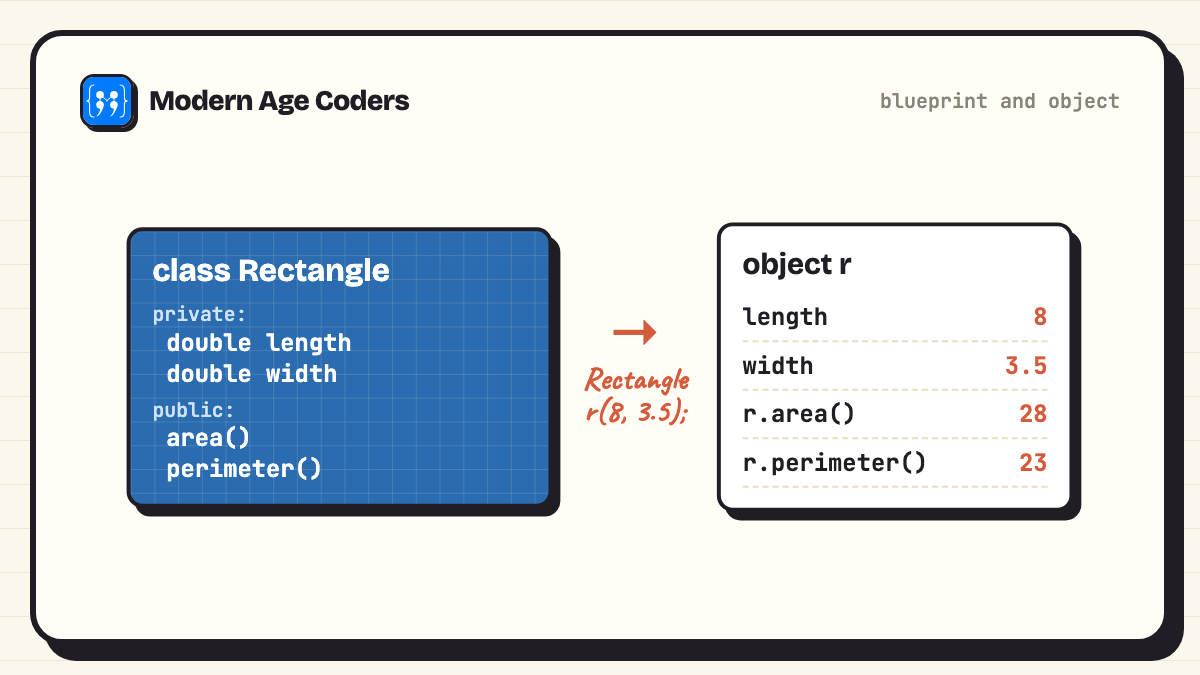
}Area: 28
Perimeter: 23Members of a class are private unless you say public:, so code outside the class cannot change length directly. That is encapsulation.
44. Bank account class with validation
Task: Model a bank account that refuses invalid deposits and withdrawals.
#include <iostream>
using namespace std;
#include <string>

class BankAccount {
    string owner;
    double balance;
public:
    BankAccount(string name, double opening) : owner(name), balance(opening) {}
    void deposit(double amt) {
        if (amt <= 0) { cout << "Deposit must be positive" << endl; return; }
        balance += amt;
        cout << "Deposited " << amt << ", balance " << balance << endl;
    }
    void withdraw(double amt) {
        if (amt > balance) { cout << "Insufficient balance" << endl; return; }
        balance -= amt;
        cout << "Withdrew " << amt << ", balance " << balance << endl;
    }
};

int main() {
    BankAccount acc("Kavya", 500);
    acc.deposit(250);
    acc.withdraw(1000);
    acc.withdraw(300);
    acc.deposit(-20);
    return 0;
}Deposited 250, balance 750
Insufficient balance
Withdrew 300, balance 450
Deposit must be positiveBecause balance is private, the only way to change it is through deposit() and withdraw(), which check every request first.
45. Constructors and destructors
Task: Show when a constructor and a destructor run.
#include <iostream>
using namespace std;
#include <string>

class Tracker {
    string name;
public:
    Tracker(string n) : name(n) { cout << "Constructor: " << name << endl; }
    ~Tracker() { cout << "Destructor: " << name << endl; }
};

int main() {
    Tracker a("first");
    {
        Tracker b("inner");
        cout << "Inside the block" << endl;
    }
    cout << "Back in main" << endl;
    return 0;
}Constructor: first
Constructor: inner
Inside the block
Destructor: inner
Back in main
Destructor: firstb is destroyed as soon as its block ends; a lasts until main() finishes. Objects are destroyed in reverse order of creation.
46. Inheritance
Task: Create a Student class that inherits from a Person class.
#include <iostream>
using namespace std;
#include <string>

class Person {
protected:
    string name;
    int age;
public:
    Person(string n, int a) : name(n), age(a) {}
    void introduce() const { cout << "I am " << name << ", age " << age << endl; }
};

class Student : public Person {
    string school;
public:
    Student(string n, int a, string s) : Person(n, a), school(s) {}
    void study() const { cout << name << " studies at " << school << endl; }
};

int main() {
    Student s("Arjun", 16, "Green Valley School");
    s.introduce();      // inherited from Person
    s.study();          // Student's own function
    return 0;
}I am Arjun, age 16
Arjun studies at Green Valley Schoolprotected members are hidden from outside code but visible to derived classes, which is why study() can use name.
47. Polymorphism with virtual functions
Task: Call the right area() for different shapes through a base-class pointer.
#include <iostream>
using namespace std;
#include <vector>
#include <memory>

class Shape {
public:
    virtual double area() const = 0;     // pure virtual: Shape is abstract
    virtual string name() const = 0;
    virtual ~Shape() = default;
};

class Circle : public Shape {
    double r;
public:
    Circle(double r) : r(r) {}
    double area() const override { return 3.14159 * r * r; }
    string name() const override { return "Circle"; }
};

class Square : public Shape {
    double s;
public:
    Square(double s) : s(s) {}
    double area() const override { return s * s; }
    string name() const override { return "Square"; }
};

int main() {
    vector<unique_ptr<Shape>> shapes;
    shapes.push_back(make_unique<Circle>(1.5));
    shapes.push_back(make_unique<Square>(4));
    for (const auto& sh : shapes)
        cout << sh->name() << " area: " << sh->area() << endl;
    return 0;
}Circle area: 7.06858
Square area: 16The loop only knows it has Shape pointers, yet each object runs its own area(). That is runtime polymorphism, made possible by virtual. unique_ptr deletes each shape automatically.
48. Operator overloading
Task: Add two fractions with the + operator and print them with <<.
#include <iostream>
using namespace std;
#include <numeric>

class Fraction {
    int num, den;
public:
    Fraction(int n, int d) : num(n), den(d) {
        int g = gcd(num, den);
        num /= g; den /= g;
    }
    Fraction operator+(const Fraction& o) const {
        return Fraction(num * o.den + o.num * den, den * o.den);
    }
    friend ostream& operator<<(ostream& out, const Fraction& f) {
        return out << f.num << "/" << f.den;
    }
};

int main() {
    Fraction a(1, 4), b(1, 6);
    cout << a << " + " << b << " = " << a + b << endl;
    return 0;
}1/4 + 1/6 = 5/12The constructor reduces every fraction with gcd(), so 10/24 becomes 5/12 automatically.
49. Function templates
Task: Write one function that works for any type.
#include <iostream>
using namespace std;
#include <string>

template <typename T>
T largest(T a, T b, T c) {
    T m = a;
    if (b > m) m = b;
    if (c > m) m = c;
    return m;
}

int main() {
    cout << largest(3, 9, 4) << endl;
    cout << largest(2.5, 1.5, 2.75) << endl;
    cout << largest(string("kiwi"), string("apple"), string("mango")) << endl;
    return 0;
}9
2.75
mangoThe compiler writes a separate version of largest() for int, double and string. Strings compare alphabetically, so "mango" wins.
The standard library, exceptions and files
Ready-made tools that save you writing your own: sort, map, set, exceptions and file streams.
50. Sorting with std::sort
Task: Sort numbers ascending and descending, and sort words by length.
#include <iostream>
using namespace std;
#include <vector>
#include <algorithm>
#include <string>

int main() {
    vector<int> v = {42, 7, 19, 73, 3, 56};
    sort(v.begin(), v.end());
    for (int x : v) cout << x << " ";
    cout << endl;
    sort(v.begin(), v.end(), greater<int>());
    for (int x : v) cout << x << " ";
    cout << endl;
    vector<string> w = {"banana", "fig", "cherry", "kiwi"};
    stable_sort(w.begin(), w.end(), [](const string& a, const string& b) {
        return a.size() < b.size();
    });
    for (auto& s : w) cout << s << " ";
    cout << endl;
    return 0;
}3 7 19 42 56 73
73 56 42 19 7 3
fig kiwi banana cherry The third argument to sort() decides the order. The last one is a lambda, a small unnamed function written in place. We use stable_sort() there so words of equal length (banana and cherry) keep their original order on every compiler.
51. Word frequency with map
Task: Count how many times each word appears in a sentence.
#include <iostream>
using namespace std;
#include <map>
#include <sstream>
#include <string>

int main() {
    string text = "the cat and the dog and the bird";
    map<string, int> freq;
    stringstream ss(text);
    string w;
    while (ss >> w) freq[w]++;
    for (const auto& [word, count] : freq)
        cout << word << ": " << count << endl;
    return 0;
}and: 2
bird: 1
cat: 1
dog: 1
the: 3freq[w]++ creates the entry with 0 the first time a word appears. A map keeps its keys sorted, so the words come out alphabetically.
52. Remove duplicates with set
Task: Keep only the unique values from a list.
#include <iostream>
using namespace std;
#include <set>
#include <vector>

int main() {
    vector<int> rolls = {4, 2, 6, 2, 4, 4, 1, 6, 3};
    set<int> unique(rolls.begin(), rolls.end());
    cout << "Unique values:";
    for (int x : unique) cout << " " << x;
    cout << "\nCount: " << unique.size() << endl;
    cout << "Contains 5? " << (unique.count(5) ? "yes" : "no") << endl;
    return 0;
}Unique values: 1 2 3 4 6
Count: 5
Contains 5? no53. Exception handling
Task: Catch division by zero and an out-of-range index.
#include <iostream>
using namespace std;
#include <vector>
#include <stdexcept>

double safeDivide(double a, double b) {
    if (b == 0) throw runtime_error("division by zero");
    return a / b;
}

int main() {
    try {
        cout << safeDivide(10, 4) << endl;
        cout << safeDivide(1, 0) << endl;
    } catch (const runtime_error& e) {
        cout << "Error: " << e.what() << endl;
    }
    vector<int> v = {1, 2, 3};
    try {
        cout << v.at(5) << endl;
    } catch (const out_of_range& e) {
        cout << "Index error caught" << endl;
    }
    return 0;
}2.5
Error: division by zero
Index error caughtthrow jumps straight to the matching catch, skipping the rest of the try block. v.at(5) throws out_of_range, where v[5] would silently read invalid memory.
54. Write and read a file with fstream
Task: Save student marks to a file, read them back and find the average.
#include <iostream>
using namespace std;
#include <fstream>
#include <string>

int main() {
    ofstream out("marks.txt");
    out << "Riya 88\nOmar 74\nLeela 93\n";
    out.close();

    ifstream in("marks.txt");
    string name;
    int mark, total = 0, count = 0;
    while (in >> name >> mark) {
        cout << name << " scored " << mark << endl;
        total += mark;
        count++;
    }
    cout << "Average: " << (double)total / count << endl;
    return 0;
}Riya scored 88
Omar scored 74
Leela scored 93
Average: 85ofstream writes and ifstream reads, using the same << and >> as cout and cin. The loop stops when in >> name >> mark fails at the end of the file.
C programs vs C++ programs: what changes
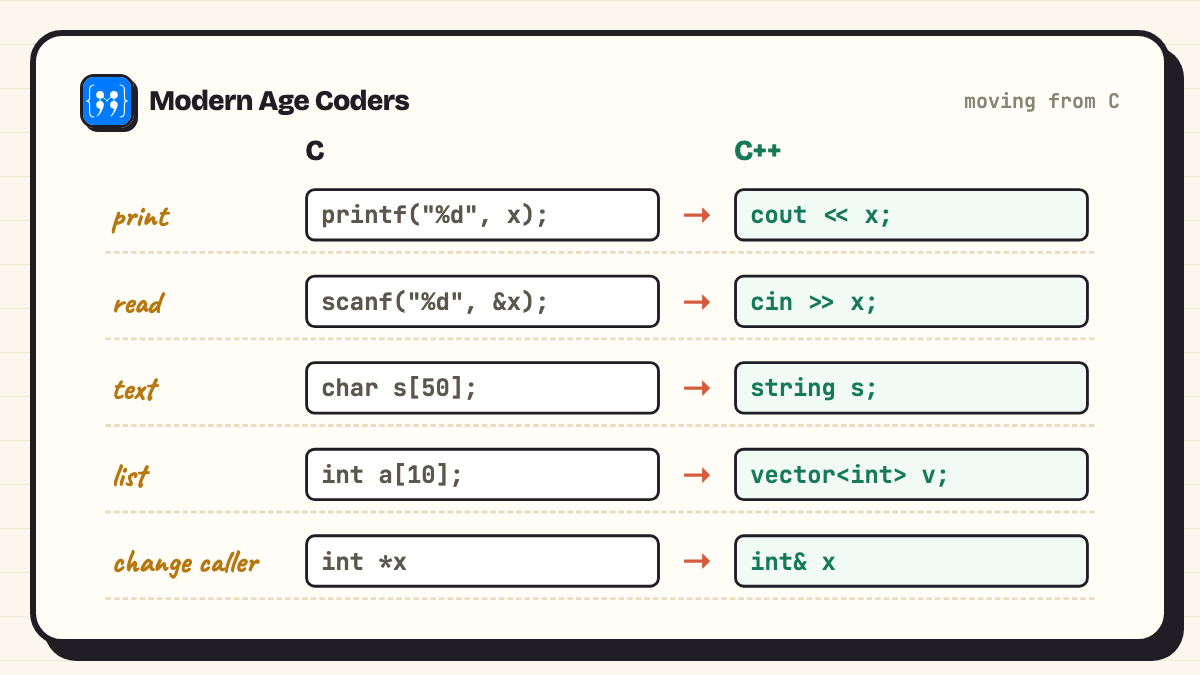
| Task | C | C++ |
|---|---|---|
printf("%d", x); |
cout << x; |
|
| Read input | scanf("%d", &x); |
cin >> x; |
| Text | char s[50]; and string.h |
string s; with +, ==, .size() |
| List of values | fixed-size array | vector<int> that grows |
| Change a caller's variable | pointer: int *x |
reference: int& x |
| Group data and functions | struct with data only |
class with data, functions and access control |
| Errors | return codes | exceptions: throw, try, catch |
Common mistakes beginners make in C++
- Mixing cin >> and getline(): after
cin >> age, the newline is still waiting, so a followinggetline()returns an empty line. Callcin.ignore()in between. - Integer division:
7 / 2is 3. Use7.0 / 2or a cast when you want 3.5. - Out-of-range indexes:
v[10]on a 5-element vector is undefined behaviour. Usev.at(10)while learning; it throws an exception instead. - Forgetting the semicolon after a class:
class A { ... };needs that final semicolon. - Comparing signed and unsigned:
v.size()is unsigned, so loop withsize_tor the range-based for to avoid surprises (and warnings). - Missing headers: code that compiles on one compiler can fail on another if you rely on a header being included by accident. Include what you use:
<vector>,<string>,<algorithm>.
Change one thing, then predict
After a program works, change one value (the vector, the loop limit, the input) and predict the new output before running it. Being right twice in a row means you understand the program; being wrong shows you exactly which line to reread.
Practice list: C++ programs to try on your own
- Read 5 numbers into a vector and print them in sorted order without using
sort(). - Count the uppercase letters, lowercase letters and digits in a string.
- Write a
Studentclass with a name and three marks, and a function that returns the average. - Add a
Triangleclass to the polymorphism program. - Use a
mapto count how many times each letter appears in a word. - Write a recursive function that reverses a string.
- Overload
==for the Fraction class so 1/2 == 2/4 is true. - Write a template function that returns the largest element of any vector.
- Read numbers from a file and write only the even ones to another file.
- Throw an exception from a
BankAccountinstead of printing a message, and catch it inmain().
Which C++ programs to learn first
- Complete beginner: programs 1 to 25 (basics, decisions, loops, patterns).
- Next: programs 26 to 37 (arrays, vectors and strings).
- Then: programs 38 to 49 (functions, recursion and classes).
- Last: programs 50 to 54 (standard library, exceptions and files).
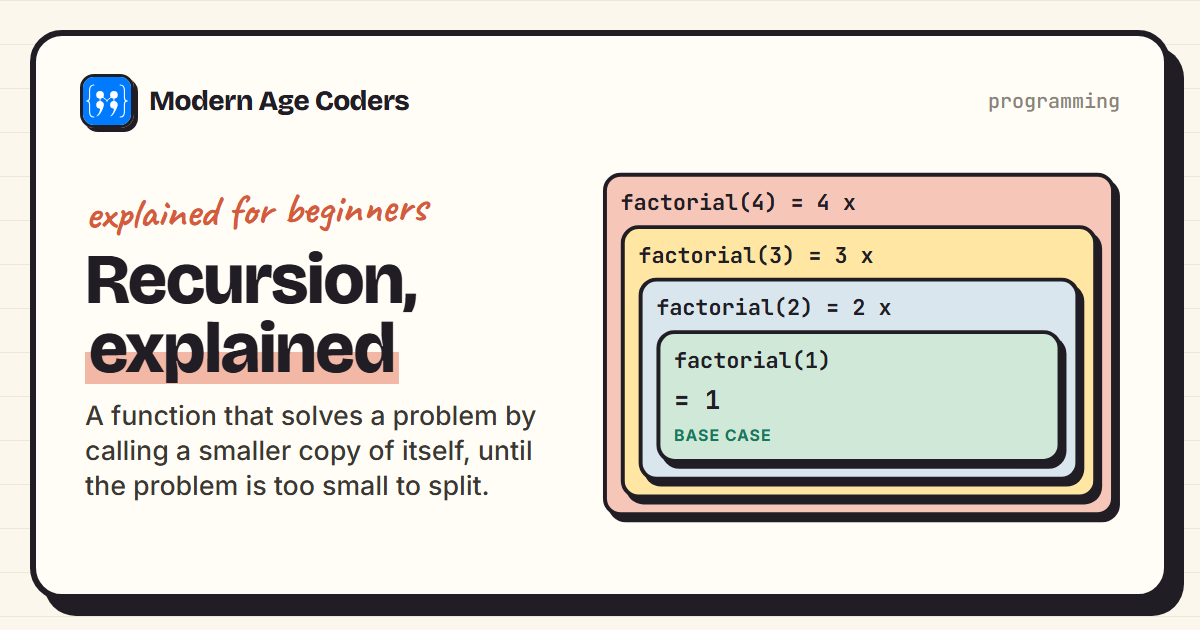
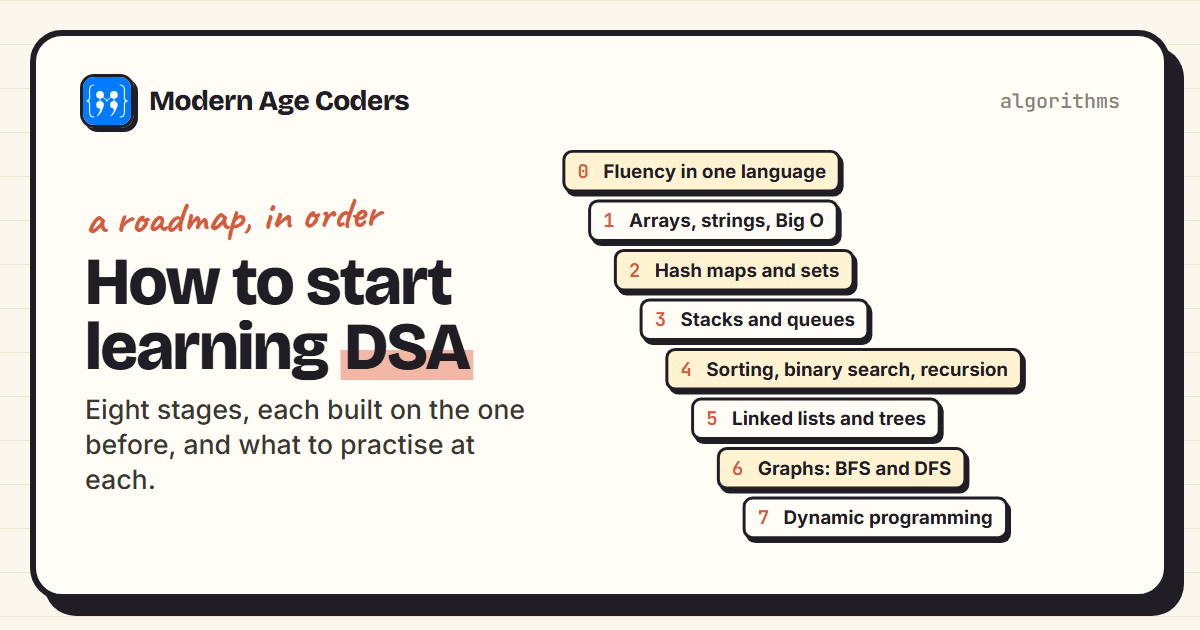
If recursion feels strange, our recursion guide traces each call step by step. Once vectors, sorting and searching feel easy, how to start learning data structures and algorithms shows where C++ is most often used next.
How we teach it
Our how we teach page describes how lessons run: students explain their thinking, trace a loop line by line until they can predict every step, and treat mistakes as data, not failures. With C++ that means predicting which constructor and destructor run before running the program, and reading a compiler error out loud before touching the code. Our C++ for beginners page explains the options, and the C++ course for teens and C++ course for kids build from programs like these to games and contest problems. The first class is free.
Frequently asked questions
Hello World, adding two numbers, swapping values, even or odd, largest of three numbers, leap year, factorial, Fibonacci, prime check, reversing a number, star patterns, array sum and average, string reversal and a first class such as Rectangle. All are on this page with their output.
Save it as a .cpp file, compile it with c++ or g++ (for example c++ -std=c++17 hello.cpp -o hello), then run the result (./hello on Mac or Linux, hello.exe on Windows). IDEs such as Code::Blocks and Visual Studio do both steps with one button.
No, you can start with C++ directly. C++ includes almost all of C, and its strings and vectors are easier for beginners than C's character arrays. Learning C first does help you understand pointers and memory, so either order works.
C++ adds classes and objects, references, function overloading, templates, exceptions and a large standard library (string, vector, map, set, sort). The table on this page shows the most common swaps, such as cout for printf and vector for fixed arrays.
In small learning programs it is fine and keeps the code short. In larger projects and header files, writing std:: in full avoids name clashes, so many teams avoid it there.
C++17 or newer. Every program here was compiled as C++17. A few use features (gcd, lcm and structured bindings) that older standards do not have.
It is widely used there, because it is fast and the standard library has sorting, maps, sets and many algorithms ready to use. Programs 26 to 32 and 50 to 52 are the foundation.
Open this page, press Ctrl+P or Cmd+P and choose Save as PDF. Every program and output prints in order.
Prefer to start with C? See our C programs for beginners, with the same topics in plain C.