CSE / EXAM / 01
HKDSE ICT: Programming and Exam Prep
Python or C++ for the DSE.
Open the syllabusHong Kong · Secondary school · S1 to S6 and Years 7 to 13
Some secondary students want coding for an exam, some for a contest, some to understand AI, and some simply to build an app their friends will use. Those are different routes with different first languages. We teach Hong Kong secondary students one to one, live and in English, and we start by working out which route is yours.
Teaching since 2020 · 10,000+ students worldwide · Hong Kong secondary students learn one to one, live, in English
In a few lines
Coding for secondary students in Hong Kong usually follows one of four routes: an exam (HKDSE ICT, IGCSE, IB or A level), a contest (HKOI), AI and data, or building real apps and sites. Each wants a different first language and pace. Modern Age Coders runs live online lessons for secondary students, always one to one and always in English, with mentors in India and lesson times set around the student's Hong Kong week. Most start with Python; contest students add C++. The first class is free and doubles as a placement check.
Courses first
Three starting points that between them cover almost every secondary student we meet in Hong Kong.

CSE / 01
The default start on every route: the language of DSE ICT (alongside C++), of IGCSE from 2029, and of nearly all AI work.
Open the syllabus →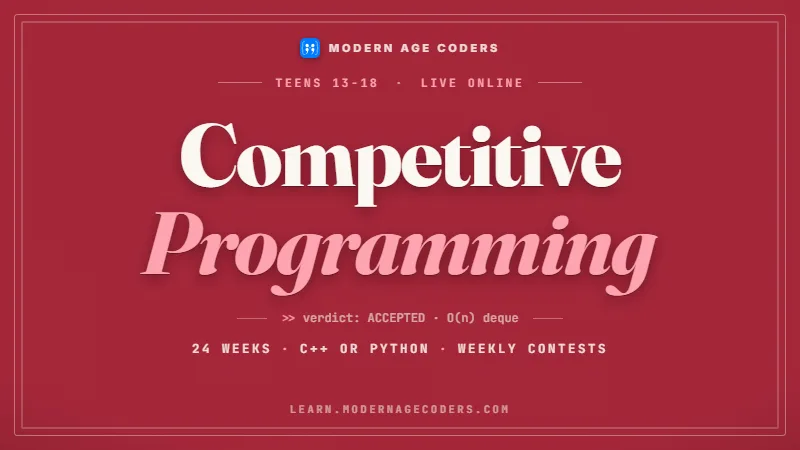
CSE / 02
For the contest route: C++, algorithms and judged problems, the skills HKOI and similar contests reward.
Open the syllabus →
CSE / 03
For builders: React and Node, ending in a site that is live on the internet and in a portfolio.
Open the syllabus →Where secondary students study
Yes, mostly through the exam at the end. Hong Kong has public sector schools, Direct Subsidy Scheme schools and international schools, and each points towards different qualifications.
| School type | Official figure | Usual exam route for coding |
|---|---|---|
| All secondary day schools | 347,820 students, mid-September 2025 (EDB) | Depends on school |
| DSS schools | 78 schools (LegCo reply, February 2026); must offer "principally a curriculum targeted at local students" | Mostly HKDSE ICT; some also offer non-local exams |
| International schools | 53 schools; 44,745 students in 2025/26, 33.8% of them local (EDB) | IGCSE, IB Diploma or A level computer science |
| Public sector schools | The majority of schools (EDB) | HKDSE ICT as an elective in S4 to S6 |
Sources: EDB, Student Enrolment Statistics 2025/26; Government reply to a LegCo question on international schools, February 2026; EDB international schools statistics page (2025/26 figures, excluding the special school); EDB, Direct Subsidy Scheme information. All read 23 November 2026. The right-hand column is our summary.
Junior forms meet programming in computer lessons and a short AI module; seniors may choose ICT. The exam is in Python or C++, set by the HKEAA.
Students at these schools often want a mentor who explains in English what the textbook says in Chinese, or who simply has time to look at their code.
Computing is usually a GCSE-style subject at 14 to 16 and then IB or A level. Cambridge says its next IGCSE Computer Science syllabus, first examined in 2029, is moving to "Python 3 as the only language for teaching, assessment and programming questions".
Our IGCSE CS tutor and IB CS tutor pages cover those exams in Hong Kong.
Four routes
Four things, broadly, and a student can switch between them. The numbers show how many Hong Kong students were on the exam and contest routes in the most recent year.
| Route | Latest figure | Source | Where we start |
|---|---|---|---|
| Exam: HKDSE ICT | 6,251 candidates sat ICT in 2026 | HKEAA, 2026 results | Python or C++, as the school teaches |
| Exam: maths alongside | 7,979 sat M2 and 3,655 sat M1 in 2026 | HKEAA, 2026 results | Maths that supports algorithms |
| Contest: HKOI | 450 senior and 415 junior contestants at the 2025/26 heat | HKOI statistics, 2026 | C++ and problem solving |
| International exams | 44,745 international school students, 2025/26 | EDB statistics | IGCSE, IB or A level CS |
| AI and data | AI module of 10 to 14 hours in junior forms | EDBCM No. 109/2023 | Python, data and simple models |
| Building | No official count | None | Web, apps or games, as a portfolio |
Figures from the HKEAA 2026 HKDSE results press release, HKOI 2025/26 statistics, EDB international schools statistics and EDB Circular Memorandum No. 109/2023, read 23 November 2026. The routes overlap, so the figures should not be added together.
Marks and syllabus first; we follow the school's order and language, and never write coursework.
Speed and correctness under a judge; C++ early, plenty of original practice problems.
A real project with users, tests and version control, shown on a portfolio.
Contest students should read competitive programming for teens in Hong Kong; AI-minded students, our AI course for teens in Hong Kong.
A secondary lesson, in full
This lesson works on every route: exam students practise strings and loops, contest students see brute force, AI students see a scoring function, and builders get something to show friends. It takes one lesson for most S1 to S3 students and half a lesson for seniors.
# Caesar cipher: encrypt, then crack by trying every key. Our own lesson.
ALPHA = "abcdefghijklmnopqrstuvwxyz"

def shift(text, key):
    out = ""
    for ch in text:
        if ch in ALPHA:
            out += ALPHA[(ALPHA.index(ch) + key) % 26]
        else:
            out += ch
    return out

COMMON = set("etaoinshr")

def score(text):
    letters = [ch for ch in text if ch in ALPHA]
    return sum(ch in COMMON for ch in letters) / len(letters)

secret = shift("meet at the ferry pier after school", 11)
print("ciphertext:", secret)
ranked = sorted(range(26), key=lambda k: score(shift(secret, -k)), reverse=True)
for k in ranked[:3]:
    print(f"key {k:2}  score {score(shift(secret, -k)):.2f}  {shift(secret, -k)}")
print("keys tried:", 26)
The message and the key are our own choice. The program uses only built-in Python 3; running it prints exactly the five lines below.
ciphertext: xppe le esp qpccj atpc lqepc dnszzw
key 11  score 0.76  meet at the ferry pier after school
key 22  score 0.52  btti pi iwt utggn extg puitg hrwdda
key 23  score 0.52  assh oh hvs tsffm dwsf othsf gqvccz
keys tried: 26
Key 11 scores 0.76, far ahead of the next best at 0.52, and its text is the original message. The runners-up are nonsense with a lucky share of common letters. Twenty-six tries are all it takes, which is why nobody uses this cipher for anything real.
Modular arithmetic for wrapping, loops over strings, a function reused for both directions, and a sort with a custom key. Each appears again in DSE ICT, IGCSE and contest problems.
Then the big idea: the cipher is weak because its key space is tiny. Modern encryption is safe because trying every key would take longer than the age of the universe, not because the method is secret.
Exam students write a trace table for one letter. Contest students crack a cipher where each letter moves by a different amount. AI-route students improve the scoring with full letter frequencies and see it fail on very short messages.
Students who enjoy this often like our cybersecurity course for teens, which teaches defence and ethics, never attacks on real systems.
First language
Usually Python, then C++ for students on the contest route or in a school that examines ICT in C++. The deciding facts come from the exam boards and contest organisers.
The EDB's 2021 ICT guide lists Python and C++ for today's DSE cohorts, Cambridge is moving IGCSE Computer Science to Python 3 alone from 2029, and almost every AI library is written for Python. It is also gentler for a first year.
The Hong Kong Python course guide traces the full route from first lines to exam and AI work.
HKOI's rules make C++ the main language and warn that "Not all tasks and subtasks are solvable using Python." In the 2025/26 heat, C++ takers produced far more finalists than Python takers in both groups (HKOI statistics).
So a student serious about HKOI usually moves to C++ by S2 or S3. See our HKOI training page for how we prepare, without promising selection.
Junior and senior
Junior years are for breadth and habit; senior years are for depth and a goal. We keep separate pages for each half of secondary school, with the school details for each.
| Stage | At school | With us, one to one |
|---|---|---|
| S1 to S3 (Years 7 to 9) | Computer lessons with at least 30% of ICT time on programming (EDB guidance), plus the AI module | Python fluency, data, a first AI project, a decision about routes |
| S4 to S6 (Years 10 to 13) | HKDSE ICT or IGCSE, IB, A level; contests for some | The exam language and topics, algorithms, contest or portfolio work |
School column from the EDB Technology Education guide (2017), EDBCM No. 109/2023 and the ICT curriculum guide (2021). Detail by form: coding for S1 to S3 and coding for S4 to S6.
AI tools have age terms set by the companies that make them, and not every tool is offered in Hong Kong: OpenAI does not offer ChatGPT here, and Anthropic does not offer Claude, which is adults only anyway. We teach with tools offered in Hong Kong or provided by the student's school, within their age terms, and teach the thinking that carries over to any tool.
We also teach students to write code themselves before asking a tool; our page on thinking with AI, not copying explains why.
Lessons are in English from mentors in India; students at Chinese-medium schools note their school's terms beside ours. In Hong Kong every lesson is private, one student to one mentor.
More on the language question: coding classes taught in English in Hong Kong.
Progress
Our own levels for secondary coders on any route. Not school grades, not exam levels.
| Level | The student can | Shown by |
|---|---|---|
| Starter | Write short programs with loops and conditions | Small tools and games |
| Builder | Use functions, lists and files in a project | A program of 100+ lines |
| Analyst | Measure and compare two solutions | A written comparison |
| Specialist | Work deeply on one route: exam, contest, AI or web | Past-paper style answers, judged solutions or a model |
| Independent | Plan and finish a project alone | A portfolio piece |
| Mentor-ready | Explain code clearly to someone younger | A walkthrough recorded or written |
If the key space is small, try every key.
Pick a route, but keep Python as home base.
Ask which route your teenager has chosen this term, and why.
The monthly note says which level comes next.
More courses
Live, in English, one to one for Hong Kong students.
CSE / EXAM / 01
Python or C++ for the DSE.
Open the syllabusCSE / EXAM / 02
0478 from theory to code.
Open the syllabusCSE / EXAM / 03
The 2027 guide and its IA.
Open the syllabusCSE / AI / 01
Models built and tested in Python.
Open the syllabusCSE / AI / 02
Questions answered from real data.
Open the syllabusCSE / AI / 03
Prompting and checking, under each tool's rules.
Open the syllabusCSE / BUILD / 01
An app on your own phone, built in React Native.
Open the syllabusCSE / BUILD / 02
Unity games, finished and shared.
Open the syllabusCSE / BUILD / 03
Speed and the standard library.
Open the syllabusTiming and setup
Any day, any time, flexible: one to one at the hour that suits your family, weekdays or weekends. India sits two and a half hours behind Hong Kong in every month of the year, so mentors are available well into a Hong Kong evening.
After school activities
5:45 pm in Hong Kong is 3:15 pm in India.
Evening
An 8:30 pm lesson is 6 pm for the mentor.
Saturday early
9 am in Hong Kong is 6:30 am in India.
Camera, microphone and a keyboard.
Python, C++ compilers and editors, installed together.
Continuity from junior to senior forms.
Lessons moved or paused in test weeks.
Every project kept and extended.
Route, level and next steps.

AI and ML
An AI nutrition coach that reads what you eat and works you toward a target.

AI and ML
A chatbot that answers mathematics and programming questions, built and deployed by a student.

AI and ML
An assistant that helps a young person recognise unsafe situations online.

Web app
A weather forecasting site with live conditions for any location.
Fees
There is one fee per month, displayed in Hong Kong dollars on the card below. Families pay as each month begins and never prepay several months. The checkout page lists any payment-gateway charge before you confirm.
Free first class
Free
no card required
One to one
$1,200 HKD
a month, eight live classes
What families say
What families wrote on Google, exactly.
★★★★★
"The one step solution for my son. Modern Age Coders make learning coding so simple that kids love it. The teachers explain complex concepts clearly with practical exercises and interactive content."
Ria Mukherjee
Parent
★★★★★
"Modern Age Coders has been a game-changer for me. I struggled to grasp IT concepts and coding before joining, but their classes transformed everything. I can now confidently write complex programs with ease."
Samriddha Mondal
Student
★★★★★
"One of the most wonderful education centres out there. Education is not limited to school syllabus but focuses on skill development."
Vansh Agarwal
Student
★★★★★
"My child Dhairya is really enjoying the Modern Age Coders classes. This is his first online class and he eagerly looks forward to it. I can already see his improvement, and the teachers are very cooperative."
Sonam Oswal
Parent of Dhairya
★★★★★
"Modern Age Coders have wonderful teachers who teach in a clear, easy and practical way. The teacher boosts students' confidence and inspires them to learn without hesitation."
Sonu Goyal
Parent
★★★★★
"I highly recommend this computer coding class! The teachers are incredibly knowledgeable and passionate about coding."
Ritu Kedia
Parent
Secondary students ask
No. Many strong programmers start in S1 or later. Secondary students learn the basics faster than younger children because they read and reason more easily.
Python first for most students. Add C++ early for HKOI, or if your school examines DSE ICT in C++.
Yes, with our HKDSE ICT course, in the language your school uses. We give SBA guidance only and never write SBA work.
Yes: IGCSE, IB and A level computer science, in the same one-to-one format.
We train the skills the heat and final test, mostly in C++. Entry is through schools, and we do not promise any medal or team place.
Yes. Every lesson is live video with one mentor and one student.
English, by mentors based in India. We do not teach in Cantonese or Mandarin.
Any day, any time, flexible: one to one at the hour that suits your family, weekdays or weekends. A 7 pm Hong Kong lesson is 4:30 pm in India.
Only tools offered in Hong Kong or provided by the school, within each tool's age terms and with a parent's permission where required. ChatGPT and Claude are not offered in Hong Kong by their makers, so they are not part of our lessons.
Monthly, shown in Hong Kong dollars, with any gateway charge shown before payment. The first class is free.
Related
Where to go next.
The junior years in detail.
The DSE years in detail.
The exam route.
The contest route.
The AI route.
Building with AI help.
Part of the guide: Every Hong Kong page
More guides: Coding and AI classes in Hong Kong · 中文:英文授課編程課程 · Start here: Online coding for kids · AI, vibe coding and AI agents: AI agents course · Coding subjects and courses: App development · HKDSE ICT and maths: DSE ICT elective guide · IB, IGCSE, A-level and SAT: A level Computer Science tutor · Olympiads and competitions: AMC 10 preparation · Guides for families: After-school coding · School holidays: AI summer course · Districts and areas: Causeway Bay
Start here
Tell us your form or year, your school type and what you want from coding. In the free class you write a real program with the mentor and agree a route and a first course.
See the full course list or how we teach first.
WhatsApp us · +91 91233 66161 · connect@modernagecoders.com
Live, online, one to one, in English. Mentors are in India. WhatsApp is quickest.
A priority demo is a full class of about 45 to 60 minutes. After the class the mentor sends a written skill report and a personal learning roadmap on WhatsApp. If you enrol, the demo fee is adjusted against your first month's fee. Share your demo Order ID with us on WhatsApp and we take it off.
Book a priority demo