HII / PRE / 01
IGCSE Computer Science 0478
The Cambridge step before the IB.
Open the syllabusHong Kong · Senior secondary computing · S4 to S6, Years 12 and 13
Most Hong Kong students who study computing in their last school years take one of two routes: Information and Communication Technology for the HKDSE, or Computer Science in the IB Diploma. A few schools offer both, and families there face a real choice. Even where the school decides, it helps to know how the two differ, because tutoring, revision and university plans follow from it. This page compares them from the boards' own documents and summaries, and explains how we tutor either one: live, online, one to one, in English.
Teaching since 2020 · 10,000+ students worldwide · 4.9 from 547 Google reviews · Hong Kong tutoring is one to one
The short answer
HKDSE ICT is a broad information-technology subject: two written papers worth 80% (one compulsory, one with two electives from databases, web applications and programming) plus a 20% school-based assessment, programmed in Python or C++. IB Computer Science is narrower and deeper in computing: two papers including a pre-seen case study, an internal assessment worth 30% at SL and 20% at HL, programmed in Python or Java. Modern Age Coders tutors either subject in live video lessons, one to one, taught in English and timed around the Hong Kong school week; a first lesson is on us.
Courses first
One course for each exam, and one that strengthens programming under either. Every Hong Kong student learns with a single mentor.
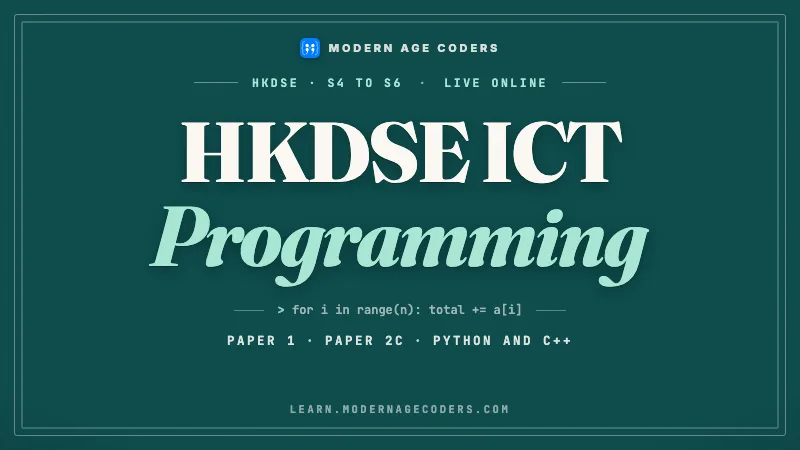
HII / 01
Paper 1, the elective you take for Paper 2, and programming in Python or C++, with SBA rules explained but never written for you.
Open the syllabus →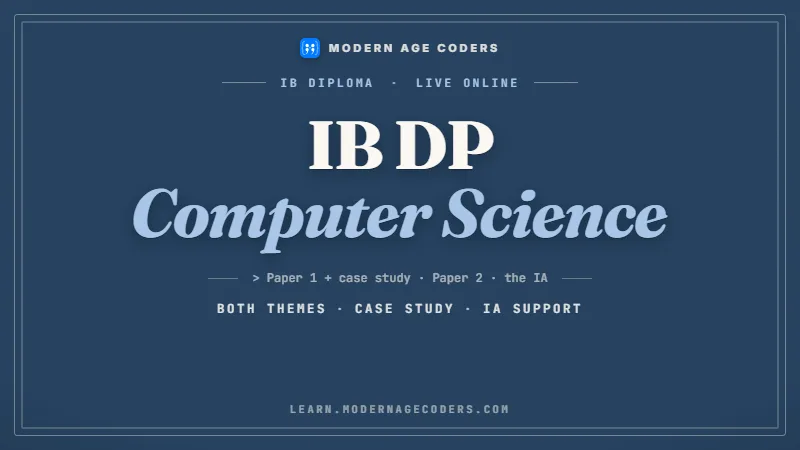
HII / 02
Concepts, algorithms, the released case study and Paper 2 practice for SL or HL, following the course as it stands from the May 2027 session.
Open the syllabus →
HII / 03
The language both routes accept, for students who want their programming solid before the exam work starts.
Open the syllabus →The two routes compared
The quotable version. HKDSE facts come from the HKEAA and the EDB; For the IB side we rely on two second-hand summaries (a teacher platform and one IB school), since the IB declined our automated requests; each IB row names which summary it comes from.
| HKDSE ICT | IB Computer Science | |
|---|---|---|
| Who sets it | HKEAA, from the EDB curriculum (revised 2021) | International Baccalaureate |
| First exams under current rules | The 2021 curriculum leads to HKDSE 2025 onwards | First assessment May 2027 (ManageBac) |
| Written papers | Paper 1 compulsory, 55%, 2 hours; Paper 2, two electives, 25%, 1 hour 30 minutes | Paper 1 (concepts plus pre-seen case study) and Paper 2 (problem solving); options removed (ManageBac) |
| Choice inside the subject | Two of: 2A Databases, 2B Web Application Development, 2C Algorithm and Programming | SL or HL; the higher level adds one extra unit, abstract data types (ManageBac) |
| Coursework | SBA, 20%: two guided tasks, 40 marks in total | Internal assessment weighted 30% (SL) or 20% (HL), with a 2,000-word ceiling (ManageBac) |
| Programming language | Python or C++; SQL for 2A (EDB language table) | Python or Java (ManageBac) |
| Curriculum time | Compulsory Part 144 hours, of which 48 on programming; Elective Part about 76 hours (EDB) | Not verified: the IB guide could not be fetched |
| Newer topics | Information processing, networks, the internet and its applications | Machine learning is included (IB school summary) |
| Exam dates | DSE written exams from 6 April 2027; ICT papers on 17 April 2027; results tentatively 14 July 2027 | IB sets its own May session; check with the school |
Sources: HKEAA, 2027 HKDSE ICT assessment framework; EDB, ICT Curriculum and Assessment Guide (2021) and Technology Education curriculum documents; HKEAA, Examination Circular No. 8 on the 2027 timetable (the session for each paper is set there; check it on the HKEAA timetable page); ManageBac's April 2025 subject-support article on the new IB Computer Science guide; the Canggu Community School DP computer science page. All read 23 November 2026.
A wide subject. Students learn how information is processed and stored, how computers and networks work, how the internet is used, and how to program, then go deeper in two electives. About a third of the compulsory hours (48 of 144) go to computational thinking and programming, and the EDB guide adds that "The Elective Part takes up about 76 hours of curriculum time and spans about one school year."
In 2026, 6,562 candidates registered for ICT (6,249 school and 313 private) and 6,251 sat it (HKEAA registration statistics and results release).
A computing subject in the university sense: concepts, algorithms, data structures, object-oriented programming and databases for everyone, a case study released before the exam, and a substantial software project as the IA.
Our 2027 IB Computer Science guide page covers what changed from the old course.
Coursework
Both subjects count school-assessed work towards the final result, and both forbid others from doing it for the student. They differ in size and shape.
The HKEAA describes "two guided tasks" on developing an information system, design and implementation then testing and evaluation, and states that "The total mark of the guided tasks is 40". It is worth 20% of the subject.
"Private candidates need not complete the SBA component" (HKEAA framework), which matters for students sitting ICT outside a school. Our SBA guidance page sets out the HKEAA's authorship rules.
One computational solution of the student's own, written up within a word cap and shown in a short video, marked on five criteria. ManageBac's summary gives it 35 hours of course time.
Under the IB's 2019 integrity policy the candidate works alone on it, and outside tutors are named among those whose help is not allowed.
Our rule is the same for both: we teach skills on separate practice tasks and explain the rules, and we never choose, write, fix or edit a student's SBA or IA. Requests for 「代做」 are refused.
Programming
This is often the deciding detail for students who already code. The two subjects share Python and differ on the second language.
The EDB's ICT language table lists Python for the latest cohorts, and the IB guide is designed to support it (ManageBac). A student fluent in Python is ready for either.
ICT also allows C++, the same language the Hong Kong Olympiad in Informatics uses as its main contest language. Schools choose; students follow the school.
The IB guide supports Java as the alternative to Python. Java is also common in first-year university courses, so it carries forward.
For the DSE side in detail, see DSE ICT programming help; for HKOI students choosing C++, see competitive programming for teens.
Shared ground
Tables of data stored as rows and columns appear in ICT programming questions and in IB Paper 2. In this lesson of ours, a student totals each row and averages each column of a small marks grid, then meets the error that every student makes once: swapping the two indexes.
# A 2D array of practice marks: rows are students, columns are four topics. All marks invented. Our own lesson.
topics = ["Data", "Networks", "Programming", "Ethics"]
names = ["Ka Yan", "Ravi", "Sophie"]
marks = [
    [14, 11, 18, 9],
    [10, 16, 12, 15],
    [17, 13, 8, 12],
]

for r in range(len(marks)):                      # row totals: one per student
    print(names[r], "total:", sum(marks[r]))

for c in range(len(topics)):                     # column means: one per topic
    col = [marks[r][c] for r in range(len(marks))]
    print(topics[c], "mean:", round(sum(col) / len(col), 1))

# The classic slip: swapping the indexes. marks[c][r] reads the wrong cell, then runs off the end.
try:
    for c in range(len(topics)):
        print(topics[c], "first cell read:", marks[c][0])
except IndexError as e:
    print("IndexError:", e)
Names and marks are made up for this page. Run under Python 3, the program gives the eleven lines that follow. The same exercise works in C++ (for ICT) or Java (for IB) with a two-dimensional array.
Ka Yan total: 52
Ravi total: 53
Sophie total: 50
Data mean: 13.7
Networks mean: 13.3
Programming mean: 12.7
Ethics mean: 12.0
Data first cell read: 14
Networks first cell read: 10
Programming first cell read: 17
IndexError: list index out of range
The totals and means are correct. The faulty loop claims to read the first cell of each topic but actually reads each student's first mark (14, 10, 17), which look believable, and only fails when the topic index reaches 3 and there is no fourth student.
A swapped index is the worst kind of bug: it produces believable numbers. Trace-table and "find the error" questions are built around exactly this, in both subjects.
Students who have seen it happen in their own code learn to say "row, then column" every time they index a grid.
Find the topic with the highest mean, and print its name, not its index. Then find the student whose lowest mark is highest.
Rewrite the column loop in C++ or Java, whichever your route uses, and check that it prints the same four means.
Which schools
The route usually follows the school. Here is what the EDB publishes about school types, and a count we made from its school database.
| School type | Figure | What it means for computing |
|---|---|---|
| DSS schools offering non-local curricula | 21 | Some run the IB beside the HKDSE; the EDB requires DSS schools to offer "principally a curriculum targeted at local students" |
| Of those 21, entries naming the IB Diploma | 10 | Our count from the EDB school database, 23 November 2026 |
| Of those 21, entries naming both IB Diploma and HKDSE | 9 | Our count; these are the schools where the choice is real |
| International schools | 53 | Mostly non-local curricula, the IB Diploma among them (EDB) |
Sources: EDB, international schools site ("Our Schools") and its school database (school-data.json), counted by our own script on 23 November 2026; EDB, Direct Subsidy Scheme information page. The count reads each entry's curriculum text; it does not show which schools offer Computer Science specifically, and no school is named here.
The route is HKDSE, and ICT is one elective among many. Whether it is offered, and whether in Python or C++, depends on the school.
Our ICT elective guide helps a student choose between 2A, 2B and 2C.
The IB Diploma is common; some schools offer A levels instead. Computer Science is one of the IB's science options, and not every school runs it.
Students on Cambridge routes can compare the IGCSE Computer Science tutor page.
Choosing
Only a family at one of the schools that offer both really chooses between the subjects; elsewhere the choice is between schools. Either way, these are the questions we would ask.
That one route gets a student into a better university, or that one is easier. We have no evidence for either claim, and admissions depend on the institution and the course.
We also make no grade promises for either subject.
Students who move from a DSE school to an IB school, or the other way, keep their programming but need the new structure. A few one-to-one lessons on the other route's papers and coursework rules usually close the gap.
For the DSE side, see our DSE ICT tutor page; for the IB side, our IB CS tutor page.
Progress
Our own stages, shared across both subjects so a student who switches keeps the record. Reported monthly; not HKEAA levels or IB grades.
| Stage | Skill on show | Checked through |
|---|---|---|
| 1. Terms | Uses the subject's vocabulary exactly as the board does | Quick definition rounds |
| 2. Tracing | Follows arrays and loops by hand, cell by cell | Trace tables on our own code |
| 3. Writing | Writes correct short programs in the school's language | Timed tasks without hints |
| 4. Structures | Handles 2D arrays, records and files without index slips | A data-handling task set |
| 5. Exam form | Answers structured questions in the board's style and time | Practice papers we write |
| 6. Independence | Plans and tests a project of their own, unrelated to coursework | A practice project with tests |
Row first, column second. Say it every time.
The language changes between routes; tracing never does.
Stage 6 never touches SBA or IA work, by design.
The record follows the student if the route changes.
Around both routes
Private live lessons in English, the only format we offer in Hong Kong.
HII / PRE / 01
The Cambridge step before the IB.
Open the syllabusHII / PRE / 02
For DSE schools that teach C++.
Open the syllabusHII / PRE / 03
For IB schools that teach Java.
Open the syllabusHII / DURING / 01
Depth beyond the IB's ML topic.
Open the syllabusHII / DURING / 02
Tables of real data, the ICT way and beyond.
Open the syllabusHII / DURING / 03
Pairs with ICT elective 2B.
Open the syllabusHII / AFTER / 01
Scripts for university and first jobs.
Open the syllabusHII / AFTER / 02
Systems-level C++ after an ICT start.
Open the syllabusHII / AFTER / 03
Web systems, front to back.
Open the syllabusTiming
Any day, any time, flexible: one to one at the hour that suits your family, weekdays or weekends. India runs 2 hours 30 minutes behind Hong Kong all year, with no clock changes on either side, so a lesson booked after school or on a Sunday lands at a settled hour for the mentor.
Straight after school
4:30 pm in Hong Kong is 2 pm in India.
After dinner
An 8 pm lesson is 5:30 pm for the mentor.
Sunday morning
11 am in Hong Kong, 8:30 am in India.
HKEAA or IB, the lesson follows the student's papers.
Python, C++ or Java, as the school chose.
Rules explained; SBA and IA left to the student.
Questions written by us, never copied from papers.
One tutor through S4 to S6 or Years 12 and 13.
Stages reached and what is next.
Student work
Learner work from our courses, none of it SBA or IA material; the student labs page has more.

AI and ML
An AI nutrition coach that reads what you eat and works you toward a target.

AI and ML
A chatbot that answers mathematics and programming questions, built and deployed by a student.

AI and ML
An assistant that helps a young person recognise unsafe situations online.

Web app
A weather forecasting site with live conditions for any location.
Fees
Whichever route, tutoring is charged monthly in Hong Kong dollars, the figure shown on the card, with nothing collected in advance for later months. If your payment method adds a gateway fee, you will see it on screen before paying.
Free first class
Free
no card required
One to one
$1,200 HKD
a month, eight live classes
What families say
What families and students posted on Google, word for word.
★★★★★
"The one step solution for my son. Modern Age Coders make learning coding so simple that kids love it. The teachers explain complex concepts clearly with practical exercises and interactive content."
Ria Mukherjee
Parent
★★★★★
"Modern Age Coders has been a game-changer for me. I struggled to grasp IT concepts and coding before joining, but their classes transformed everything. I can now confidently write complex programs with ease."
Samriddha Mondal
Student
★★★★★
"One of the most wonderful education centres out there. Education is not limited to school syllabus but focuses on skill development."
Vansh Agarwal
Student
★★★★★
"My child Dhairya is really enjoying the Modern Age Coders classes. This is his first online class and he eagerly looks forward to it. I can already see his improvement, and the teachers are very cooperative."
Sonam Oswal
Parent of Dhairya
★★★★★
"Modern Age Coders have wonderful teachers who teach in a clear, easy and practical way. The teacher boosts students' confidence and inspires them to learn without hesitation."
Sonu Goyal
Parent
★★★★★
"I highly recommend this computer coding class! The teachers are incredibly knowledgeable and passionate about coding."
Ritu Kedia
Parent
DSE ICT or IB Computer Science
ICT is broader (information processing, systems, networks, the internet and programming, with two electives), while IB Computer Science goes deeper into computing (algorithms, data structures, object-oriented programming, a case study and a larger software project).
DSE ICT uses Python or C++, with SQL for the database elective. IB Computer Science supports Python or Java. Python is common to both.
The ICT SBA is 20% of the subject and private candidates are exempt. The IB IA carries 30% at SL and 20% at HL, the figures given in ManageBac's guide notes.
HKDSE written exams start on 6 April 2027, with the ICT papers on 17 April 2027 and results tentatively on 14 July 2027 (HKEAA). IB exams follow the IB's May session; your school will have the dates.
We do not make that claim. Entry requirements depend on the university and the course, so check them directly with the institutions your child is considering.
No. We teach skills on separate practice tasks and explain the rules, but the SBA and the IA must be the student's own work. We refuse all 代做 requests.
English, live, which matches the IB papers and English-medium ICT classes. Our mentors work from India, and Cantonese or Mandarin teaching is not something we offer.
Yes. In Hong Kong all tutoring is one to one, with the same mentor each week.
Any day, any time, flexible: one to one at the hour that suits your family, weekdays or weekends. A 4:30 pm lesson in Hong Kong is 2 pm in India, all year.
Monthly, in Hong Kong dollars, with no lump sum. Any payment-gateway charge is shown before you pay, and the first lesson is free.
Related
Pages that go deeper into one side of the comparison.
The 2027 papers and where marks go.
Choosing two of 2A, 2B and 2C.
Tasks, marks and authorship rules.
Papers, languages and the IA line.
What changed in the new course.
Every Hong Kong page.
Part of the guide: Every Hong Kong page
More guides: Coding and AI classes in Hong Kong · 中文:英文授課編程課程 · Start here: Online coding for kids · AI, vibe coding and AI agents: AI agents course · Coding subjects and courses: App development · By age and school level: Adults · IB, IGCSE, A-level and SAT: A level Computer Science tutor · Olympiads and competitions: AMC 10 preparation · Guides for families: After-school coding · School holidays: AI summer course · Districts and areas: Causeway Bay
Start here
Tell us the school, the route and the current topic. The mentor teaches a real short lesson on it, and if you are still choosing, explains how that topic would look on the other route.
Want outlines first? See the DSE ICT course and the IB Computer Science course.
WhatsApp us · +91 91233 66161 · connect@modernagecoders.com
Live, online, one to one, in English, with mentors based in India. WhatsApp is the quickest way to reach us.
A priority demo is a full class of about 45 to 60 minutes. After the class the mentor sends a written skill report and a personal learning roadmap on WhatsApp. If you enrol, the demo fee is adjusted against your first month's fee. Share your demo Order ID with us on WhatsApp and we take it off.
Book a priority demo