UNI / LNG / 01
Python Masterclass
From first line to confident, idiomatic code.
Open the syllabusUK · University students · Any subject
Computer science graduates in the UK found the first year after university harder than graduates overall. In What do graduates do? 2025/26, which reads HESA's Graduate Outcomes survey for UK-domiciled first-degree graduates of 2022/23, 9.7% of computer science graduates were unemployed or waiting to start a job about 15 months after graduating, against 6.2% across all subjects. Yet 63.4% of those in work were in IT occupations, and the most common professional job was programming and software development. So the degree leads somewhere for most, but it is not the whole application. Students in every other subject hear a version of the same message from the other side: the report's guide to digital skills for non-tech graduates says flatly that "The concept of the 'digital native' is a myth" and lists coding among the digital skills it recommends graduates build. This page is for both groups: computing students who want projects and interview practice beyond their modules, and students of economics, psychology, the sciences or history who want to code with data. Lessons run alongside a degree and never touch assessed work.
Live teaching since 2020 · 10,000+ students · projects alongside a degree, never assessed work
In short
According to What do graduates do? 2025/26, based on HESA's Graduate Outcomes survey, 9.7% of UK computer science graduates of 2022/23 were unemployed or due to start work about 15 months after graduating, compared with 6.2% of all first-degree graduates, while 63.4% of those in work held IT occupations. For students outside computing, the same report describes the "digital native" as a myth and recommends building digital skills deliberately, with coding among them. Modern Age Coders teaches UK university students live and online: Python, Java, C++, data structures and algorithms, SQL, web development and data analysis, through projects of their own and practice for technical interviews. We never work on coursework, lab reports, dissertations or anything assessed. The first class is free; afterwards a group place is USD 100 a month and one-to-one lessons USD 150 a month, and you can stop at the end of any month.
Start here
Interview preparation for computing students, Python from zero for everyone else, and data analysis for any subject. Each card opens a full syllabus.
UNI / 01
The material technical interviews test, practised until you can explain it at a whiteboard.
Open the syllabus →
UNI / 02
For students outside computing: the first language, taught properly from the first line.
Open the syllabus →
UNI / 03
Spreadsheets, SQL and Python for students whose degree runs on data.
Open the syllabus →Graduate outcomes
From What do graduates do? 2025/26, published by Prospects Luminate with the Graduate Futures Institute in November 2025. It covers UK-domiciled first-degree graduates of 2022/23, surveyed about 15 months after graduating.
| Outcome | Share |
|---|---|
| Working full time | 58.5% |
| Working part time | 12.9% |
| Working and studying | 9.3% |
| Further study | 3.9% |
| Unemployed, including those due to start work | 9.7% |
| Other | 5.6% |
The report's overview puts it plainly: "computer science graduates recorded an unemployment rate of 9.7% and mathematics graduates 7.5%, both higher than the overall graduate rate of 6.2%". Roughly one computer science graduate in ten was out of work or waiting to start a job.
That is not a verdict on the subject. It says that a computing degree, on its own, did not carry every graduate into work within fifteen months, in a market the report describes as having begun to cool.
63.4% of computer science graduates in UK employment worked in IT occupations, spread across many sectors. The most common professional jobs were programmers and software development professionals, then IT user support technicians, then cyber security professionals.
At the other end, 9.2% of those in UK employment were working in retail, catering, waiting or bar jobs. The same degree led to very different places.
Across all subjects, unemployment rose to 6.2% from 5.6% a year earlier, and the share of working graduates in professional-level jobs fell to 71.9% from 75.1%.
An Institute of Student Employers essay in the report notes 140 applications per graduate vacancy for the last two years, the highest since it began collecting the data in 1991.
Of computer science graduates in further study, 40.7% were on a masters and 33.4% were working towards a professional qualification.
Source, read 21 September 2026: Prospects Luminate, What do graduates do? 2025/26, published November 2025, using HESA Graduate Outcomes data. Figures describe UK-domiciled first-degree graduates who responded to the survey. Salary figures in the report are left out here.
Placements
The same report carries an essay from Sheffield Hallam University on work experience during a degree, and it is useful reading for anyone in their first or second year.
It describes the classic placement: "the classic model is 24 to 48 weeks' work, between or after different levels of study", with many undergraduates going out on placement after their level 5 year, the equivalent of two years of a bachelors degree, and bringing what they learned back into their final year. It also notes newer forms: consultancy projects on employer briefs, and placements that run within a semester. Elsewhere in the report, the ISE observes that competition for internships and placements has risen too.
| Evidence | Why it helps | Where it is taught |
|---|---|---|
| Two or three finished projects | Shows you can carry work from idea to a working result | Full stack, data or game projects of your choosing |
| A tidy GitHub history | Lets anyone see the work happen over time | Git and GitHub, alongside every project |
| Fluency in data structures | The subject of most technical interview questions | Data structures and algorithms, with timed practice |
| One language known deeply | Depth reads better than a long list of names | Python, Java or C++ taken beyond module level |
| A way of talking about code | Interviews test explanation as much as answers | Explaining your own solutions aloud in lessons |
We never write, edit, debug or review coursework, lab submissions, group project code, dissertation work or take-home assessments. If a module's assignment is on the same topic as a lesson, the lesson uses a different problem.
We also do not promise placements or jobs. We teach skills and help you build evidence; employers decide the rest.
University careers services usually offer application support and know your department's placement arrangements. Use them.
What a careers service is not set up to do is teach code week by week, which is the gap lessons fill.
Other subjects
The report's guide to digital skills for non-STEM and non-tech graduates, written by a work-based learning adviser at City St George's, University of London, starts from a blunt premise.
That premise is that "The concept of the 'digital native' is a myth". Growing up with a phone does not teach anyone to clean a dataset, automate a report or judge a chart. The guide organises what graduates need around the six elements of Jisc's digital capabilities framework, and coding sits under digital creation, problem solving and innovation, next to digital projects and portfolios.
| Element | Where coding helps |
|---|---|
| Digital proficiency and productivity | Automating repetitive tasks instead of doing them by hand |
| Digital learning and development | Learning new tools quickly because the ideas underneath are familiar |
| Digital creation, problem solving and innovation | Writing programs, building projects and portfolios |
| Information, data and media literacies | Querying, cleaning and analysing data yourself |
| Digital communication, collaboration and participation | Working in shared repositories and notebooks |
| Digital identity and wellbeing | A public portfolio that shows what you can do |
| If you study | Useful coding | A first project |
|---|---|---|
| Economics or finance | Python with data libraries, SQL | Recreating a published chart from the original public data |
| Psychology | Python or R-style analysis in Python, reproducible notebooks | Re-running a statistical analysis on an open dataset |
| Biology, chemistry or physics | Python for data, simple simulations | Plotting and fitting experimental-style data |
| Business or management | SQL, spreadsheets, dashboards | A small database with questions a manager would ask |
| History, English or languages | Python for text analysis | Counting and comparing words across public-domain texts |
| Engineering | Python, C++ and numerical methods | A small simulation checked against a hand calculation |
The guide itself gives "SPSS for psychology students" as an example of subject-specific tools, so the point is not to replace what your department uses. It is to understand data well enough that any tool, including an AI assistant, is something you direct rather than follow. None of the first projects above use your own course data or overlap with an assignment.
Source: the digital skills and placements essays in What do graduates do? 2025/26. The subject table is our own teaching guidance, not taken from the report.
Alongside a degree
A degree already fills the week. Lessons have to fit around lectures, labs, part-time work and exams, not compete with them.
One lesson a week, usually an evening, with a small project moving forward between lessons.
Billing is monthly, so you can pause for exams and restart the following month.
A good time to finish a larger project or prepare for placement interviews in the autumn.
| You are | A sensible route |
|---|---|
| First-year computing student | Take one language beyond the module, then start data structures |
| Second-year computing student applying for placements | Data structures and algorithms, plus one finished project on GitHub |
| Final-year computing student | Interview practice and a portfolio project in the area you want to work in |
| Student in another subject, new to code | Python from zero, then data analysis on public data |
| Postgraduate with a data-heavy project | Python and SQL for research-style analysis, kept apart from your thesis code |
Your university's rules on AI and academic conduct apply to everything you submit, and they differ by module; the AI agents course for students explains how we keep portfolio work apart from assessed work. If you are drawn to competitions, student hackathons in the UK are a good place to take a finished project, and understanding the code rather than copying it is the habit every interviewer checks for.
Stages
The pace depends on your starting point and your timetable; placement is by what you can already do.
| Stage | What should be true |
|---|---|
| 1. Fluent basics | You can write, run and debug small programs in one language without looking everything up |
| 2. Structures and data | You choose sensible data structures and can query and clean a real dataset |
| 3. A finished project | One project is complete, documented and on GitHub with a readable history |
| 4. Interview ready | You can solve a typical interview problem aloud and explain your project in depth |
A finished project turns a list of modules into something an employer can look at.
The full order of topics is on the coding roadmap.
Lessons add depth and practice; your degree remains the qualification.
Where a lesson and a module cover the same idea, the lesson uses different problems.
The catalogue
Grouped by purpose. The free class settles where to begin.
UNI / LNG / 01
From first line to confident, idiomatic code.
Open the syllabusUNI / LNG / 02
Object-oriented design, the way large systems use it.
Open the syllabusUNI / LNG / 03
Memory, performance and the language beneath much engineering.
Open the syllabusUNI / INT / 01
The core of technical interviews.
Open the syllabusUNI / INT / 02
Relational design and SQL that real applications use.
Open the syllabusUNI / INT / 03
The workflow every team expects you to know.
Open the syllabusUNI / APP / 01
A complete web application, front to back.
Open the syllabusUNI / APP / 02
Excel, SQL and Python on real data.
Open the syllabusUNI / APP / 03
Statistics and machine learning with Python.
Open the syllabusHow lessons work
Our teachers are in India, where clocks stay the same all year; UK time is four and a half hours behind India in British Summer Time and five and a half hours behind in winter. Evenings and weekends in the UK suit both sides.
Weekday evening
After lectures and labs.
Weekend morning
For students who work evening shifts.
Weekend afternoon
A longer block for project work.
We look at where you are, what you want and which route fits.
University students at the same level, from the UK and elsewhere.
For a faster pace or a specific interview deadline.
The portfolio is built from your interests, not a fixed template.
A teacher reads your program and explains exactly what to improve.
Nothing you submit to your university is ever touched in a lesson.
Student work
Four finished projects by our students. More, from every age group, are gathered in student labs.
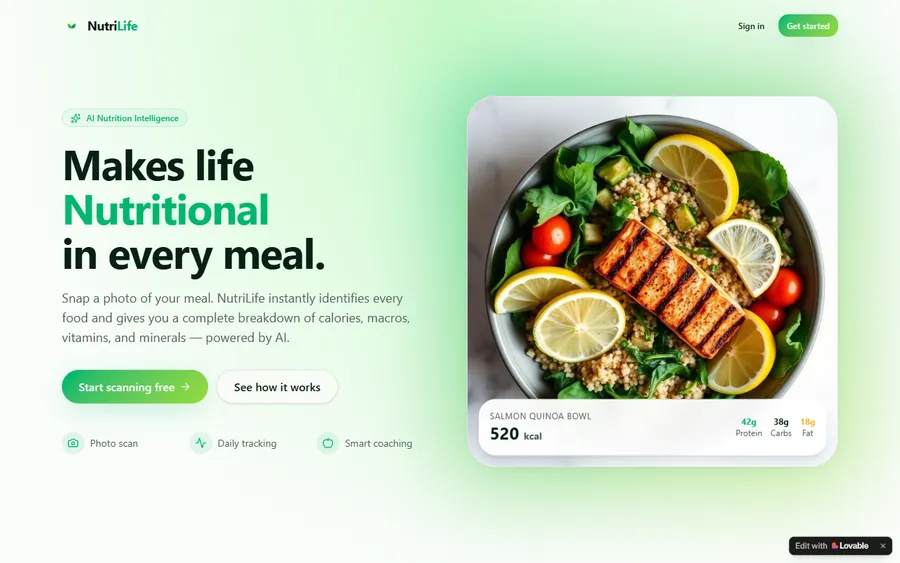
AI and ML
An AI nutrition coach that reads what you eat and works you toward a target.
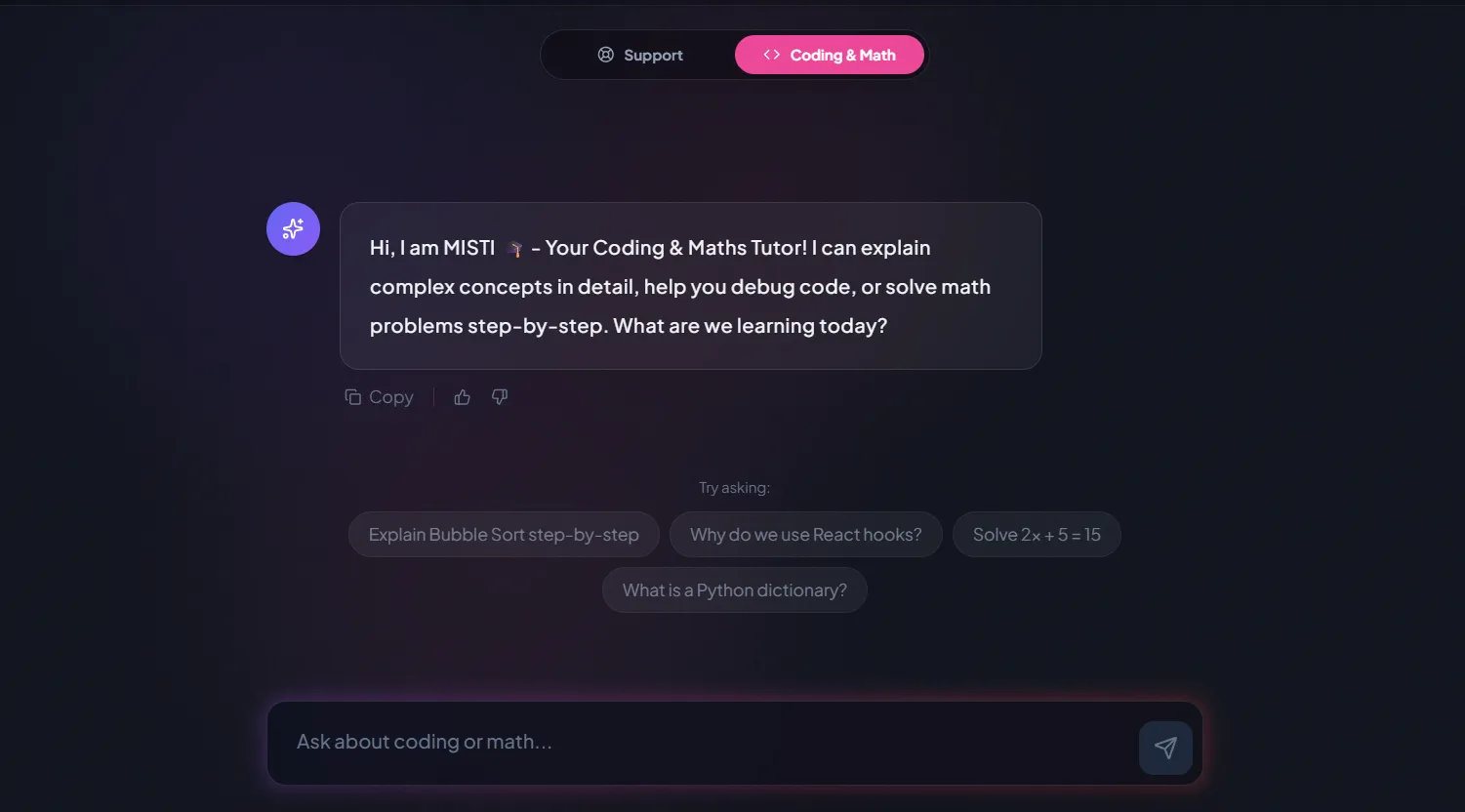
AI and ML
A chatbot that answers mathematics and programming questions, built and deployed by a student.
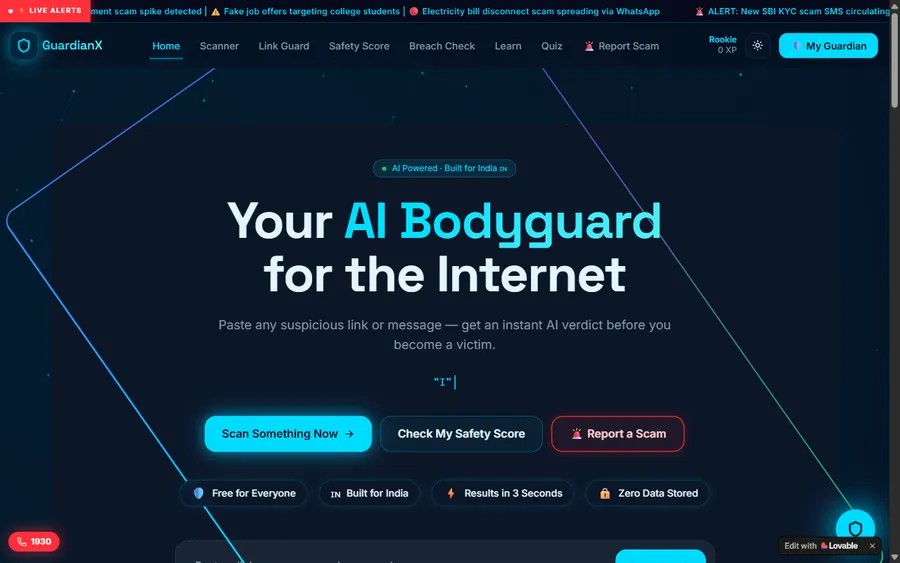
AI and ML
An assistant that helps a young person recognise unsafe situations online.
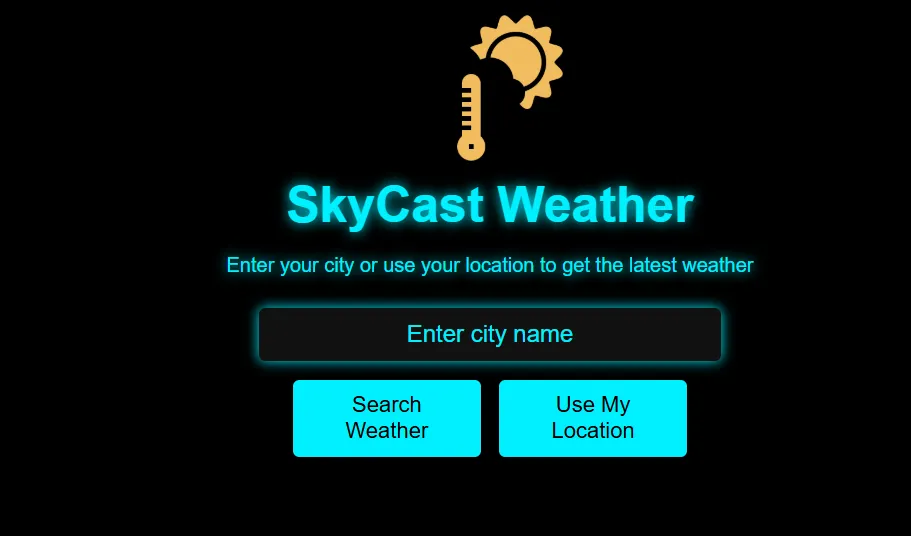
Web app
A weather forecasting site with live conditions for any location.
Fees
One monthly fee in US dollars, identical in every country outside India, with no enrolment fee and no commitment beyond the month, so a heavy term or exam season never locks you in.
Free first class
USD 0
no card required
Group batch
USD 100
a month, billed in US dollars
One to one
USD 150
a month, billed in US dollars
What families say
Reviews from our students and their families on Google, copied exactly.
★★★★★
"The one step solution for my son. Modern Age Coders make learning coding so simple that kids love it. The teachers explain complex concepts clearly with practical exercises and interactive content."
Ria Mukherjee
Parent
★★★★★
"Modern Age Coders has been a game-changer for me. I struggled to grasp IT concepts and coding before joining, but their classes transformed everything. I can now confidently write complex programs with ease."
Samriddha Mondal
Student
★★★★★
"One of the most wonderful education centres out there. Education is not limited to school syllabus but focuses on skill development."
Vansh Agarwal
Student
★★★★★
"My child Dhairya is really enjoying the Modern Age Coders classes. This is his first online class and he eagerly looks forward to it. I can already see his improvement, and the teachers are very cooperative."
Sonam Oswal
Parent of Dhairya
★★★★★
"Modern Age Coders have wonderful teachers who teach in a clear, easy and practical way. The teacher boosts students' confidence and inspires them to learn without hesitation."
Sonu Goyal
Parent
★★★★★
"I highly recommend this computer coding class! The teachers are incredibly knowledgeable and passionate about coding."
Ritu Kedia
Parent
Questions from students
In What do graduates do? 2025/26, 9.7% of computer science graduates of 2022/23 were unemployed or due to start work about 15 months after graduating, against 6.2% for all graduates. Most who found work, 63.4%, were in IT occupations.
No. We never write, edit, debug or review anything you submit for assessment, including lab work, group projects and dissertation code.
We cannot promise that. We help you build the evidence applications and interviews ask about: finished projects, a clean GitHub history, and fluency in data structures and algorithms.
Often, yes. Data work runs through economics, psychology, the sciences and business, and the report's guide to digital skills lists coding among the skills it recommends for graduates outside tech.
Computing students usually deepen the language their degree uses. Students in other subjects usually start with Python, because it is readable and strong for data.
Typically 24 to 48 weeks of work, often taken after the second year of a bachelors degree. Your department and careers service will explain the arrangements at your university.
Yes, through data structures and algorithms practice and by having you explain solutions aloud. We do not claim inside knowledge of any employer's process.
Yes. Billing is monthly, so you can stop at the end of a month and restart when exams are over.
The first class is free. After that a group place is USD 100 a month and one-to-one lessons USD 150 a month, with no enrolment fee.
Weekday evenings or weekends in UK time, agreed in the free class. Our teachers are four and a half hours ahead of the UK in summer and five and a half in winter.
Elsewhere on this site
Agents, competitions, Python in depth, and the habit of understanding code.
Building an agent as portfolio evidence.
Where to take a finished project.
How we teach Python properly.
What interviewers are really checking.
The thinking behind every interview question.
Every UK page in one place.
Start here
Leave a number and we will call at a UK time that fits your timetable. Tell us your year and subject; the class works out where you are and ends with a route for the term.
Would you rather read first? How we teach explains the method, each course page has its syllabus, and student labs shows finished work.
WhatsApp us · +91 91233 66161 · contact@modernagecoders.com
Messaging us on WhatsApp from a UK number is usually fastest. The team is in India, so the number begins +91, and there is no UK office.