LET / YOUNG / 01
Computational Thinking for Kids
Plans and patterns before any code.
Open the syllabusHong Kong · AI and honest learning · Ages 8 to 18
A student in Hong Kong can now get a working answer to almost any homework question in seconds. The answer is often right. Sometimes it is wrong in a way that only someone who understands the problem would notice. Learning to think, not copy, means being that someone: using AI the way a good student uses a textbook or a tutor, never as a replacement for their own head. We teach it live, one to one, in English, through coding, where mistakes cannot hide.
Live classes since 2020 · 10,000+ students worldwide · Hong Kong students learn one to one, online, in English
What this page answers
Learning to think, not copy, means a student uses AI only after their own attempt, checks what it says, and can explain every line they hand in. Modern Age Coders teaches this to Hong Kong children and teenagers of about 8 to 18 through coding, taught live online with one student per mentor, in English, at whatever hour suits the family in Hong Kong. Students predict a program's output before running it, test copied answers against edge cases, and use AI tools only at agreed points and within each tool's age terms. It matches what Hong Kong's own exam authority asks: AI use acknowledged, never passed off as the student's own.
Courses that build the habit
The habit is taught in every course we run, but these three put it at the centre. In Hong Kong each is taught one to one, so the mentor sees exactly where a student is thinking and where they are guessing.
LET / 01
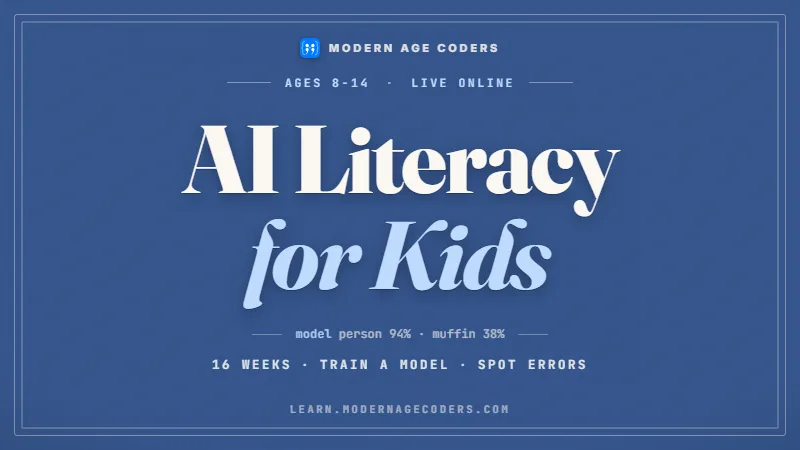
Children learn how AI produces answers, why it can be confidently wrong, and when to leave it out. They train and test small models themselves, so AI stops being an oracle.
Open the syllabus →
LET / 02
Algorithms worked out on paper before a line is typed. Teens learn to find the edge cases a quick answer misses, which is the skill this page is about.
Open the syllabus →
LET / 03
Building with AI assistance the honest way: the teen describes, the tool drafts, and the teen reads, tests and explains every line before it stays.
Open the syllabus →The idea
It does not mean banning AI. It means deciding, each time, whether the tool is helping you think or doing the thinking for you, and being honest about which.
A student writes their own attempt, gets stuck, and asks an AI to explain one concept they are missing. They close the chat, try again, and the second attempt is theirs. Or they finish a program and ask an AI to find weaknesses in it, then decide for themselves which criticisms are fair.
In both cases the student's head did the work the exercise was designed to build. The AI was a hint, or a critic. That is how good programmers use these tools every day.
A student pastes the question, copies the answer, and hands it in. It may even be correct. But the skill the homework was meant to practise never got practised, and next time the student is just as stuck, now with less time.
Worse, they cannot tell when the answer is wrong. The example further down this page shows how: a pasted rule that passes every year a student is likely to test, and fails the two that matter.
Your own answer, however rough, exists before any AI is opened.
Nothing from an AI is trusted until it has been tested or verified.
If you cannot explain a line, it is not yours yet, and it does not go in.
The same idea runs through our general approach, set out on we teach you how to think. Searches such as "ai 寫程式" and the worry that AI means the end of learning to code suggest many Hong Kong parents are asking this question already.
What Hong Kong's authorities say
Hong Kong's exam authority and its Education Bureau say much the same thing in different words: AI can help learning, it cannot replace it, and passing off AI work as your own is plagiarism. Here are their own words.
| Point | Their words | Document |
|---|---|---|
| AI can help | "Using AI tools in the learning process can undoubtedly offer new and exciting opportunities if used in a proper manner." | HKEAA, HKDSE 2027 ICT SBA Teachers' Handbook |
| Misuse is malpractice | "using an AI tool to gain an undue advantage is considered to be malpractice and can have serious consequences" | Same handbook |
| It cannot replace learning | AI tools "cannot replace the actual learning experience"; "Overreliance and misuse of AI tools will diminish students' authentic learning opportunities" | Same handbook |
| Say when you used it | "the use of AI tools in SBA must be properly acknowledged" | Same handbook |
| Copying AI is plagiarism | Plagiarism includes "presenting work completed by others, including those generated using Artificial Intelligence tools, in part or in whole, as one's own work" | Same handbook |
| The penalty | "Zero marks will be given to the task in which serious plagiarism is proven" | Same handbook |
| AI is a helper | 「學校應引導學生明白人工智能只是輔助工具」: schools should help pupils see AI as only an auxiliary tool | EDB pilot primary AI strand, 2026 |
| Know when to do it yourself | 「學會分辨甚麼時候需要人工智能協助完成工作,甚麼時候應該由自己完成工作」: learn when a task needs AI's help and when you should do it yourself | EDB pilot primary AI strand, 2026 |
| Hands and head | 「要親自動手和動腦,不要濫用或完全依賴人工智能」: use your own hands and brain; do not misuse or wholly depend on AI | EDB pilot primary AI strand, 2026 |
Sources: HKEAA, HKDSE 2027 ICT School-based Assessment (SBA) Teachers' Handbook; EDB, Information and Innovation Technology Curriculum Framework for Primary Schools, AI strand (Pilot Version), Chinese edition. Read on 23 November 2026. The English renderings of the EDB's Chinese are ours. We have no link with either body.
In the 2027 HKDSE ICT exam, the School-based Assessment carries 20% of the subject (HKEAA assessment framework). The handbook asks schools to have students sign a declaration "at the beginning of each school year" that their SBA work is their own.
A student who reaches S5 having always pasted answers will find that declaration hard to keep. A student who has spent years predicting, testing and explaining will barely notice it. We guide students on the SBA, and we never write any part of it for them.
The government told the Legislative Council in a written reply of 24 January 2024 that the EDB had launched its "Module on AI for Junior Secondary Level" in mid-2023, and that it "also includes the latest development of AI and generative AI ChatGPT".
So Hong Kong students meet chatbots at school as a topic of study, not only at home as a shortcut. The question is no longer whether they will use AI, but whether they will use it with judgement. The EDB strand uses the word for that: 慎思明辨, careful and discerning thought.
A worked example
Here is a small coding exercise we use with students of about 11 to 16: write a function that says whether a year is a leap year. One version is the short kind of answer that gets pasted without a second look. The other was written after reading the actual rule. The student has to predict every result before running anything.
calendar.isleap, which plays the part of a trusted reference.# Copy, or think? A leap-year check, written two ways. Our own lesson.
import calendar, datetime
def copied_is_leap(year):
# A short answer of the kind that gets pasted without a second look
return year % 4 == 0
def thought_is_leap(year):
# Written after reading the rule: every 4 years, except
# whole centuries, except every 400 years
if year % 400 == 0:
return True
if year % 100 == 0:
return False
return year % 4 == 0
# Step 1: the student writes predictions BEFORE running anything
predicted = {2024: True, 2026: False, 2028: True,
2000: True, 1900: False, 2100: False}
print("year predicted copied thought truth")
copied_ok = thought_ok = 0
for year, guess in predicted.items():
truth = calendar.isleap(year)
c, t = copied_is_leap(year), thought_is_leap(year)
copied_ok += c == truth
thought_ok += t == truth
flag = " <- copied is wrong" if c != truth else ""
print(year, str(guess).rjust(9), str(c).rjust(7), str(t).rjust(8), str(truth).rjust(6) + flag)
print("copied passes", copied_ok, "of", len(predicted), "| thought passes", thought_ok, "of", len(predicted))
print("only the easy years (2024, 2026, 2028)?", all(copied_is_leap(y) == calendar.isleap(y) for y in (2024, 2026, 2028)))
try:
datetime.date(2100, 2, 29)
except ValueError as err:
print("29 February 2100:", err)Both functions, the comments and the predictions are ours, written for teaching. On Python 3.14, the version we ran, it prints exactly the lines below; older versions word the final error message differently.
year  predicted  copied  thought  truth
2024      True    True     True   True
2026     False   False    False  False
2028      True    True     True   True
2000      True    True     True   True
1900     False    True    False  False  <- copied is wrong
2100     False    True    False  False  <- copied is wrong
copied passes 4 of 6 | thought passes 6 of 6
only the easy years (2024, 2026, 2028)? True
29 February 2100: day 29 must be in range 1..28 for month 2 in year 2100
The pasted rule agrees with the truth for 2024, 2026, 2028 and 2000, the years a hurried student would think to test. It is wrong for 1900 and 2100. The reasoned rule is right six times out of six, and the student's own predictions matched the truth before anything ran.
The pasted line is short, readable and correct for every year in a child's lifetime so far. If you test it on this year and the next, it passes. That is exactly why copying is dangerous: the failure is not where you are looking.
Notice that 2000 also passes, by luck. It divides by 400, so it is a leap year, and the pasted rule says so for the wrong reason. A student who tests 2000 and feels reassured has learned the wrong lesson.
They read the full rule, wrote three conditions, and chose test years that sit on the boundary of each condition: a century year, a 400-year, and ordinary years. Choosing those tests is the thinking. Typing the function is the easy part.
This is what the EDB strand means by knowing when to do the work yourself. An AI could draft the function. Only a student who understands the rule can tell whether the draft is right. For more practice in this style, see how to think like a programmer.
and and or. Does it still pass all eight years?How we teach it
With a routine that is the same every lesson, so it becomes a habit, and with clear rules about when AI is switched on. A one-to-one mentor can enforce both, because they see every keystroke.
Every student keeps a simple notebook, on paper or in a file, with three columns: what I think, what the tool or the program said, and what I tested. Before running code or asking an AI, the first column must have something in it.
Over a few weeks, the notebook shows the student their own pattern. Usually the first column gets better: predictions match results more often, and the student starts reaching for AI later and less. That is the progress we are looking for.
At the end of each task the student explains their solution aloud, in English, to the mentor, line by line. Any line they cannot explain is either rewritten or removed.
Explain-back is also our protection against the shortcut. A mentor who hears a student stumble over a perfect-looking line asks where it came from, kindly, and the lesson turns to understanding that line.
| Lesson phase | AI role | Rule the student follows |
|---|---|---|
| Meeting a new idea | Off | Learn it from the mentor and by doing; the struggle is the point |
| First practice | Off | Write a full attempt, wrong or right, before any help |
| Stuck after a real attempt | Hint | Ask about one concept, not for the answer; close the chat and retry |
| Reviewing finished work | Critic | Ask what could go wrong; decide which points are fair and why |
| Projects, 13 and over | Pair | The tool may draft; the student tests and explains every line kept |
| Anything assessed at school | As the school allows | Follow the school's rules and acknowledge any AI use |
Our own lesson rules. The last row follows the HKEAA handbook, which requires AI use in SBA to be "properly acknowledged". Where a school sets stricter rules, those come first.
Students who want to build with AI tools once they are old enough will find the same discipline in our parent's guide to vibe coding, which explains how describing software to an AI differs from understanding it.
The big worry
More than before. Someone still has to decide what the code should do, judge whether the draft is right, and take responsibility when it is wrong. Those are thinking jobs, and they get harder, not easier, when code is cheap.
The leap-year example is tiny, but it is the whole argument in miniature. The AI-style answer was fine for most inputs and wrong at the edges. Real software fails at the edges too, and the person who catches it is the one who understood the problem.
The EDB strand puts it simply: 「人工智能可以提供靈感,但真正的創意仍然來自人的想法」, AI can offer inspiration, but real creativity still comes from human ideas. A student who has never designed anything has nothing for the AI to help with.
Students will spend less time typing and more time specifying, reading and testing. That makes the skills on this page more valuable: precise thinking, good test cases, clear explanations.
It also changes what to look for in a course. One that teaches students to paste prompts is teaching a skill with a short shelf life. One that teaches them to reason about what comes back is teaching something that lasts.
If you are choosing an AI course for a younger child, our AI course for kids in Hong Kong starts with how AI learns, which is the foundation for questioning it.
Age rules for AI tools
Each company sets its own minimum age, some coding tools are adults-only, and some well-known ones are not offered in Hong Kong at all. Our lessons use only tools that are available in Hong Kong or that the student's school supplies, the maker's terms are read first, and a parent hears about it before a tool appears.
| Tool | Maker's rule | In our classes |
|---|---|---|
| ChatGPT | At least 13 or the local minimum; under 18 needs a parent's or legal guardian's permission | Left out: ChatGPT is not available in Hong Kong |
| GitHub Copilot | A minimum age of 13 in the vendor's terms | Used only if a school or employer supplies it; its Hong Kong availability is unconfirmed by us |
| Replit | "You must be an adult"; the one exception is a written-consent route for children under 13 | Kept away from students under 18 |
| Claude | 18 minimum, raised wherever local law sets a higher age | Left out: Claude is not available in Hong Kong |
Source: the makers' own terms, quoted word for word in our AI tools age guide (audit dated 15 July 2026). Terms change; we check again before a course uses a tool. Meeting a maker's minimum age does not mean the tool is right for a given child. Hong Kong is missing from OpenAI's supported countries and territories list and from Anthropic's supported regions list, each checked on 23 November 2026; the thinking habits on this page carry over to whatever tool a school provides.
Under 13, the thinking habits on this page are taught without chatbots at all: predicting program output, testing edge cases and explaining code aloud need nothing more than Python or Scratch.
For parents
You do not need to read code. Ask about the thinking, not the answer, and watch how your child responds.
If you would like a mentor to build these habits with your child, every course on our Hong Kong coding classes page is taught this way.
Progress
Our own stages, used in monthly notes to parents. They describe habits, not marks, and they are not a school or exam level.
| Stage | The student | Evidence you will see |
|---|---|---|
| 1. Predicts | Writes what they expect before running anything | A filled first column in the notebook |
| 2. Tests | Chooses tests beyond the obvious ones | Boundary cases such as 1900 and 2100 |
| 3. Explains | Can account for every line they submit | A smooth explain-back with the mentor |
| 4. Asks well | Asks AI (13+) or the mentor about a concept, not for an answer | Short, specific questions in the notes |
| 5. Judges | Spots a flaw in an AI or textbook answer and fixes it | A corrected draft with a reason given |
| 6. Declares | States plainly where any help came from | An honest note on each project |
If the first column is empty, you are not ready to ask.
The answer is not the work; the reasoning is.
Stage 2 is where most of the change shows: children start choosing hard tests on purpose.
Stage 6 matches what Hong Kong exam rules already ask of students.
More courses
All taught live, in English, and one to one for Hong Kong families.
LET / YOUNG / 01
Plans and patterns before any code.
Open the syllabusLET / YOUNG / 02
Predict what the sprite will do, then press go.
Open the syllabusLET / YOUNG / 03
Typed code and small models, tested by the child.
Open the syllabusLET / TEEN / 01
A full language, learned by reasoning, not pasting.
Open the syllabusLET / TEEN / 02
Using AI tools within age terms, and checking them.
Open the syllabusLET / TEEN / 03
How the models work, so their output can be judged.
Open the syllabusLET / EXAM / 01
Exam skills built on code the student understands.
Open the syllabusLET / EXAM / 02
The new guide, with honest internal-assessment support.
Open the syllabusLET / EXAM / 03
Contest problems where only real reasoning scores.
Open the syllabusTimes and format
Any day, any time, flexible: one to one at the hour that suits your family, weekdays or weekends. Mentors are in India, two and a half hours behind Hong Kong in every season.
After school
A 4:45 pm lesson in Hong Kong is 2:15 pm for the mentor.
Evening
At 7:30 pm in Hong Kong it is 5 pm in India.
Weekend
Sunday at 2 pm in Hong Kong is 11:30 am in India.
Every exercise starts with the student's own expected result.
The mentor sees every keystroke, so shortcuts show.
Explanations given and received in clear English.
Tools appear only at the phases set out above.
We teach the ideas; the student does the school task.
A monthly summary of habits as well as topics.
Student work
Work by students on our longer courses, each one explained by the student who built it. More on the student labs page.

AI and ML
An AI nutrition coach that reads what you eat and works you toward a target.

AI and ML
A chatbot that answers mathematics and programming questions, built and deployed by a student.

AI and ML
An assistant that helps a young person recognise unsafe situations online.

Web app
A weather forecasting site with live conditions for any location.
Fees
Families pay for one month at a time, priced in Hong Kong dollars on the card; nobody pays for a term or a year ahead. Any payment-gateway charge is displayed before you pay, so nothing is added afterwards.
Free first class
Free
no card required
One to one
$1,200 HKD
a month, eight live classes
What families say
Google reviews from parents and students, reproduced exactly.
★★★★★
"The one step solution for my son. Modern Age Coders make learning coding so simple that kids love it. The teachers explain complex concepts clearly with practical exercises and interactive content."
Ria Mukherjee
Parent
★★★★★
"Modern Age Coders has been a game-changer for me. I struggled to grasp IT concepts and coding before joining, but their classes transformed everything. I can now confidently write complex programs with ease."
Samriddha Mondal
Student
★★★★★
"One of the most wonderful education centres out there. Education is not limited to school syllabus but focuses on skill development."
Vansh Agarwal
Student
★★★★★
"My child Dhairya is really enjoying the Modern Age Coders classes. This is his first online class and he eagerly looks forward to it. I can already see his improvement, and the teachers are very cooperative."
Sonam Oswal
Parent of Dhairya
★★★★★
"Modern Age Coders have wonderful teachers who teach in a clear, easy and practical way. The teacher boosts students' confidence and inspires them to learn without hesitation."
Sonu Goyal
Parent
★★★★★
"I highly recommend this computer coding class! The teachers are incredibly knowledgeable and passionate about coding."
Ritu Kedia
Parent
Hong Kong families ask
No. We switch it on at set points: never while a student is meeting a new idea, as a hint only after a real attempt, and as a critic when reviewing finished work. From 13, project work can use AI to draft, as long as the student tests and explains every line kept.
We teach the ideas and skills behind it and help a student plan their own approach. We never write, code or edit any part of an SBA, internal assessment or coursework for a student. The HKEAA counts work generated by AI and presented as the student's own as plagiarism.
It depends how. Using it to understand a concept after trying first can help. Pasting answers cannot. ChatGPT itself is not offered in Hong Kong by OpenAI, so the habits matter most with the tools a school provides, and we can help your child build them.
About 8 to 18. Younger children learn the habits without chatbots, by predicting and testing their own programs. Teenagers apply them to AI tools allowed at their age.
Yes. Each lesson runs live, in English, with mentors based in India. Explaining your reasoning in English is part of the method, and mentors adapt their pace to each student. We do not teach in Cantonese or Mandarin.
Yes, always, for Hong Kong families. One to one is what makes the method work: the mentor sees every step and can ask about any line.
Pick the day and the hour, weekday or weekend; each one to one lesson is booked around your family. India runs two and a half hours behind Hong Kong year round, which puts a 6 pm Hong Kong lesson at 3:30 pm for the mentor.
No. We are independent and not approved by either body. We quote their published documents on this page because they set the rules Hong Kong students work under.
Monthly notes describe habits as well as topics: whether your child predicts before running code, chooses hard tests, and explains their work. You can also sit in on any lesson.
Monthly, billed in Hong Kong dollars; nothing is paid upfront for a term or a year, and a gateway fee, if there is one, appears on screen before you confirm. The first class is free.
Related
Pages that go further.
Our general approach to teaching.
Breaking problems down before coding.
Every tool's minimum age, quoted.
How AI learns, for children.
All courses offered here.
Honest support for the internal assessment.
Part of the guide: Every Hong Kong page
More guides: Coding and AI classes in Hong Kong · 中文:英文授課編程課程 · Start here: Online coding for kids · Coding subjects and courses: App development · By age and school level: Adults · HKDSE ICT and maths: DSE ICT elective guide · IB, IGCSE, A-level and SAT: A level Computer Science tutor · Olympiads and competitions: AMC 10 preparation · Guides for families: After-school coding · School holidays: AI summer course · Districts and areas: Causeway Bay
Start here
In the free class your child predicts what a short program will do, tests it, and explains the result. You see how they think under gentle questioning, and the mentor suggests where to begin.
Want to read first? Every course syllabus is in our course list, and how we teach describes a lesson.
WhatsApp us · +91 91233 66161 · connect@modernagecoders.com
Live, online and one to one, in English, with mentors based in India. WhatsApp is the quickest route to us.
A priority demo is a full class of about 45 to 60 minutes. After the class the mentor sends a written skill report and a personal learning roadmap on WhatsApp. If you enrol, the demo fee is adjusted against your first month's fee. Share your demo Order ID with us on WhatsApp and we take it off.
Book a priority demo