KC / A / 01
Scratch, start to finish
From a moving cat to a full game of their own design.
Open the syllabusKowloon · Kowloon City District · Hung Hom to Kai Tak
Kowloon City District reaches from the waterfront at Hung Hom and Whampoa, up through Ho Man Tin and Kadoorie Hill, to Kowloon Tong and the new estates at Kai Tak. It also holds more international and private primary school places than any other district in Hong Kong. Families here ask for teaching that fits a busy school week, in English, without another journey. That is what we offer, one learner to one mentor, online.
Teaching online since 2020 · more than 10,000 learners worldwide · in Hong Kong, every lesson is one learner, one mentor, in English
What we offer here
For children, teenagers and adults in Kowloon City District, Modern Age Coders teaches coding, AI and maths in live online lessons that are one to one and in English. A mentor based in India works with your child alone, at flexible Hong Kong times you choose, on Scratch, Python, AI and vibe coding, IGCSE or IB computer science and maths, or contest problems. Hung Hom, Ho Man Tin, Kowloon Tong and Kai Tak families all learn the same way: at home.
Where most start
Because so many children here attend international or private schools, the three routes below lead the list: an early AI course for primary pupils, the Cambridge computer science course and the IB Diploma course. Nine others follow lower down.
KC / 01
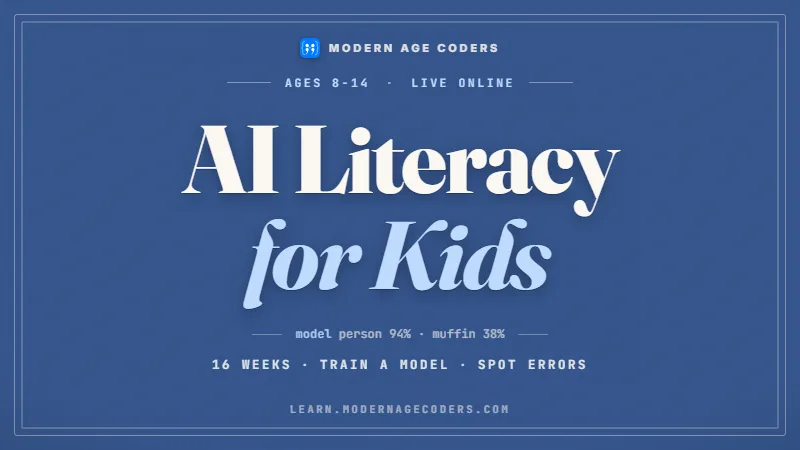
For children of about 7 to 11 who have heard about AI at school. What a model is, how it learns from examples and why it can sound sure and still be wrong, taught with games and no chatbot accounts.
Open the syllabus →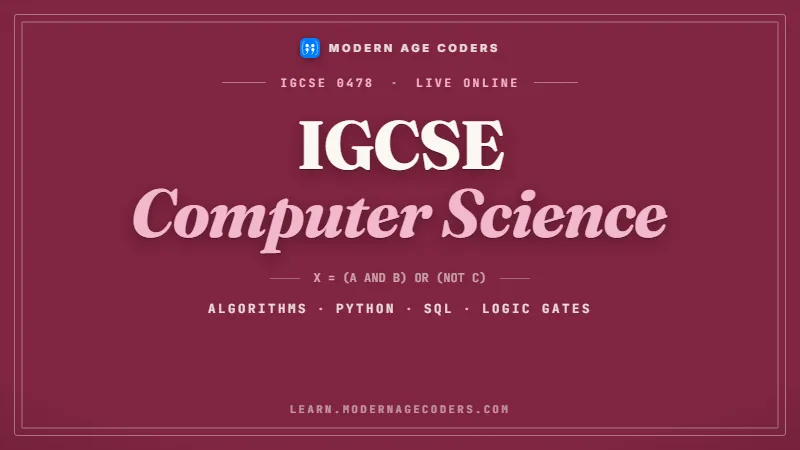
KC / 02
For Year 9 to Year 11. Algorithms, data representation and programming in Python, which Cambridge says becomes the only language in the syllabus listed for 2029 to 2031.
Open the syllabus →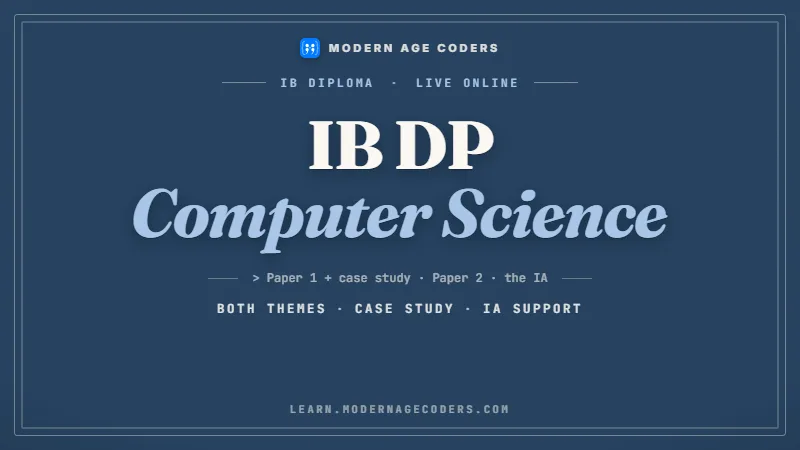
KC / 03
For DP1 and DP2 at either level. Concepts, coding practice and honest guidance on planning the internal assessment, which stays the student's own work.
Open the syllabus →Who lives here
The 2021 Population Census counted 410,634 residents in Kowloon City District, one of five districts in Kowloon. The census also publishes much smaller constituency areas, which come closer to the neighbourhood names families actually use.
| Census unit | Residents | Below age 15 | English as usual language (5+) | Read English (5+) |
|---|---|---|---|---|
| Kowloon City District | 410,634 | 50,327 | 24,779 | 74.2% |
| Hung Hom (紅磡) | 11,515 | 1,403 | 560 | 72% |
| Hung Hom Bay (紅磡灣) | 18,224 | 2,308 | 1,385 | 78.5% |
| Whampoa West (黃埔西) | 20,847 | 2,765 | 1,611 | 85.9% |
| Ho Man Tin (何文田) | 19,830 | 2,044 | 2,613 | 84.1% |
| Kowloon Tong (九龍塘) | 18,849 | 2,542 | 3,119 | 87.3% |
From the Census and Statistics Department's 2021 Population Census: the district row is in the table by District Council district (DC_21C) and the five smaller rows in the table by 2019 District Council constituency area (DCCA_21C). The constituency areas are separate published rows, are not the whole district and are not added together here; they were replaced by larger constituencies in 2023, so read them as 2021 statistical areas only.
Reading English is common across the district and very common in parts of it. In 2021, 74.2% of Kowloon City residents aged five or older could read English, above the 70.6% recorded for Hong Kong's land population as a whole, and the Kowloon Tong area reached 87.3%.
The neighbourhoods differ sharply. The Hung Hom area recorded 560 residents who usually speak English at home; Kowloon Tong, with a broadly similar population, recorded 3,119. A class taught wholly in English feels natural to some families here and like a stretch to others, which is one reason we teach one learner at a time.
C&SD's 2025 district survey estimates 421,600 people in Kowloon City District. That estimate covers only the land-based non-institutional population and comes from a household survey, so it should be read beside the census figure, never subtracted from it to claim growth.
Nothing in either source says how many children in the district study coding. We do not estimate it, and we never present our own worldwide student numbers as a Kowloon City figure.
The district sits in the middle of Kowloon, which the 2021 census counted at 2,232,339 people. Yau Tsim Mong lies to its west and south-west, Sham Shui Po to the north-west, Wong Tai Sin to the north-east and Kwun Tong to the east beyond the Kai Tak runway. Across the water, the Hung Hom ferry pier looks towards North Point on Hong Kong Island, which is where our lesson below begins. For the wider picture, start at our coding classes in Hong Kong page.
A lesson from Hung Hom
Yes, and a very good one. Sun Ferry publishes its North Point to Hung Hom timetable as open data. Turning "7:23 a.m." into something a computer can subtract is the first real puzzle, and the answers that follow tell a child something true about their own district.
The file is the Ferry Schedule of North Point - Hung Hom Service (English), one of the timetables Sun Ferry Services Company Limited publishes on DATA.GOV.HK. Each row gives a direction, the kind of day (Monday to Friday, or weekends and public holidays), a departure time written as people write it, and a remark column. Under DATA.GOV.HK's terms, data on the portal may be downloaded, copied and shared without charge for commercial or non-commercial purposes, as long as the source is named and the owners' rights acknowledged. The timetable belongs to Sun Ferry; our copy is dated 23 November 2026, and a company can change its timetable at any time.
minutes() turns each into minutes after midnight, with care over 12 noon and 12 midnight.import csv
# Sun Ferry open data on DATA.GOV.HK:
# "Ferry Schedule of North Point - Hung Hom Service (English)"
FILE = "SunFerry_northpoint_hunghom_timetable_eng.csv"
def minutes(text):
"""'7:23 a.m.' -> minutes after midnight"""
clock, half = text.split()
h, m = (int(x) for x in clock.split(":"))
if half == "p.m." and h != 12:
h += 12
if half == "a.m." and h == 12:
h = 0
return 60 * h + m
def clock(mins):
return f"{mins // 60:02d}:{mins % 60:02d}"
sailings = {}
with open(FILE, encoding="utf-8-sig", newline="") as f:
for r in csv.DictReader(f):
day = "weekday" if r["Service Date"].startswith("Mondays") else "weekend"
key = (r["Direction"], day)
sailings.setdefault(key, []).append(minutes(r["Service Hour"]))
for (direction, day), times in sorted(sailings.items()):
times.sort()
gaps = [b - a for a, b in zip(times, times[1:])]
widest = max(gaps)
at = gaps.index(widest)
print(f"{direction}, {day}")
print(f" sailings {len(times)}, first {clock(times[0])}, last {clock(times[-1])}")
print(f" gaps used: {sorted(set(gaps))} minutes")
print(f" widest gap {widest} min, first at {clock(times[at])}, "
f"{gaps.count(widest)} gap(s) that wide")
target = minutes("12:00 p.m.")
weekday = sailings[("Hung Hom to North Point", "weekday")]
nxt = min(t for t in weekday if t >= target)
print("Arrive at Hung Hom pier at 12:00 on a weekday; next sailing", clock(nxt),
"| wait", nxt - target, "min")Written by us for this page. Download the English CSV from DATA.GOV.HK, keep it beside the script with the file name shown, and run it with Python 3. Only the built-in csv module is imported.
Hung Hom to North Point, weekday
   sailings 22, first 07:05, last 19:35
   gaps used: [30, 60] minutes
   widest gap 60 min, first at 10:35, 4 gap(s) that wide
Hung Hom to North Point, weekend
   sailings 24, first 08:05, last 19:35
   gaps used: [30] minutes
   widest gap 30 min, first at 08:05, 23 gap(s) that wide
North Point to Hung Hom, weekday
   sailings 21, first 07:23, last 19:23
   gaps used: [30, 60] minutes
   widest gap 60 min, first at 10:23, 4 gap(s) that wide
North Point to Hung Hom, weekend
   sailings 23, first 08:23, last 19:23
   gaps used: [30] minutes
   widest gap 30 min, first at 08:23, 22 gap(s) that wide
Arrive at Hung Hom pier at 12:00 on a weekday; next sailing 12:35 | wait 35 min
Exactly what the program printed on our saved copy. Times are on the 24-hour clock, Hong Kong time.
On weekdays the boats run every 30 minutes in the morning and late afternoon, but four times in the middle of the day the gap stretches to 60 minutes. At weekends every gap in the file is 30 minutes. A learner who sees only the first and last sailing would never notice the midday thinning.
Weekends start later. The first weekend boat from Hung Hom leaves at 08:05, an hour after the first weekday one at 07:05, and the last boats from both piers leave at the same time every day.
Converting human formats into numbers, grouping records by a key, comparing each item with the next and asking a precise question of the result: those four moves sit underneath most real programs, from booking systems to exam timetables.
It also teaches doubt. The remark column contains no explanation in the file itself, so the program ignores it and says so, instead of guessing. Our page on learning to think rather than copy from AI explains why that habit matters more than speed.
Schools in the district
Kowloon City District is unusual. Alongside its aided and government schools, it has the largest cluster of international and private primary schooling in Hong Kong, so children around the same estate can be following four different curricula.
| Level | Kowloon City District | For comparison |
|---|---|---|
| Primary | 11,806 | Southern District, next highest: 8,618 |
| Secondary | 4,950 | All districts together: 33,047 |
Education Bureau, Student Enrolment Statistics 2025/26, tables 3.7(C) and 4.7(C) on international and other private schools, mid-September 2025. Districts are those of the school premises, so the figures describe where children study, not where they live. The Bureau does not separate international from other private schools at district level.
Publicly funded primaries follow the Education Bureau's guidance in EDBCM 109/2023: 10 to 14 hours of enriched coding education at each of P4, P5 and P6, and at junior secondary 10 to 14 hours of AI learning. Those hours introduce block coding, simple programs and ideas about AI.
At senior secondary, students who take ICT for the HKDSE meet programming as an exam subject. Our DSE ICT programming help page explains what the paper asks and how one-to-one help fits beside school.
Many of the district's international pupils follow IB or Cambridge courses. Cambridge has announced that its IGCSE Computer Science 0478 syllabus for 2029 to 2031 uses Python 3 as the only language for teaching, assessment and programming questions, so a Year 7 starting Python now meets the same language later in the exam.
We list no school by name as a source of students and have no tie with any of them. Families tell us the curriculum; the mentor matches the lessons to it. Our page on coding for international school students compares the programmes side by side.
Learning from home
For coding, usually yes. The subject happens on a screen anyway, and a learner who works alone with a mentor gets every minute of attention, and nobody has to cross the district to reach it.
Kowloon City District is well connected, with Ho Man Tin, Whampoa, Hung Hom, Kowloon Tong and the Kai Tak area all served by MTR stations (each is named in the MTR station list), yet every trip to a class still costs time on both sides of the lesson. We do not quote travel times; only your family knows what yours are.
A lesson at home starts on the minute. If it ends at 6:15 pm, the evening is already free for dinner, homework or rest.
A mentor teaching only your child sees where the cursor stops and asks about it. Misunderstandings come out within minutes instead of at the end of a term.
Hong Kong homes are well equipped: 96.9% of households had internet access at home in 2025, according to C&SD. A computer with a keyboard, a headset and a steady connection are the whole requirement.
| In Kowloon City | In India | Often requested by |
|---|---|---|
| 4:30 pm, Monday to Friday | 2:00 pm | Primary pupils home from school |
| 6:00 pm, Monday to Friday | 3:30 pm | Students after a club or sport |
| 8:30 pm, Monday to Friday | 6:00 pm | S5 and S6 students, adults |
| 2:00 pm, Saturday | 11:30 am | Families with full weekday diaries |
Hong Kong has kept UTC+8 throughout the year and observed no summer time since 1979 (Hong Kong Observatory summer-time records; IANA tz data); India keeps UTC+5:30. Every Hong Kong time is therefore 2 hours 30 minutes ahead of the mentor's. These conversions are ours; the right-hand column describes common requests, not a schedule.
Routes by age
The answer depends on age, school and interest more than on address. The table is where our mentors usually begin; the free lesson decides the real starting point.
| Age band | Usual first course | Natural next step |
|---|---|---|
| 6 and 7 | Scratch: sprites, events, simple games | Block coding projects with more logic |
| 8 to 10 | AI literacy, then first typed Python | Python games and maths through coding |
| 11 to 13 | Python for teens, data from real files | AMC 8 style problems, early C++ |
| 14 and 15 | IGCSE Computer Science or junior DSE ICT work | Competitive programming in C++ |
| 16 to 18 | IB Computer Science, IB Maths, DSE M1 or M2 | Machine learning and research-style projects |
| Adults | Python from scratch, AI tools for the office | Web apps, automation and data analysis |
Our own placement map. Any AI tool used in class is used inside the age terms its maker publishes; our AI tools age guide lists them.
Secondary students who like hard problems often aim at the Hong Kong Olympiad in Informatics, which takes entries through registered day secondary schools and treats C++ as its main language. We teach the algorithms in C++ with problems we write, and we never promise a place or a medal. Competitive programming for teens explains the ladder of contests.
Primary maths contests are a separate world; our maths olympiad classes cover that side.
Younger children learn how a model guesses before they ever use one, then build small projects whose output they test themselves. Teenagers go further into how models are trained and measured.
If a teenager wants to build with AI help from the start, our vibe coding course in Hong Kong shows how that works when every line is reviewed.
Checking progress
Six steps of our own, used for placement and for the short reports parents receive. They are not school grades and no exam board sets them.
| Step | The learner | You will see |
|---|---|---|
| 1. Trace | Follows a program line by line on paper | A traced table of values |
| 2. Tweak | Alters a working program and predicts the effect | Before and after versions |
| 3. Create | Writes a complete small program unaided | The end-of-unit project |
| 4. Measure | Pulls a fact out of a real data file | An answer like the ferry gaps |
| 5. Challenge | Tries inputs designed to break the code | Notes on what failed and the fix |
| 6. Present | Explains the work to someone new | A short recorded explanation |
Text that looks like a time is not yet a number.
If the file does not explain a column, do not invent the meaning.
Ask which step your child is on and what would move them up.
A recorded explanation at step 6 is worth keeping.
The rest of the list
Nine more, in three bands. Every one runs live, one to one and in English for learners anywhere in the district.
KC / A / 01
From a moving cat to a full game of their own design.
Open the syllabusKC / A / 02
Real scripting inside a game children already play.
Open the syllabusKC / A / 03
Number patterns tested by code rather than by worksheet.
Open the syllabusKC / B / 01
Files, functions, data and projects for secondary students.
Open the syllabusKC / B / 02
Core and Extended, matched to the school's scheme of work.
Open the syllabusKC / B / 03
Speed and reasoning for the 25-question contest.
Open the syllabusKC / C / 01
Analysis and approaches or applications, SL or HL.
Open the syllabusKC / C / 02
Algorithms and C++ practice for informatics contests.
Open the syllabusKC / C / 03
Web and Python projects with AI help that teens check.
Open the syllabusScheduling
Any day, any time, flexible: one to one at the hour that suits your family, weekdays or weekends.
Late afternoon
It is early afternoon for the mentor, so these slots are easy to fill.
Saturday
Morning or afternoon, whichever keeps the weekend calm.
Evening
For DSE and IB students and for adults after work.
The mentor who starts with your child stays with them.
The mentor sees each keystroke and asks about it.
Clear speech; tricky words typed out in the chat.
Every unit ends with something that runs.
A few lines on progress after classes.
Computer, headset, reliable connection.
Student work
A selection from students on longer courses in several countries. There is more in our student labs.

AI and ML
An AI nutrition coach that reads what you eat and works you toward a target.

AI and ML
A chatbot that answers mathematics and programming questions, built and deployed by a student.

AI and ML
An assistant that helps a young person recognise unsafe situations online.

Web app
A weather forecasting site with live conditions for any location.
Fees
The price is a monthly fee, displayed below in Hong Kong dollars. You pay for one month, then the next, with no term bundles and nothing paid far ahead. If your chosen payment method carries a gateway charge, checkout shows it before you agree to pay.
Free first class
Free
no card required
One to one
$1,200 HKD
a month, eight live classes
What families say
Google reviews from parents and students, unedited.
★★★★★
"The one step solution for my son. Modern Age Coders make learning coding so simple that kids love it. The teachers explain complex concepts clearly with practical exercises and interactive content."
Ria Mukherjee
Parent
★★★★★
"Modern Age Coders has been a game-changer for me. I struggled to grasp IT concepts and coding before joining, but their classes transformed everything. I can now confidently write complex programs with ease."
Samriddha Mondal
Student
★★★★★
"One of the most wonderful education centres out there. Education is not limited to school syllabus but focuses on skill development."
Vansh Agarwal
Student
★★★★★
"My child Dhairya is really enjoying the Modern Age Coders classes. This is his first online class and he eagerly looks forward to it. I can already see his improvement, and the teachers are very cooperative."
Sonam Oswal
Parent of Dhairya
★★★★★
"Modern Age Coders have wonderful teachers who teach in a clear, easy and practical way. The teacher boosts students' confidence and inspires them to learn without hesitation."
Sonu Goyal
Parent
★★★★★
"I highly recommend this computer coding class! The teachers are incredibly knowledgeable and passionate about coding."
Ritu Kedia
Parent
Questions from the district
Online, at your home. We have no centre in Hung Hom, Ho Man Tin, Kowloon Tong or anywhere else in Hong Kong, so nobody travels for a lesson.
English, for the whole lesson, from a mentor based in India. We do not offer Cantonese or Putonghua teaching. Mentors adjust their pace and type key words into the chat.
No. Hong Kong families are taught one to one: a single learner with a single mentor, every time.
Not at all. Children of six or seven start with Scratch or block coding. A P3 child often moves to Python within a year, before the school coding module begins in P4.
Any day, any time, flexible: one to one at the hour that suits your family, weekdays or weekends. The mentor's clock in India is two and a half hours behind Hong Kong, so a 7 pm lesson in Kowloon City is 4:30 pm for them.
Each month is paid separately, at the fee shown in Hong Kong dollars on this page. There is no large advance payment, and any gateway charge is displayed at checkout before you pay.
We teach the content and coach the process, but every internal assessment and piece of coursework is written by the student. We do not write or edit graded work.
Not ChatGPT or Claude: OpenAI and Anthropic do not include Hong Kong among the regions where they offer them. We teach with tools that are available in Hong Kong or supplied by your child's school, within the age terms each maker sets, and younger children learn the ideas without any account.
It matters for the content, not for joining. We teach children from local, DSS, private and international schools, and the mentor shapes lessons around the curriculum you tell us about.
A laptop or desktop computer, a headset with a microphone and home internet that stays up. A tablet is fine for the trial, but a keyboard matters once real code begins.
Read next
Where parents in the district usually go after this page.
The full Hong Kong guide and course list.
IGCSE, IB and A level computing compared.
What the exam asks of programmers.
AI for primary children, without chatbots.
Contest ladders for Hong Kong teens.
Why we teach reasoning first.
Part of the guide: Every Hong Kong page
More guides: Coding and AI classes in Hong Kong · 中文:英文授課編程課程 · Start here: Online coding for kids · AI, vibe coding and AI agents: AI agents course · Coding subjects and courses: App development · By age and school level: Adults · HKDSE ICT and maths: DSE ICT elective guide · IB, IGCSE, A-level and SAT: A level Computer Science tutor · Olympiads and competitions: AMC 10 preparation · Guides for families: After-school coding · School holidays: AI summer course
Start here
Send your child's age, school and curriculum. During the free lesson a mentor works through a short coding or maths problem with your child, notices how they reason and suggests the course that fits, live online with just the two of them.
Curious about the method first? How we teach describes a lesson from start to end, and our course list has every syllabus.
WhatsApp us · +91 91233 66161 · connect@modernagecoders.com
Lessons are live, online and in English, taught by mentors based in India. WhatsApp messages in English are answered fastest.
A priority demo is a full class of about 45 to 60 minutes. After the class the mentor sends a written skill report and a personal learning roadmap on WhatsApp. If you enrol, the demo fee is adjusted against your first month's fee. Share your demo Order ID with us on WhatsApp and we take it off.
Book a priority demo