HV / A / 01
Scratch coding
Animation and games from blocks.
Open the syllabusHong Kong Island · Wan Chai District · Happy Valley
Happy Valley is a quiet residential pocket with hills on three sides and the city on the fourth. Getting children out of it at rush hour is the hard part of most activities. With us there is nothing to get to: a mentor teaches your child live, online and one to one, in English, from your own table. Below you will find the valley in census figures, its schools, and a first coding lesson built on the Observatory's Happy Valley weather station.
Teaching online since 2020 · 10,000+ students worldwide · Hong Kong classes: one to one, live, in English
The short answer
Modern Age Coders teaches coding, AI and maths to children, teenagers and adults in Happy Valley, Hong Kong, through live online classes that are one to one and in English. An India-based mentor works with a single learner: Scratch, Minecraft and Python for younger children, AI basics, IGCSE and IB computer science and maths for teenagers, olympiad problems for keen mathematicians, and practical coding for adults. Your family chooses the hour on Hong Kong time, and the lesson happens at home.
Start with a course
Three good openings for families in the valley: Minecraft coding for primary children, Python with AI for older children, and olympiad maths for those who love hard problems.
HV / 01
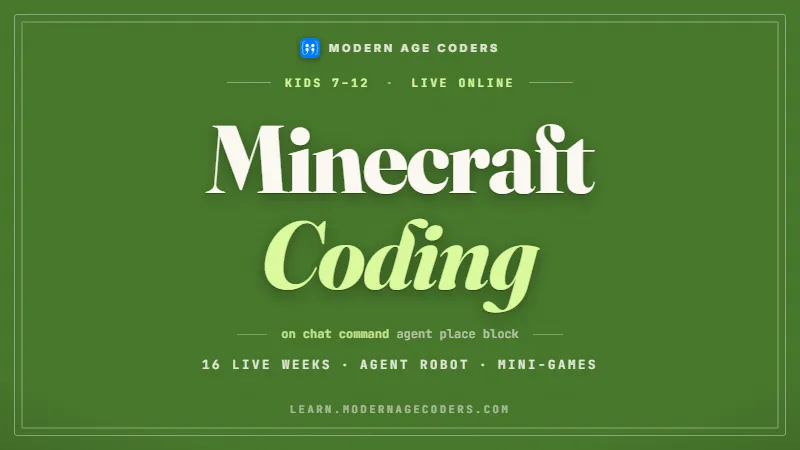
For about 7 to 11. Children use a game they already enjoy to learn loops, conditions and coordinates, then move from blocks to typed code.
Open the syllabus →
HV / 02
For about 9 to 13. Real Python from the first lesson: drawings, small games and simple AI projects, each explained step by step in English.
Open the syllabus →
HV / 03
For strong mathematicians from upper primary up. Problem solving well beyond the syllabus, using practice problems we write ourselves.
Open the syllabus →The valley in numbers
The 2021 Population Census has a small area called Happy Valley inside Wan Chai District, home to 13,248 people. The hillside areas around it are separate census rows; they appear below one by one, never added together.
| Census area | Residents | Under-15s | Speak English at home (aged 5+) | Read English (aged 5+) |
|---|---|---|---|---|
| Happy Valley (跑馬地) | 13,248 | 1,613 | 3,480 | 88.7% |
| Broadwood (樂活) | 12,958 | 1,759 | 2,652 | 92.9% |
| Stubbs Road (司徒拔道) | 14,245 | 1,475 | 4,154 | 92.1% |
| Jardine's Lookout (渣甸山) | 14,459 | 1,433 | 3,935 | 92.2% |
C&SD, 2021 Population Census, table DCCA_21C by 2019 District Council Constituency Area, at 30 June 2021. The column "speak English at home" is the census measure of usual spoken language. Constituencies changed in 2023, and these areas are listed one by one because no published figure combines them.
Happy Valley had 1,613 children under 15 in 2021, about one resident in eight, and Broadwood next door had 1,759. Across Wan Chai District as a whole the 2021 share was lower, 16,917 children among 166,695 residents.
Reading English is close to universal on the slopes: 92.9% in Broadwood, 92.2% in Jardine's Lookout and 92.1% around Stubbs Road, with 88.7% in the valley itself. Lessons taught only in English are a natural fit here.
Happy Valley belongs to Wan Chai District, the least populous of Hong Kong's 18 districts with 166,695 residents in the 2021 census. For 2025, C&SD's district statistics give 160,600 land-based non-institutional residents, a different and narrower count rather than a sign of decline.
Families in neighbouring Causeway Bay, Tai Hang and Wan Chai book the same lessons; nothing about the course changes with the street.
The valley opens north towards Causeway Bay and Wan Chai, with Tai Hang and Jardine's Lookout on the slopes to the east, Broadwood and Stubbs Road to the south and west, and the hills of Wong Nai Chung Gap leading over to Southern District. The tram runs a loop into Happy Valley from the north shore line. For the rest of the territory, our coding classes in Hong Kong page covers every district, and Mid-Levels has its own page on the island.
Schools in the valley
In the Education Bureau's school list, four primary and secondary schools give a Happy Valley address, all of them aided schools. Many valley children travel to schools elsewhere, including ESF and international schools in the district and beyond.
| School (as listed by EDB) | Category | Address given |
|---|---|---|
| Po Kok Primary School | Aided primary | Shan Kwong Road |
| Precious Blood Primary School | Aided primary | Sing Woo Road |
| St. Paul's Primary Catholic School | Aided primary | Wong Nai Chung Road |
| St. Paul's Secondary School | Aided secondary | Ventris Road |
Source: Education Bureau, School Location and Information, from DATA.GOV.HK, as saved on 23 November 2026; we filtered the English address for "Happy Valley". Schools are listed only to describe the neighbourhood. We have no relationship with any school, and nothing here says where our learners study.
Aided schools follow EDB's guidance in circular 109/2023: between ten and fourteen hours of enriched coding a year in each of P4, P5 and P6, and a similar allowance of AI learning advised across S1 to S3.
That gives every child a taste. Children who enjoy it usually want more practice than a timetable can hold, and a weekly lesson with a patient mentor gives them room to build something bigger.
Wan Chai District also contains an ESF primary school on Stubbs Road and the French International School's secondary campus on Blue Pool Road, both listed in the same EDB file, and EDB counts 4,930 primary and 1,073 secondary pupils at international and other private schools sited in the district in 2025/26.
Students on those programmes often take Cambridge IGCSE or the IB. Our IB computer science tutor and IGCSE maths tutor pages explain how lessons fit around school.
For strong secondary students, the Hong Kong Olympiad in Informatics is entered through school and uses C++ (C++20) as its main language; our HKOI training page describes how we prepare students with our own problems and why we promise no result. Maths contests are covered on our Hong Kong maths competitions calendar.
Learning at home
Because the valley has few ways out, and they all meet busy roads at the hour school finishes. A coding lesson needs a computer and concentration, both of which are easier at home.
Most activity centres are in the commercial streets of Causeway Bay, Wan Chai or further afield. We will not estimate how long the trip takes; that depends on your road, the traffic and the day, and you already know it.
With an online lesson, a child finishes a snack, sits down and starts. The hour that would have gone on travel goes to homework or play.
Our lessons have one learner. The mentor follows every line your child writes, notices hesitation, and changes the example or the pace on the spot.
Nearly every Hong Kong home can do this already; C&SD found home internet access in 96.9% of households in 2025. Add a computer with a real keyboard and a headset, and the lesson is ready.
| Hong Kong | India | Often picked by |
|---|---|---|
| 3:30 pm, school day | 1:00 pm | Younger children home early |
| 5:00 pm, school day | 2:30 pm | Children after a club |
| 7:15 pm, school day | 4:45 pm | Secondary students |
| 9:00 am, Saturday | 6:30 am | Early-rising families |
Hong Kong stays on UTC+8 all year with no summer time since 1979 (Hong Kong Observatory) and India on UTC+5:30, so India is always 2 hours 30 minutes behind. We worked out the conversions ourselves; the last column describes common requests, not booked slots.
A real lesson
The Hong Kong Observatory runs a weather station in Happy Valley and publishes its daily maximum temperature as open data, back to 2008. Working with a year of it teaches a teenager three things at once: trusting a quality flag, averaging fairly, and sliding a window along a calendar.
The dataset is Daily maximum, mean and minimum temperatures from the Hong Kong Observatory on DATA.GOV.HK; the file we use is the daily maximum for station HPV, Happy Valley, which the Observatory's open data documentation lists with records from 2008. Each row has a year, month, day, a value in degrees Celsius and a flag: C for complete data, # for incomplete, *** for unavailable. DATA.GOV.HK's terms let anyone reuse the data free of charge, commercially or otherwise, if the source is stated and ownership acknowledged. We downloaded it on 23 November 2026.
None, so they cannot quietly pull an average up or down.import csv
from datetime import date, timedelta
# Saved from DATA.GOV.HK: Hong Kong Observatory, "Daily maximum, mean and minimum temperatures",
# daily maximum at the Happy Valley station (HPV). Flags: C = complete, # = incomplete, *** = none.
days = {}
with open("hko_clmmaxt_hpv.csv", encoding="utf-8-sig", newline="") as f:
for row in csv.reader(f):
if len(row) == 5 and row[0].isdigit():
y, m, d, value, flag = row
days[date(int(y), int(m), int(d))] = (float(value) if flag == "C" else None, flag)
year = [d for d in days if d.year == 2025]
print("1. 2025 days by flag:", {f: sum(1 for d in year if days[d][1] == f) for f in ("C", "#")})
print("2. Mean daily maximum by month, 2025 (complete days only)")
for m in range(1, 13):
vals = [days[d][0] for d in year if d.month == m and days[d][0] is not None]
print(f" {date(2025, m, 1):%b} {sum(vals) / len(vals):5.1f} C from {len(vals):>2} days" if vals else f" {date(2025, m, 1):%b} no complete days")
hot_start, hot_avg = None, -99.0
d = date(2025, 1, 1)
while d + timedelta(days=6) <= date(2025, 12, 31):
week = [days.get(d + timedelta(days=k), (None, ""))[0] for k in range(7)]
if None not in week and sum(week) / 7 > hot_avg:
hot_start, hot_avg = d, sum(week) / 7
d += timedelta(days=1)
print(f"3. Warmest 7 complete days in a row: from {hot_start:%d %b} averaging {hot_avg:.1f} C")
run = longest = 0
for d in sorted(year):
v = days[d][0]
run = run + 1 if v is not None and v >= 30.0 else 0
longest = max(longest, run)
print("4. Longest run of complete days at 30.0 C or above:", longest)Our program, written for this page. Download the Happy Valley daily maximum CSV from the Observatory's dataset on DATA.GOV.HK, name it as shown and run it with Python 3. Standard library only.
1. 2025 days by flag: {'C': 302, '#': 63}
2. Mean daily maximum by month, 2025 (complete days only)
   Jan   21.6 C  from 24 days
   Feb   20.8 C  from 27 days
   Mar   24.1 C  from 25 days
   Apr   27.0 C  from 29 days
   May   30.8 C  from 21 days
   Jun   31.9 C  from 24 days
   Jul   33.6 C  from 28 days
   Aug   32.5 C  from 19 days
   Sep   32.7 C  from 14 days
   Oct   30.7 C  from 31 days
   Nov   25.9 C  from 29 days
   Dec   23.6 C  from 31 days
3. Warmest 7 complete days in a row: from 01 Jul averaging 34.5 C
4. Longest run of complete days at 30.0 C or above: 24
Exact output on our saved file. Means are rounded to one decimal place.
In 2025, 302 days were marked complete and 63 incomplete. September's average rests on only 14 complete days and August's on 19, so those two months deserve less confidence than October, which had all 31.
July was the warmest month on these complete days, with a mean daily maximum of 33.6 degrees, and the warmest seven complete days in a row began on 1 July, averaging 34.5. The longest unbroken stretch of complete days at 30 degrees or above lasted 24 days.
Students meet None as a deliberate choice, not an accident. Storing "no trustworthy value" as nothing, instead of zero, is what keeps the averages honest, and the run counter resets on a missing day as well as on a cool one.
The sliding window is a pattern that turns up everywhere, from moving averages in finance to signal processing. It is also a place where AI-written code often gets the edges wrong. Our coding with AI without copying page explains why learners write and test windows like this themselves.
By age
Every route is live, online, in English and one to one. The free class decides the starting point, because two children of the same age rarely start in the same place.
| Age | A common start | What follows |
|---|---|---|
| 6 to 8 | Scratch: first animations and games | Longer projects, early AI ideas |
| 7 to 11 | Minecraft coding | Typed Python, maths through coding |
| 9 to 13 | Python and AI for kids | AI projects, AMC 8 style problems |
| 13 to 16 | IGCSE Computer Science and Maths | C++ and contest problems |
| 16 to 18 | IB Computer Science and IB Maths | Independent projects |
| Adults | Python for everyday work | Data tools, web apps, AI agents |
This map is ours and only a starting guide; mentors move learners up or down once they see them work. AI tools appear in lessons only within their age terms and only where their makers offer them in Hong Kong or a school provides them; see the AI tools age guide.
Under-tens build confidence by making things that move and respond, and by explaining in English what they changed. Our coding for 9-year-olds page shows what one year can look like.
Children curious about AI can learn how it works before they use it, as our AI classes for primary students page describes.
Teenagers usually arrive with a goal: an exam, an exploration, a contest, a portfolio. We work towards it, and every piece of assessed work stays the student's own.
Parents who want to learn themselves can book a separate course, often in the evening after children are in bed.
In English
English, every time, from mentors based in India. Programming languages, error messages and computing exams are all in English, so the lesson language matches the subject.
Pupils at ESF, international and English-medium schools hear the same terms with us that they hear at school, so nothing needs translating before an exam.
Mentors ask learners to explain code aloud, which builds the precise vocabulary coursework rewards.
For pupils at Chinese-medium schools, a coding lesson is a chance to use English for something they enjoy. Mentors slow down, repeat and write new words in the chat.
We do not offer lessons in Cantonese or Putonghua; a free first class shows quickly whether English-only teaching suits your child.
For a fuller explanation of the single-learner format, read one-on-one coding tutoring in Hong Kong; for pricing, our page on fees in Hong Kong.
Progress
Six stages of our own, used in every course on this page. They describe what a learner can do, and carry no official standing with any school or exam board.
| Stage | The learner | Evidence |
|---|---|---|
| 1. Predict | Says what short code will do before it runs | Right more often than not |
| 2. Change | Adapts a working program on purpose | A game with a new rule |
| 3. Build | Writes a small program from empty | A finished unit project |
| 4. Measure | Answers a question from a real data file | A lesson like the weather one |
| 5. Doubt | Says how much to trust each number | A note on missing or thin data |
| 6. Teach | Explains the work to someone else | A short show-and-tell at home |
A missing value is not a zero.
Say how many days your average stands on.
Ask how sure your child is, not only what they found.
The unit projects make a good record of the year.
More courses
Nine more, in three bands. All are taught to Hong Kong families live, one to one and in English.
HV / A / 01
Animation and games from blocks.
Open the syllabusHV / A / 02
Understanding AI before using it.
Open the syllabusHV / A / 03
Contest maths, original problems.
Open the syllabusHV / B / 01
Cambridge 0478, theory and Python.
Open the syllabusHV / B / 02
The new guide, assessed from 2027.
Open the syllabusHV / B / 03
AA or AI, standard or higher level.
Open the syllabusHV / C / 01
The language of HKOI, from basics.
Open the syllabusHV / C / 02
Web and AI projects, tested by hand.
Open the syllabusHV / C / 03
Full-stack building for adults.
Open the syllabusHow classes run
Any day, any time, flexible: one to one at the hour that suits your family, weekdays or weekends.
Mid-afternoon
Lunchtime in India, so plenty of mentors are free.
Early Saturday
Mentors begin at dawn in India to meet it.
Evening
Teenagers and adults after their day.
The same mentor all the way through.
Code typed and discussed together.
Calm pace, new words written down.
A finished piece for every unit.
A quick summary after lessons.
Computer, headset, reliable internet.
Student work
Work by learners in longer courses in other countries; there is more in our student labs.

AI and ML
An AI nutrition coach that reads what you eat and works you toward a target.

AI and ML
A chatbot that answers mathematics and programming questions, built and deployed by a student.

AI and ML
An assistant that helps a young person recognise unsafe situations online.

Web app
A weather forecasting site with live conditions for any location.
Fees
Fees are monthly and appear on this page in Hong Kong dollars. Each month is paid on its own, so there is no large sum up front. If your payment method adds a gateway charge, checkout lists it before you agree.
Free first class
Free
no card required
One to one
$1,200 HKD
a month, eight live classes
What families say
Parents and learners on Google, in their own words.
★★★★★
"The one step solution for my son. Modern Age Coders make learning coding so simple that kids love it. The teachers explain complex concepts clearly with practical exercises and interactive content."
Ria Mukherjee
Parent
★★★★★
"Modern Age Coders has been a game-changer for me. I struggled to grasp IT concepts and coding before joining, but their classes transformed everything. I can now confidently write complex programs with ease."
Samriddha Mondal
Student
★★★★★
"One of the most wonderful education centres out there. Education is not limited to school syllabus but focuses on skill development."
Vansh Agarwal
Student
★★★★★
"My child Dhairya is really enjoying the Modern Age Coders classes. This is his first online class and he eagerly looks forward to it. I can already see his improvement, and the teachers are very cooperative."
Sonam Oswal
Parent of Dhairya
★★★★★
"Modern Age Coders have wonderful teachers who teach in a clear, easy and practical way. The teacher boosts students' confidence and inspires them to learn without hesitation."
Sonu Goyal
Parent
★★★★★
"I highly recommend this computer coding class! The teachers are incredibly knowledgeable and passionate about coding."
Ritu Kedia
Parent
Questions from Happy Valley
No, and none anywhere in Hong Kong. Lessons are online, so your child stays in the valley and learns from home.
Yes. Every lesson is live and in English, with a mentor based in India. We do not teach in Cantonese or Putonghua.
One to one. Every Hong Kong lesson pairs one learner with one mentor, and we offer no other format here.
About six, with Scratch. Many children try Minecraft coding or Python from seven to eleven, and teenagers can work towards IGCSE or IB computing and maths.
Any day, any time, flexible: one to one at the hour that suits your family, weekdays or weekends. Clocks in India sit two and a half hours behind Hong Kong all year, so a 5 pm lesson here starts at 2:30 pm there.
Yes. Mentors teach the content and programming, set practice and coach planning. Assessed work, including the IB internal assessment, is written by the student alone.
Each month separately, at the Hong Kong dollar fee shown here. There is no advance payment for later months, and a gateway charge, if any, shows at checkout before you pay.
No. OpenAI and Anthropic do not list Hong Kong where they offer ChatGPT and Claude. Lessons use AI tools available in Hong Kong or provided by your child's school, inside their age rules, and children learn to check AI answers in ways that apply to any tool.
Yes, with problems we write ourselves. We describe what each contest tests and link the organiser's own pages, and we never promise a medal or a place.
A computer with a physical keyboard, a headset with a microphone and steady internet. A tablet works for the free lesson but is slow for typing code.
Related
Pages that answer the next questions parents in the valley tend to have.
Every district in one guide.
Another island neighbourhood page.
Diploma CS, one to one.
Contest dates and organisers.
Where younger learners begin with AI.
Projects our learners have built.
Part of the guide: Every Hong Kong page
More guides: Coding and AI classes in Hong Kong · 中文:英文授課編程課程 · Start here: Online coding for kids · AI, vibe coding and AI agents: AI agents course · Coding subjects and courses: App development · By age and school level: Adults · HKDSE ICT and maths: DSE ICT elective guide · IB, IGCSE, A-level and SAT: A level Computer Science tutor · Olympiads and competitions: AMC 10 preparation · Guides for families: After-school coding · School holidays: AI summer course
Start here
Send your child's age, school programme and anything they have tried. In the free lesson, live and one to one, the mentor offers a small coding or maths problem, follows how your child approaches it and suggests where to begin.
Would you rather read first? How we teach explains our lessons, and the courses page lists every syllabus.
WhatsApp us · +91 91233 66161 · connect@modernagecoders.com
An India-based mentor teaches each lesson live online in English. Message us on WhatsApp in English for the quickest reply.
A priority demo is a full class of about 45 to 60 minutes. After the class the mentor sends a written skill report and a personal learning roadmap on WhatsApp. If you enrol, the demo fee is adjusted against your first month's fee. Share your demo Order ID with us on WhatsApp and we take it off.
Book a priority demo