COLLEGE / ONE / 01
Python Masterclass
Python until it is genuinely automatic.
Open the syllabusIreland · Higher education · Live online
First year of a computing degree in Ireland has a particular shape. The lectures move fast, the labs assume you already type fluently, and the language you are taught depends entirely on where you ended up: University College Cork introduces programming "using a modern programming language (currently Python)", while University College Dublin's Computer Programming I says students "learn how to program a computer using a simple programming language (e.g. C)". Two respected departments, two different first languages, and a student in either one can be the person in the lab who has never written a line before. This page is for students in Irish higher education who want to stop feeling behind: what first-year modules actually ask, what the graduate outcomes data shows about internships and employment, and how weekly live lessons fit around semester dates at UCD, Trinity and elsewhere. We are not affiliated with any Irish institution, and we never write or edit work that will be submitted for assessment.
Live teaching since 2020 · 10,000+ students · never assessed work, always your own
In short
Irish computing degrees do not share a first language: UCC introduces programming in Python, while UCD's first-year module uses C as its example. Whichever you are in, the gap that hurts is fluency, not talent, and it closes with weekly practice and someone to ask. Modern Age Coders teaches students in Ireland live online, in groups of five to ten at one level or one to one, around semester dates and exam weeks. We teach the skills and your own projects, never work being submitted for assessment. The first class is free; after it a group place is USD 100 a month and one-to-one lessons USD 150 a month.
Start here
The language, the theory and the practice that most first and second years need. Each card opens its syllabus.
COLLEGE / 01
For students whose modules are in Python, and for anyone who wants one language they can genuinely rely on.
Open the syllabus →
COLLEGE / 02
Pointers, memory and the machine underneath, for degrees that start students in C rather than a friendlier language.
Open the syllabus →
COLLEGE / 03
The module most students find hardest, taught as reasoning about cost rather than memorising implementations.
Open the syllabus →First-year modules
Read from the institutions' own module catalogues for 2026/27. Departments change their choices, so always check your own module descriptor.
| Module | Institution | Language, in the descriptor's words | Shape |
|---|---|---|---|
| CS1117 Introduction to Programming | University College Cork | "using a modern programming language (currently Python)" | 15 credits, Semesters 1 and 2 |
| COMP10110 Computer Programming I | University College Dublin | "a simple programming language (e.g. C)" | 5 credits, Level 1, Autumn trimester |
| COMP10280 Programming I (Conversion) | University College Dublin | Python, with "at least 100 programs" written | Graduate conversion, not first-year undergraduate |
UCD's two entry modules illustrate something worth knowing: the language is a teaching choice, not a statement about the subject. One module uses C as its example, the other teaches Python to graduates converting into computing.
So the question "what language does Ireland teach?" has no single answer, and anyone who gives you one has not checked. What transfers between them is the thinking: variables, control flow, decomposition, testing.
Look at the credits. UCC's introduction to programming runs across both semesters and carries 15 credits, three times a standard 5-credit module, with a summer written exam worth most of the marks.
A module that size rewards steady weekly work and punishes catching up in April. That is the single most useful thing to know in September of first year.
Sources, read 16 September 2026: UCC Book of Modules, CS1117; UCD, COMP10110 and COMP10280. We have no connection with either university; check your own department's current descriptor, which is the only one that governs your course.
Students and outcomes
The Higher Education Authority publishes both enrolment figures and a graduate outcomes survey. Together they say something useful about where effort pays.
| Measure | Figure | Source |
|---|---|---|
| Student enrolments, 2024/25 | 278,880, up 4.9% on the year | HEA Key Facts and Figures |
| New full-time undergraduate entrants, 2024/25 | 48,485 | HEA |
| ICT share of postgraduate graduates, Class of 2024 | 13.2%, the third largest field | HEA |
| ICT share among internationally domiciled graduates | 18.3%, second only to business, administration and law | HEA |
| In employment nine months after graduating, Class of 2024 | 80.2% of all graduates; 74.9% of undergraduate honours graduates | HEA Graduate Outcomes |
| Completed an internship | 61.6% of 2024 honours graduates, up from 58.4% | HEA Graduate Outcomes |
| Working in Ireland nine months on | 92.9%, with Dublin 43.4%, Cork 13.0% and Galway 6.8% | HEA Graduate Outcomes |
The internship figure is the one students should act on. Nearly two in three honours graduates had done one, which means a student without any relevant experience is competing against a majority who have some.
Building something real, and putting it somewhere public, is the version of that available to a first or second year who has not reached a placement module yet.
The HEA also notes that honours graduates of technological universities are employed at nine months at rates between 79.4% and 85.6%, against 65.1% to 79.1% at universities, partly because more university graduates go straight into further study.
On supply, SOLAS reports 11,200 ICT awards in 2023, with software development awards up 29%, a rise of 735 in a single year, and Ireland having the third largest share of IT graduates in the EU.
Sources: HEA Key Facts and Figures; HEA Graduate Outcomes, Class of 2024 (published 27 November 2025); SOLAS National Skills Bulletin, October 2025. The HEA does not publish employment figures for ICT graduates alone, so none are claimed here.
Around the semester
Terms differ by institution, so the timetable is agreed with each student. Two published 2026/27 calendars show the usual shape.
| Institution | First semester | Second semester |
|---|---|---|
| University College Dublin | Teaching 7 September to 27 November 2026, revision to 4 December, exams 5 to 19 December | Teaching from 18 January 2027, study period 8 to 21 March, exams 1 to 15 May |
| Trinity College Dublin | Michaelmas teaching from 14 September 2026, study and review week from 26 October, assessment 11 to 22 December | Hilary teaching from 18 January 2027, study and review from 1 March, assessment 19 to 30 April |
The heaviest teaching block. Weekly lessons here keep a student level with labs instead of trying to catch up at Christmas.
Lessons lighten or pause. We do not run revision of your modules, and we never touch assessed work, but we do practise the underlying skills.
Study periods and the summer are when portfolios actually get built, which is why our project courses fill up then.
One boundary, stated plainly: we teach skills and personal projects. We do not write, debug, review or edit anything that will be handed up for marks, and we tell students the same thing when they ask.
Students who want to build agents as their own project can go on to AI agents for students, which covers the Irish academic integrity guidance in detail.
Sources: UCD Academic Year 2026/27 term dates; Trinity College Dublin academic year structure 2026/27, read 16 September 2026.
The rungs
A rough map. Students arrive at different points, and plenty of final years still need the first rung nailed down.
| Stage | What should be solid | What to build |
|---|---|---|
| First year | One language, fluently: loops, functions, files, debugging | Small programs, finished and kept |
| Second year | Data structures, complexity, version control, SQL | A project with a database behind it |
| Third year or placement | Working in a team codebase, reading other people's code | Something used by somebody other than you |
| Final year | Depth in one area, and honest evaluation of it | A project you can defend in an interview |
Interviewers ask what you built and why you made each choice. Marks rarely come up. Two or three finished projects with public code do more than a long list of modules.
The order the pieces fit together in is on the coding roadmap.
The HEA funds retention supports on ICT programmes precisely because the first year is where students fall away. Ask your department what it runs; most have labs, mentors or peer supports.
Weekly outside lessons work best as a supplement to those, not a replacement for them.
The catalogue
Grouped by where students usually need them. The free first class settles the level.
COLLEGE / ONE / 01
Python until it is genuinely automatic.
Open the syllabusCOLLEGE / ONE / 02
Memory and pointers, taught patiently.
Open the syllabusCOLLEGE / ONE / 03
Your work saved, versioned and visible.
Open the syllabusCOLLEGE / MID / 01
The hard module, made reasonable.
Open the syllabusCOLLEGE / MID / 02
Databases as more than a place to put things.
Open the syllabusCOLLEGE / MID / 03
A whole system you can demonstrate.
Open the syllabusCOLLEGE / FINAL / 01
Models built and evaluated honestly.
Open the syllabusCOLLEGE / FINAL / 02
What sits under the tools everyone uses.
Open the syllabusCOLLEGE / FINAL / 03
Speed and precision for technical interviews.
Open the syllabusHow the classes run
Teaching is live, with teachers based in India, whose clock does not shift. They run four and a half hours ahead of Irish time during the summer months and five and a half hours ahead through the Irish winter, so evening classes in Ireland land comfortably in their day.
Weekday evening
After lectures and labs, Irish time.
Weekend
Project sessions, longer and quieter.
Gaps in a timetable
Daytime slots, usually one to one.
You work through something real and get a frank view of which level to join at.
Students at one level, including students from other countries taking similar modules.
For final-year projects, or when a timetable will not fit a fixed group slot.
Lessons lighten during exams and pick up again after, planned at the start of each term.
We never write, edit, debug or review anything being submitted for marks.
Projects live in your own repository, ready for placement and graduate applications.
Student work
Four projects built by our students and put online where anyone can see them. The student labs page holds many more.
AI and ML
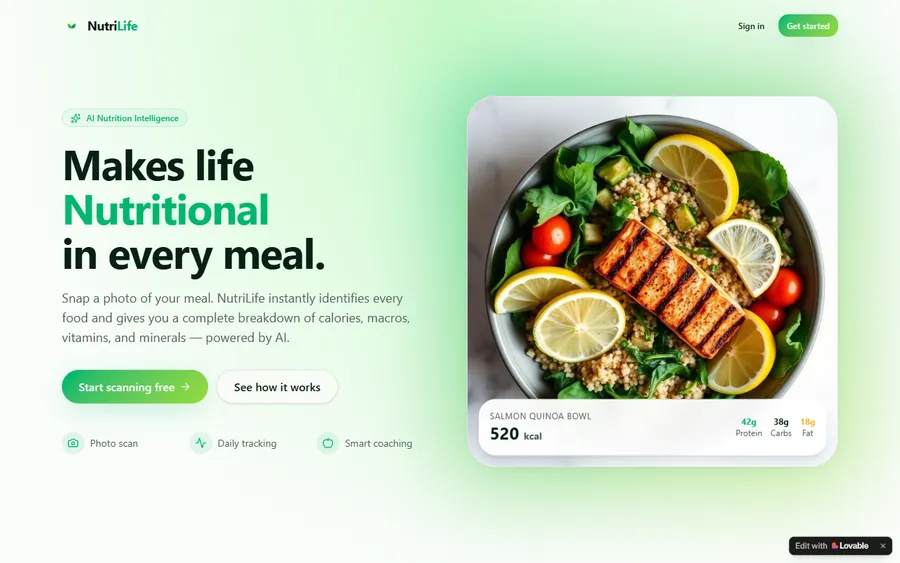
An AI nutrition coach that reads what you eat and works you toward a target.
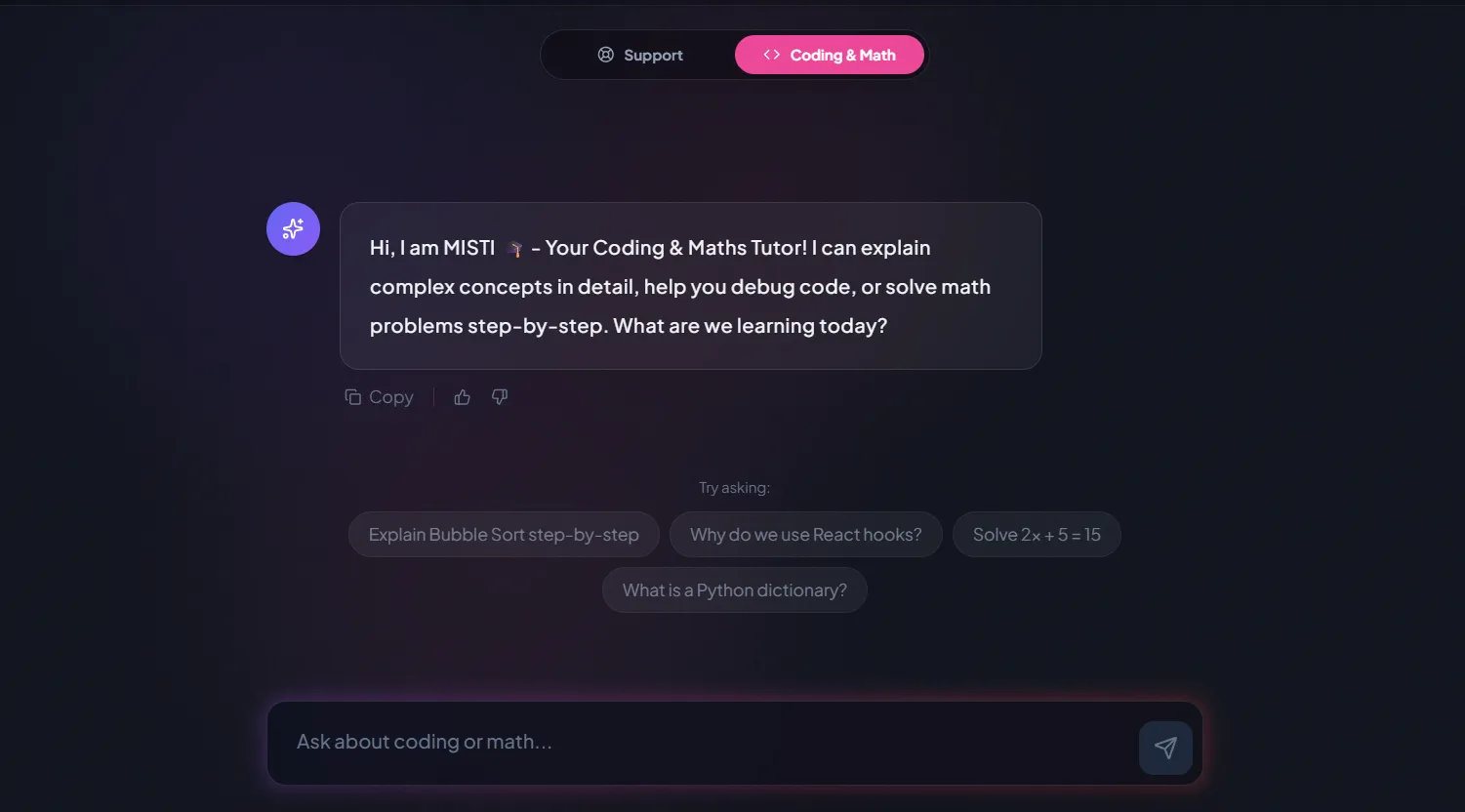
AI and ML
A chatbot that answers mathematics and programming questions, built and deployed by a student.
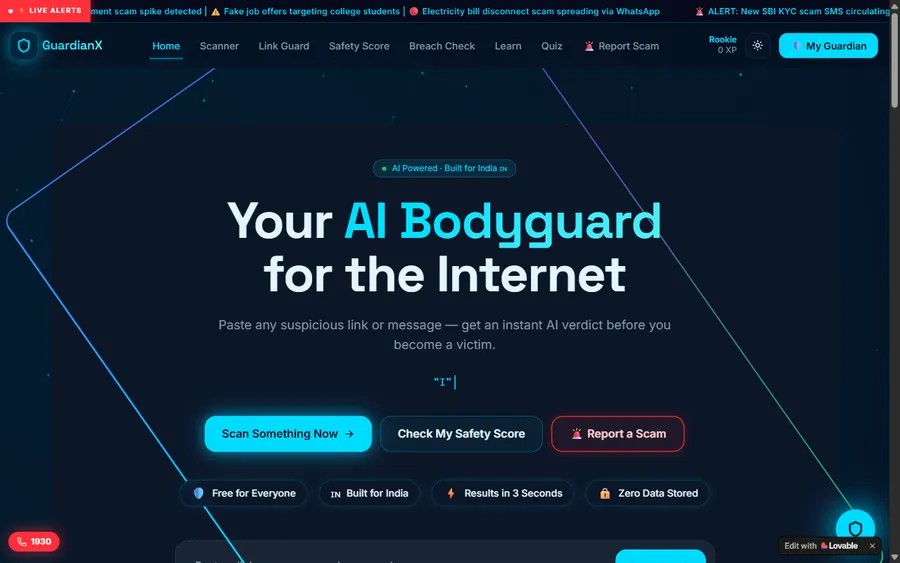
AI and ML
An assistant that helps a young person recognise unsafe situations online.
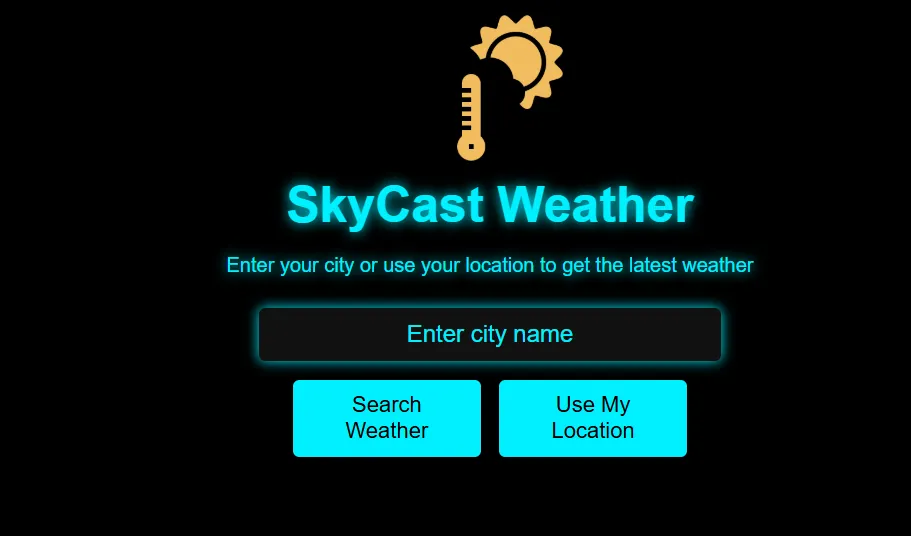
Web app
A weather forecasting site with live conditions for any location.
Fees
A flat monthly price in US dollars, identical in every country outside India, with no enrolment fee and no obligation beyond the month you are in. Students often pause over the summer and pick the same slot up in September.
Free first class
USD 0
no card required
Group batch
USD 100
a month, billed in US dollars
One to one
USD 150
a month, billed in US dollars
What families say
Our Google reviews, exactly as written by the families and students who left them.
★★★★★
"The one step solution for my son. Modern Age Coders make learning coding so simple that kids love it. The teachers explain complex concepts clearly with practical exercises and interactive content."
Ria Mukherjee
Parent
★★★★★
"Modern Age Coders has been a game-changer for me. I struggled to grasp IT concepts and coding before joining, but their classes transformed everything. I can now confidently write complex programs with ease."
Samriddha Mondal
Student
★★★★★
"One of the most wonderful education centres out there. Education is not limited to school syllabus but focuses on skill development."
Vansh Agarwal
Student
★★★★★
"My child Dhairya is really enjoying the Modern Age Coders classes. This is his first online class and he eagerly looks forward to it. I can already see his improvement, and the teachers are very cooperative."
Sonam Oswal
Parent of Dhairya
★★★★★
"Modern Age Coders have wonderful teachers who teach in a clear, easy and practical way. The teacher boosts students' confidence and inspires them to learn without hesitation."
Sonu Goyal
Parent
★★★★★
"I highly recommend this computer coding class! The teachers are incredibly knowledgeable and passionate about coding."
Ritu Kedia
Parent
Questions from students
No. We never write, edit, debug or review work that will be submitted for assessment. We teach the underlying skills and your own projects, which is a different thing.
It depends on the institution. UCC introduces programming in Python, while UCD's first-year module uses C as its example language. Check your own module descriptor.
Usually yes, and quickly, because the gap is almost always fluency rather than understanding. Weekly practice with someone watching closes it fastest.
Only once the first is fluent. After that, a second language takes weeks rather than months and makes you a better programmer in both.
The HEA found 61.6% of 2024 honours graduates had completed one. If you cannot get a placement yet, finished public projects are the next best evidence.
No. We are an independent school teaching live online from India, and we are not affiliated with any Irish institution.
Yes. Most students lighten or pause for exam weeks and resume afterwards, and the slot is held where possible.
The first class is free. A group place is then USD 100 a month and one-to-one lessons are USD 150 a month, billed in US dollars, with no enrolment fee.
Evenings, weekends or free daytime slots, agreed in the free class. Our teachers are four and a half hours ahead of Irish time in summer and five and a half in winter.
We ring you at a sensible Irish hour and arrange the free first class. Nothing is charged unless you continue.
Elsewhere on this site
Related pages for study and for what comes next.
Agents, and the integrity rules.
What the labour market shows.
For the module everyone finds hard.
Where Java appears in Irish degrees.
For mature students.
The national page.
Start here
Leave a number and we will phone at a reasonable Irish hour. In the free class you work through a real problem with a teacher and get a straight answer about where you stand and what to do weekly.
Have a look first if you prefer: how our classes work, every course syllabus, and projects our students published.
WhatsApp us · +91 91233 66161 · contact@modernagecoders.com
WhatsApp is usually quickest, and free from an Irish number. Ours is an Indian number, since the team is in India, and we keep no office in Ireland.