HOC / EARLY / 01
Early Maths Foundations
Counting, place value and shapes, through play.
Open the syllabusHong Kong · Home education · Coding and maths
Teaching a child at home is mostly about the parent, and coding and maths are often the subjects that leave parents least sure of themselves. That is where we come in: a mentor of your child's own, one to one, live online and speaking English, who takes over those two subjects for a few hours a week and reports back plainly. The rest of your home curriculum stays yours.
Live classes since 2020 · 10,000+ students worldwide · coding and maths for home learners, one to one, in English
In one paragraph
Modern Age Coders gives home-educated children in Hong Kong live online coding and maths lessons, one to one, in English, with the same mentor each week. Lessons run at any hour, including school-day mornings, so they slot into a home timetable. The Education Bureau has said in writing that it does not encourage home-schooling in place of school but examines cases one by one; we give no legal advice on that. We teach the two subjects parents most often hand over, and send written notes after each month.
Courses first
Home learners do well on courses that join the two subjects together, so each strengthens the other. These three are where we usually begin.
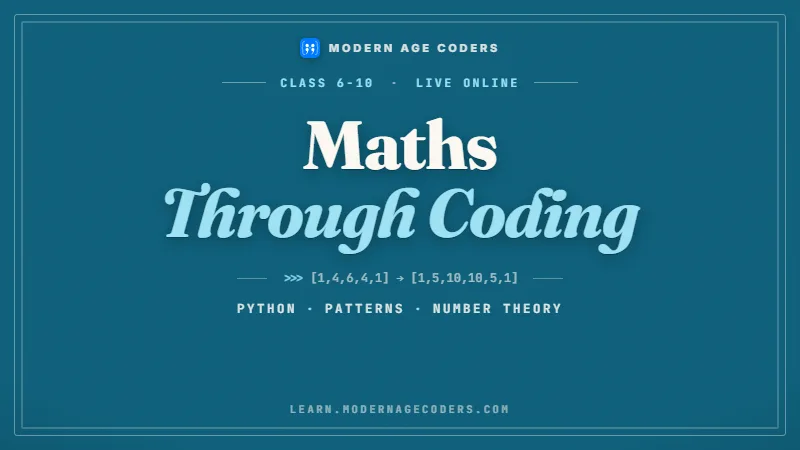
HOC / 01
Number patterns, factors, angles and chance, each explored by writing a short Python program. The lesson on this page comes from it.
Open the syllabus →
HOC / 02
A complete primary maths spine: number, fractions, measures, shapes and data, taught at the child's pace rather than a class's.
Open the syllabus →
HOC / 03
Typed code, functions and small smart projects. Many home learners move here after a term of Scratch.
Open the syllabus →In the Education Bureau's words
There is no home-education law that sets out a simple yes or no. What exists are the Education Bureau's written replies to questions in the Legislative Council, which state its position. We quote them here as published; we are not lawyers, and nothing on this page is legal advice.
| Point | The published words | Source and date |
|---|---|---|
| Basic education | "The Government provides nine years of free and universal basic education to children aged between six and 15." | LegCo written reply, 15 October 2014 |
| Attendance | Under sections 74 and 78 of the Education Ordinance (Cap. 279), "the Permanent Secretary of the EDB may issue an attendance order" | LegCo written reply, 15 October 2014 |
| The stance | "the EDB does not encourage home-schooling in place of formal school education" | LegCo written reply, 15 October 2014 |
| Case by case | "While we would not as a rule disallow home-schooling, for the interest of the children, we would examine it case by case" | LegCo written reply, 15 October 2014 |
| How to ask | "Parents who wish to home-school can write or email to the EDB seeking an assessment." | LegCo written reply, 15 October 2014 |
| Numbers then | "Currently, there are 25 such cases." | LegCo written reply, 15 October 2014 |
| Numbers earlier | "In the past five years, there were two such cases" | LegCo written reply, 14 February 2001 (EDB archive) |
Sources: GovHK press release LCQ11 "Home-schooling", 15 October 2014 (info.gov.hk); EDB archive, LegCo written reply of 14 February 2001, "Allow children to receive education at home" (edb.gov.hk). Both read on 23 November 2026. These are the latest published statements and figures on home education we could find; the position or the number of cases may have changed since. Ask the Education Bureau directly for your own situation.
The 2014 reply says the bureau looks at "whether the family is likely to be able to provide children with all-round education." Whatever a family's arrangement, that phrase is a useful test for any home curriculum: is every major area covered, and can you show it?
Coding and maths are two areas where showing it is easy. A program either runs or it does not; a page of worked algebra is either right or it is not. Our monthly notes record what was covered in a form a parent can keep.
We do not tell families whether they may home-educate, how to apply, or what to write to the bureau. We do not act as a school or issue school qualifications, and our certificate of completion is our own.
Plenty of the families we teach are not home-schooling at all: their children attend school and take extra lessons at home. Everything on this page applies to them too, and the one-on-one coding tutor page is written with them in mind.
Fitting a home timetable
Better than at school hours, in one respect: a home-educated child is free on weekday mornings, when an online mentor in India is wide awake and most other children are in class. A 10 am Hong Kong lesson is 7:30 am for the mentor; 11:30 am is 9 am.
| Day | Lesson with the mentor | Follow-up at home |
|---|---|---|
| Monday, 10:30 am Hong Kong time | Maths: new idea, worked together | Ten minutes of practice the mentor set |
| Tuesday | None | Child reads back the maths notes to a parent |
| Wednesday, 11:00 am Hong Kong time | Coding: build or extend a project | Child shows the project at lunch |
| Thursday | None | A short practice set, checked by a program |
| Friday, 10:30 am Hong Kong time | Maths and code together | Parent reads the week's short note |
Our own illustration. Every lesson time here is just an example; families pick any day and hour, and many have one or two lessons a week rather than three. India time is two and a half hours behind Hong Kong all year.
Home learning is already individual. A group class drags a home-educated child back to someone else's pace, which is often what the family chose to leave. One mentor and one child keeps the freedom: a fast week can go fast, a slow topic can take three lessons.
It also gives the parent a break from being the only teacher. Many home-educating parents tell us the hour they gain is as valuable as the lesson.
Local primary schools give coding in short regular lessons: CoolThink@JC describes "14+ hours of computational thinking and coding education" a year for P4 to P6. A home-educated child with one coding lesson a week passes that in a single term.
For maths, the government provides "12 years of free primary and secondary education" in public sector schools (EDB, Hong Kong Education at a Glance), so most Hong Kong children follow the local maths curriculum. Home learners can follow it, an international one, or both; the mentor works from whichever you choose.
A lesson where maths and code meet
This one suits children of about 11 to 14 who know what a factor is. The maths question is old: what is the highest common factor of two numbers? The coding question is new to them: how much work does each method take, and can the computer count it?
# Two ways to find the highest common factor, and how much work each does.
def hcf_by_trying(a, b):
    tries = 0
    for d in range(min(a, b), 0, -1):
        tries += 1
        if a % d == 0 and b % d == 0:
            return d, tries

def hcf_euclid(a, b):
    steps = 0
    while b:
        a, b = b, a % b
        steps += 1
    return a, steps

for a, b in [(84, 126), (1071, 462), (987, 610), (100000, 99999)]:
    d1, t = hcf_by_trying(a, b)
    d2, s = hcf_euclid(a, b)
    assert d1 == d2
    print(f"HCF({a}, {b}) = {d1}: trying took {t} checks, Euclid took {s} steps")

a, b = 1071, 462
while b:
    print(f"{a} = {a // b} x {b} + {a % b}")
    a, b = b, a % b
print("simplest form of 462/1071:", 462 // 21, "/", 1071 // 21)
Our own lesson program; the number pairs were chosen by us. It runs in any Python 3, and the output below is exactly what it prints.
HCF(84, 126) = 42: trying took 43 checks, Euclid took 3 steps
HCF(1071, 462) = 21: trying took 442 checks, Euclid took 3 steps
HCF(987, 610) = 1: trying took 610 checks, Euclid took 14 steps
HCF(100000, 99999) = 1: trying took 99999 checks, Euclid took 2 steps
1071 = 2 x 462 + 147
462 = 3 x 147 + 21
147 = 7 x 21 + 0
simplest form of 462/1071: 22 / 51
Same answers, wildly different effort. For 100000 and 99999, trying every number takes 99,999 checks; Euclid takes 2. The chain for 1071 and 462 ends with remainder 0 after dividing by 21, so 21 is the highest common factor, and 462/1071 simplifies to 22/51.
Why Euclid works: any number that divides both a and b also divides a minus a multiple of b, which is the remainder. So the pair can shrink without the common factors changing. A child who can explain that sentence has done real proof, not just arithmetic.
Then the payoff: simplifying fractions, which every curriculum asks for, and which is suddenly quick for awkward numbers.
Loops that count, a while loop that stops on a condition, functions that return two values, and assert as a safety net. Most of all: two correct programs can differ enormously in cost, which is the first idea of algorithm design.
This is the kind of lesson our Maths Through Coding course is built from. For the general approach, see how to think like a programmer.
Routes by age
Children at home can start early and go deep, because nobody is waiting for the rest of a class. The order matters more than the age; these are the routes we most often use.
| Age (about) | Coding | Maths |
|---|---|---|
| 6 to 8 | Scratch Coding | Early Maths Foundations |
| 8 to 11 | Blocks to apps | Elementary Mathematics |
| 10 to 14 | Python and AI for Kids | Maths Through Coding |
| 12 to 15 | Python for Teens | Middle School Mathematics |
| 14 to 16 | IGCSE Computer Science | IGCSE Mathematics |
| 16 to 18 | AI and Machine Learning | High School Mathematics |
Ages are how we place children, not official stages. Home-educated teenagers who want an external qualification sometimes aim at Cambridge IGCSE as private candidates; arranging entry is the family's task, and our IGCSE maths tutor page for Hong Kong explains the papers.
Six-year-olds learn coding best as play: a cat that moves, a story that branches. With no school timetable to fit, short frequent lessons work well, for example twenty-five minutes twice a week rather than a long weekly session.
Our page on what age to start coding lists the signs of readiness.
Older home learners often want a portfolio more than a certificate: projects they can show a college, an employer or a competition. We plan lessons around a few substantial builds a year.
The coding roadmap shows the full path from first blocks to real software.
Keeping evidence
Home-educating parents tell us they want a clear record, both for themselves and for anyone who asks. Coding and maths make that unusually easy.
For more on choosing coding material for home learning in general, our homeschool coding curriculum guide covers the options in detail.
Progress
Our own stages for children who learn coding and maths at home with a mentor. We use them to write monthly notes; they are not school levels.
| Stage | Your child can | Evidence you will have |
|---|---|---|
| 1. Follow | Carry out a method step by step | Correct worked examples |
| 2. Explain | Say why each step works | A spoken or written explanation |
| 3. Automate | Turn a method into a program | Code that solves a set of questions |
| 4. Check | Test answers by a second method | A program that verifies itself |
| 5. Compare | Judge which method is faster | Counts of steps, like the Euclid lesson |
| 6. Invent | Pose and solve a question of their own | A small investigation in the folder |
If two methods give the same answer, ask which one does less work.
Keep your working; it is the best record of what you can do.
Hand over the subjects you find hardest, and keep the ones you love teaching.
Read the monthly note together with your child; it doubles as a review lesson.
More courses
All live, in English, one to one, at any hour of the home week.
HOC / EARLY / 01
Counting, place value and shapes, through play.
Open the syllabusHOC / EARLY / 02
Fast, confident number work without paper.
Open the syllabusHOC / EARLY / 03
Puzzles and plans before any code.
Open the syllabusHOC / MID / 01
Letters, equations and graphs, built carefully.
Open the syllabusHOC / MID / 02
Loops and logic in a world they know.
Open the syllabusHOC / MID / 03
Harder problems for a child who wants more.
Open the syllabusHOC / OLD / 01
The Cambridge syllabus, paced for one.
Open the syllabusHOC / OLD / 02
A second language, closer to the machine.
Open the syllabusHOC / OLD / 03
Real data sets, questions and charts in Python.
Open the syllabusTiming
Any day, any time, flexible: one to one at the hour that suits your family, weekdays or weekends. Home learners often use weekday mornings, when the mentor in India, two and a half hours behind Hong Kong, is at the start of the working day.
Weekday morning
10:30 am Hong Kong time is 8 am in India.
Midday
1 pm in Hong Kong is 10:30 am for the mentor.
Afternoon
3:30 pm in Hong Kong is 1 pm in India.
With camera, microphone and a keyboard.
Scratch and Python cost nothing.
Maths is still worked by hand first.
The same person through the year.
A written record for your files.
Family trips need not cost a month.
Student work
Some work from learners in our longer courses; see the student labs page for more.

AI and ML
An AI nutrition coach that reads what you eat and works you toward a target.

AI and ML
A chatbot that answers mathematics and programming questions, built and deployed by a student.

AI and ML
An assistant that helps a young person recognise unsafe situations online.

Web app
A weather forecasting site with live conditions for any location.
Fees
Fees are charged monthly and displayed below in Hong Kong dollars. You pay for each month as it comes, with no package to buy in advance, and a payment-gateway charge, if there is one, is shown at checkout before you pay.
Free first class
Free
no card required
One to one
$1,200 HKD
a month, eight live classes
What families say
Google reviews from parents and students, quoted without edits.
★★★★★
"The one step solution for my son. Modern Age Coders make learning coding so simple that kids love it. The teachers explain complex concepts clearly with practical exercises and interactive content."
Ria Mukherjee
Parent
★★★★★
"Modern Age Coders has been a game-changer for me. I struggled to grasp IT concepts and coding before joining, but their classes transformed everything. I can now confidently write complex programs with ease."
Samriddha Mondal
Student
★★★★★
"One of the most wonderful education centres out there. Education is not limited to school syllabus but focuses on skill development."
Vansh Agarwal
Student
★★★★★
"My child Dhairya is really enjoying the Modern Age Coders classes. This is his first online class and he eagerly looks forward to it. I can already see his improvement, and the teachers are very cooperative."
Sonam Oswal
Parent of Dhairya
★★★★★
"Modern Age Coders have wonderful teachers who teach in a clear, easy and practical way. The teacher boosts students' confidence and inspires them to learn without hesitation."
Sonu Goyal
Parent
★★★★★
"I highly recommend this computer coding class! The teachers are incredibly knowledgeable and passionate about coding."
Ritu Kedia
Parent
Home-educating parents ask
We cannot give legal advice. In a 2014 written reply to the Legislative Council, the Education Bureau said it does not encourage home-schooling in place of formal school education, would not as a rule disallow it, and examines cases one by one. Parents were told they can write or email the bureau for an assessment.
The latest published figure we found is from the same 2014 reply: 25 cases at that time. We found no newer official count.
No. We teach coding and maths only. Questions about home education arrangements should go to the Education Bureau.
Any day, any time, flexible: one to one at the hour that suits your family, weekdays or weekends. Weekday mornings are popular with home-educated children.
Either. Tell us what your home curriculum follows and the mentor plans lessons from it, or we suggest a route by age.
Often yes, especially for younger children and for our Maths Through Coding course. For exam-level maths we may suggest a maths specialist.
Yes. Every lesson is live on video and taught one to one in English by a mentor based in India.
Our own certificate of completion when a course is finished. It is not a school or government qualification. Some teenagers sit external exams such as IGCSE privately; entry is arranged by the family.
From about six, with Scratch and short playful lessons. Typed Python usually begins from about nine.
Monthly, in Hong Kong dollars, with nothing paid ahead for later months. Any gateway charge appears before payment.
Related
Useful next reads.
Choosing coding material for home.
How a live lesson runs for a child.
Papers, tiers and timing.
Private lessons, explained.
What a month costs and why.
Every course for families here.
Part of the guide: Every Hong Kong page
More guides: Coding and AI classes in Hong Kong · 中文:英文授課編程課程 · Start here: Online coding for kids · AI, vibe coding and AI agents: AI agents course · Coding subjects and courses: App development · By age and school level: Adults · HKDSE ICT and maths: DSE ICT elective guide · IB, IGCSE, A-level and SAT: A level Computer Science tutor · Olympiads and competitions: AMC 10 preparation · School holidays: AI summer course · Districts and areas: Causeway Bay
Start here
In the free class the mentor works through a short coding or maths task with your child, notices where they are confident and where they hesitate, and then suggests a starting course and a rhythm that fits your home week.
Reading first? Our course list has every syllabus, and how we teach walks through a lesson.
WhatsApp us · +91 91233 66161 · connect@modernagecoders.com
Live, one to one, in English, with mentors based in India. Weekday mornings are fine. WhatsApp is the quickest route.
A priority demo is a full class of about 45 to 60 minutes. After the class the mentor sends a written skill report and a personal learning roadmap on WhatsApp. If you enrol, the demo fee is adjusted against your first month's fee. Share your demo Order ID with us on WhatsApp and we take it off.
Book a priority demo