IAC / PRE / 01
Maths Through Coding
Patterns, proof ideas and data, explored in Python.
Open the syllabusHong Kong · IB Diploma mathematics · SL and HL
IB maths in Hong Kong usually goes wrong quietly. A student who coasted through MYP or IGCSE meets proof, modelling with a calculator, and questions that read like short essays. Marks slip, and by the mock exams in Year 13 the gap is wide. A tutor who knows which of the two IB courses your child takes, and at which level, can close it early. Every lesson with us is one to one, live online, in English, with the same mentor each week.
Teaching live since 2020 · 10,000+ students worldwide · Hong Kong lessons are one to one, online, in English
The short answer
Modern Age Coders gives Hong Kong students live online IB maths tutoring, one to one and in English, at flexible Hong Kong times. We teach both IB Diploma courses, Analysis and Approaches and Applications and Interpretation, at SL and HL: algebra, functions, statistics, calculus, proof and calculator technique, with timed paper practice and HL Paper 3 problem solving. For the exploration we teach the mathematics and the method but never write, edit or mark the student's draft, which the IB's own integrity rules forbid. The first class is free.
Start here
Most families arriving here need the first course. The other two serve students a year or two earlier on the road, and every one of them runs one to one for Hong Kong learners.
IAC / 01
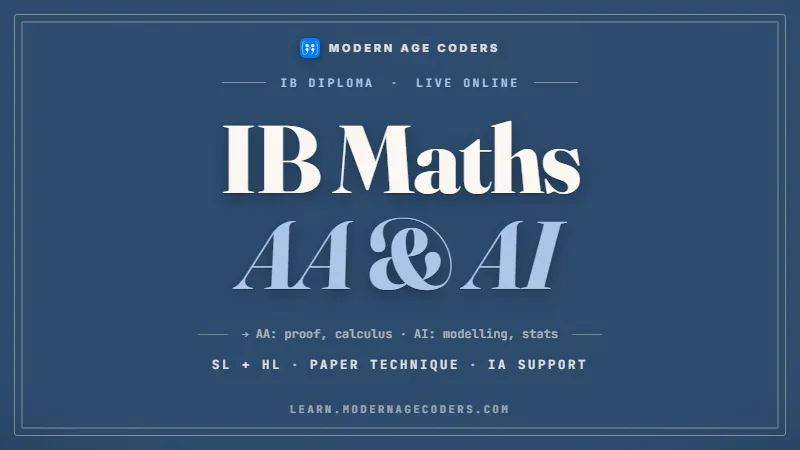
The Diploma course itself, matched to your child's school course and level. Topic teaching in the order the school uses, past-paper style practice, calculator fluency for AI, and Paper 3 problem solving for HL students.
Open the syllabus →
IAC / 02
For students in Year 10 or 11 at a school that runs IGCSE before the Diploma. Secure algebra here is the cheapest way to make IB AA HL survivable later.
Open the syllabus →
IAC / 03
A bridge for MYP students and for anyone moving into an IB school from another system, filling gaps in functions, trigonometry and early calculus before the Diploma starts.
Open the syllabus →Two courses, one name
IB Diploma students choose between two mathematics subjects, each offered at standard level (SL) and higher level (HL). Families often learn which one their child is in only when a tutor asks. It matters, because the two courses weight the topics very differently.
The IB describes AA students as those who enjoy "the thrill of mathematical problem solving and generalization". In practice that means more algebra by hand, more functions, and more proof. At HL the guide adds proof by contradiction, proof by induction and the use of counterexamples to show that a statement is not true.
AA suits a student heading for engineering, physics, economics with heavy theory, or mathematics itself. It is also where Hong Kong students who were strong at IGCSE Additional Mathematics feel most at home.
AI is written for students who, in the IB's words, "enjoy mathematics best when seen in a practical context". It leans on statistics and modelling, and its subject brief says plainly that all external assessments involve the use of technology, so the graphic display calculator is part of every paper.
AI is no soft option. Its HL course spends more teaching time on statistics than AA does, and the modelling questions punish students who can press buttons but cannot explain what the output means.
| Syllabus component | SL hours | HL hours |
|---|---|---|
| Number and algebra | 16 | 29 |
| Functions | 31 | 42 |
| Geometry and trigonometry | 18 | 46 |
| Statistics and probability | 36 | 52 |
| Calculus | 19 | 41 |
| Investigation, problem solving, modelling and the exploration | 30 | 30 |
| Total teaching hours | 150 | 240 |
Source: International Baccalaureate, DP Subject Brief, Mathematics: applications and interpretation (first assessments 2021), table read on the rendered page, 23 November 2026. The same brief says AI and AA "share 60 hours of common content" and gives 150 hours for SL and 240 for HL. ibo.org refused our requests, so we used a copy of the IB's PDF hosted by the University of Tartu; AA's own hour split was not in the copy of the AA guide we could read, so it is not printed here.
Two practical consequences for a Hong Kong family. First, a tutor who has taught only AA will under-prepare an AI HL student for the statistics load, and the reverse is also true; ask which course the tutor will be teaching before the first lesson. Second, both courses share their first 60 hours, so a student who is unsure, or who may switch level after the first term, loses little by starting on the shared core. Our page on IB maths AI at standard level goes deeper on the AI SL course, and IB maths tuition online covers both courses for students anywhere.
The Diploma in Hong Kong
More than most people guess, and not only international schools. The Education Bureau keeps a public database of schools offering non-local curricula; we read the curriculum line of every entry and counted the ones that name the IB Diploma.
| School type in the EDB database | Entries in that type | Name the IB Diploma | Name the IB MYP |
|---|---|---|---|
| International schools (campuses merged) | 53 | 18 | 10 |
| Direct Subsidy Scheme schools offering non-local curricula | 21 | 10 | 0 |
| Private Independent Schools | 8 | 6 | 2 |
Source: Education Bureau, International Schools in Hong Kong school search (internationalschools.edb.gov.hk), the “curriculum” field of each school entry, downloaded and counted by us on 23 November 2026. Schools whose entry says only “British Curriculum” or “American Curriculum” are not counted even if they also run the Diploma, so these figures are a floor, not a census. The EDB itself says there are “53 international schools, 8 Private Independent Schools, and 21 local schools under Direct Subsidy Scheme offering non-local curricula”.
The EDB's statistics for 2025/26 count 44,745 students at international schools (excluding the special school), and say 33.8% of them are local students. Secondary enrolment at those schools has risen from 19,464 in 2023/24 to 20,797 in 2024/25 and 21,969 in 2025/26.
Ten Direct Subsidy Scheme schools also name the IB Diploma beside the HKDSE in their entries. So an IB maths student in Hong Kong may sit in a classroom where Cantonese is the language of the corridor and English the language of the exam, which shapes what a tutor needs to explain.
A student at a DSS school that runs both the HKDSE and the Diploma has often met local mathematics first, with its own notation and habits. Switching to the IB's command terms ("show that", "hence", "justify") is a language task as much as a maths one, and it is the first thing we check.
The standard is high at the top. The English Schools Foundation reports that in 2025, 22 of its students achieved the perfect score of 45 points in the IB Diploma. Most students are not chasing 45; they want a 6 or 7 in maths without it eating their other five subjects. One-to-one teaching is how that time gets used well.
If your child is still in the Middle Years Programme, our IB MYP maths tutor page covers the years before the Diploma. Families living on Hong Kong Island near several of these schools may also find our Mid-Levels page useful for coding alongside maths.
Papers and weights
The grade comes from timed papers set by the IB and from the exploration, which the school marks and the IB moderates. The IB's subject brief for the AI course sets out the papers; here they are as the brief prints them.
| Component | Time at SL (hours) | Time at HL (hours) | Weight at SL | Weight at HL |
|---|---|---|---|---|
| Paper 1: compulsory short-response questions, technology allowed | 1.5 | 2 | 40% | 30% |
| Paper 2: compulsory extended-response questions, technology allowed | 1.5 | 2 | 40% | 30% |
| Paper 3: two compulsory extended problem-solving questions, HL only | not taken | 1 | not taken | 20% |
| Exploration (internal assessment) | 15 hours of class time | 15 hours of class time | 20% | 20% |
Source: International Baccalaureate, DP Subject Brief, Mathematics: applications and interpretation, “Assessment at a glance”, read on the rendered PDF on 23 November 2026. The AA course has its own papers (including a non-calculator paper); the copy of the AA guide available to us stopped before its assessment chapter, so for AA timings and weights your child's teacher's copy of the current guide is the authority.
Most of the grade. Short questions reward speed and accuracy; long ones reward a clear chain of reasoning that a stranger can follow.
Two long questions that start easy and climb. Students who have only drilled past papers struggle; students who have practised spotting a pattern and generalising it do well.
A fifth of the grade at both levels. It must be the student's own work, so the useful preparation happens long before the draft exists.
Because the papers carry most of the weight, our lessons are built around them: the topic first, then exam-style questions under a timer, then a post-mortem of every lost mark. For AI students a fair part of that time goes on the calculator, because a correct method entered into the wrong menu still scores nothing. For AA HL students we add Paper 3 practice from the spring of Year 12 onwards, since that paper rewards habits that take months to build.
A sample lesson
Here is a lesson we use with AA students meeting proof for the first time. The student makes a guess about whole numbers, a short program hunts for a counterexample, and then the student does the part no program can: the proof. Both claims and the code are ours.
# Conjecture hunting: let the computer look for a counterexample,
# then decide what still needs a proof. Both claims chosen by us.

def is_prime(m):
    if m < 2:
        return False
    d = 2
    while d * d <= m:
        if m % d == 0:
            return False
        d += 1
    return True

# Claim A: n*n + n + 41 is prime for every whole number n >= 0
for n in range(0, 100):
    value = n * n + n + 41
    if not is_prime(value):
        print("Claim A fails at n =", n, ":", value, "=", 41, "x", value // 41)
        break
else:
    print("Claim A survived n = 0 to 99")

# Claim B: n**3 - n is a multiple of 6 for every whole number n
bad = [n for n in range(0, 10001) if (n ** 3 - n) % 6 != 0]
print("Claim B counterexamples up to 10000:", bad)
print("First few values of n**3 - n:", [n ** 3 - n for n in range(1, 7)])
Our own lesson code. Run it with Python 3 and it prints exactly the three lines below. The 100 and 10,000 limits are arbitrary: we chose them to show that a search has to stop somewhere, which is why a search can never stand in for a proof.
Claim A fails at n = 40 : 1681 = 41 x 41
Claim B counterexamples up to 10000: []
First few values of n**3 - n: [0, 6, 24, 60, 120, 210]
Claim A dies at n = 40, where the value is 41 squared. Claim B has no counterexample in ten thousand tries, yet only the three-consecutive-integers argument proves it for every whole number.
The AA guide asks HL students to use counterexamples to show that a statement is false, and both courses expect students to make and test conjectures. A student who has watched a convincing pattern collapse at n = 40 stops trusting "it worked for the first few".
The code matters less than the habit. On Paper 3, a question often asks the student to spot a pattern in early cases, then justify it. Students who have practised the switch from "I checked" to "I proved" pick up those last marks.
For an AI student the same lesson becomes a modelling question: fit a curve to the first few data points, predict the next, and then test the prediction against fresh data. The lesson is the same: a model that fits what you have seen can still fail on what you have not.
Students who enjoy the programming side can go further with our Maths Through Coding course, or with Python for teens, both of which use the same check-then-prove rhythm.
The exploration
Yes, but only in one way. The IB is direct about outside help, and a family paying for tutoring should know the rule before anyone touches a draft.
The IB's academic integrity policy asks students to "abstain from receiving non-permitted assistance in the completion or editing of work", and its list of sources of such help names "private tutors" alongside friends, relatives and essay services. The same policy says students "are expected to produce work autonomously".
The AA guide sets aside up to 15 hours of class time for the exploration, inside 30 hours given to inquiry, modelling and investigation. That time is the school's, and the teacher is the one person who may comment on the work in the way the subject rules allow.
We teach the mathematics a student might use, for example regression, optimisation, or a proof technique, using our own examples rather than the student's topic. We show how to read the published criteria, how to keep a research log, and how to judge whether an idea is too thin or too large.
We never choose the topic, write, edit, proofread, structure or mark any part of the exploration, and we do not look at drafts. If a student asks, the mentor says no and explains why. Our longer guide to IB maths IA guidance sets out that line in more detail.
The same rule covers the extended essay. The IB's guide for essays first assessed in 2027 sets a limit of 4,000 words and says the essay is the result of about 40 hours of the student's own work. A student writing a mathematics essay can learn the mathematics with us; the essay stays theirs. See extended essay mentoring in maths and computer science for how we handle that.
Timing
Earlier than most do. The pattern we see is a student who signs up two months before the final exams with gaps from the first term of Year 12. Here is a calmer route across the two Diploma years.
| Hong Kong time | India time | When students use it |
|---|---|---|
| 4:30 pm, weekday | 2:00 pm | Straight after school, before activities |
| 8:00 pm, weekday | 5:30 pm | After dinner, a common slot for Year 13 |
| 11:00 am, Sunday | 8:30 am | A weekend lesson before the week starts |
Hong Kong keeps UTC+8 all year and has had no summer time since 1979 (Hong Kong Observatory); India keeps UTC+5:30 (IANA time zone database), so Hong Kong is two and a half hours ahead every day of the year. The conversions are our arithmetic, shown as examples, not a timetable.
Progress
Our own stages for IB maths students, used to plan lessons and to report to parents. They are not IB grade boundaries and do not predict an IB grade.
| Stage | The student can | Evidence you will see |
|---|---|---|
| 1. Foundations | Handle algebra and functions without slips | A clean diagnostic, redone after four weeks |
| 2. Topic control | Solve standard questions on each school topic | Topic checks marked against the command terms |
| 3. Communication | Write a method a stranger could follow | Fewer marks lost for missing steps |
| 4. Technology | Use the calculator or software for the right job | AI: full marks on calculator-heavy parts |
| 5. Reasoning | Generalise a pattern and justify it | HL: Paper 3 style answers carried to the end |
| 6. Exam speed | Finish full papers in time, with checking | Timed papers with a falling error list |
Checking five cases is a hunch. A proof is a promise.
Every lost mark goes on your error list until it stops happening.
A short monthly note covers topics taught, timed results and the error list, in plain English.
You will never receive a predicted IB grade from us; that is the school's job.
More courses
All are live and in English, and for Hong Kong learners all are taught one to one.
IAC / PRE / 01
Patterns, proof ideas and data, explored in Python.
Open the syllabusIAC / PRE / 02
Contest algebra that makes HL algebra feel light.
Open the syllabusIAC / PRE / 03
Problem solving for younger MYP students.
Open the syllabusIAC / DP / 01
For HL students who want harder problems than school gives.
Open the syllabusIAC / DP / 02
For IB students applying to American universities.
Open the syllabusIAC / DP / 03
Real data and Python, useful context for AI statistics.
Open the syllabusIAC / CS / 01
The new guide, first assessed in 2027.
Open the syllabusIAC / CS / 02
The language behind our proof and modelling lessons.
Open the syllabusIAC / CS / 03
Where statistics and calculus meet real models.
Open the syllabusHow lessons run
Any day, any time, flexible: one to one at the hour that suits your family, weekdays or weekends. The student joins from home in Hong Kong; the mentor teaches from India, which sits two and a half hours behind all year.
School days
A 4:30 pm start in Hong Kong reaches the mentor at 2 pm.
Late evenings
An 8 pm Hong Kong lesson is 5:30 pm for the mentor.
Weekends
Saturday or Sunday, at whatever hour suits the family.
Working is written live, so the mentor sees each step.
AI students share their calculator emulator or screen.
We follow the topic sequence your school uses.
Every answer is checked against what the question asked.
A running list of the student's own repeat mistakes.
The same mentor teaches your child from month to month.
Student work
Coding and data projects by learners in our longer courses; maths students who code often build tools like these. More are on student labs.

AI and ML
An AI nutrition coach that reads what you eat and works you toward a target.

AI and ML
A chatbot that answers mathematics and programming questions, built and deployed by a student.

AI and ML
An assistant that helps a young person recognise unsafe situations online.

Web app
A weather forecasting site with live conditions for any location.
Fees
You pay one month at a time, for the lessons in that month only; we never ask for a term or a year up front. Fees appear in Hong Kong dollars on the card, and any payment-gateway charge is listed separately before you confirm.
Free first class
Free
no card required
One to one
$1,200 HKD
a month, eight live classes
What families say
Reviews from parents and students on Google, copied as they were written.
★★★★★
"The one step solution for my son. Modern Age Coders make learning coding so simple that kids love it. The teachers explain complex concepts clearly with practical exercises and interactive content."
Ria Mukherjee
Parent
★★★★★
"Modern Age Coders has been a game-changer for me. I struggled to grasp IT concepts and coding before joining, but their classes transformed everything. I can now confidently write complex programs with ease."
Samriddha Mondal
Student
★★★★★
"One of the most wonderful education centres out there. Education is not limited to school syllabus but focuses on skill development."
Vansh Agarwal
Student
★★★★★
"My child Dhairya is really enjoying the Modern Age Coders classes. This is his first online class and he eagerly looks forward to it. I can already see his improvement, and the teachers are very cooperative."
Sonam Oswal
Parent of Dhairya
★★★★★
"Modern Age Coders have wonderful teachers who teach in a clear, easy and practical way. The teacher boosts students' confidence and inspires them to learn without hesitation."
Sonu Goyal
Parent
★★★★★
"I highly recommend this computer coding class! The teachers are incredibly knowledgeable and passionate about coding."
Ritu Kedia
Parent
Questions from Hong Kong families
Yes. Every lesson is live over video and taught in English by a mentor based in India. That matches the language of the IB papers, so your child practises reading and writing mathematics in the same English the examiners use. We do not teach in Cantonese or Mandarin.
One to one, always, for families in Hong Kong. There are no shared classes. Your child has a private mentor who follows your school's topic order and spends the time on your child's weak spots only.
Any day, any time, flexible: one to one at the hour that suits your family, weekdays or weekends. Hong Kong is two and a half hours ahead of India all year, with no clock changes on either side, so a 6 pm lesson in Hong Kong is 3:30 pm for the mentor.
Yes. We teach Analysis and Approaches and Applications and Interpretation, each at SL and HL. Tell us the course and level in the free class, or ask your child to check the course name on a school report, and we will match the mentor.
No. The IB's academic integrity policy names private tutors among the sources of help a student must not receive on assessed work. We teach the mathematics and how to read the criteria, using our own examples, and we never write, edit or read the exploration.
No. Predicted grades come from the school. We report what we see: topics secure, timed paper results and the error list. We make no promise of any grade.
The IB papers are the same everywhere. What differs is the starting point: students who began with local secondary maths often need work on IB command terms and on writing a full method in English. We check that in the free class.
Whatever the school uses. For the AI course every paper allows technology, so the mentor will practise with the same model or emulator your child takes into the exam.
Monthly, in Hong Kong dollars as shown on the fee card, for that month only. There is no prepayment, and any payment-gateway charge is shown before you pay. The first class is free.
Students who complete a course receive our own certificate of completion. It is not an IB qualification and is not issued with the IB, any school or any government body.
Related
Pages that help with the same decision.
Coding, AI and maths for every age, in one list.
If your child also takes CS in the Diploma.
Where honest help ends, set out in full.
For the two years before the Diploma.
Machine learning for teens who like the maths.
What a live lesson looks like from the inside.
Part of the guide: Every Hong Kong page
More guides: Coding and AI classes in Hong Kong · 中文:英文授課編程課程 · Start here: Online coding for kids · AI, vibe coding and AI agents: AI agents course · Coding subjects and courses: App development · By age and school level: Adults · HKDSE ICT and maths: DSE ICT elective guide · Olympiads and competitions: AMC 10 preparation · Guides for families: After-school coding · School holidays: AI summer course · Districts and areas: Causeway Bay
Start here
Bring a recent test or a topic that keeps going wrong. The mentor works through it with your child, checks the basics the topic rests on, and suggests how often to meet before the next school assessment.
Want to read more first? How we teach explains our lesson format, and the full syllabus sits on the IB maths course page.
WhatsApp us · +91 91233 66161 · connect@modernagecoders.com
Live, online and one to one, in English, with mentors based in India. A WhatsApp message gets a quick reply.
A priority demo is a full class of about 45 to 60 minutes. After the class the mentor sends a written skill report and a personal learning roadmap on WhatsApp. If you enrol, the demo fee is adjusted against your first month's fee. Share your demo Order ID with us on WhatsApp and we take it off.
Book a priority demo