TM / Y / 01
Scratch projects
Games and stories made of blocks.
Open the syllabusNew Territories · Tuen Mun District · Town Centre, Siu Hong, San Hui, Butterfly
Tuen Mun is home to the largest new town in Hong Kong's census, at the western end of the New Territories and a long ride from the city. For a weekly coding class, that ride is the problem, so we skip it. Lessons are live and online, one to one, with a mentor who teaches in English at an hour you choose. On this page: Tuen Mun in census numbers, the schools around it, and a lesson that turns the Light Rail route list into a Python puzzle.
Teaching online since 2020 · 10,000+ learners in many countries · Hong Kong lessons: one to one, English only
What we do in Tuen Mun
Modern Age Coders gives Tuen Mun learners live online coding, AI and maths lessons in English, one to one, from age six to adult. A mentor based in India takes each learner through Scratch, Python, AI projects, IGCSE, IB or HKDSE support, contest problems or practical coding for work, at a time agreed with the family on Hong Kong time. Lessons are at home in Siu Hong, San Hui or anywhere in the district, so there is no trip into town and no wait afterwards.
Courses to start with
Three courses suit most Tuen Mun families who write to us: a first taste of making games, the jump into real Python, and the Cambridge exam course for students at international schools.
TM / 01
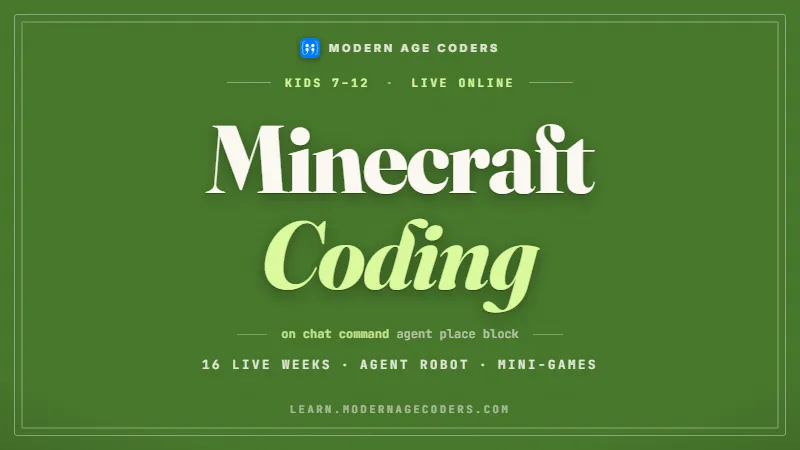
About 7 to 11. Code that builds and changes things inside a world children already love, so loops and conditions feel like tools, not homework.
Open the syllabus →
TM / 02
About 9 to 12. A first proper programming language: turtle drawings, small games, then programs that make simple decisions, with a mentor who checks understanding at every step.
Open the syllabus →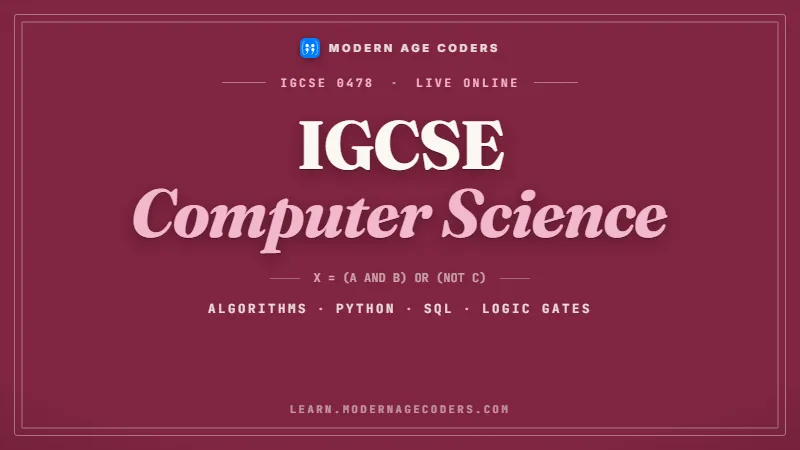
TM / 03
For students in Years 10 and 11 on the Cambridge route: algorithms, data and Python programming alongside the theory papers, at one student's pace.
Open the syllabus →Census
Tuen Mun District counted 506,879 residents in the 2021 Population Census, with 54,136 under 15. Almost all of them live in Tuen Mun new town, which the census lists first among Hong Kong's new towns, at 501,491 people.
| Year | Residents | Change on 2011 | Change on 2016 |
|---|---|---|---|
| 2011 | 485,898 | ||
| 2016 | 487,407 | +0.3% | |
| 2021 | 501,491 | +3.2% | +2.9% |
From Table 9.2 in the Census and Statistics Department's report on the 2021 census, which sets each new town against its 2011 and 2016 figures and prints the percentage changes shown here. The new-town boundary is not the district boundary, so the two figures are different measures and never combined.
| Area on the 2019 constituency map | Residents |
|---|---|
| Tuen Mun Rural | 27,142 |
| Prime View | 21,518 |
| Tuen Mun Town Centre | 20,420 |
C&SD census table by District Council constituency area. Separate rows, as published; these 2019 areas were replaced in 2023 and are not summed here.
Between 2016 and 2021 Tuen Mun new town grew by 2.9%, after barely moving in the five years before. The constituency table shows how uneven the district is: Tuen Mun Rural alone held 27,142 people, more than any of the town-centre areas listed here.
In 2021, 9,038 residents aged five and over said English was the language they usually speak, and 67.5% could read English, a little under the 70.6% for Hong Kong's land population. Many Tuen Mun children meet English mainly at school.
C&SD's district tables for 2025 put Tuen Mun's land-based non-institutional population at 538,700, in 207,300 domestic households averaging 2.5 people, with a median age of 47.
538,700 is larger than the 2021 census count, but the 2025 survey and the census are different instruments covering different groups. We report both and do not treat the gap as growth.
Tuen Mun District forms the south-western corner of the New Territories. Yuen Long and Tin Shui Wai are to the north, Tsuen Wan and Sham Tseng to the east along Castle Peak Road, and the sea and the bridge towards Lantau to the south and west. Our Hong Kong overview links every district page.
Schools
Tuen Mun children attend a mix of local schools and, in smaller numbers, international and private ones. A tutor who knows which helps a child far more than one who does not.
| Level | Pupils | Counted where |
|---|---|---|
| Primary | 698 | At the school's own district |
| Secondary | 913 | International and other private schools together |
Education Bureau, Student Enrolment Statistics 2025/26 (position in mid-September 2025), international and other private schools by District Council district.
The Education Bureau's international schools database lists Harrow International School Hong Kong, a primary and secondary school, at 38 Tsing Ying Road, Tuen Mun. Across Hong Kong, the Bureau's statistics show international schools taught 44,745 students in 2025/26 (excluding a special school), 33.8% of them local students.
We name the school only to place the district. We have no link with it, and nothing here says where any learner of ours studies.
Local primary and secondary schools now teach coding and introduce AI, following Education Bureau guidance measured in hours a year. That gives every child a start; it cannot give a keen child the depth they want.
Secondary students at local schools often need help with HKDSE ICT programming or with maths, and our HKDSE ICT tutor page explains how one-to-one lessons fit beside school.
For students at Cambridge-route schools, our IGCSE computer science tutor page covers the 0478 course, and for the IB Diploma, IB maths tutoring works the same way: one student, one mentor, the student's own syllabus.
Why online
Because a good class an hour away is, for a busy family, often no class at all. A live lesson at home keeps the teaching and drops the distance.
Tuen Mun sits at the end of several routes: the Tuen Ma line, the Light Rail network, the buses along Tuen Mun Road. Families here know how long an evening trip into town really takes, so we will not pretend to know it better.
With an online lesson there is no trip. A child finishes school, has a snack and sits down at a laptop; the lesson starts on time and ends on time.
Teaching one child at a time lets the mentor watch the code as it is typed and step in at the exact moment of confusion, instead of discovering it in next week's homework.
It also lets the mentor tune everything, from examples to vocabulary, to one child. Our online coding classes for kids page shows a lesson from start to finish.
| Tuen Mun | India | Who tends to choose it |
|---|---|---|
| 4:30 pm on weekdays | 2:00 pm | Primary pupils after school |
| 6:15 pm on weekdays | 3:45 pm | Children with a later finish |
| 8:15 pm on weekdays | 5:45 pm | Teenagers and adults |
| 9:00 am on Sundays | 6:30 am | Early-rising weekend learners |
Hong Kong is on UTC+8 year-round, with no daylight saving, and India is on UTC+5:30; a lesson is always two and a half hours earlier on the mentor's clock. Conversions are ours, and the last column describes typical requests rather than fixed times.
The Light Rail lesson
Tuen Mun and Yuen Long share the Light Rail, a tram-like network that children here ride every week. The MTR publishes every route and stop as open data, and counting routes at each stop is a tidy first lesson in Python's Counter, with a trap hidden in the answer.
The file is Light Rail Routes & Stops, one of the CSV files in the MTR Corporation's dataset "MTR routes, fares and barrier-free facilities" on DATA.GOV.HK, updated monthly. Each row is one stop on one route in one direction, with its English and Chinese names and its order. Our copy dates from 23 November 2026. Reuse is free under the DATA.GOV.HK terms, for business and non-business purposes, as long as you name the source and acknowledge who owns the data.
Counter built from the size of each set can report its most_common() stops directly, without writing a sort.Counter keyed by route and direction counts how many stops each route has, which finds the longest and shortest routes.import csv
from collections import Counter, defaultdict
# MTR "Light Rail routes and stops" (DATA.GOV.HK), saved as
# light_rail_routes_and_stops.csv
routes_at = defaultdict(set) # stop name -> routes that call there
stops_on = Counter() # (route, direction) -> number of stops
with open("light_rail_routes_and_stops.csv", encoding="utf-8-sig") as f:
for row in csv.DictReader(f):
if not row["Line Code"]:
continue
routes_at[row["English Name"]].add(row["Line Code"])
stops_on[(row["Line Code"], row["Direction"])] += 1
print(f"Stops: {len(routes_at)}, routes: {len({r for r, d in stops_on})}")
busy = Counter({stop: len(r) for stop, r in routes_at.items()})
print("1. Stops served by the most routes")
for stop, n in busy.most_common(6):
print(f" {stop:<21}{n} routes: {', '.join(sorted(routes_at[stop]))}")
print("2. How many stops have exactly one route?", sum(1 for n in busy.values() if n == 1))
print("3. Longest and shortest routes (direction 1)")
one_way = {r: n for (r, d), n in stops_on.items() if d == "1"}
for r in sorted(one_way, key=lambda r: (-one_way[r], r))[:2] + sorted(one_way, key=lambda r: (one_way[r], r))[:2]:
print(f" Route {r}: {one_way[r]} stops")We wrote this program for the lesson. Put the MTR file in the same folder, keep its name, and run it with Python 3. Only standard modules are used.
Stops: 68, routes: 11
1. Stops served by the most routes
   Siu Hong             7 routes: 505, 610, 614, 614P, 615, 615P, 751
   Tuen Mun Ferry Pier  6 routes: 507, 610, 614, 614P, 615, 615P
   On Ting              5 routes: 505, 507, 614, 614P, 751
   Town Centre          5 routes: 505, 507, 614, 614P, 751
   Siu Lun              4 routes: 505, 507, 614, 614P
   Shek Pai             4 routes: 505, 610, 615, 615P
2. How many stops have exactly one route? 6
3. Longest and shortest routes (direction 1)
   Route 610: 26 stops
   Route 615: 26 stops
   Route 705: 5 stops
   Route 706: 12 stops
Exact output on our saved copy. Route numbers are the MTR's own.
The file lists 68 stops and 11 routes. Siu Hong is served by seven routes, more than any other stop, and Tuen Mun Ferry Pier by six. Only six stops have a single route. For a network many people think of as a handful of lines, it is a tightly woven web.
Routes 610 and 615 tie for the longest, with 26 stops each in direction 1.
The program says route 705 has just 5 stops. That is true of direction 1 in the file, and misleading. Routes 705 and 706 run in loops around Tin Shui Wai, and the file splits each loop into two directions of different lengths: route 705 lists 5 stops in direction 1 and 12 in direction 2.
A student who reports "705 is the shortest route" has read the output correctly and the world wrongly. Checking the raw rows before trusting a result is the habit that matters most, and it matters even more when AI writes the code, which is why we teach thinking first.
By age
Typical starting points, each taught live, one to one and in English. The first lesson settles where your child actually starts.
| Age | Often starts with | Often goes on to |
|---|---|---|
| 6 to 8 | Scratch and block games | Minecraft coding; first ideas about AI |
| 8 to 11 | Python through pictures and games | How AI makes guesses; number puzzles in code |
| 11 to 14 | A first serious Python course | Counting and ranking real data, like the Light Rail file |
| 14 to 16 | Cambridge CS or maths; local ICT programming | Contest problems in C++ |
| 16 to 19 | IB CS and maths; HKDSE maths | Data, AI or app projects |
| Adults | Python from scratch | Automation, web apps, AI agents |
Our guide; it is adjusted after the free lesson. AI tools are used within each provider's age terms, as set out in our AI tools age guide.
Students who like counting and searching problems, like the one above, often enjoy informatics contests. Secondary students enter the Hong Kong Olympiad in Informatics through their schools; we prepare them in C++ with problems of our own and never promise a result.
Our competitive programming for teens page explains the C++ route.
We teach what AI is and how to test what it says before children lean on it. ChatGPT and Claude do not appear in our lessons, since OpenAI and Anthropic do not name Hong Kong among the regions where they offer them.
Where a lesson calls for AI, the tool is one people in Hong Kong can get, or one a school or workplace issues, and it is used only at the ages it allows. See AI for teens for what older learners build.
English
Usually, yes. All lessons are in English, given by mentors in India who adjust their language to each learner.
Programming languages use English words, and error messages are in English. In a coding lesson, English is something a child uses to make things work, which is a different experience from an English lesson.
Students heading for IGCSE, IB or study abroad meet the same vocabulary in their courses.
Mentors speak slowly, show rather than tell, and ask children to explain ideas back in their own words. The free lesson shows how your child copes.
Lessons are never in Cantonese or Putonghua. See coding taught in English for more.
Progress
Six stages of our own make up the shared scale for every course here. They are not an exam result and have no official standing.
| Stage | Learner is able to | Parents will see |
|---|---|---|
| 1. Anticipate | Predict the result of a few lines of code | Guesses checked against the run |
| 2. Customise | Change a working program on purpose | A game or drawing made their own |
| 3. Produce | Write a short program from nothing | A project per unit |
| 4. Count | Tally and rank items in a real file | A ranking like the Light Rail lesson |
| 5. Check | Go back to the raw data before believing a result | A note on a trap they found |
| 6. Share | Explain their solution to another person | A recorded explanation |
Read the output, then read the raw rows.
A loop split in two is still one loop.
Short updates come after lessons.
At stage 5, ask what trap they found.
Other courses
Nine further courses across three age bands. All are available to Hong Kong learners live, one to one and in English.
TM / Y / 01
Games and stories made of blocks.
Open the syllabusTM / Y / 02
Ideas tried with AI, then tested by hand.
Open the syllabusTM / Y / 03
Number puzzles checked by small programs.
Open the syllabusTM / T / 01
From scripts to data and projects.
Open the syllabusTM / T / 02
SL and HL, with the IA kept the student's.
Open the syllabusTM / T / 03
Using AI well, within age terms.
Open the syllabusTM / F / 01
Foundations for informatics contests.
Open the syllabusTM / F / 02
Contest maths with our own problems.
Open the syllabusTM / F / 03
AI-assisted web apps, 18 and over.
Open the syllabusHow it works
Any day, any time, flexible: one to one at the hour that suits your family, weekdays or weekends.
Afternoon
Midday for mentors in India, so plenty of room.
Weekend
Early starts in India cover weekend mornings.
Night
For older students and working adults.
One mentor stays with your child.
Every line seen and talked through.
Slow, clear, key words written.
Each unit leaves a project behind.
A short summary after lessons.
Computer, headset, reliable Wi-Fi.
Student work
Work by students on longer courses across the world; there is more in our student labs.

AI and ML
An AI nutrition coach that reads what you eat and works you toward a target.

AI and ML
A chatbot that answers mathematics and programming questions, built and deployed by a student.

AI and ML
An assistant that helps a young person recognise unsafe situations online.

Web app
A weather forecasting site with live conditions for any location.
Fees
Lessons are billed monthly, with the fee shown in Hong Kong dollars, and each month is paid separately: no deposit, no term up front. Any gateway charge tied to your payment method is shown at checkout first.
Free first class
Free
no card required
One to one
$1,200 HKD
a month, eight live classes
What families say
Reviews from Google, written by parents and students and shown unedited.
★★★★★
"The one step solution for my son. Modern Age Coders make learning coding so simple that kids love it. The teachers explain complex concepts clearly with practical exercises and interactive content."
Ria Mukherjee
Parent
★★★★★
"Modern Age Coders has been a game-changer for me. I struggled to grasp IT concepts and coding before joining, but their classes transformed everything. I can now confidently write complex programs with ease."
Samriddha Mondal
Student
★★★★★
"One of the most wonderful education centres out there. Education is not limited to school syllabus but focuses on skill development."
Vansh Agarwal
Student
★★★★★
"My child Dhairya is really enjoying the Modern Age Coders classes. This is his first online class and he eagerly looks forward to it. I can already see his improvement, and the teachers are very cooperative."
Sonam Oswal
Parent of Dhairya
★★★★★
"Modern Age Coders have wonderful teachers who teach in a clear, easy and practical way. The teacher boosts students' confidence and inspires them to learn without hesitation."
Sonu Goyal
Parent
★★★★★
"I highly recommend this computer coding class! The teachers are incredibly knowledgeable and passionate about coding."
Ritu Kedia
Parent
Tuen Mun questions
No. We have no physical classroom in Hong Kong. Lessons take place by live video, so your child learns at home anywhere in Tuen Mun.
Yes, always: one learner with one mentor. Group classes are not offered in Hong Kong.
English, throughout. Mentors in India teach in clear English; Cantonese and Putonghua are not used.
Any day, any time, flexible: one to one at the hour that suits your family, weekdays or weekends. The mentor's clock is two and a half hours behind Tuen Mun every day of the year: 7 pm for you is 4:30 pm for them.
Around six, with Scratch or Minecraft-style block coding. Typed Python usually starts between eight and ten.
Yes: IGCSE Computer Science and Maths, IB Computer Science and Maths, and HKDSE ICT and maths support, all one to one. IA, coursework and SBA are written by the student alone; we explain and question but write none of it.
Monthly, with the fee shown in Hong Kong dollars on this page, one month at a time. A gateway charge, if any, appears before you pay.
No. ChatGPT and Claude are not offered in Hong Kong, according to the supported-region lists of OpenAI and Anthropic. When an AI tool is needed we use one available in Hong Kong or given by the school, within its age terms, and teach children to test its answers.
Yes. Secondary students train in C++ on problems our mentors write. Entry is through the school, and no medal or team place is ever promised.
A desktop or laptop with a keyboard, a headset with a microphone and a reliable internet connection. A tablet will get through the trial lesson but not regular coding.
Keep reading
Common next steps after this page.
The full set of Hong Kong pages.
Coding inside a game children love.
The Cambridge 0478 course.
Help beside local senior secondary.
How the fee is worked out.
A lesson from start to finish.
Part of the guide: Every Hong Kong page
More guides: Coding and AI classes in Hong Kong · 中文:英文授課編程課程 · Start here: Online coding for kids · AI, vibe coding and AI agents: AI agents course · Coding subjects and courses: App development · By age and school level: Adults · HKDSE ICT and maths: DSE ICT elective guide · IB, IGCSE, A-level and SAT: A level Computer Science tutor · Olympiads and competitions: AMC 10 preparation · Guides for families: After-school coding · School holidays: AI summer course
Start here
A short message about your child is all we need. A mentor will meet them online for a free trial lesson, try a puzzle together and suggest a course, one to one and in English.
Prefer to look first? How we teach shows a lesson, and every course is listed with its syllabus.
WhatsApp us · +91 91233 66161 · connect@modernagecoders.com
Lessons run live online in English, taught by mentors from India. WhatsApp us in English for the fastest response.
A priority demo is a full class of about 45 to 60 minutes. After the class the mentor sends a written skill report and a personal learning roadmap on WhatsApp. If you enrol, the demo fee is adjusted against your first month's fee. Share your demo Order ID with us on WhatsApp and we take it off.
Book a priority demo