CISS / PRI / 01
Scratch Coding
Games and stories from blocks.
Open the syllabusHong Kong · International schools · Ages 6 to 18
International school students in Hong Kong already learn in English, often in more than one system over a childhood. What they rarely get at school is an adult who sits with them, one to one, and takes their coding as far as their curiosity goes. That is what our lessons are: live, online, one to one and in English, lined up with IGCSE, IB, A level or a US-style course when the student wants, or free of any syllabus when they do not.
Live classes since 2020 · 10,000+ students worldwide · one to one, in English, beside any curriculum
In one paragraph
Modern Age Coders teaches coding, AI and computer science to international school students in Hong Kong, live online, one to one and in English. Lessons can follow the school's course, such as Cambridge IGCSE Computer Science, the IB Diploma or A level, or go beyond it with projects in Python, Java, C++ and AI. Hong Kong's international schools had 44,745 students in 2025/26 (EDB). Families choose any Hong Kong time, weekdays or weekends; we never write coursework for a student.
Courses first
For international school families, these three are the most common starting points, depending on the stage and the exam ahead.
CISS / 01
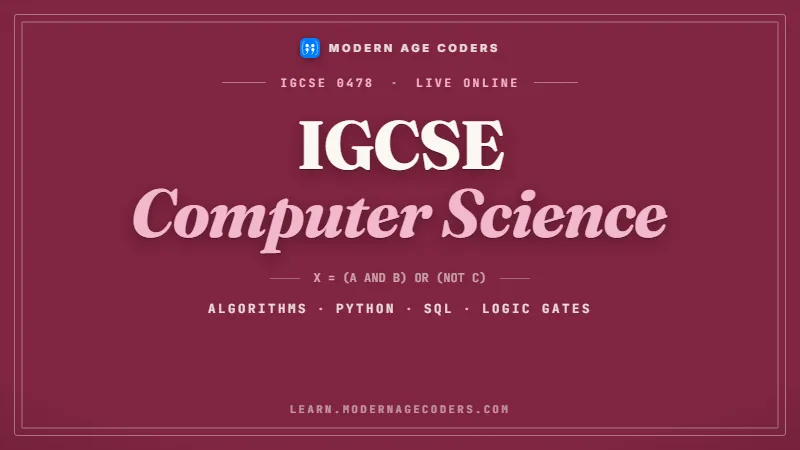
The Cambridge 0478 course: theory, algorithms and programming. Cambridge's next syllabus moves to Python only, so we teach in Python from the start.
Open the syllabus →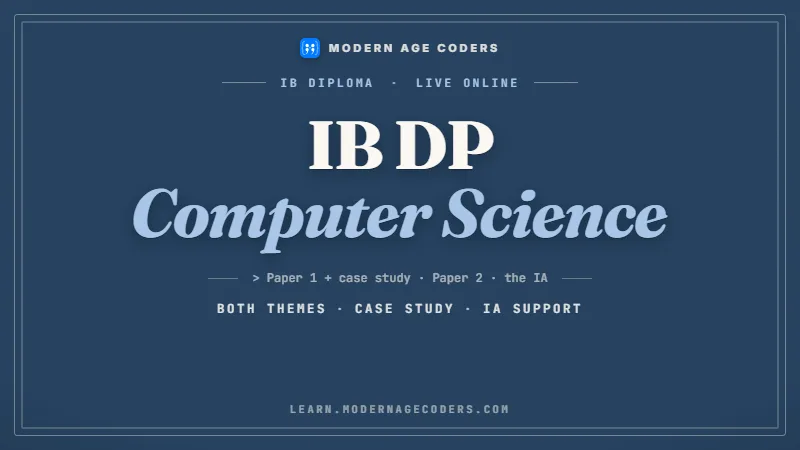
CISS / 02
Concepts, programming and guidance on the internal assessment, without writing any of it for the student.
Open the syllabus →
CISS / 03
For primary-age students who have outgrown block coding at school and want to type real programs and build small AI projects.
Open the syllabus →In EDB figures
About 44,700 in 2025/26, according to the Education Bureau, and the number has risen each year in the bureau's three-year table. Around a third are local students. The figures below are the bureau's own.
| Measure | 2023/24 | 2024/25 | 2025/26 |
|---|---|---|---|
| Students, all levels | 42,074 | 43,581 | 44,745 |
| Primary students | 22,610 | 22,784 | 22,776 |
| Secondary students | 19,464 | 20,797 | 21,969 |
| Places offered | 46,526 | 47,530 | 48,413 |
Source: EDB, "Statistics of International Schools at a Glance" (internationalschools.edb.gov.hk), read 23 November 2026. For 2025/26 the same page gives non-local students as 66.2% and local students as 33.8%. A LegCo written reply of 25 February 2026 adds that students filled "around 92.4 per cent of the total places provided, leaving some 3 700 surplus places available to meet demand".
The EDB's school types page says: "Currently, there are 53 international schools, 8 Private Independent Schools, and 21 local schools under Direct Subsidy Scheme offering non-local curricula in Hong Kong." All of them teach towards curricula from outside the local system.
The same page notes that, besides serving families who settle in Hong Kong, "these schools also provide more diversified curricula and modes of teaching for Hong Kong school children". That matches the one-third local share in the table.
According to the February 2026 reply, a consultancy study published in early 2024 "forecasted that by the 2028/29 school year, Hong Kong would have some 4 400 surplus school places among international schools". In plain terms, the sector expects room, not a squeeze, over the next few years.
For coding, the size of the sector matters less than its variety. Students in the same building may be heading for IGCSE, the IB Diploma or A level, each with a different computing course.
Computing in each curriculum
It depends on the curriculum each school follows. The EDB lists curricula "from Australia, Canada, France, Germany, Japan, Korea, Singapore, the United Kingdom and the United States, as well as the International Baccalaureate Diploma Programmes". For English-medium computing, three exam routes come up most often.
| Course | What its board says now | Our page for Hong Kong students |
|---|---|---|
| Cambridge IGCSE Computer Science (0478) | The updated syllabus uses "Python 3 as the only language for teaching, assessment and programming questions"; first examination in 2029 | IGCSE Computer Science tutor |
| Cambridge IGCSE ICT (0417) | Practical ICT skills alongside theory | IGCSE ICT tutor |
| IB Diploma Computer Science | A new syllabus with first exams in 2027 | IB Computer Science tutor |
| Cambridge A level Computer Science (9618) | The 2027 to 2029 syllabus is "adding Visual Basic (console mode), Python and Java" | A level Computer Science course |
Sources: EDB international schools site, School Types; Cambridge International pages for IGCSE Computer Science 0478 and AS and A Level Computer Science 9618; all read 23 November 2026. The IGCSE ICT and IB rows summarise our own pages, which cite their sources. Which course a student takes is set by the school.
Before IGCSE or the IB, computing varies widely. Some schools teach block coding and design projects in the primary years; others fold computing into technology or design subjects. A parent often does not know how much coding a child is actually doing.
Our first lesson answers that quickly: the mentor gives a short task at two levels and tells you plainly where your child is.
Across these routes, Python keeps appearing: the only language in the next IGCSE, one of the new A level languages, and a common choice in IB classes. A student who learns Python well before Year 10 starts the exam course already fluent.
For maths, which every computing course leans on, see our IB maths tutor page for Hong Kong and IGCSE maths tutor page.
A lesson from this page
Roughly, by age, yes. International school families switch between UK-style years, US-style grades and Hong Kong's P and S levels all the time, and so do our mentors. We turned that into a lesson for students of about 12 and up: one table, three naming systems, and a program that finds any label.
# One row per school year, three naming systems: build an index so any label finds its row.
ROWS = [  # (Hong Kong local, UK-style year, US-style grade): our rough alignment by age
    ("P1", "Year 2", "Grade 1"), ("P2", "Year 3", "Grade 2"), ("P3", "Year 4", "Grade 3"),
    ("P4", "Year 5", "Grade 4"), ("P5", "Year 6", "Grade 5"), ("P6", "Year 7", "Grade 6"),
    ("S1", "Year 8", "Grade 7"), ("S2", "Year 9", "Grade 8"), ("S3", "Year 10", "Grade 9"),
    ("S4", "Year 11", "Grade 10"), ("S5", "Year 12", "Grade 11"), ("S6", "Year 13", "Grade 12"),
]
SYSTEMS = ("Hong Kong", "UK-style", "US-style")

index = {}
for row in ROWS:
    for label in row:
        key = label.lower().replace(" ", "")
        if key in index:
            raise ValueError("duplicate label: " + label)
        index[key] = row

def translate(label):
    row = index.get(label.lower().replace(" ", ""))
    if row is None:
        return f"{label!r}: not a label we know; ask the school"
    return f"{label!r} -> " + ", ".join(f"{s}: {l}" for s, l in zip(SYSTEMS, row))

for asked in ["Year 9", "grade 11", "P6", "S3", "Year 14", "Form 2"]:
    print(translate(asked))
print("labels indexed:", len(index), "for", len(ROWS), "school years")
Our own program. The alignment is our rough guide by age: schools differ in cut-off dates, and some use other names entirely. It prints exactly the output below in any Python 3.
'Year 9' -> Hong Kong: S2, UK-style: Year 9, US-style: Grade 8
'grade 11' -> Hong Kong: S5, UK-style: Year 12, US-style: Grade 11
'P6' -> Hong Kong: P6, UK-style: Year 7, US-style: Grade 6
'S3' -> Hong Kong: S3, UK-style: Year 10, US-style: Grade 9
'Year 14': not a label we know; ask the school
'Form 2': not a label we know; ask the school
labels indexed: 36 for 12 school years
Twelve rows produce 36 index entries, one per label. "Year 9" finds S2 and Grade 8; "grade 11" finds S5 and Year 12 despite the lower case. "Year 14" does not exist, and "Form 2", an older name some people still use for S2, is not in our table, so the program says to ask the school rather than guess.
Lists of tuples, dictionaries as an index, normalising text before comparing it, and raising an error deliberately. The index is the idea behind every search box: do the work once, up front, so each lookup is instant.
The "Form 2" case is a good discussion: should the program learn it? Adding it is one more label in one row, and that is exactly how real data grows.
Add a fourth system: the IB programmes. Which rows would say MYP 1 to MYP 5, and which DP 1 and DP 2? Then add "Form 1" to "Form 5" as extra labels and check that the duplicate guard stays quiet.
For more on how our lessons build thinking habits like this one, see how to think like a programmer.
Alongside school
Mostly depth and pace. A school computing class serves twenty-odd students; a one-to-one mentor serves one, and can go wherever that student is ready to go.
Learn Python, data structures or Java before the exam course reaches them, so school becomes revision.
Untangle the topic the class rushed: recursion, binary, SQL, trace tables, at the student's pace.
Projects no syllabus asks for: a game, an app, an AI model, a contest problem.
IGCSE, IB and A level computing all include work that must be the student's own, such as the IB internal assessment. We explain the requirements, teach the skills and comment on a student's plan; we never write code, text or analysis that will be submitted.
The same goes for AI tools. We teach students to use them as a tutor would want, to think rather than to copy; our page on thinking with AI, not copying sets out how.
International school students learn in English every day, so our English-taught lessons need no adjustment. For students at local or bilingual schools, our page on coding classes taught in English in Hong Kong explains how the mentor adapts.
Students who change schools, or move abroad, keep the same mentor; the curriculum may change, but the lessons follow it.
Stage by stage
Our usual routes, written in UK-style years with the US-style grade beside them, since most international school parents use one or the other.
| Stage | Course | Why then |
|---|---|---|
| Years 2 to 4 (Grades 1 to 3) | Scratch Coding | Ideas before typing |
| Years 5 to 7 (Grades 4 to 6) | Python and AI for Kids | First real language |
| Years 7 to 9 (Grades 6 to 8) | Python for Teens | Fluency before exam courses |
| Years 10 and 11 (Grades 9 and 10) | IGCSE Computer Science | Exam course support |
| Years 12 and 13 (Grades 11 and 12) | IB Computer Science or A level | Diploma-level depth |
| Any stage, keen | Competitive Programming | Contests and algorithms |
The stages reflect how we place students, not any school's or board's requirement. Students interested in contests can read our page on competitive programming for teens in Hong Kong.
The main aim is enjoyment and ideas: loops, conditions, events. Most children who love it at seven are still coding at fourteen.
Our AI course for kids in Hong Kong suits children who ask how chatbots and image apps work.
From about Year 8, the gap between students who code at home and those who do not becomes visible. A year of steady Python before IGCSE or MYP design projects makes the exam years calmer.
In the diploma years, lessons narrow to the syllabus and the assessed work, within the rules above.
Progress
Our own stages, independent of any curriculum, so they carry across schools and systems.
| Stage | The student can | Evidence |
|---|---|---|
| 1. Sequence | Order instructions correctly | A program that does what was planned |
| 2. Abstract | Write functions and reuse them | Shorter, cleaner code |
| 3. Structure | Choose lists, dictionaries and records well | Programs that scale with data |
| 4. Test | Plan tests, including edge cases | Bugs found before the teacher finds them |
| 5. Analyse | Compare algorithms by their work | Reasoned choices in written answers |
| 6. Design | Plan and build a full project | A portfolio piece ready for university applications |
Learn one language deeply before collecting several.
Keep your projects in one place; they become your portfolio.
Share the school's course outline with the mentor once a year.
Ask your child to explain one program a month; explaining is learning.
More courses
All live, one to one and in English, at any Hong Kong hour.
CISS / PRI / 01
Games and stories from blocks.
Open the syllabusCISS / PRI / 02
How machines learn, tested by hand.
Open the syllabusCISS / PRI / 03
Maths ideas brought to life in Python.
Open the syllabusCISS / MID / 01
Fluency before any exam course.
Open the syllabusCISS / MID / 02
Objects and classes, as A level now allows.
Open the syllabusCISS / MID / 03
Speed and structure for contest coders.
Open the syllabusCISS / DIP / 01
The Cambridge 9618 course, paced for one.
Open the syllabusCISS / DIP / 02
The maths beside IB computing.
Open the syllabusCISS / DIP / 03
Models built and evaluated properly.
Open the syllabusTiming
Any day, any time, flexible: one to one at the hour that suits your family, weekdays or weekends. International school terms and holidays differ from local ones, so tell us yours; the mentor in India works two and a half hours behind Hong Kong.
After school
4:45 pm in Hong Kong is 2:15 pm in India.
Evening
8:15 pm in Hong Kong is 5:45 pm for the mentor.
Weekend
11 am Saturday in Hong Kong is 8:30 am in India.
We follow your school's calendar, not a standard one.
Extra lessons before mocks if you ask.
Continuity from year to year.
With an editor we help set up.
What was covered, and what is next.
Lessons continue on holidays abroad.
Student work
A selection of work from longer courses; the student labs page shows more.

AI and ML
An AI nutrition coach that reads what you eat and works you toward a target.

AI and ML
A chatbot that answers mathematics and programming questions, built and deployed by a student.

AI and ML
An assistant that helps a young person recognise unsafe situations online.

Web app
A weather forecasting site with live conditions for any location.
Fees
The monthly fee shows below in Hong Kong dollars. Families pay one month at a time, never a term or a year ahead, and any charge a payment gateway adds is shown on the checkout screen before payment.
Free first class
Free
no card required
One to one
$1,200 HKD
a month, eight live classes
What families say
Google reviews from parents and students, reproduced as written.
★★★★★
"The one step solution for my son. Modern Age Coders make learning coding so simple that kids love it. The teachers explain complex concepts clearly with practical exercises and interactive content."
Ria Mukherjee
Parent
★★★★★
"Modern Age Coders has been a game-changer for me. I struggled to grasp IT concepts and coding before joining, but their classes transformed everything. I can now confidently write complex programs with ease."
Samriddha Mondal
Student
★★★★★
"One of the most wonderful education centres out there. Education is not limited to school syllabus but focuses on skill development."
Vansh Agarwal
Student
★★★★★
"My child Dhairya is really enjoying the Modern Age Coders classes. This is his first online class and he eagerly looks forward to it. I can already see his improvement, and the teachers are very cooperative."
Sonam Oswal
Parent of Dhairya
★★★★★
"Modern Age Coders have wonderful teachers who teach in a clear, easy and practical way. The teacher boosts students' confidence and inspires them to learn without hesitation."
Sonu Goyal
Parent
★★★★★
"I highly recommend this computer coding class! The teachers are incredibly knowledgeable and passionate about coding."
Ritu Kedia
Parent
International school parents ask
The EDB says there are 53 international schools, as well as 8 Private Independent Schools and 21 Direct Subsidy Scheme schools offering non-local curricula.
The EDB counts 44,745 students at international schools in 2025/26, excluding the special school: 22,776 primary and 21,969 secondary.
Yes, whichever your child's school follows. Lessons can also sit outside any syllabus, for projects and contests.
Python for most students. Cambridge's next IGCSE Computer Science syllabus uses Python only, and the A level now allows Python and Java.
We explain the requirements and teach the skills, and we comment on plans, but we never write any part that the student submits.
Yes, live and one to one, in English, by mentors based in India.
Any day, any time, flexible: one to one at the hour that suits your family, weekdays or weekends.
By age, roughly yes, and both line up with S2 in Hong Kong local schools. Schools use different cut-off dates, so check with your school if it matters.
Your child keeps the same mentor, and lessons follow the new curriculum.
Monthly, shown in Hong Kong dollars, with nothing prepaid. Any gateway charge appears before you pay.
Related
Pages that go deeper.
The 0478 course in detail.
Paper by paper, with the IA line.
What changed for first exams in 2027.
English as an advantage.
Contests and algorithms.
All our routes here.
Part of the guide: Every Hong Kong page
More guides: Coding and AI classes in Hong Kong · 中文:英文授課編程課程 · Start here: Online coding for kids · AI, vibe coding and AI agents: AI agents course · Coding subjects and courses: App development · By age and school level: Adults · HKDSE ICT and maths: DSE ICT elective guide · IB, IGCSE, A-level and SAT: A level Computer Science tutor · Olympiads and competitions: AMC 10 preparation · School holidays: AI summer course · Districts and areas: Causeway Bay
Start here
In the free lesson the mentor asks which curriculum and year your child is in, gives a short task at two levels, and afterwards tells you where your child stands and which course fits, in or beyond the syllabus.
Prefer to read first? The course list has every syllabus; how we teach shows the lesson format.
WhatsApp us · +91 91233 66161 · connect@modernagecoders.com
Live, one to one, in English, with mentors based in India. WhatsApp is quickest.
A priority demo is a full class of about 45 to 60 minutes. After the class the mentor sends a written skill report and a personal learning roadmap on WhatsApp. If you enrol, the demo fee is adjusted against your first month's fee. Share your demo Order ID with us on WhatsApp and we take it off.
Book a priority demo