Table of Contents
- What is logical reasoning for kids?
- Types of logical reasoning questions
- Logical reasoning questions for kids aged 6 to 7
- Logical reasoning questions for kids aged 8 to 9
- Logical reasoning questions for kids aged 10 to 12
- Logical reasoning questions for teens aged 13 to 14
- A deduction grid for kids (with a Python check)
- Answers to the puzzles by age
- Logical reasoning worksheet for kids
- How to teach logical reasoning to kids
- Logical reasoning for kids online
- How we teach it
- Frequently asked questions
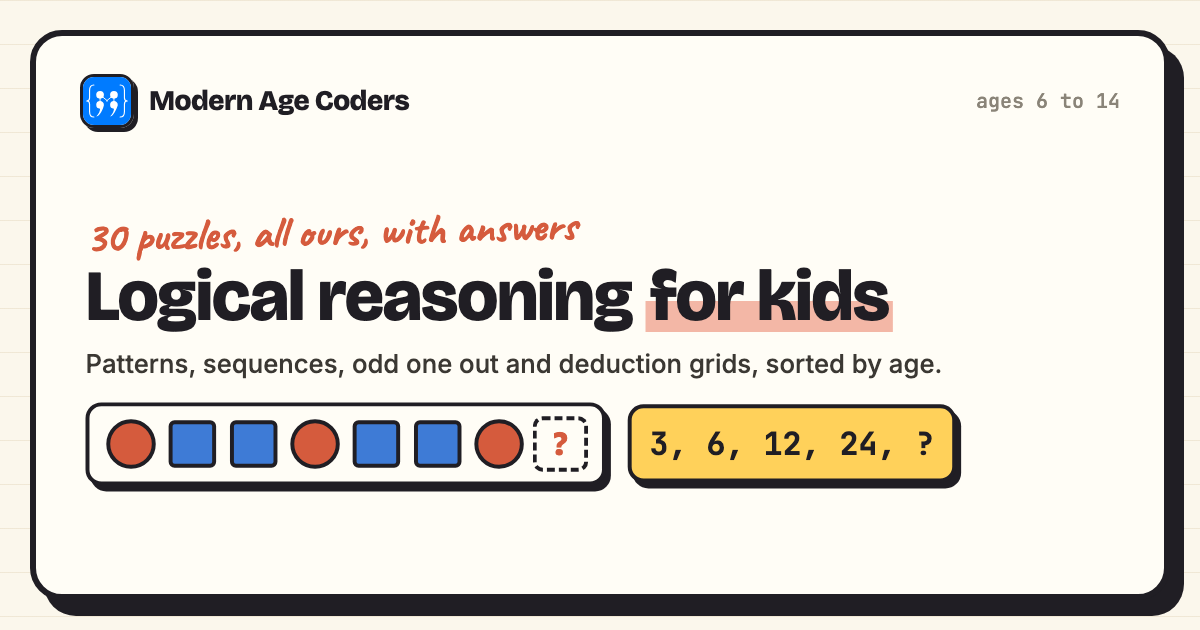
Logical reasoning for kids is the skill of using clues and rules to reach an answer that must be true, instead of guessing. Children practise it with patterns, number sequences, odd one out, analogies and deduction grids. Start at 6 with shape patterns and simple comparisons, move to sequences and short deductions at 8 or 9, and to deduction grids from about 10, always asking the child to explain why the answer must be right.
Below are 30 puzzles sorted by age, every one written by us for this page, with answers and the reasoning behind each. There is a printable-style worksheet, a deduction grid that we checked with a short Python program to prove it has exactly one answer, and ideas for practising logical reasoning online.
What is logical reasoning for kids?
A child is reasoning logically when they can say because: "it must be Ben, because Tom is older than Ana and Ana is older than Ben." The answer matters less than the because. That is what separates reasoning from a lucky guess, and it is the skill tested in school reasoning papers, entrance tests and every coding class.
Logical reasoning sits next to problem solving but is narrower. Problem solving is the whole loop of trying, checking and trying again; our guide to problem solving skills for kids covers that. Reasoning is the thinking that decides which answer must be right.
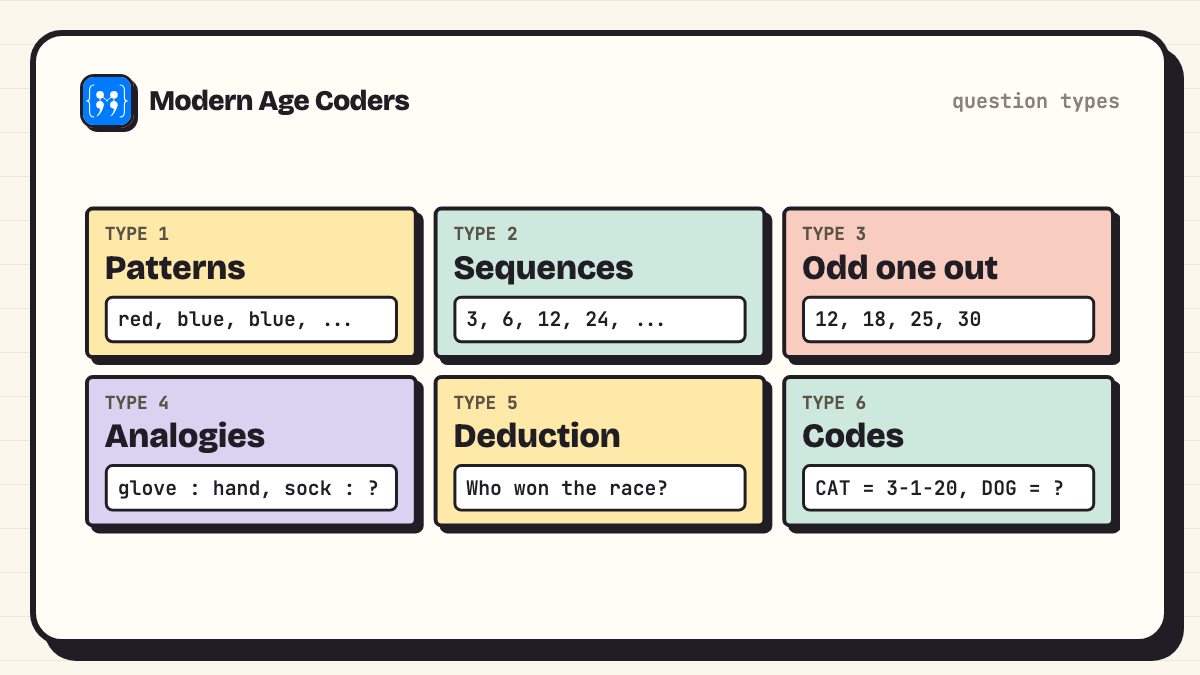
Types of logical reasoning questions
| Type | What the child does | Example (ours) |
|---|---|---|
| Patterns | Find the rule in shapes or colours and continue it | red, blue, blue, red, blue, blue, ... |
| Sequences | Find the rule in numbers or letters | 3, 6, 12, 24, ... |
| Odd one out | Find the item that breaks the group's rule | 12, 18, 25, 30 |
| Analogies | Spot a relationship and apply it again | glove is to hand as sock is to ... |
| Deduction | Combine clues to reach the only possible answer | Who won the race? |
| Codes | Crack a rule that turns words into numbers | CAT = 3-1-20, so DOG = ? |
Logical reasoning questions for kids aged 6 to 7
At this age, keep it visual and say the rule out loud. Use real objects when you can.
- Pattern: red, blue, blue, red, blue, blue, red, ... What comes next?
- Pattern: big ball, small ball, big ball, small ball, ... What comes next?
- Sequence: 2, 4, 6, 8, ... What comes next?
- Shapes: a triangle has 3 sides, a square has 4. How many sides does a pentagon have?
- Odd one out: apple, banana, carrot, mango.
- Analogy: glove is to hand as sock is to ...
- Comparison: the cat is bigger than the mouse. The dog is bigger than the cat. Which is the smallest?
Logical reasoning questions for kids aged 8 to 9
- Sequence: 1, 4, 9, 16, ... What comes next?
- Sequence: 3, 6, 12, 24, ... What comes next?
- Letters: A, C, E, G, ... What comes next?
- Odd one out: 12, 18, 25, 30.
- Analogy: bird is to nest as bee is to ...
- Calendar: today is Wednesday. What day will it be in 10 days?
- Deduction: Mia is taller than Leo. Leo is taller than Sam. Who is the shortest?
- Code: if A = 1, B = 2, C = 3 and so on, CAT is 3-1-20. What is DOG?
Logical reasoning questions for kids aged 10 to 12
- Sequence: 2, 3, 5, 8, 12, 17, ... What comes next?
- Sequence: 1, 1, 2, 3, 5, 8, ... What comes next?
- Odd one out: 2, 3, 5, 9, 11.
- Analogy: 7 is to 49 as 9 is to ...
- Deduction: Riya, Kabir and Zoe ran a race. Zoe did not finish last. Kabir finished straight after Riya. Who won?
- Number clue: I am a two-digit number below 50. I am a multiple of 7, and my digits add up to 8. What am I?
- Deduction grid: the pets and colours puzzle further down this page.
Logical reasoning questions for teens aged 13 to 14
- Sequence: 1, 2, 6, 24, 120, ... What comes next?
- Odd one out: 8, 27, 64, 100, 125.
- Statement: All my pens are blue. This pen is blue. Is it definitely mine?
- Statement: If it rains, the match is cancelled. The match was not cancelled. Did it rain?
- Rule-finding: a machine turns 2 into 5, 3 into 7 and 10 into 21. What does it turn 6 into?
- Grid design: write your own three-person deduction grid with four clues, then check it has exactly one answer (the Python below shows how).
A deduction grid for kids (with a Python check)
Our puzzle: pets and colours
Aarav, Bea and Chen each have one pet (a cat, a dog or a fish) and each has a different favourite colour (red, blue or green). Clue 1: the cat's owner likes blue. Clue 2: Aarav likes green. Clue 3: Chen does not like blue. Clue 4: Chen does not have the fish. Who has which pet, and who likes which colour?
Solving it by reasoning: Aarav likes green (clue 2), so Aarav is not the cat's owner, because the cat's owner likes blue (clue 1). Chen does not like blue (clue 3), so Chen is not the cat's owner either. That leaves Bea with the cat, and Bea likes blue. Chen does not have the fish (clue 4), so Chen has the dog and Aarav has the fish. The only colour left for Chen is red.
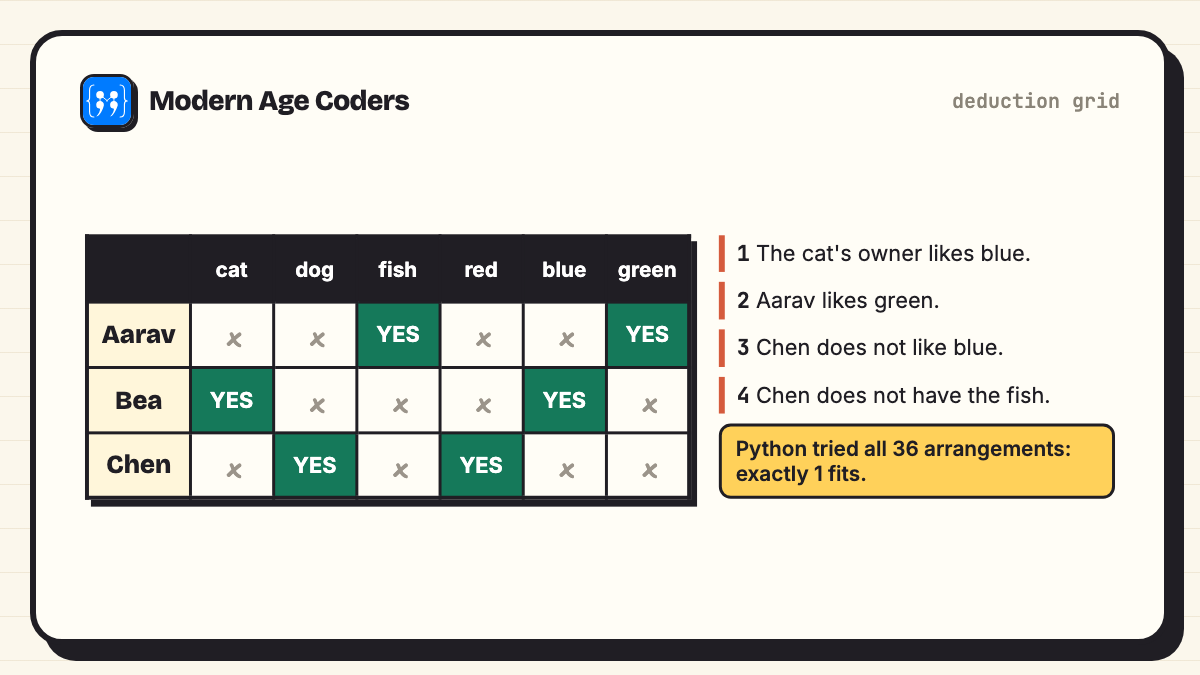
A good puzzle has exactly one answer, and every clue should be needed. Instead of trusting ourselves, we checked both with a short Python program. It tries all 36 ways to hand out the pets and colours, keeps the ones that fit every clue, and then removes each clue in turn to see whether the puzzle still has one answer without it.
# Check our deduction-grid puzzle: try every possible arrangement and keep
# only the ones that obey the clues. A fair puzzle has exactly one answer.
from itertools import permutations

people = ["Aarav", "Bea", "Chen"]
clues = {
    "1. The cat's owner likes blue": lambda pet, col: all(
        col[p] == "blue" for p in people if pet[p] == "cat"),
    "2. Aarav likes green": lambda pet, col: col["Aarav"] == "green",
    "3. Chen does not like blue": lambda pet, col: col["Chen"] != "blue",
    "4. Chen does not have the fish": lambda pet, col: pet["Chen"] != "fish",
}

def solve(active):
    found = []
    for pets in permutations(["cat", "dog", "fish"]):
        for cols in permutations(["red", "blue", "green"]):
            pet, col = dict(zip(people, pets)), dict(zip(people, cols))
            if all(clues[c](pet, col) for c in active):
                found.append({p: (pet[p], col[p]) for p in people})
    return found

answers = solve(clues)
print("arrangements tried: 36, fitting every clue:", len(answers))
for p in people:
    print(f"  {p}: {answers[0][p][0]}, {answers[0][p][1]}")
print("drop one clue and see if it was needed:")
for c in clues:
    print(f"  without clue {c[0]}: {len(solve([k for k in clues if k != c]))} answers")
Output:
arrangements tried: 36, fitting every clue: 1
  Aarav: fish, green
  Bea: cat, blue
  Chen: dog, red
drop one clue and see if it was needed:
  without clue 1: 4 answers
  without clue 2: 4 answers
  without clue 3: 3 answers
  without clue 4: 2 answers
Exactly one arrangement fits, and dropping any clue lets in two to four answers, so every clue earns its place. Children from about 11 can write a checker like this themselves, and writing your own puzzle and then testing it is a far deeper reasoning exercise than solving one.
Answers to the puzzles by age
| Age | Puzzle | Answer | Why |
|---|---|---|---|
| 6 to 7 | red, blue, blue, ... | blue | The block red, blue, blue repeats; after red come two blues |
| 6 to 7 | big, small, big, small, ... | big ball | It alternates |
| 6 to 7 | 2, 4, 6, 8 | 10 | Add 2 each time |
| 6 to 7 | Pentagon sides | 5 | Triangle 3, square 4, pentagon 5 |
| 6 to 7 | apple, banana, carrot, mango | carrot | The others are fruits; a carrot is a vegetable |
| 6 to 7 | glove : hand, sock : ? | foot | What you wear on it |
| 6 to 7 | cat, mouse, dog | the mouse | The cat is bigger than the mouse and the dog is bigger than the cat |
| 8 to 9 | 1, 4, 9, 16 | 25 | Square numbers: 1x1, 2x2, 3x3, 4x4, 5x5 |
| 8 to 9 | 3, 6, 12, 24 | 48 | Double each time |
| 8 to 9 | A, C, E, G | I | Skip one letter each time |
| 8 to 9 | 12, 18, 25, 30 | 25 | The others are in the 6 times table |
| 8 to 9 | bird : nest, bee : ? | hive | Where it lives |
| 8 to 9 | Wednesday + 10 days | Saturday | 7 days is Wednesday again; 3 more is Saturday |
| 8 to 9 | Mia, Leo, Sam | Sam | Order: Mia, Leo, Sam |
| 8 to 9 | DOG | 4-15-7 | D is the 4th letter, O the 15th, G the 7th |
| 10 to 12 | 2, 3, 5, 8, 12, 17 | 23 | The gaps grow: +1, +2, +3, +4, +5, so +6 |
| 10 to 12 | 1, 1, 2, 3, 5, 8 | 13 | Each number is the sum of the two before |
| 10 to 12 | 2, 3, 5, 9, 11 | 9 | The others are prime; 9 = 3 x 3 |
| 10 to 12 | 7 : 49, 9 : ? | 81 | Square the number |
| 10 to 12 | The race | Zoe | Kabir is straight after Riya, so the order is Riya, Kabir, Zoe or Zoe, Riya, Kabir. Zoe was not last, so it is Zoe, Riya, Kabir |
| 10 to 12 | Multiple of 7, digits add to 8 | 35 | Multiples of 7 below 50: 14, 21, 28, 35, 42, 49. Only 3 + 5 = 8 |
| 10 to 12 | Pets and colours | Aarav: fish, green. Bea: cat, blue. Chen: dog, red | See the worked solution and the Python check above |
| 13 to 14 | 1, 2, 6, 24, 120 | 720 | Multiply by 2, 3, 4, 5, then 6 |
| 13 to 14 | 8, 27, 64, 100, 125 | 100 | The others are cubes: 2, 3, 4 and 5 cubed |
| 13 to 14 | Blue pens | No | All my pens being blue does not mean all blue pens are mine |
| 13 to 14 | Rain and the match | No | If it had rained, the match would have been cancelled. It was not, so it did not rain |
| 13 to 14 | The machine | 13 | Double and add 1: 2 to 5, 3 to 7, 10 to 21, so 6 to 13 |
| 13 to 14 | Design your own grid | Your puzzle | It is fair if a checker finds exactly one answer and every clue is needed |
That is 28 puzzles in the age lists plus two more for practice below, which makes 30.
Logical reasoning worksheet for kids
Copy this mixed worksheet onto paper for a 15-minute session. Ask for the answer and one sentence that starts with "because". Answers are in the right-hand column, so fold it over before you start.
| # | Question (ours) | Answer |
|---|---|---|
| 1 | What comes next? 5, 10, 15, 20, ... | 25 (add 5) |
| 2 | Odd one out: square, circle, triangle, rectangle | circle (the only one with no straight sides) |
| 3 | What comes next? 3, 6, 12, 24, ... | 48 (double) |
| 4 | Today is Wednesday. What day is it in 10 days? | Saturday |
| 5 | Odd one out: 2, 3, 5, 9, 11 | 9 (not prime) |
| 6 | If CAT is 3-1-20, what is DOG? | 4-15-7 |
| 7 | Riya, Kabir and Zoe: who won the race? | Zoe |
| 8 | A machine turns 2 into 5 and 3 into 7. What does 6 become? | 13 |
Questions 1 and 2 above are the two extra practice puzzles that bring the total to 30. For more practice with maths reasoning, our guide to solving maths word problems uses the same "because" habit.
How to teach logical reasoning to kids
- Always ask "how do you know?" A right answer without a reason is half an answer.
- Let them make puzzles. Writing a pattern for you to solve forces them to think about rules.
- Talk about wrong answers. "Why did 25 look right at first?" teaches more than the right answer.
- Little and often. Five puzzles at breakfast beat a long worksheet on Sunday.
- Connect to coding. An if statement is a logical rule. Programs make reasoning visible, and the computer checks it honestly.
Logical reasoning for kids online
Logical reasoning practises well online when the activity makes the child think before clicking. Good options include block coding in Scratch, where a program either works or does not, competition-style computational thinking challenges (our Bebras practice guide explains the format), and live classes where a teacher asks the child to explain each step. Be wary of apps that reward fast tapping: speed is not reasoning.
AI tools have age rules
Check the vendor's age rule before a young learner uses any AI tool. Most chat assistants require users to be at least 13. ChatGPT's terms ask for a parent's or guardian's permission for anyone under 18, and Claude is for adults (18 and over) only. Under-13s should build these skills with puzzles, Scratch and Python, without a chatbot account. Our guide to teaching kids AI at home covers safe options by age.
How we teach it
The principles on our how we teach page are the ones on this page: children explain their thinking out loud, we trace a loop line by line until they can predict every step, they work out a rule themselves before they see it written down, we solve the same problem three ways, and mistakes are treated as data. You can see it in Reasoning and Readiness for ages 6 to 9, our problem solving and computational thinking course for kids and the Python and AI course for kids, live online. The first class is free.
Frequently asked questions
Using clues and rules to reach an answer that must be true, and being able to explain why. Children practise it with patterns, sequences, odd one out, analogies, codes and deduction puzzles.
Do a few puzzles often, always ask "how do you know?", let your child invent puzzles for you, and talk about why wrong answers looked right. Coding is excellent practice because a program checks the reasoning.
This page has 30, sorted by age from 6 to 14, with an answer table that explains each one. Every puzzle was written by us.
From about 6, with shape and colour patterns and simple comparisons. Number sequences suit 8 and up, and deduction grids suit most children from about 10.
Yes, the eight-question worksheet on this page has answers in its last column. Copy it out or print the page and fold the answers over.
Problem solving is the whole process of understanding a problem, trying ideas and checking them. Logical reasoning is the part that decides which answer must be true from the information you have.
Yes. Programs are built from rules (if this, then that), and a computer follows them exactly, so a child sees at once when their reasoning has a gap.
Check every possible arrangement. For small puzzles you can do it with a table; for bigger ones a short program, like the Python check on this page, tries every arrangement and counts how many fit the clues.