Table of Contents
Trigonometry sounds intimidating, but at the beginner level it comes down to one idea: in a right-angled triangle, the angles and the side lengths are linked, so if you know enough of one you can work out the other. SOH CAH TOA is the memory aid that tells you exactly how.
This guide explains how to label a triangle correctly (the step most mistakes come from), what sin, cos and tan actually mean, how to choose the right one, and how to find a missing side or a missing angle. Every calculation is also run in Python, which is a quick way to check your answers and a good warning about the calculator mistake that catches almost everyone.
Step 1: label the sides
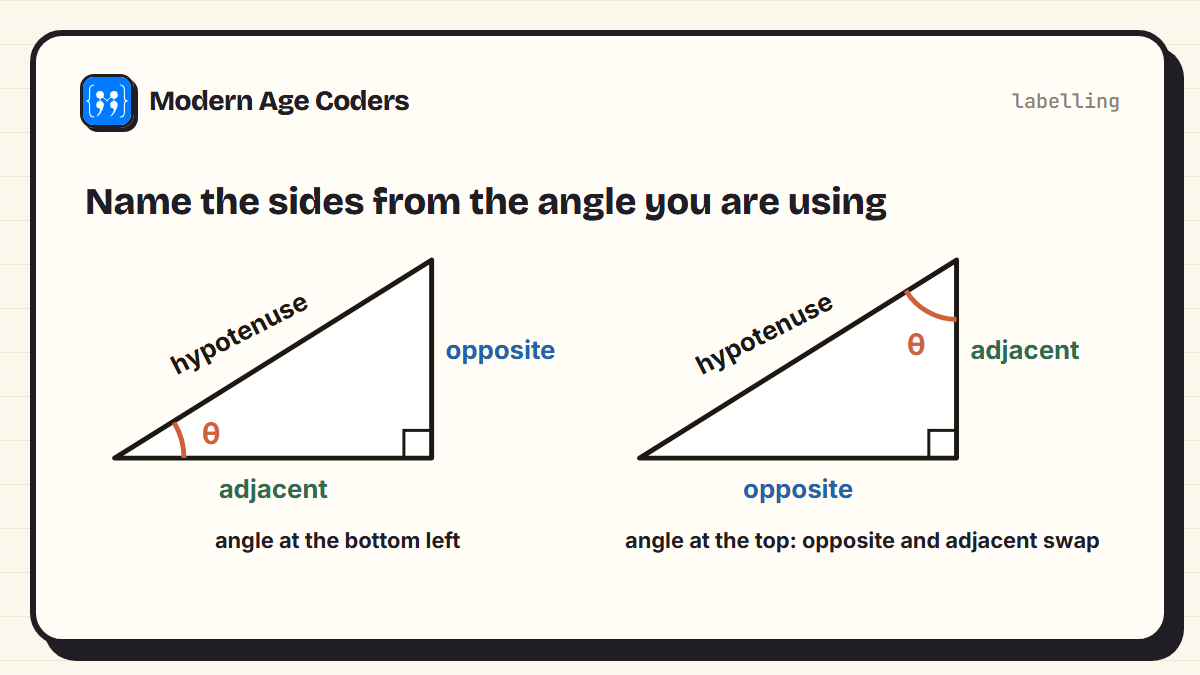
Trigonometry at this level only works in right-angled triangles. Pick the angle you are working with, usually called θ (theta). Then name the three sides:
- Hypotenuse: the longest side, opposite the right angle. It never changes.
- Opposite: the side directly across from your angle θ. It does not touch θ.
- Adjacent: the side next to θ that is not the hypotenuse.
The most common mistake
Opposite and adjacent are not fixed sides of the triangle. They depend on which angle you are using. Always mark your angle first, then label the sides from it.
Step 2: what SOH CAH TOA means
| Mnemonic | Ratio | Meaning |
|---|---|---|
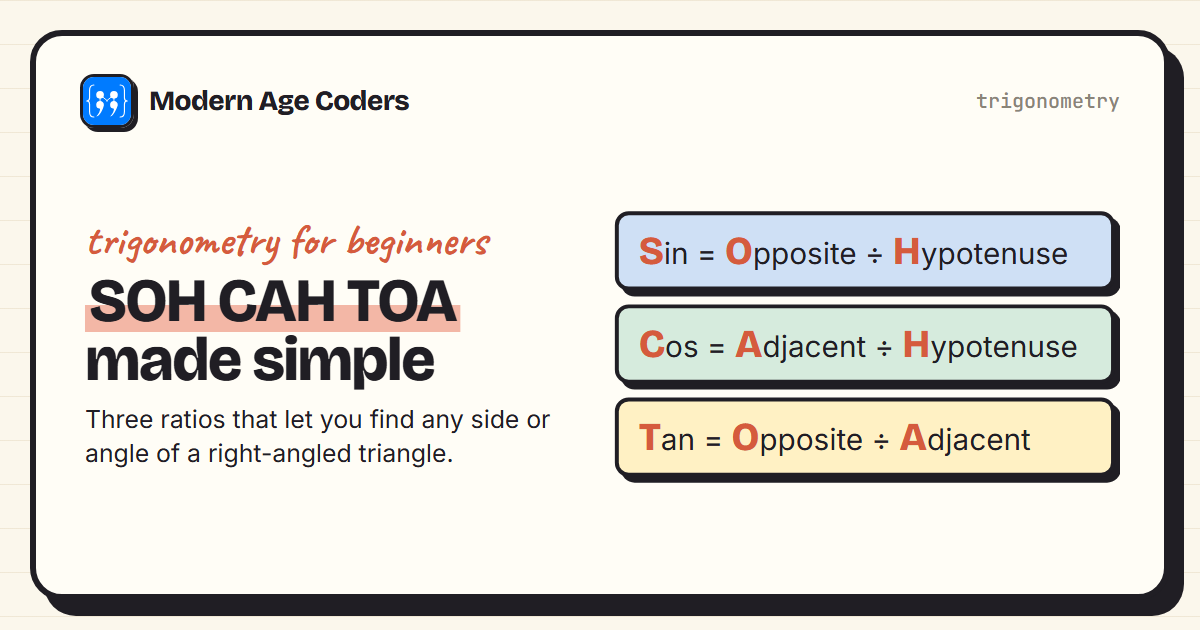
| SOH | sin θ = opposite / hypotenuse | Sine is opposite over hypotenuse |
| CAH | cos θ = adjacent / hypotenuse | Cosine is adjacent over hypotenuse |
| TOA | tan θ = opposite / adjacent | Tangent is opposite over adjacent |
These ratios depend only on the angle, not on the size of the triangle. Every right-angled triangle with a 30° angle has the side opposite it exactly half the length of the hypotenuse, whether the triangle is drawn on paper or measured across a field. That is why sin 30° is always 0.5. Here are the ratios for the famous 3-4-5 triangle:
import math

# A 3-4-5 right-angled triangle. The angle A is opposite the side of length 3.
opposite, adjacent, hypotenuse = 3, 4, 5

sin_a = opposite / hypotenuse
cos_a = adjacent / hypotenuse
tan_a = opposite / adjacent
print(f"sin A = {sin_a}, cos A = {cos_a}, tan A = {tan_a}")

angle = math.degrees(math.atan(tan_a))
print(f"A = {angle:.2f} degrees")
print(f"sin A squared + cos A squared = {sin_a**2 + cos_a**2}")sin A = 0.6, cos A = 0.8, tan A = 0.75
A = 36.87 degrees
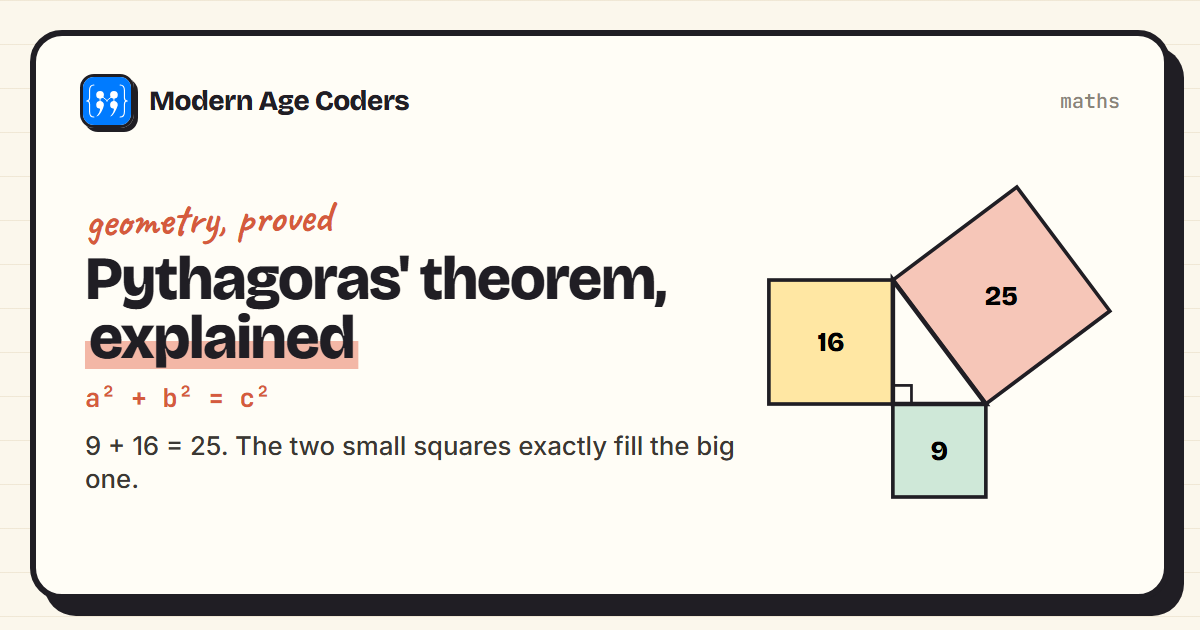
sin A squared + cos A squared = 1.0The angle opposite the side of length 3 is about 36.87°. The last line shows a neat fact: sin² + cos² always equals 1, because it is really Pythagoras' theorem in disguise (divide a² + b² = c² by c²).
Step 3: choose the right ratio
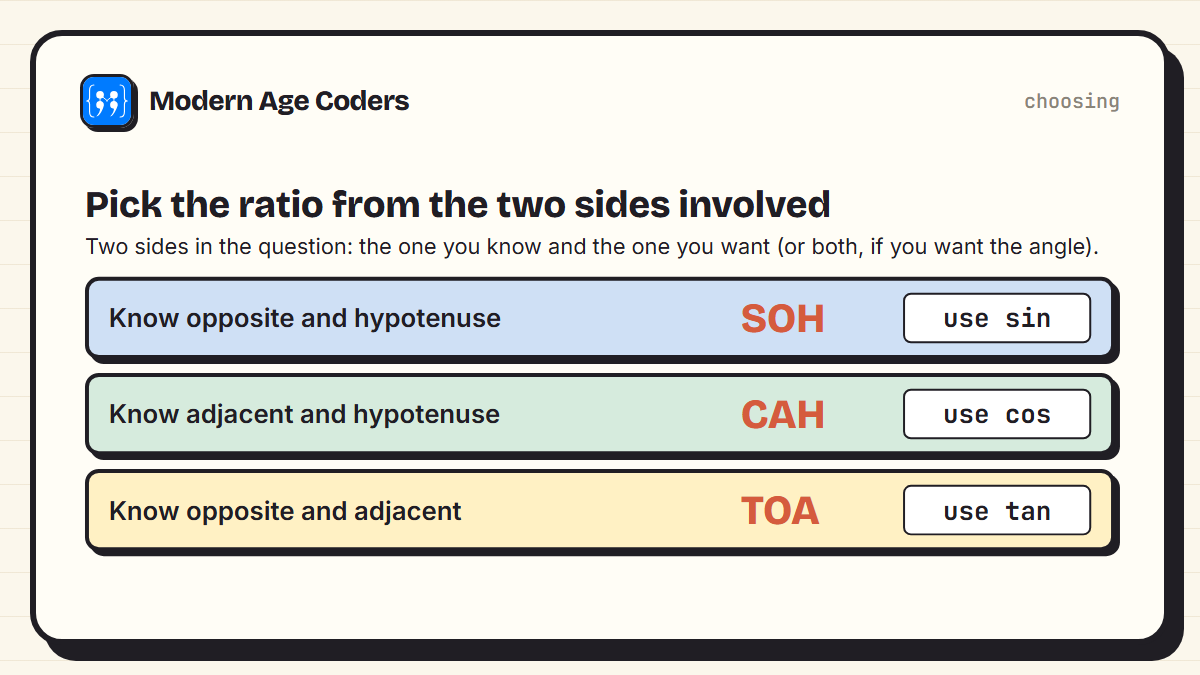
Look at the two sides involved in the question: the one you know and the one you want to find. If you want an angle, use the two sides you know. Then pick the ratio that uses exactly those two.
Finding a missing side
Two worked examples:
- A ladder: a 6 m ladder leans against a wall at 70° to the ground. How high up the wall does it reach? You know the hypotenuse (6) and want the opposite side. That is SOH: opposite = sin 70° × 6 = 5.64 m.
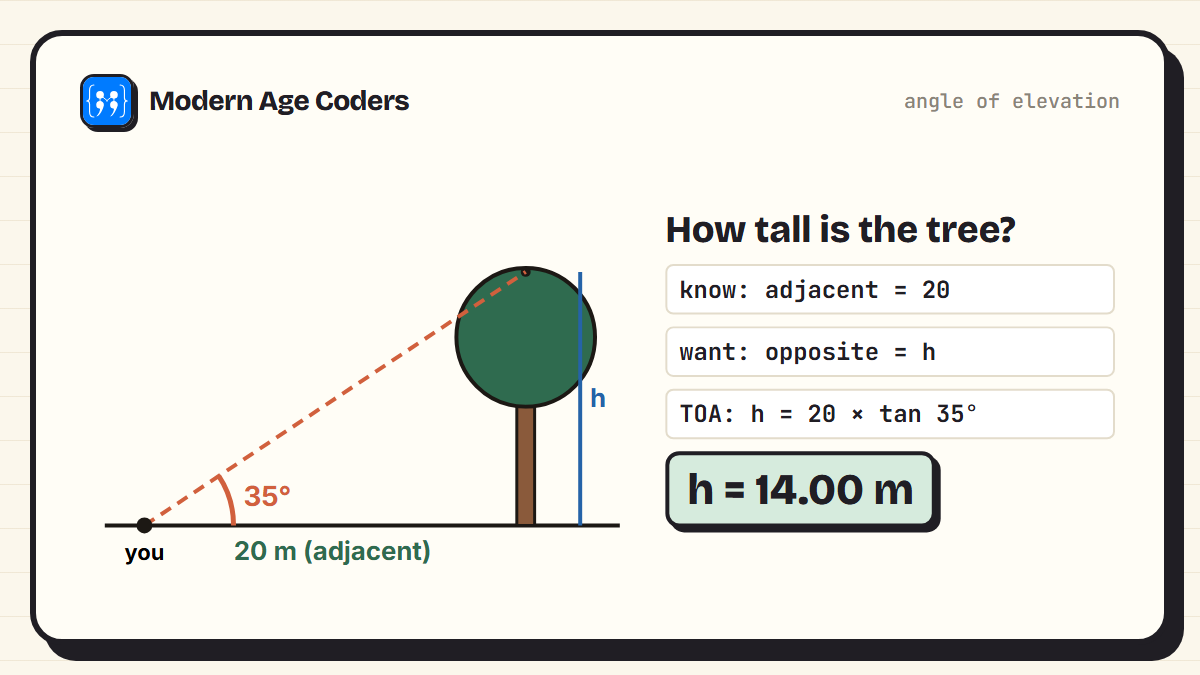
- A tree: standing 20 m from a tree, you look up at its top at an angle of 35°, called the angle of elevation. You know the adjacent side (20) and want the opposite (the height). That is TOA: height = tan 35° × 20 = 14.00 m.
When the unknown side is on the bottom of the ratio, rearrange before calculating. For example, if cos 40° = 8 / h, then h = 8 / cos 40°. A quick check: the hypotenuse must always be the longest side, so if your answer for the hypotenuse is shorter than another side, something has gone wrong.
Finding a missing angle
To find an angle, use the inverse functions, written sin⁻¹, cos⁻¹ and tan⁻¹ (or arcsin, arccos, arctan). They take a ratio and give back the angle. A ramp rises 1.2 m over 10 m of ground: you know the opposite and adjacent sides, so use TOA, and the angle is tan⁻¹(1.2 / 10) = 6.84°. Here are all three examples in code:
import math

# A 6 m ladder leans against a wall at 70 degrees to the ground. How high does it reach?
# We know the hypotenuse and want the opposite side: SOH, so opposite = sin(angle) x hypotenuse
height = 6 * math.sin(math.radians(70))
print(f"ladder reaches {height:.2f} m up the wall")

# From 20 m away, the top of a tree is 35 degrees above the ground. How tall is it?
# We know the adjacent side and want the opposite: TOA, so opposite = tan(angle) x adjacent
tree = 20 * math.tan(math.radians(35))
print(f"tree is {tree:.2f} m tall")

# A ramp rises 1.2 m over 10 m of ground. What angle is it?
# Opposite and adjacent are known: TOA, so angle = inverse tan(opposite / adjacent)
ramp = math.degrees(math.atan(1.2 / 10))
print(f"ramp angle is {ramp:.2f} degrees")ladder reaches 5.64 m up the wall
tree is 14.00 m tall
ramp angle is 6.84 degreesThe calculator mistake: degrees and radians
Angles can be measured in degrees or in radians, a unit used in higher maths where a full turn is 2π instead of 360. Calculators have a mode for each, and Python's math functions always use radians. Get the mode wrong and your answers are nonsense:
import math

print("math.sin(30)               =", round(math.sin(30), 4))
print("math.sin(math.radians(30)) =", round(math.sin(math.radians(30)), 4))
print("30 degrees in radians =", round(math.radians(30), 4))math.sin(30) = -0.988
math.sin(math.radians(30)) = 0.5
30 degrees in radians = 0.5236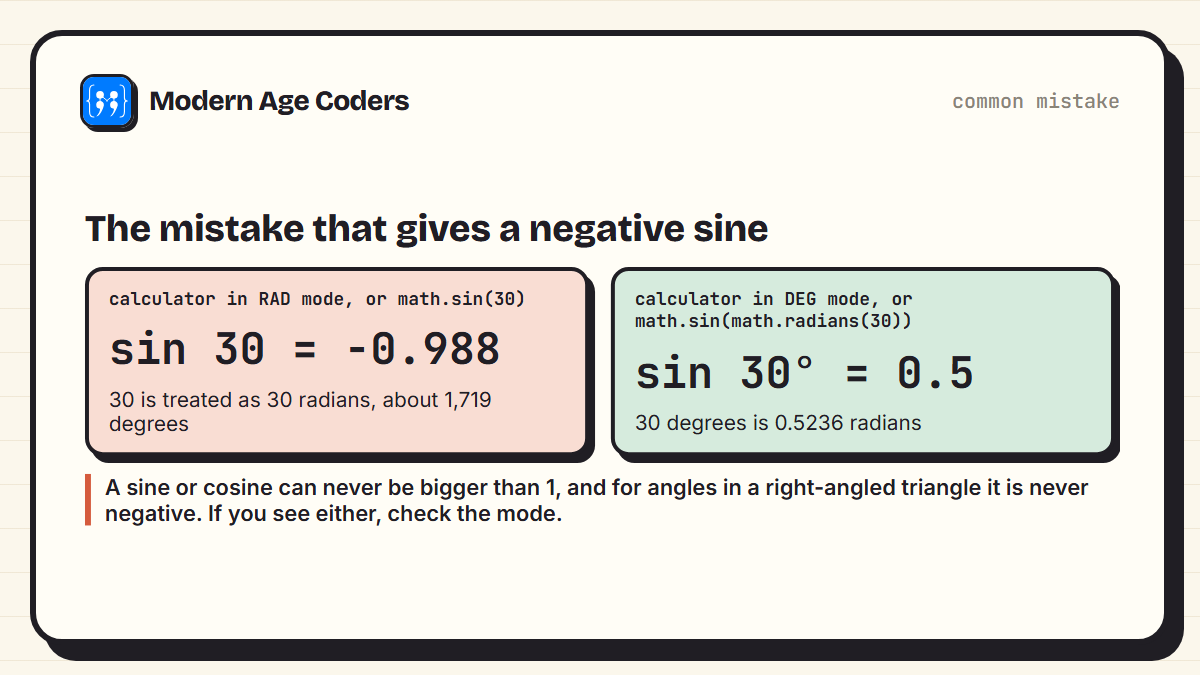
math.sin(30) gave -0.988, because Python read 30 as 30 radians, well over four full turns. Converting first with math.radians(30) gives the expected 0.5. On a school calculator, look for a small D or DEG on the screen before any triangle question.
Exact values worth knowing
| Angle | sin | cos | tan |
|---|---|---|---|
| 30° | 1/2 = 0.5 | √3/2 ≈ 0.866 | 1/√3 ≈ 0.577 |
| 45° | √2/2 ≈ 0.707 | √2/2 ≈ 0.707 | 1 |
| 60° | √3/2 ≈ 0.866 | 1/2 = 0.5 | √3 ≈ 1.732 |
These come from two simple triangles: half of a square (giving 45°) and half of an equilateral triangle (giving 30° and 60°). Many exams, including non-calculator GCSE papers, expect you to know them. Notice sin 30° = cos 60°: the sine of an angle equals the cosine of the angle that makes it up to 90°.
Where trigonometry is used
- Building and surveying: heights of buildings, slopes of roofs and ramps, distances across rivers.
- Navigation: working out bearings and distances for ships, planes and GPS.
- Games and animation: moving a character at an angle, rotating objects and aiming. Every 2D game with rotation uses sin and cos.
- Physics and engineering: forces on slopes, waves, sound and electricity.
GPS itself works mostly with distances rather than angles: your phone times signals from several satellites and finds the one point that fits them all. Our guide to how GPS works explains the method, called trilateration.
If you are learning to code games, trigonometry stops being abstract very quickly. Moving a sprite 5 steps at 30° means moving 5 × cos 30° across and 5 × sin 30° up.
Label the angle, name the sides, pick the ratio. Almost every trigonometry question follows those three steps.
How we teach it
Trigonometry is a good fit for a principle on our how we teach page: students derive the rule themselves before they ever see it written down. Measure the sides of a few right-angled triangles with the same angle, and the ratios turn out to be the same every time, which is what sin, cos and tan are. Students also explain their thinking, including why they chose a ratio. Our GCSE maths tuition runs one to one or in small groups of 5 to 10.
Frequently asked questions
It is a memory aid for the three trigonometric ratios: Sine = Opposite / Hypotenuse, Cosine = Adjacent / Hypotenuse, and Tangent = Opposite / Adjacent. It applies to right-angled triangles.
Label the sides from your angle, then look at the two sides in the question: the one you know and the one you want. Opposite and hypotenuse means sin, adjacent and hypotenuse means cos, and opposite and adjacent means tan.
Use the two sides you know to form the ratio, then apply the inverse function: sin to the power minus 1, cos to the power minus 1 or tan to the power minus 1 on a calculator. For example, if tan of the angle is 0.12, the angle is inverse tan of 0.12, about 6.84 degrees.
It is probably in radian mode. In degree mode, sin 30 degrees is 0.5. In radian mode, the calculator treats 30 as 30 radians and gives about minus 0.988. Look for D or DEG on the screen.
The hypotenuse is the longest side of a right-angled triangle, the side opposite the right angle. Unlike the opposite and adjacent sides, it does not depend on which angle you use.
No, only for right-angled triangles. For other triangles you use the sine rule and the cosine rule, which are usually taught after SOH CAH TOA.
Right-angled trigonometry is usually taught around ages 13 to 15: in Key Stage 3 and GCSE in the UK, Class 10 in CBSE, and geometry courses in the US.